| Author |
Message |
ulf
Profi-Schrauber

Joined: 04/13/2002
Posts: 11058
Karma: +18 / -0 
Location: Saarland
2023 MG ZS
Premium Support
|
 14-03-2006, 20:58 Subject: KP39B to GT1749VB Turbocharger Swap: Results 14-03-2006, 20:58 Subject: KP39B to GT1749VB Turbocharger Swap: Results |
Quote |
|
Hello,
I once compiled some key data regarding the effects of a charger replacement on a combined heat and power unit (96 kW).
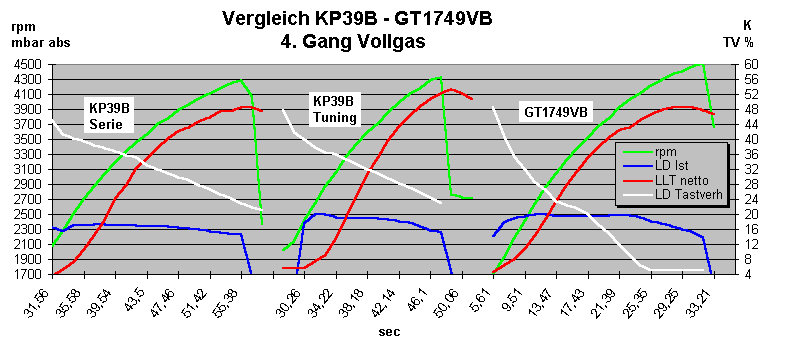
The KP39B was installed from the factory. The log data for the left and middle graphs in the attachment were generated using the standard software and a tuning file (117 kW, +0.1 bar).
Eventually, the KP39B turbocharger was replaced with a GT1749VB (from ARL, 110 kW), but the fuel injection amounts were not changed compared to the tuning file for the KP39B.
In the attachment, you can see that the GT1749VB turbocharger can provide approximately 150-200 mbar more boost pressure compared to the standard configuration with the KP39B, without causing an increase in the maximum intake air temperature.
The KP39B already exhibits a pressure increase of 100 mbar compared to the standard version, resulting in an approximately 5K increase in lower limit temperature (LLT) within the maximum power range (Pmax) (after LLK; all LLT data indicate the difference from the respective ambient temperature).
It is also noteworthy that the GT1749VB delivers higher boost pressure (in the upper RPM range) with a significantly lower vacuum control signal, meaning its variable turbine geometry (VTG) is relatively more open than in the KP39B, even at higher boost levels – see the curve showing the relationship between boost pressure and valve opening.
This fundamentally results in lower exhaust back pressure compared to the KP39B, which in turn leads to lower exhaust temperatures before the turbine and improved gas exchange.
The popometer confirms this: with the GT1749VB turbocharger, the engine bites slightly better above approximately 3500 rpm compared to the KP39B, as mentioned, with unchanged fuel injection amounts.
To avoid giving the impression of hidden advertising for the charging offer in Rainer's shop:
The downside of the GT1749VB is its significantly larger turbo lag compared to the KP39B. The full torque delivery is subjectively shifted upwards by approximately 200-300 rpm depending on the gear, and below around 1500 rpm, the ASZ engine starves for power in higher gears when going uphill, even more so than with the stock turbocharger.
In predominantly low-rpm cruising conditions, the GT1749VB even causes an increase in fuel consumption of approximately 0.2 liters per 100 km - apparently because at low engine speeds, the ratio between exhaust back pressure and generated boost pressure is less favorable than with the KP39B, which is exactly the opposite of what happens in the higher power range.
| Description: |
| KP39B to GT1749VB Turbocharger Swap: Results |
|
| File size: |
11.75 KB |
| Viewed: |
17416 times |
|
Gruß Ulf
_________
MG4 Electric
Translated on 22-07-2026, 17:47.
|
|
| Back to top |
Profile PM Garage |
 |
dieselmartin
Profi-Schrauber

Joined: 03/13/2003
Posts: 10121
Karma: +29 / -0
Location: in der Werkstatt
2007 Volkswagen Passat
Premium Support
|
| 15-03-2006, 9:24 Subject: KP39B to GT1749VB Turbocharger Swap: Results |
Quote |
|
Hi Ulf,
I'm concerned (because it usually indicates a problem) that in the GT..., the throttle opening ratio is at its minimum limit starting from 25 seconds (4200 rpm).
That means the turbo is operating somewhere within an unstable range...
That would make me nervous, because it's not quite as insignificant as the "injection start at full throttle" setting on my machine.
Or?
Okay, please provide the German text you would like me to translate into English. I will only provide the translation.
Transparency, Teamwork
... there was another T.
I don't know what the f*ck it was.
Translated on 22-07-2026, 17:51.
|
|
| Back to top |
Profile PM Garage |
|
ulf
Profi-Schrauber
Joined: 04/13/2002
Posts: 11058
Karma: +18 / -0
Location: Saarland
2023 MG ZS
Premium Support
|
| 15-03-2006, 14:12 Subject: KP39B to GT1749VB Turbocharger Swap: Results |
Quote |
|
dieselmartin wrote: | I'm concerned (because it's usually a warning sign) that in the GT..., the throttle response is at its lowest limit starting from second gear (at 4200 rpm).
That means the turbo is operating somewhere within an unpredictable range... |
Hi Martin,
Basically, you are right.
While a TV in the "active" area could theoretically allow lifting the LD from above, this would not be necessary when tuning the test vehicle: the amount of air supplied by the loader with the VTG fully open is sufficient for a (largely) soot-free Pmax operation.
Furthermore, the actual turbocharger pressure in the higher RPM range roughly corresponds to the target values for the ARL (Anti-Roll Line) – meaning that the turbocharger is not overboosting compared to its standard application.
Since the tuning allows for a few more horsepower by increasing the exhaust flow, the variable turbine geometry (VTG) must be fully opened to ensure that the turbocharger operates within its specifications.
However, it could become problematic with further (significant) increases in boost pressure at higher engine speeds: in that case, the actual turbocharger boost pressure (LD) could exceed the standard target value set by the engine control unit (ARL), even with the variable turbine geometry (VTG) fully open, which would lead to premature wear of the turbocharger. Gruß Ulf
_________
MG4 Electric
Translated on 22-07-2026, 17:53.
|
|
| Back to top |
Profile PM Garage |
|
bafische
Profi-Schrauber
Joined: 01/13/2005
Posts: 196
Karma: +22 / -0
Support
|
| 17-03-2006, 15:08 Subject: KP39B to GT1749VB Turbocharger Swap: Results |
Quote |
|
Hello Ulf,
"Interesting comparison. However, the results are not conclusive for me. Even with OBD tuning, the mass airflow at your engine/data point is only slightly larger than that of the standard 110kW version (assuming the boost pressures are truly comparable), which means the Garrett turbocharger shouldn't be as overloaded as the measurements suggest."
Could it be that the control of the vacuum sensor for the turbocharger is different between VTG (Variable Turbine Geometry) systems? According to the software, at least different linearization curves are configured. So, does the KKK concept, compared to the Garrett concept, have the same vacuum control values from the EPW (Electronic Pressure Control) measured at the sensor, with 20/80% turbocharger boost pressure, in the EDC (Engine Management System) base setting 011? (So, measuring on a standard 110kW engine). Perhaps not the entire turbine cross-section is being utilized? Or could the ATL (Air Throttle Linkage) base setting potentially be incorrect?
The Garrett must also be able to handle tolerances above the 110 kW output – that doesn't seem to fit together for me.
The engine's behavior during transient conditions must be extremely harsh within the maximum power range (e.g., briefly lifting off the throttle at 4000 RPM and then quickly returning to full throttle), which will inevitably damage the head gasket over time.
There's still something wrong with it. It's understandable that the Garret consumes significantly more power in the lower sections, but if necessary, you could connect it to the control panel's TV power supply to compensate for that.
I hope you're not installing the charger like that.
Best regards,
"Luft und Menge müssen stimmen - der Rest ist Physik."
unumstössliches Gesetz in der Dieselmotorenentwicklung
Translated on 22-07-2026, 17:57.
|
|
| Back to top |
Profile PM |
|
ulf
Profi-Schrauber
Joined: 04/13/2002
Posts: 11058
Karma: +18 / -0
Location: Saarland
2023 MG ZS
Premium Support
|
| 17-03-2006, 22:20 Subject: KP39B to GT1749VB Turbocharger Swap: Results |
Quote |
|
bafische wrote: | | That is to say, the turbine from Garrett should not be so overloaded as the measurements indicate. | Hi Bavaria,
It also seems a bit strange to me that in the Pmax range, you already have to fully open the VTG (Variable Turbine Geometry) with about 6-7% more quantity (compared to ARL) to avoid getting too much LD (Load Deviation).
On the other hand, the test vehicle  only uses one SMIC and - compared to the ARL - relatively short air ducts between the supercharger and the intake manifold: in other words, with the ARL, I believe that more pressure is lost between the supercharger and the LD sensor, which must be compensated for by a higher duty cycle.
According to the information available, the ARL loader is likely designed for a "slightly" higher pressure build-up than initially suggested by comparing the maximum target values of the ASZ and ARL (1.35 vs. 1.50 bar).
If one were to install an original ARL-FMIC (fuel metering injection control) unit with its associated components in the test vehicle, it would likely be necessary to slightly reduce the VTG (variable turbine geometry) setting at Pmax to achieve the same load demand (LD) after LLK (low load condition) as shown in the log diagram above...
You probably know better than I do how significant the pressure losses in the charge air cooling system actually are with a turbocharger bypass valve (ARL) compared to a twin-scroll intercooler (SMIC) design like the G4 ASZ and similar models. I only have vague guesses, on the order of about 0.1 bar at maximum boost pressure...
Quote: | | Could it be that the control of the vacuum sensor for the VTG is different? According to the software, at least different linearization values are configured. So, does the KKK concept, compared to the Garrett concept, have the same vacuum control values from the EPW measured at the sensor in the EDC basic setting 011, with 20/80% throttle valve opening (TV) in each case? (So, measure this on a standard 110kW engine). |
That would still be a possible explanation:
"As far as I know, the ARL has the standard individual EPW (electric pneumatic valves), while the test vehicle has one of those more modern all-in-one solenoid valve blocks (charger, EGR, and shut-off valve). It's possible that a 20% power draw could result in different vacuum values, and that the TV (throttle valve) vacuum curve might not match the VB-VTG (vacuum booster - variable turbo geometry)."
Unfortunately, I cannot re-measure it (at this time) because I don't have a precise duty cycle generator with a power amplifier, nor do I have an EPW from ARL for comparison purposes.
Quote: | | Will the entire turbine cross-section perhaps not be released? Or is the default setting of the ATL possibly not working correctly? | So, the default setting in MWB 11 showed a pressure difference of 144 mbar for the GT1749VB - exactly the same as what the KP39B delivered on the same engine (TV according to log = 0 or 99.6%).
The speed fluctuations during switching of the VTG (i.e., the difference in exhaust back pressure) were practically the same for both turbochargers, as far as one can determine from the 21 rpm VAGCOM data grid.
Therefore, the valve body should probably be okay, especially since it was purchased as a new part.
The valve is easy to operate, it doesn't whistle, and otherwise it behaves exactly as I expected.
Quote: | | The transient response must therefore be extremely harsh in the Pmax range (i.e., briefly lifting off the throttle at 4000 rpm and then returning to full throttle), which will eventually destroy every head gasket. | That is not entirely correct: the overshoots are quite mild, especially with digital throttle control, up to about 3500 rpm, less than 100 mbar. But this is probably only because the pre-control valve has already been adjusted to meet the TV (torque converter) requirements of this "application".
Above approximately 2500 rpm, according to the LDA, the LD briefly drops to about 0.1 bar below the target value when full throttle is applied, and then increases to the final value without any overshoot  - as if control interventions are dampened in the last segment to keep overshoots (in the "fast" KP39B) small.
The GT1749VB, which apparently has a heavier lens assembly, probably doesn't need this feature, but in that case, the suspected software limiter kicks in, causing the overall response to be slightly over-damped.
It remains to be tested how the loader actually behaves with Digital Gas at 4000 rpm. However, I find it unlikely that the described overdamping of the load-displacement curve above 3500 rpm would suddenly transform into wild oscillations.
Quote: | | There's still something wrong with it somewhere. Then it's clear that the Garret consumes significantly more power at the bottom, but if necessary, you could connect to the control TV interface to compensate for that. |
Okay, I don't think it will get any better. Once the engine provides enough exhaust mass flow, the LD (likely referring to a control loop or system) should regulate itself to the target value without major issues, even under partial load conditions – as far as we can tell from the logged data so far.
The LDA (presumably a testing or analysis method) has so far not revealed any unusual malfunctions in the charger. Gruß Ulf
_________
MG4 Electric
Translated on 22-07-2026, 18:05.
|
|
| Back to top |
Profile PM Garage |
|
ulf
Profi-Schrauber
Joined: 04/13/2002
Posts: 11058
Karma: +18 / -0
Location: Saarland
2023 MG ZS
Premium Support
|
| 18-03-2006, 16:18 Subject: KP39B to GT1749VB Turbocharger Swap: Results |
Quote |
|
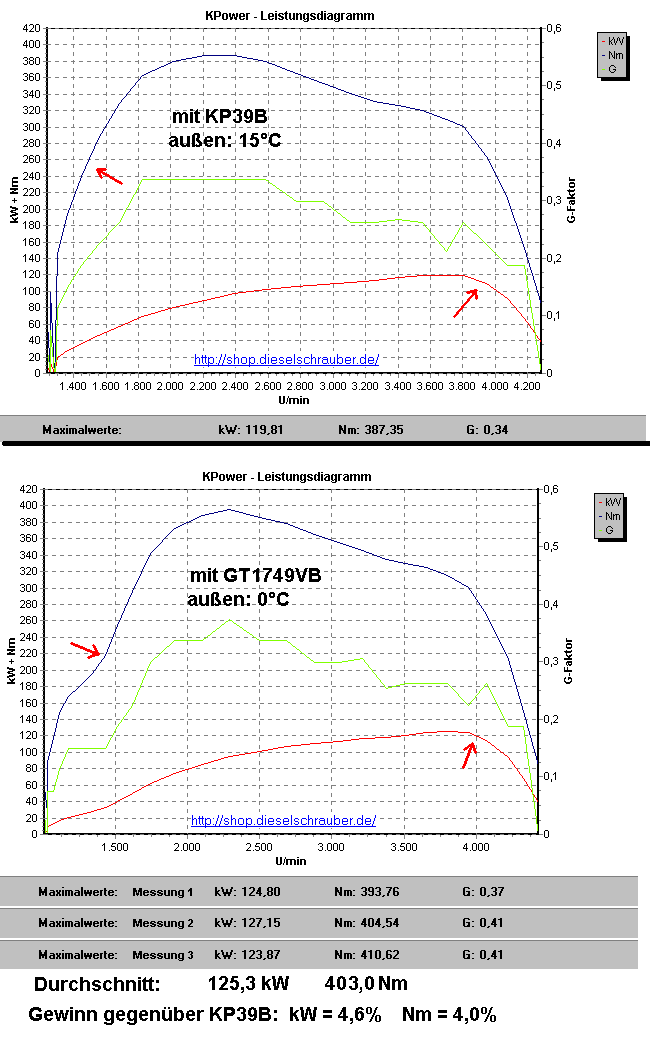
Here's another K-Power comparison of the engine curves with both chargers.
While the K-Power device isn't exactly a precision measuring instrument, the statement regarding the comparison with IMO is quite clear.
The vehicle, gear used, and measurement distance are always the same; likewise, the most important data fields, especially the torque curve.
The calculations included differences in combat weight, tire rolling radius, and temperature. The road surface was dry during all measurements.
Unfortunately, only one usable log exists for the KP39B (see the image attached above).
The average of the 3 usable GT1749VB logs is about 4% above the performance with the KP39B, which translates to a power increase of approximately 7 horsepower (PS) just by changing the turbocharger. 
Since the amount of fuel injected is always the same, this means that approximately 7 horsepower are lost within the Pmax range around the KP39B simply because it's slightly too small for a 160 horsepower engine.
The problem becomes clearly visible when looking at the performance curves in the area around 4000 rpm:
While the curve with the KP39B shows a significant drop starting at just 3800 rpm (and the occupants' "butt meter" notices a corresponding lack of power, see initial post and arrows on the right in the attachment), the curve with the GT1749VB follows the torque limit fairly precisely.
The downside of the GT1749VB is a noticeable dip in torque below 2000 rpm, while the KP39B offers a more balanced and harmonious performance in this range.
| Description: |
| KP39B to GT1749VB Turbocharger Swap: Results |
|
| File size: |
25.64 KB |
| Viewed: |
3244 times |
|
Gruß Ulf
_________
MG4 Electric
Translated on 22-07-2026, 18:13.
|
|
| Back to top |
Profile PM Garage |
|
ulf
Profi-Schrauber
Joined: 04/13/2002
Posts: 11058
Karma: +18 / -0
Location: Saarland
2023 MG ZS
Premium Support
|
| 27-03-2006, 17:38 Subject: KP39B to GT1749VB Turbocharger Swap: Results |
Quote |
|
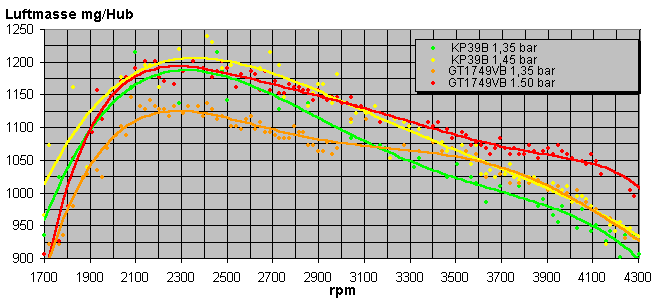
...and finally, a comparison of the air volumes delivered by both chargers.
Several logs were analyzed for each setup ( KP39B with a maximum pressure of 1.35 and 1.45 bar, GT1749VB with 1.35 and 1.5 bar). This explains the sometimes significant variations in the measured values, even though the most extreme overshoots and undershoots have already been excluded.
Excel trendlines provide a slightly better indication of what's going on.
For example, an absolute increase of approximately 4% in the turbocharger's boost pressure (LD) at KP39 in the Pmax range (4000 rpm) only results in a 2.5% increase in air mass flow. This suggests that the turbocharger is already operating near its saturation point within its standard settings, with exhaust backpressure increasing significantly with each increase in boost pressure.
This assumption is supported by the 1.35 bar pressure curve of the GT1749VB turbocharger, which already delivers as much air at 3500 rpm as the KP39B does with a 1.45 lambda value.
Within the Pmax range, the GT1749VB delivers approximately the same amount of air mass with about 8.5% more LD (lambda), and the actual pressure at 4000 rpm is around 2.3 or 2.5 bar, suggesting that it is not yet operating in the initial stages of saturation.
Above 3500 rpm, the curves clearly show that more boost pressure does not automatically mean a corresponding increase in air mass, and that to achieve a significant increase in the airflow that enhances performance, there is essentially no way around using a larger turbocharger.
Conversely, at lower speeds: the KP39B already achieves approximately 1200 mg/stroke at around 2300 rpm with a pressure of 1.35 bar, while the GT1749VB only reaches that level with 1.5 bar of boost pressure.
In this context, a particularly noticeable feature is the relatively significant drop in performance of the GT1749VB turbocharger at 1.35 bar boost pressure, occurring between approximately 1900 and 2700 rpm.
The VB (compared to the KP39B) is therefore obviously optimized for high pressures and high mass flow rates, partially at the expense of the pleasant TDI "boom" in the mid-speed and power range - so on the 1.9 TDI, it's already something like a budding racing turbocharger.
EDIT:
The competitor product to the KP39B is the Garrett GT1749VA, which is primarily used in vehicles with the G4 platform and an output of 130 horsepower. Based on the software of these vehicles, the VA might be slightly closer in performance to the VB turbocharger than the KP39B.
It would therefore be interesting to obtain air mass log values (MWB 8 and 10) from the VA turbocharger for comparison - so G4 ASZ drivers and others with GT1749VA, please connect your laptops (regardless of whether the cars are tuned or chipped, but please with a functioning VTG and MAF sensor) .
The best way to do this is on the highway in 5th or 6th gear, accelerating with full throttle from approximately 1500 rpm and trying to reach as high a speed as possible: this usually results in only slight over-revving, and the air mass readings tend to produce a more uniform curve rather than resembling mountainous terrain.
Then, for the rpm range that hasn't been logged yet, apply full throttle in a lower gear as well.
Ideally, the range from approximately 1500 to 4500 rpm should be covered with full throttle data without any significant gaps.
Please send the logs to me via private message or to ubeck13"at"aol.com.
| Description: |
| Luftmasse Vergleich KP39B, GT1749VB |
|
| File size: |
11.54 KB |
| Viewed: |
15301 times |
|
Gruß Ulf
_________
MG4 Electric
Translated on 22-07-2026, 18:20.
|
|
| Back to top |
Profile PM Garage |
|
|


 Bookmarks
 Links
Links Garage
 FAQ, Legal Notice & Privacy
 RSS Feed
 Register
 Login
Login


