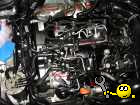
I urgently need your help with a classic problem. I just installed a replacement engine (1.9 TDI, engine code: ALH).
Unfortunately, the crankshaft pulley is now wobbling, and a newly installed oil seal has immediately started leaking again. The symptoms are: the engine runs unevenly and makes a loud clacking noise during load changes. At a constant speed between 2000 and 3000 RPM, it's quiet for a short time, but when releasing the throttle in coasting, there's an immediate metallic clanging sound. I strongly suspect that the front surface of the crankshaft is tilted or that the groove is damaged. This defect was unfortunately overlooked during the replacement engine installation. Since the car is already parked and I want to save the engine, I would need to have the end of the crankshaft faced on its front surface.
Since I only need the tool once, I wanted to ask if any TDI colleagues in the area (I live in 4225 Luftenberg an der Donau, near Linz, Upper Austria) happen to have a suitable crankshaft stub-facing cutter (and ideally the matching holder) that they could lend me for a day in exchange for a fair deposit and a few bottles of beer/a donation to the coffee fund. I would, of course, pick up the tool myself.
However, I have a point to make: The oil seal is actually located on the straight section of the crankshaft and has nothing to do with whether the crankshaft is properly aligned. If it leaks again so quickly, then there's more to be done. In my opinion, simply resurfacing the component won't save the engine. Whether it's even worth saving this engine depends on the extent of the underlying damage. The noises make me fear something worse.
My guess is that the imbalance is constantly pushing the seal slightly to one side, causing oil to leak out. When I loosen the ribbed belt, the clicking noise also disappears, and I suspect that when the belt is under tension, the roller for the ribbed belt is hitting against a cover.
Raphi, a loose crankshaft pulley won't cause the crankshaft to swing in a way that makes the seal leak. The crankshaft bearings are more robust than that.
If the KW pulley is wobbling, is it properly mounted? It's likely there's a keyway connecting it to the drive shaft, and the screws might not be offset by 90 degrees, but who knows (possible installation error). I should take another look at that, and also check if the KW drive gear is wobbling.
Was war die neue Hauptschraube, und wurde sie auch gemäß den Spezifikationen angezogen?
If the clicking sound disappears when the tensioner is removed, it's likely due to the tensioner itself. Could it be a faulty freewheel, a loose tensioner pulley, or a worn-out bearing in a component?
hg
Herbert.
Horch A4 8K CJCD
Golf 7 DDYA
(+ Audi 80 Avant B4 1Z 475Tkm - habe ich vom ersten bis zum letzten Tag gerne gefahren)
(+ Passat Variant 32B CY 400Tkm)
We reassembled everything according to the instructions after installing the new Simmerring, paying close attention to detail. What we noticed was that when we removed the gear from the timing belt, it was very difficult to take off; it required a few gentle hammer taps. However, the problem was already present before, so we didn't damage anything. We've already tested the KRR drive system, and everything works fine.
"At first, I thought the crankshaft pulley that drives the timing belt might be unbalanced, so we replaced it. Now, I'm wondering if the surface of the crankshaft itself isn't perfectly flat anymore. Because of the slight left-to-right movement it experiences at idle (around 900 RPM), the crankshaft seal might not be able to keep up. Usually, a crankshaft from a car like this legendary 1.9 wouldn't develop such a problem easily. But I'm not very knowledgeable; I'm not a mechanic, I just do this as a hobby, and I want to get it running smoothly before winter."
"So, would you suspect that it's the crankshaft itself? I really don't want to have to remove the crankshaft and install one from my old engine, but if there's no other way, then I guess I have to. Are there any other possible sources of the oil leak? It's leaking when the timing belt cover is on, coming out from underneath through a small slit."
No, I don't think it's the crankshaft itself. If it were, it would have suffered such a severe impact that the bearing caps would have been shattered. That would have ruined the entire engine block. Is the history of this engine known? What happened to the old engine?
I would try to check the radial play on the front side and temporarily mount the front pulley and timing belt. Then, during a test run, I would observe how the front pulley operates. And definitely don't hit it with a hammer; use a puller for that.
Do you have a repair manual for the ALH engine?
hg
Herbert.
Horch A4 8K CJCD
Golf 7 DDYA
(+ Audi 80 Avant B4 1Z 475Tkm - habe ich vom ersten bis zum letzten Tag gerne gefahren)
(+ Passat Variant 32B CY 400Tkm)
Unfortunately, I have some bad news. I hadn't been accelerating since the KRR (presumably a knock resistance system) wasn't installed, but I tried it now, and unfortunately, the knocking sound is still there. I'm afraid I don't know the history of the engine.
How can I measure radial runout? With a dial indicator?
Unfortunately, I don't have a repair manual either.
I made a video of the KRR disc (please upload it to the thread). You can see that the KRR disc moves up and down.
So, it's probably the main bearings, or possibly the connecting rod bearings.
I know I should have checked this before, but I've never looked at the oil filter. I just changed it, and I found a relatively large amount of metal shavings inside. This probably means the crankshaft bearings are worn. My question is, was this caused by just worn bearings, or is the crankshaft itself also damaged? I'm not sure about the "oval" shape of the pulley, so I'm not certain about the extent of the damage.
I still have the crankshaft from the other engine, but the work involved, plus replacing both oil seals, the connecting rod bearings, and the crankshaft bearings, and all the screws – that's going to be a lot more work for me.
Sure, here is the translation of the text from German to English:
"Lg" is a German abbreviation that stands for "Liebe Grüße," which means "Best regards" or "Warm greetings" in English.
Why didn't you make the video without the pulley?
If the crankshaft itself is damaged, it would be a miracle if the engine, with its damaged crankshaft, would even run.
A repair like the one you suggested would be completely pointless.
hg
Herbert.
Horch A4 8K CJCD
Golf 7 DDYA
(+ Audi 80 Avant B4 1Z 475Tkm - habe ich vom ersten bis zum letzten Tag gerne gefahren)
(+ Passat Variant 32B CY 400Tkm)
My car is currently at my house because my friend has a lift, so it had to be moved. That's why I could only record a video using a pulley system.
Okay, so it's not just about new bearings and screws, but do I also need the crankshaft from the old engine, or what exactly are you asking? Is the entire engine scrap?
Thank you very much.
Sure, here is the translation of the text from German to English:
As a student, I never gave up on my 1.6D engine in my Mk1 Passat.
I bought a new cooler and disassembled everything.
The result was:
- Storage of the ESP input shaft within the bucket (clearance).
- Sprocket on flywheel is damaged.
- Cracked cylinder head.
- Starter motor is broken.
- Wheel bearing/brakes stuck.
- Cracked windshield.
- Rust everywhere.
- Electrical system is old and unreliable.
The mileage was somewhere over 500,000.
I then called a scrap dealer, and that was a good decision. I got an old Polo, which was much cheaper than the cost of the spare parts alone.
I mean to say: Actually, I only wanted to replace the ZKD (head gasket) and the radiator. I think the new radiator is probably still lying around somewhere.
If you start taking the thing apart and you already find metal shavings in the oil, you're going to find even more.
Yes, I had that problem. I bought a Golf 4 as a winter car just two weeks before the first engine failed. Then, because it was running very rough and diesel was leaking from the exhaust, I thought the injectors were broken. It turned out that the injectors were indirectly the cause, as one of them broke off and completely destroyed the piston, cylinder head, and valves. It's amazing that it even ran. I then bought a replacement engine, which is now installed.
Initially, it wouldn't start because the alternator was faulty and locked up. After replacing the alternator, it ran for about 10-20 kilometers, then the knocking started. My sister's boyfriend and I replaced the engine in my driveway at home, and we vowed never to do that again.
"I'd prefer to just replace the crankshaft with new bearings; I could do that at my grandpa's place, he has a pit, but not enough space to remove and reinstall the engine. The thought of taking the engine out again, buying another one, and putting it in makes me want to cry. And probably, like you, I can't give up. I've already invested so much time in it, and I can't even sell it; if I did, I'd get very little money, and it would be more trouble than it's worth, but I don't have the space or the tools for that. It has to run."


 Bookmarks
 Links
Links Garage
 FAQ, Legal Notice & Privacy
 RSS Feed
 Register
 Login
Login