| Author |
Message |
Juergen
Guest
Free account, no CAN development support
|
 06-03-2003, 8:53 Subject: Idle speed control 06-03-2003, 8:53 Subject: Idle speed control |
Quote |
|
Hello experts!
I obtained the following data regarding the idle speed control (engine code AJM) using VAGCOM:
Cylinder 1: -0.9
Cylinder 2: -0.4
Cylinder 3: +0.9
Cylinder 4: -0.6
I conclude that cylinder 3 is weaker than the others.
However, I would be interested to know how much weaker.
The value is within the tolerance range (-2.8 / +2,  ), but I can't make much sense of it with just the raw numbers.
Can this be expressed as a percentage?
Best regards and thank you very much!
Jürgen.
Translated on 03-07-2026, 15:19.
|
|
| Back to top |
|
 |
Brad
Guest
Free account, no CAN development support
|
| 07-03-2003, 17:29 Subject: Idle speed control |
Quote |
|
Hello Jürgen,
The sum of all the sets must equal 0. Do you have a typo?
The run-time regulator only compensates for the tolerances of the individual power electronic devices (PDEs) in the low-voltage (LV) system. I wouldn't feel confident making a statement about the maximum load capacities given these small differences.
Brad.
Translated on 03-07-2026, 15:19.
|
|
| Back to top |
|
|
Michael II
Profi-Schrauber

Joined: 04/12/2002
Posts: 1132
Karma: +3 / -0 
Location: Stuttgart
Support
|
| 07-03-2003, 19:28 Subject: Idle speed control |
Quote |
|
Hello Brad,
Why must the sum be 0? It is quite possible that all cylinders are more powerful than the default power. Then all the values are negative.
The correction factor doesn't only refer to the tolerance of the individual pressure-dependent element. Rather, the overall performance of the cylinder, including all the tolerance ranges involved (e.g., compression behavior), plays a role.
Tschüss
Michael II
Translated on 03-07-2026, 15:19.
|
|
| Back to top |
Profile PM |
|
Brad
Guest
Free account, no CAN development support
|
| 08-03-2003, 0:46 Subject: Idle speed control |
Quote |
|
You are right, Michael II, it's not just the PDE tolerance that is being compensated for.
However, if the sum of the control signals were not 0, the motor would generate a torque that the driver would not desire. To achieve a smooth, consistent ride, the vehicle must not accelerate or decelerate on its own.
This regulator doesn't balance power output; instead, it ensures the engine runs smoothly. The amount of fuel it needs to maintain its idle speed is supplied by the idle speed control unit, which takes into account factors like water temperature, oil temperature, and mileage. The idle speed control only compensates for the differences between the individual cylinders.
Of course, measurements taken with VAGCOM can also result in a sum that is not equal to 0, due to insufficient sampling rates. Physically, it is always 0.
Sure, here is the translation of the text from German to English:
'cu Brad' translates to 'with Brad' in English.
Translated on 03-07-2026, 15:19.
|
|
| Back to top |
|
|
Michael II
Profi-Schrauber
Joined: 04/12/2002
Posts: 1132
Karma: +3 / -0
Location: Stuttgart
Support
|
| 08-03-2003, 13:22 Subject: Idle speed control |
Quote |
|
Hello Brad,
Precisely because the idle speed control system balances the performance of individual cylinders in relation to the desired idle speed, it can certainly happen that the sum of these adjustments is not equal to zero. My AJM has the following values:
-0.1 -0.8 -0.4 -0.1
This regulation only specifies how much the standard amount needs to be adjusted to achieve a stable idle speed. If, for example, all cylinders produce a greater torque than the base torque, how can the sum still be zero?
Tschüss
Michael II
Translated on 03-07-2026, 15:19.
|
|
| Back to top |
Profile PM |
|
ulf
Profi-Schrauber
Joined: 04/13/2002
Posts: 11058
Karma: +18 / -0
Location: Saarland
2023 MG ZS
Premium Support
|
| 08-03-2003, 13:36 Subject: Idle speed control |
Quote |
|
Michael II wrote: | | For example, if all cylinders produce a larger torque than the base torque, how can the sum still be zero? |
Hello.
I assume that Brad thought that VAGCOM reports the deviations of each cylinder from the average idle injection volume.
Then the sum should result in zero, according to my opinion.
Apparently, with VAGCOM, the PD value refers to a "pre-calculated" amount, which, of course, may not be accurate or may vary depending on the condition of the engine. Gruß Ulf
_________
MG4 Electric
Translated on 03-07-2026, 15:19.
|
|
| Back to top |
Profile PM Garage |
|
Juergen
Guest
Free account, no CAN development support
|
| 08-03-2003, 14:09 Subject: Idle speed control |
Quote |
|
Thank you for the answers!
If I understand you correctly, this 'power equalization' only works at idle. That is, if one cylinder is significantly different from the others, you would feel vibrations at engine speeds higher than idle speed.
Am I understanding this correctly?
Best regards, Jürgen.
Translated on 03-07-2026, 15:19.
|
|
| Back to top |
|
|
Michael II
Profi-Schrauber
Joined: 04/12/2002
Posts: 1132
Karma: +3 / -0
Location: Stuttgart
Support
|
| 08-03-2003, 18:41 Subject: Idle speed control |
Quote |
|
Hello Ulf,
Let's assume that, according to the specification, a torque of 30 Nm per cylinder is required for an idle speed of 900 RPM. If, due to tolerance ranges, each cylinder were to produce 50 Nm, this would result in an increased idle speed (until a new equilibrium is established). As a result of a control intervention: each cylinder would be adjusted until it produces the required 30 Nm. In this case, all values would be negative.
Different case:
Cylinders 1-3 produce 50 Nm of torque, while cylinder 4 produces 20 Nm. The idle speed control reduces the values for cylinders 1-3 and increases the amount for cylinder 4.
If the sum happens to be zero, then it's a coincidence.
Tschüss
Michael II
Translated on 03-07-2026, 15:19.
|
|
| Back to top |
Profile PM |
|
Michael II
Profi-Schrauber
Joined: 04/12/2002
Posts: 1132
Karma: +3 / -0
Location: Stuttgart
Support
|
| 08-03-2003, 18:43 Subject: Idle speed control |
Quote |
|
Hello Jürgen,
This value is actually interesting when viewed over a certain period of time. Then you can see which cylinder is losing more or less power.
Based on your current values, I would say: Everything is okay.
Tschüss
Michael II
Translated on 03-07-2026, 15:19.
|
|
| Back to top |
Profile PM |
|
Gremlin
Guest
Free account, no CAN development support
|
| 09-03-2003, 14:14 Subject: Idle speed control |
Quote |
|
If I understand you correctly, this 'power equalization' only works at idle. That is, if one cylinder is significantly different from the others, you would feel vibrations at engine speeds higher than idle speed.
Am I understanding this correctly?
Yes, I understand the context, but the idle speed control is always active.
She indeed claims a significant portion of the computing power within the motor electronics.
CU Gremlin.
Translated on 03-07-2026, 15:19.
|
|
| Back to top |
|
|
Michael II
Profi-Schrauber
Joined: 04/12/2002
Posts: 1132
Karma: +3 / -0
Location: Stuttgart
Support
|
| 09-03-2003, 18:11 Subject: Idle speed control |
Quote |
|
Hello Gremlin,
The vibration damping is also active under load. The idle speed control only works when the engine is idling.
Tschüss
Michael II
Translated on 03-07-2026, 15:19.
|
|
| Back to top |
Profile PM |
|
Gremlin
Guest
Free account, no CAN development support
|
| 09-03-2003, 20:07 Subject: Idle speed control |
Quote |
|
Yep.
That thing is called a 'quantity balancing regulation.'
'All magnet valve-controlled injection systems have this feature, but NOT our VP37. All other pumps do.' PD and CR.
Run regulation / Quantity balancing.
regulation
Not all cylinders in an engine produce...
With the same injection duration, the result will be the same.
Torque. This can be due to differences.
In cylinder compression, there are differences.
cylinder friction or differences
in the hydraulic injection components.
to be located. Follow these torque specifications.
is a rough engine running and a...
Increase in engine emissions.
The 'Laufruheregelung' (LRR), also known as the 'Mengenausgleichsregelung'.
(MAR) have the...
Task: To identify such differences based on the...
resulting speed fluctuations.
to identify and adapt in a targeted manner.
the amount of fuel injected by the affected component.
To balance the cylinders. Here, we will...
the speed after injection into a...
certain cylinder with a median.
Speed compared. What is the speed of the...?
regarding the cylinder, it will be...
Fuel injection amount increased; if it is too high,
Should the injection amount be reduced?
(Image 3).
The 'eco' mode is a comfort feature.
whose primary goal is improvement.
The engine idle speed in the area of...
Idle speed. The quantity equalization regulation.
in addition to improving comfort.
idle emissions.
mid-range by a...
Equalization of injection quantities.
Improving engine cylinders. For Nkw,
quantity balancing regulation, also known as AZG.
(Adaptive cylinder equalization) or
Called SRC (Smooth Running Control).
CU Gremlin.
Translated on 03-07-2026, 15:19.
|
|
| Back to top |
|
|
Bluetruck
Joined: 05/16/2017
Posts: 1
Karma: +0 / -0
Premium Support
|
| 09-06-2018, 16:55 Subject: Idle speed control |
Quote |
|
Hi everyone,
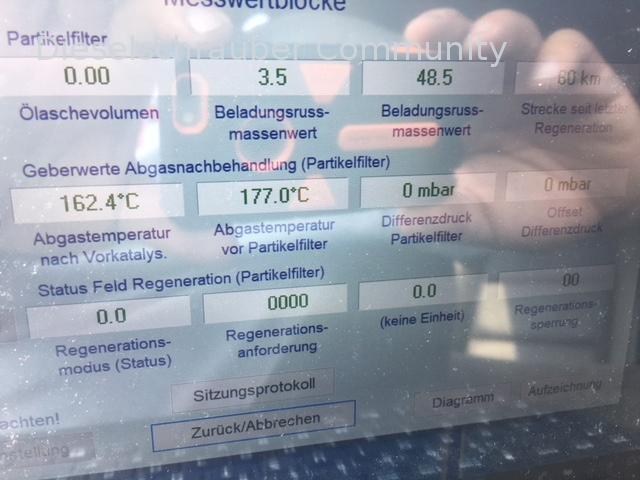
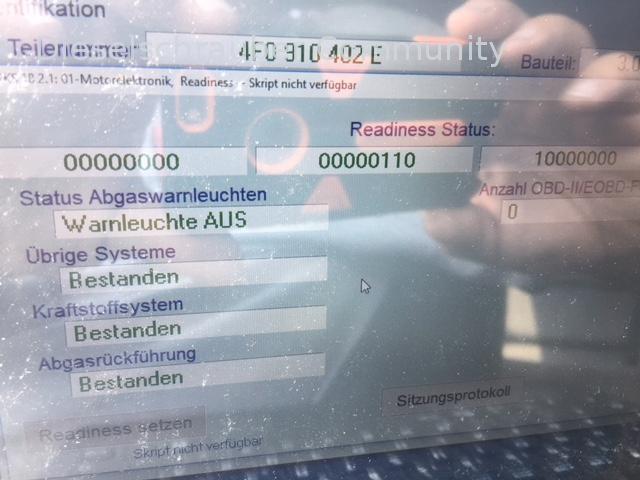
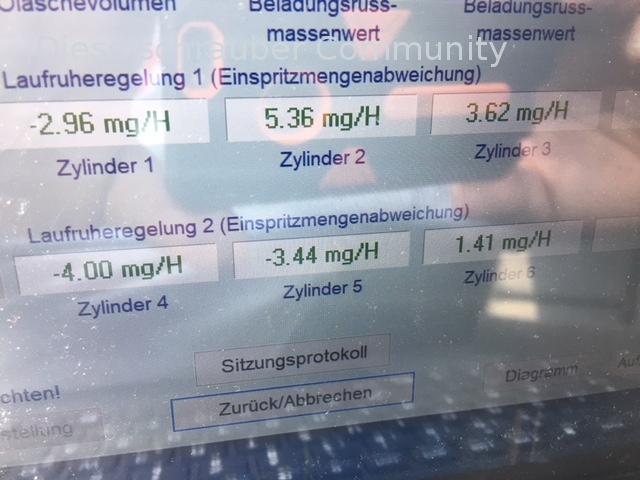
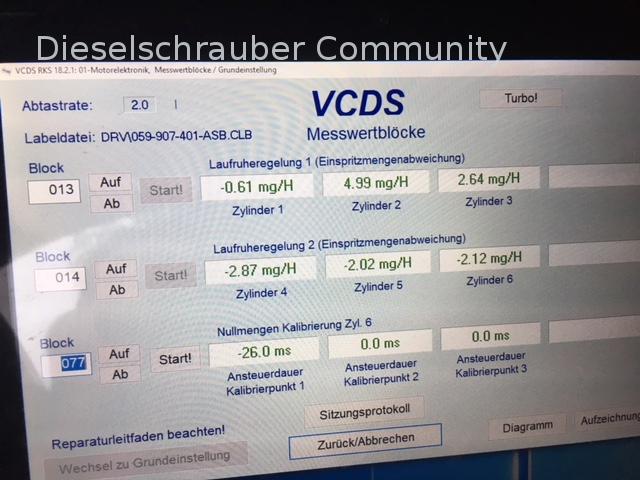
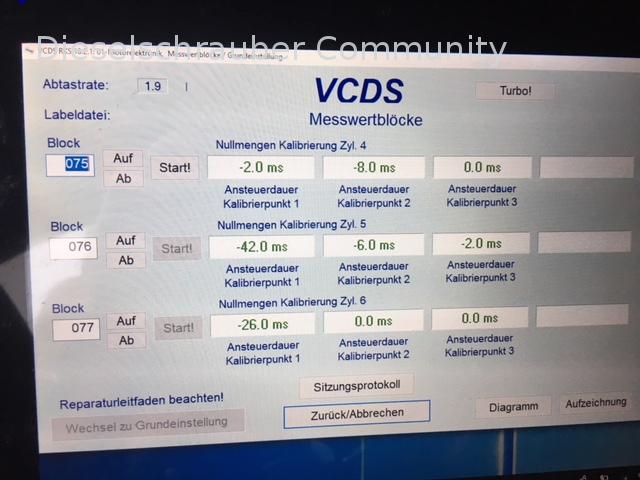
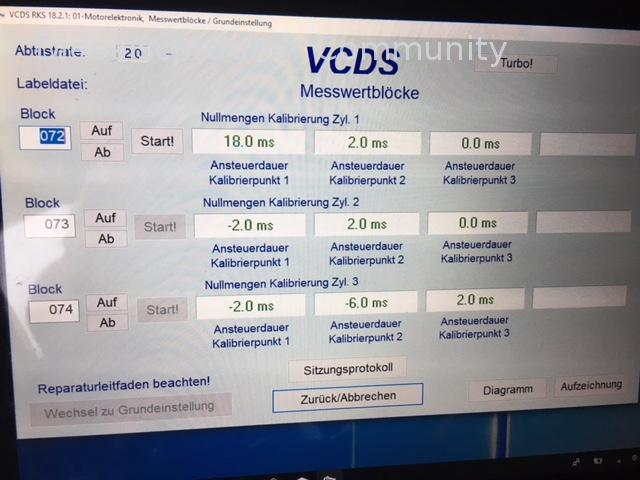
I'm reviving this old thread because I couldn't find anything better. After the DPF was full, I had it cleaned and the intake manifold flaps were completely replaced. Now, within 60 km, it's showing the DPF symbol and the flashing glow plug symbol again. I've read the idle speed values and zero mass calibration, and the values are quite strange. Also, it's showing an error for the second intake manifold flap. Does anyone have an explanation for this, or are the injectors simply failing? The engine is running rough (like one or two cylinders are misfiring in a 6-cylinder gasoline engine) and has little to no power in the lower RPM range (up to about 1800 RPM). "It intermittently starts when I put it in gear, and then it rolls forward without any throttle input. I've attached some diagnostic scans and photos. It would be great if someone could provide some information." Thank you in advance.
| Description: |
|
| File size: |
109.89 KB |
| Viewed: |
659 times |
|
| Description: |
|
| File size: |
112.2 KB |
| Viewed: |
549 times |
|
| Description: |
|
| File size: |
114.51 KB |
| Viewed: |
675 times |
|
| Description: |
|
| File size: |
116.57 KB |
| Viewed: |
634 times |
|
| Description: |
|
| File size: |
104.79 KB |
| Viewed: |
1300 times |
|
| Description: |
|
| File size: |
109 KB |
| Viewed: |
579 times |
|
| Description: |
|

Download |
| File name: |
Log-DU-WAUZZZ4FX7N018550-297933.txt |
| File size: |
22.25 KB |
| Downloaded: |
298 times |
Translated on 03-07-2026, 15:19.
|
|
| Back to top |
Profile PM |
|
dieselschrauber
Administrator

Joined: 04/12/2002
Posts: 18097
Karma: +799 / -0
Location: St.Gallen
2018 Volkswagen T6 
|
| 09-06-2018, 18:30 Subject: Idle speed control |
Quote |
|
Hello,
As you can already see from the idle speed control, at least some of the injectors in your engine are defective, and/or the engine or ignition coil has a mechanical problem.
Everything else, including the DPF, are secondary issues.
I would start by shifting the injectors by one cylinder and see how the values of the idle speed control change compared to before.
If the valve stems move along with the injectors, then the injectors are defective. If the engine isn't running smoothly, it could indicate mechanical damage to the engine (e.g., pistons, cylinder head, etc.).
Best regards, Rainer.
Translated on 03-07-2026, 15:19.
|
|
| Back to top |
Profile PM WWW Garage |
|
|


 Bookmarks
 Links
Links Garage
 FAQ, Legal Notice & Privacy
 RSS Feed
 Register
 Login
Login
