A colleague has a Volvo S60 2.4D with 163 horsepower, a common rail engine, and approximately 300,000 kilometers on the odometer.
The problem is that the coolant level is at the MAX mark. After driving approximately 100 km, the coolant level drops below the MIN mark, triggering the warning light on the instrument cluster. If you slightly loosen the coolant reservoir cap, the coolant level rises again.
Does anyone have any idea what might be causing this?
In this case, ZKD would be the first candidate. With the engine running at operating temperature, apply a good amount of throttle and observe the coolant return to the expansion tank for equalization. Caution, risk of scalding!
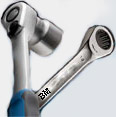
I'm not familiar with that Volvo model, but I'm sure it has a similar hose like the one in the picture.
If, with sufficient coolant levels, instead of a continuous stream, you observe foam or if the stream is interrupted by bubbles, it indicates that combustion gases are entering the coolant.
I was almost afraid that it might be the head gasket .
He disconnected the hose from the expansion tank. I'll observe whether the flow is interrupted by bubbles, and I haven't seen any foam.
Unfortunately, that's not normal. I'm experiencing something similar with my TDI right now, but it has almost 500,000 km on it - it's basically on its last legs. I'm getting a replacement engine block.
I would, however, want to test a few things first. The valve should open at a certain pressure (I think around 1.5 bar?), otherwise the system might get clogged, and the thermostat could get stuck.
I once had a D5, and I experienced something similar. In particular, when using the auxiliary heating system (which all of them have), I often had water that was close to boiling - which was quite strange.
However, D5 engines are unfortunately quite common in Germany, and they tend to suffer from overheating, especially when subjected to prolonged periods of high-speed driving.
My TDI is currently running with a definitely damaged cylinder head, but without a thermostat and with the reservoir cap open, the effects of the blown head gasket are limited – until the new engine block is installed.
Regards,
P.S.: It seems that, regardless, the same cap is used on all Volvos --> http://goo.gl/YYu8q
I think it would be worth trying.
The hoses can also become clogged, or their connections, such as those in the radiator.
Check if it's available.
I remember once, I almost took apart a BMW engine because I suspected a blown head gasket, but thankfully I caught it in time.
The effect was that the radiator didn't vent properly, the engine no longer had a proper water circulation system, and it "boiled."
It definitely looked like it was caused by a head injury, and I'm really glad I noticed it.
Later, the same thing happened again with an older Caddy. He brought the car to me specifically for a head gasket replacement. It was the same issue: the small hose connector at the top of the radiator was clogged.
Furthermore, it can sometimes be quite challenging to bleed the cooling system, especially in certain types of vehicles. I've experienced some truly remarkable things in that regard.
where you have to remove temperature sensors (Opel), or those small, amusing screws in the middle of the water hose (Renault).
Or the VW T3 isn't that bad either; that's a whole science in itself.
Hello, I disconnected the hose from the expansion tank and also gave it gas.
No liquid is coming out, which should actually indicate a faulty WSP.
Hi!
Yes, that's right, thinking about it now.
You need to figure out a way to make water come out of it.
And then, it's better to check the water pump first, before you completely disassemble the engine.
And check again to make sure the engine is properly vented.
I've gotten into the habit of, when I encounter problems like this and I'm not familiar with the engine's intricacies, draining all the coolant, researching how many liters the system requires, and then somehow figuring out how to measure that amount and get it back in.
Furthermore, there are also possibilities to analyze the cooling water, or possibly the gases that may be escaping.
There are test kits, chemical reagents, that can be used to check for carbon dioxide, specifically designed for use in automotive workshops. Some workshops also use exhaust gas analyzers for this purpose.
Normally, there is no CO² dissolved in the coolant water.
If there's anything inside, it can only have come from exhaust gases being forced in.
But whether it will actually be the ZKD remains to be seen. While the first candidate is, in a sense, the ZKD...
and there's no other option than to behead someone, and the only way to examine visible damage is to look at the exposed area.
I have also found hairline cracks in the cylinder bores (on several occasions) that extended into a water channel, and once a casting defect in the cylinder head that appeared as a tiny spot.
It was clearly detectable with compressed air and soapy water in the water channel, as evidenced by the bubbles. This was on a 13-year-old Hyundai.
I really have a problem with people who change cylinder head gaskets without thinking.
unless I can absolutely rule out all other possibilities.
Because this has happened to me several times before,
and I always get really frustrated when I waste customers' money on something pointless.
And it's also always a potential source of errors when you're tinkering with such a complex and functional system.
"Yes, Steffen, I completely agree. The timing belt needs to be replaced soon anyway. The customer wants to continue driving like this for about 10,000 km, as the heating is working properly and the operating temperature of 90 degrees is being reached and maintained."
I know about these CO2 test boxes, but I've never tried one. Is the result of this test really reliable? Also, what exactly do you mean by "exhaust gas analyzer"?
I mean, the CO2 test isn't 100% accurate. I've tried a lot of things - the CO2 test initially came back negative - but still, the head gasket is faulty.
I checked the water pump by observing the flow of water to the radiator – if the water pump is working correctly, it should push water through. And that's what it did in my case.
I don't have a CO2 test myself; I just saw it mentioned in catalogs.
However, I have also heard on several occasions that it is not reliable.
Exhaust gas analyzer:
You place a container over the open reservoir, and then collect the escaping vapors in that container.
A probe is inserted through a hole to measure the exhaust gases.
and it is measured using CO (carbon monoxide).
It should be reliable.
It definitely works with gasoline engines, but I don't know if it works with diesel engines.
One could also consider having a heating technician use a measuring device to check the CO2 emissions of the diesel engine.
I don't have a CO² test myself; I've only seen them mentioned in catalogs.
However, I have also heard on several occasions that it is not reliable.
Exhaust gas analyzer:
You place a container over the open reservoir, and then collect the escaping vapors in that container.
A probe is inserted through a hole to measure the CO (carbon monoxide) levels.
It should be reliable, especially for gasoline engines, but I don't know if it works with diesel engines.
One could also consider having a heating technician use a measuring device to measure CO2 emissions in the diesel engine,
A diesel engine, just like a gasoline engine, also burns carbon monoxide .
Co-measurement can also be performed on diesel engines using a gasoline analyzer.
The CO2 test works reliably with CORRECT application, even with minor/early signs of a leaking head gasket! Unfortunately, many mechanics don't do it correctly, which is often seen (head shaking...).
With a severely damaged head gasket (after the engine has already overheated significantly), you will immediately see a yellowish test fluid.
Proper testing: Water level normal, cap open to possibly release air - then drive and give it full throttle . Of course, with a warm engine, turn on the air conditioning (to activate the radiator fan) and the heater to the hottest setting and the fan to the highest level until the pressure has decreased. Keep the engine running, leave the cap open, and immediately use a CO2 tester to check the exhaust, making sure that no wind interferes with the CO2 tester (use cardboard or something similar as a windbreak).
The CO2 tester also reacts to human breathing; I always do this before the actual test to ensure that it is working properly.
If CO levels are detected and the car has a water-cooled EGR system, try disconnecting it and then try again!
NA,Gehörlose wie ich können auch Schrauben! Ihr HÖRT ich FÜHLE! T3 TD EX-JX Jetzt 1Z mit 122PS und Renaultgetriebe Golf II TD Bj 84 512Tkm Passi 35I 1Z 468Tkm--> Seat Toledo AHF-- Toledo ARL 477Tkm mit Spritspartuning 99er T4 Syncro-Cross 100800km grad eingefahren
Yes Steffen, I completely agree with you. The ZR (water pump) replacement is due soon anyway. The customer wants to continue driving like this for about 10,000 km, as the heating performance is still good and the operating temperature of 90 degrees is being reached and maintained.
That doesn't really suggest a faulty water pump.
Let's see if he can still drive the planned 10,000 km like this...
LG, Onkel BM
*Nichts ist einfacher, als sich schwierig auszudrücken......*
**Technische Fragen bitte ins Forum und nicht in mein Postfach**
A colleague has a Volvo S60 2.4D with 163 horsepower, a common rail engine, and approximately 300,000 kilometers on the odometer.
The problem is that the coolant level is at the MAX mark. After driving approximately 100 km, the coolant level drops below the MIN mark, triggering the warning light on the instrument cluster. If you slightly loosen the coolant reservoir cap, the coolant level rises again.
Does anyone have any idea what it could be due to?
Hi!
Okay, let's keep it simple:
Perhaps the pressure relief valve in the coolant reservoir cap is broken.
Put a new lid on it.
These kinds of problems were common in older BMWs.
Or, for testing purposes, leave the lid slightly loose.


 Bookmarks
 Links
Links Garage
 FAQ, Legal Notice & Privacy
 RSS Feed
 Register
 Login
Login






 .
.
 .
.
 application, even with minor/early signs of a leaking head gasket! Unfortunately, many mechanics don't do it correctly, which is often seen (head shaking...).
 99er T4 Syncro-Cross 100800km grad eingefahren