| Author |
Message |
ulf
Profi-Schrauber

Joined: 04/13/2002
Posts: 11058
Karma: +18 / -0 
Location: Saarland
2023 MG ZS
Premium Support
|
 30-05-2005, 18:31 Subject: Tuning: Reduced Engine Efficiency? 30-05-2005, 18:31 Subject: Tuning: Reduced Engine Efficiency? |
Quote |
|
Hello,
I once recalculated my chip tuning using the DZR software.
Between 2000 and 4000 rpm, the fuel injection volume is increased by an average of 21% compared to the standard configuration (according to the torque map; the opacity has been sufficiently adjusted; the driver's preference remains the highest).
The reduction in the time between the standard configuration and the tuning process should be calculable if a 21% power increase is factored in.
For my car, this results in a theoretical reduction of 1.2 seconds.
However, several measurements taken consecutively on the same track showed only a "mere" difference of 1.0 seconds between the stock and tuning software.
(Real-world data according to the dyno test: Stock configuration = 335 Nm / 141 hp, Tuned configuration = 365 Nm / 164 hp)
This, in turn, means that only approximately 81% of the additional power is actually converted into usable output, or that the overall efficiency of the modified engine is lower than with the original software.
Possible explanations that come to mind are:
-> the lower excess air compared to, for example, the BPX (a 160 hp series with 0.1 bar more boost pressure and a massive front-mounted intercooler).
-> the extended injection duration. However, this would be practically the same for the BPX because it uses the same pressure drop equations (PDEs) and has the same pump start characteristics in the full load range.
Apart from the turbocharger and LLK (likely referring to an intercooler), the ASZ and BPX engines are practically identical in construction (even the catalytic converter exhaust flange is the same), which means that differences in efficiency due to combustion chamber shape and other internal engine characteristics can likely be ruled out.
Can the engine experts  say something about this? (besides "measurement error" - I have driven three runs of both the standard and tuned versions, and the times were determined by interpolation from the VAGCOM logs. Parallel measurements with a stopwatch tended to show the same result.) Gruß Ulf
_________
MG4 Electric
Translated on 17-08-2026, 1:19.
|
|
| Back to top |
Profile PM Garage |
 |
rinderwahnsinn
Guest
Free account, no CAN development support
|
| 30-05-2005, 20:20 Subject: Tuning: Reduced Engine Efficiency? |
Quote |
|
Is the question meant to be taken seriously, or not?
Go buy some introductory textbooks on thermodynamics and internal combustion engines!
Translated on 17-08-2026, 1:22.
|
|
| Back to top |
|
|
Nero24
Blaumann

Joined: 12/07/2004
Posts: 32
Karma: +6 / -0
Free account, no CAN development support
|
| 30-05-2005, 20:31 Subject: Tuning: Reduced Engine Efficiency? |
Quote |
|
ulf wrote: | | -> the extended injection duration. | Hmm, I think that will be the problem. As you correctly stated, increasing the amount injected with the same pressure and nozzle size can only be achieved by extending the injection duration. This means that you are injecting for a longer period in the area where the piston is already on its way towards TDC (Top Dead Center). It should be clear that this is not efficient. I don't know at what engine speed you measured the power, but I believe that this becomes increasingly unfavorable as the engine speed increases, because the time window in which the piston is in a favorable position decreases with increasing engine speed, while increasing the injection amount results in a constantly longer injection time.
I would like to compare the behavior of the throttle at very low RPM with its behavior at very high RPM. Perhaps that will confirm or refute something I've been thinking about . Audi A6 2.0 TDI
MKB: BRE
140 PS / 103 kW - 320 Nm
Translated on 17-08-2026, 1:23.
|
|
| Back to top |
Profile PM |
|
guste100
Profi-Schrauber

Joined: 07/27/2004
Posts: 2405
Karma: +441 / -0
Location: Mitte Schleswig Holsteins
2007 Volkswagen Passat
Premium Support
|
| 30-05-2005, 23:09 Subject: Tuning: Reduced Engine Efficiency? |
Quote |
|
Hello Ulf,
Instead of providing answers, I would like to encourage finding solutions by posing a few counter-questions.
Please provide the text you would like me to translate from German to English. I will then give you only the translation, without any explanations.
Why do you think that the BPX doesn't produce a lower efficiency at full load compared to a standard air conditioning system at full load?
2.
To what extent can you actually trust the logged flow rates? (Or, to what extent does the pump performance curve match the actual conditions, and was it necessary to extend it for higher flow rates, and is that extension truly accurate?)
EDIT: Of course, you'll have the corresponding PD parameter maps for your system.
3.
You yourself state that the BPX's charger is different. And such a charger requires a considerable amount of power (>20 horsepower). At full load, the charger is always operating far outside its optimal efficiency range (i.e., its minimum consumption level). If you demand even more from your charger now, you will push it further beyond its intended efficiency range. What effect will that have?
Regards,
Sure.
Here is the translation of the text from German to English:
"Guste" means "gust" in English. It can also be used as a verb, meaning "to gust."
Translated on 17-08-2026, 1:26.
|
|
| Back to top |
Profile PM Garage |
|
bafische
Profi-Schrauber
Joined: 01/13/2005
Posts: 196
Karma: +22 / -0
Support
|
| 30-05-2005, 23:25 Subject: Tuning: Reduced Engine Efficiency? |
Quote |
|
You can answer the question yourself. You recently posted efficiency/consumption diagrams. Those show what happens at higher mean pressures. The maximum efficiency is slightly below full load, in the range of the maximum mean pressure. If you extend the combustion duration further, the center of combustion shifts towards later timing, and the efficiency decreases. An earlier injection timing could help shift the efficiency maximum towards higher mean pressures, but it's avoided due to peak pressure concerns. That's why even the more powerful engine doesn't have an earlier injection start time programmed.
You yourself described the efficiency-enhancing property of cooling the intake air in your technical article. A simple look at the thermodynamic comparison process is all that's needed.
The increased air mass flow required to achieve the same lambda value when increasing boost pressure must also be taken into account.
The second point of concern is the EDC quantity. If the EDC states that it releases 21% more quantity, it doesn't necessarily mean that physically 21% more is being injected. This would only be true if the pump characteristic maps were identical and correctly calibrated in both DST systems. However, I highly doubt that's the case.
"Luft und Menge müssen stimmen - der Rest ist Physik."
unumstössliches Gesetz in der Dieselmotorenentwicklung
Translated on 17-08-2026, 1:29.
|
|
| Back to top |
Profile PM |
|
ulf
Profi-Schrauber
Joined: 04/13/2002
Posts: 11058
Karma: +18 / -0
Location: Saarland
2023 MG ZS
Premium Support
|
| 31-05-2005, 12:43 Subject: Tuning: Reduced Engine Efficiency? |
Quote |
|
rinderwahnsinn wrote: | Is the question meant to be taken seriously, or not?
Buy some basic textbooks on thermodynamics and internal combustion engines! |
Are you studying medicine, for example, because you sometimes need to disinfect a wound and apply a bandage occasionally, or do you also ask a professional if you have any doubts?
If you see a basic information need regarding thermodynamics here, feel free to write it out as a detailed article... for further discussion, please use the forum.
Nero24 wrote: |
I don't know at what RPM you measured the torque | .
2000 - 4000 rpm
Quote: | | I would like to compare the airflow at very low RPM with the airflow at very high RPM. Perhaps that will confirm or refute something I've been thinking about | .
Between 3500 and 4000 RPM in the fourth gear, the trend already looks similar...
Guste100 wrote: | | Why do you think that the BPX doesn't produce a lower efficiency at full load compared to a standard ASZ at full load? |
"Because the BPX torque limiter specifies 59mg at 3750 rpm, just like mine does, and TDIs generally have a wider variation upwards than my approximately 2.5% (164 hp versus the nominal 160 hp)."
Quote: | To what extent can you be sure that you can trust the logged values at all? (Or, to what extent does the pump characteristic curve match the actual conditions, or was it extended for higher flow rates, and is this extension really accurate?)
EDIT: Of course, you have the corresponding PD parameter tables. |
The key features of my MSG (Message Sequence Generator) are the same as those of the BPX (Business Process Execution).
Quote: | | If you demand even more from your charger now, you will push it further beyond its intended operating range. What effect will that likely have? |
It will slightly reduce the engine's efficiency, but the turbocharger runs on exhaust energy that would otherwise be lost.
If a charger used to generate charging pressure 'x' produces slightly more back pressure than the next larger charger (e.g., from ARL/BPX), then it raises the question of how much useful power this could cost.
I'm going to temporarily adjust the boost pressure to the tuning level on the standard performance settings and compare the knock detection response (KDR) times with the original software.
However, I don't expect to see any clearly measurable performance losses with only a 0.1 bar increase in pressure compared to the standard configuration...
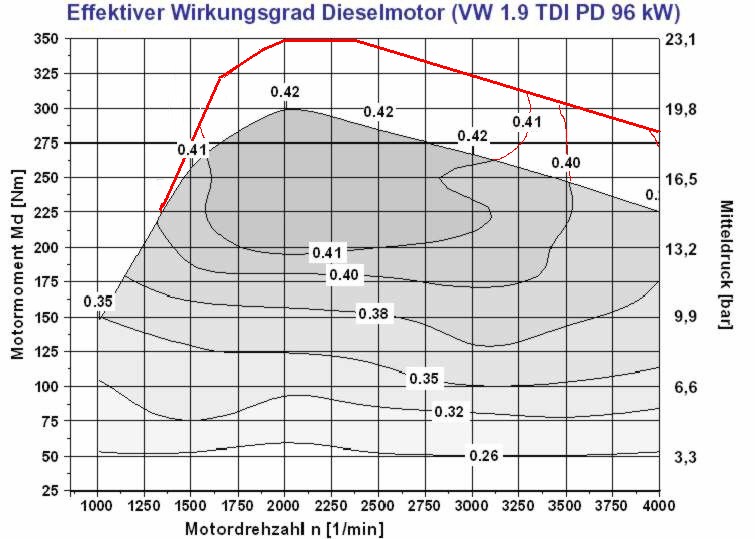
bafische wrote: | | You posted efficiency/consumption diagrams recently. | You can see what happens at higher mean pressures from those. The maximum efficiency is slightly below full load, within the range of the maximum mean pressure, depending on the design of the combustion process. Quote: | Hmm, the lines representing the same level of efficiency in the diagram for the 96kW TDI don't necessarily look like a torque curve that is about 20% higher would be located in significantly less favorable areas...
| You yourself described the efficiency-enhancing property of cooling the intake air in your technical article. https://community.dieselschrauber.org/en/viewtopic.php?t=3261
Are you misunderstanding something? I described the beneficial effects of intercooling in terms of cylinder filling (as a prerequisite for tuning) and thermal material stress.
Regarding the question of efficiency with cooler intake air, there is, to my knowledge, only this information here: Quote: |
Perhaps you can correct a few things there?
| The second issue is the EDC quantity. If the EDC states that it releases 21% more quantity, it doesn't necessarily mean that physically 21% more is being injected. Unless the pump characteristic maps are identical and correctly tuned in both DSTs. However, I would be very surprised if that were the case.
I don't know if they are correctly} calibrated for the BPX and my car... but they are practically the same -> if you log 60 mg on both cars, the same amount goes into the combustion chambers (subject to mechanical tolerances in the injection system, which is otherwise identical according to the parts catalog). Gruß Ulf
_________
MG4 Electric
Translated on 17-08-2026, 1:35.
|
|
| Back to top |
Profile PM Garage |
|
rinderwahnsinn
Guest
Free account, no CAN development support
|
| 31-05-2005, 13:53 Subject: Tuning: Reduced Engine Efficiency? |
Quote |
|
Are you studying medicine, for example, because you sometimes need to disinfect a wound and apply a bandage occasionally, or do you also ask a professional if you have any doubts?
If I want to 'disinfect' something (meaning perform maintenance or an oil change), I study the instructions and, if necessary, have it shown to me by a professional (like a mechanic).
If I want to know how a substance kills pathogens (thermodynamics) and the detailed process of wound healing (where does the injected diesel go?), I would visit a library or a specialist bookstore and obtain relevant literature!
Initially, I assumed that you possessed the necessary expertise, not least because of the numerous specialized articles written by you.
However, your recent posts make me very doubtful about that.
I'm going to bow out of this thread; I have enough on my plate with my own apprentices.
Translated on 17-08-2026, 1:42.
|
|
| Back to top |
|
|
ulf
Profi-Schrauber
Joined: 04/13/2002
Posts: 11058
Karma: +18 / -0
Location: Saarland
2023 MG ZS
Premium Support
|
| 31-05-2005, 14:12 Subject: Tuning: Reduced Engine Efficiency? |
Quote |
|
rinderwahnsinn wrote: | Initially, I assumed that you possessed the corresponding expertise, not least because of the numerous specialized articles written by you.
Your recent posts, however, make me very doubtful about that. |
Write something better, and I'll delete my articles. Gruß Ulf
_________
MG4 Electric
Translated on 17-08-2026, 1:44.
|
|
| Back to top |
Profile PM Garage |
|
bafische
Profi-Schrauber
Joined: 01/13/2005
Posts: 196
Karma: +22 / -0
Support
|
| 31-05-2005, 16:20 Subject: Tuning: Reduced Engine Efficiency? |
Quote |
|
ulf wrote: | | Hmm, the lines representing similar performance levels in the diagram for the 96kW TDI don't necessarily look like a torque curve that is approximately 20% higher would be located in significantly less favorable areas. |
I can't seem to find the diagram for the 96KW TDI engine anymore, but I did find one for the 2.0 TDI. This one is available in literature and press, and as mentioned before, it's been "smoothed out" quite a bit – but it's representative of all VW TDIs. Here, you can more or less clearly see the efficiency behavior described, which also reflects my own experience. Of course, it's not perfect, but we're looking for theories here.
A small stone, plus...
The same applies to the ATL; I don't know the turbine/compressor characteristic curves of both engines by heart, but it is likely undisputed that the ATL has shifted the efficiency peak of the more powerful engine to higher volumetric flow rates and pressure differences. Similarly, the efficiency decreases at higher volumetric flow rates/pressure differences, as is the case here.
Just one more piece, plus...
Quote: | Are you misunderstanding something? I described the beneficial effects of intercooling regarding cylinder filling (as a prerequisite for tuning) and thermal material stress.
Regarding the question of efficiency with cooler intake air, there is, to my knowledge, mainly only this here: https://community.dieselschrauber.org/en/viewtopic.php?t=3261 |
"Sorry, I probably just skimmed your article and also attributed the thread you mentioned to your article. Many correct things were posted there, but also some that weren't entirely accurate. I don't want to discuss it further. The efficiency-enhancing property of intercooling in theory and practice is a fundamental fact of the diesel engine operating principle."
Just one more piece, plus...
Quote: | | See above: I don't know if they are correctly calibrated for the BPX and my car... but they are practically the same -> if you log 60 mg in both cars, the same amount goes into the combustion chambers (subject to mechanical tolerances in the injection system, which is otherwise identical according to the parts catalog). |
If the pump performance curves and hydraulics are identical for both systems, then approximately the same amount of fluid should be introduced (although it may not necessarily be the physically correct amount).
Not a single stone here...
Another consideration is how the performance curves of the different power variants relate to each other within the specified speed range. Is there a constant increase in power of XX% across the entire speed range?
Maybe a small stone, plus...
Calculating the effective motor power from the drive torque of the wheels is usually a matter of guesswork and often contains significant errors. Dyno rollers typically only provide an approximate value and are better suited for qualitative assessments rather than quantitative ones. Therefore, the dynamometer (DZR) cannot be more accurate either, because it inherently has at least the same number of potential sources of error as a roller dyno.
It's already difficult enough to achieve the same results under laboratory conditions, whether it's between different engine test benches or even just between multiple engines of the same type.
This results in a whole bag of stones, which collectively can lead to the DZR (German term for "digital road sign") also being inaccurate to some extent. "Luft und Menge müssen stimmen - der Rest ist Physik."
unumstössliches Gesetz in der Dieselmotorenentwicklung
Translated on 17-08-2026, 1:48.
|
|
| Back to top |
Profile PM |
|
lappen
Guest
Free account, no CAN development support
|
| 31-05-2005, 19:36 Subject: Tuning: Reduced Engine Efficiency? |
Quote |
|
This results in a whole bag of stones that, in total, can lead to the DZR also being inaccurate to a certain extent.
If you replace 'can' with 'is,' then I will put my signature on it.
Translated on 17-08-2026, 1:52.
|
|
| Back to top |
|
|
ulf
Profi-Schrauber
Joined: 04/13/2002
Posts: 11058
Karma: +18 / -0
Location: Saarland
2023 MG ZS
Premium Support
|
| 31-05-2005, 21:04 Subject: Tuning: Reduced Engine Efficiency? |
Quote |
|
bafische wrote: | | I can't seem to find the diagram for the 96KW TDI engine anymore, but I do have the one for the 2.0 TDI. This one is available in literature and press, and as mentioned before, it was drawn very smoothly - but it is representative of all VW TDIs. Here, you can more or less clearly see the described efficiency behavior, which also reflects my experience. |
Hello Bavarian.
I'm attaching the aforementioned diagram from 1996 here, along with my approximate torque curve and my speculation about the efficiency characteristic curves (as a possible extension of the trends below the standard curve, each shown in red).
For the DZR comparison, only the range between 2000 and 4000 rpm is relevant.
Quote: | | The efficiency-enhancing property of intercooling, both in theory and practice, is a fundamental fact of the diesel working process. |
Does this imply a "direct tuning effect," such as that of a larger intercooler without any other modifications to the engine?
"If so, do you know of a rule of thumb that relates the reduction in engine speed (LLT) to the percentage increase in torque?"
Or are you referring specifically to ways to reduce boost pressure without losing cylinder filling, in order to decrease exhaust backpressure and thereby reduce the work required for charge exchange(?).
Quote: | | Another consideration is how the two performance curves of the different power variants behave relative to each other within the considered speed range. Is there a constant increase in power of XX% across the entire speed range? |
The increase in quantity is 16.3% at 2000 rpm and increases to over 21% at 3000 rpm, reaching approximately 22.5% at 4000 rpm, with an average increase of around 21.2% across all speeds (2000-4000).
Quote: | Roll testing benches typically only provide a rough value and are more suited for qualitative assessments than quantitative ones. Therefore, the DZR (Dynamic Rotor Balancing) cannot be more accurate either, because it inherently has at least the same number of potential sources of error as the roll testing bench.
It is already difficult enough to achieve the same results under laboratory conditions, whether it's between different engine test benches or even just between multiple engines of the same type. |
Regarding the absolute results, I completely agree with you.
In my DZR comparison, the focus is mainly on changes in performance, and it's my opinion that computational errors should generally be largely "canceled out"...?
| Description: |
| Tuning: Reduced Engine Efficiency? |
|
| File size: |
103.84 KB |
| Viewed: |
7052 times |
|
Gruß Ulf
_________
MG4 Electric
Translated on 17-08-2026, 1:56.
|
|
| Back to top |
Profile PM Garage |
|
bafische
Profi-Schrauber
Joined: 01/13/2005
Posts: 196
Karma: +22 / -0
Support
|
| 31-05-2005, 22:39 Subject: Tuning: Reduced Engine Efficiency? |
Quote |
|
Quote: | I'm attaching the aforementioned diagram from '96 here, with my approximate torque curve and my speculation about the efficiency characteristic curves (as a possible continuation of the trends below the standard curve, each shown in red).
The only relevant range for the DZR comparison is naturally between 2000 and 4000 rpm. |
This is not realistic; let me see what else I can find...
Quote: | | Does this include a "direct tuning effect," such as that of a larger intercooler without any other changes to the engine? |
No.
Okay, so let's go over this again for clarity:
Charge air cooling = lower air temperature = higher air density.
With the same boost pressure:
larger volume of air.
larger injection volume.
higher engine power.
lower thermal stress.
lower specific fuel consumption.
lower NOx emissions.
lower particle emissions.
with the same engine power:
same amount of air.
Lower boost pressure.
lower mechanical stress.
lower thermal stress.
lower specific fuel consumption.
lower NOx emissions.
lower particle emissions.
Quote: | | If so, do you know of a rule of thumb relating the reduction in engine speed (LLT) to the percentage gain in torque? |
Yes.
It can occur with the same boost pressure and a temperature difference of 10°C.
gesenkten Ladelufttemperatur die Luftdichte um etwa 3% gesteigert werden. With the...
A lower intake air temperature also improves fuel consumption by approximately 0.5% for every 10°C reduction in intake air temperature. Thus, with a constant...
Boost pressure, air-fuel ratio, and fuel consumption – these factors contribute to a performance increase of approximately...
A yield of 3.5% is achievable. Under constant thermal stress on the engine, even higher yields are possible.
Even higher performance gains, on the order of 5%, are achievable.
"The professional literature provides this as a rule of thumb."
But please, not torque gain – efficiency gain.
Quote: | | The increase in quantity is 16.3% at 2000 rpm and increases to over 21% at 3000 rpm, up to approximately 22.5% at 4000 rpm, with an average increase of around 21.2% across all speeds (2000 - 4000). |
"I meant, could you compare the performance curves of both engine variants at the known injection volumes? I think you're referring to the 96 kW and the 110 kW PD engines, right?"
[/b] "Luft und Menge müssen stimmen - der Rest ist Physik."
unumstössliches Gesetz in der Dieselmotorenentwicklung
Translated on 17-08-2026, 2:03.
|
|
| Back to top |
Profile PM |
|
chris11
Profi-Schrauber
Joined: 10/02/2002
Posts: 326
Karma: +3 / -1
Location: Münster
Premium Support
|
| 01-06-2005, 8:38 Subject: Tuning: Reduced Engine Efficiency? |
Quote |
|
Hello,
Here's a different perspective. Without considering the turbocharger, the compression ratio is approximately constant. With tuning, you increase the peak pressure, but even more importantly, the average working pressure. You would be maximizing the process if, at full boost (UT), almost only atmospheric pressure or the actual necessary turbine working pressure of the turbo remained. The higher the average working pressure is increased, the more pressure surplus remains at the UT (turbine outlet), which then only heats up the exhaust. Therefore, with a constant geometry, the efficiency must decrease as tuning increases.
Best regards,
Christian.
Translated on 17-08-2026, 2:08.
|
|
| Back to top |
Profile PM |
|
bafische
Profi-Schrauber
Joined: 01/13/2005
Posts: 196
Karma: +22 / -0
Support
|
| 01-06-2005, 14:42 Subject: Tuning: Reduced Engine Efficiency? |
Quote |
|
bafische wrote: | | This is not realistic, I'll take a look... |
I haven't found any published consumption diagrams for the 96kW or 110kW PD models yet, but I have found some diagrams related to liquid cooling (LLC) – see attachment if you weren't already aware.
| Description: |
| Infos zur LLK 85-110kW PD TDIs |
|

Download |
| File name: |
110kW.doc |
| File size: |
211 KB |
| Downloaded: |
509 times |
"Luft und Menge müssen stimmen - der Rest ist Physik."
unumstössliches Gesetz in der Dieselmotorenentwicklung
Translated on 17-08-2026, 2:09.
|
|
| Back to top |
Profile PM |
|
ulf
Profi-Schrauber
Joined: 04/13/2002
Posts: 11058
Karma: +18 / -0
Location: Saarland
2023 MG ZS
Premium Support
|
| 01-06-2005, 17:36 Subject: Tuning: Reduced Engine Efficiency? |
Quote |
|
Hello Bavarian.
Thank you for your explanations  .
Quote: | It can occur with the same boost pressure and a temperature difference of 10 °C.
gesenkten Ladelufttemperatur die Luftdichte um etwa 3% gesteigert werden. With the...
A lower intake air temperature also improves fuel consumption by approximately 0.5% for every 10°C reduction in intake air temperature. Thus, with a constant...
Boost pressure, air-fuel ratio, and fuel consumption – these factors contribute to a performance increase of approximately...
A yield of 3.5% is achievable. Under constant thermal stress on the engine, even higher yields are possible.
Even higher performance gains, on the order of 5%, are achievable.
"The professional literature provides this as a rule of thumb."
But please, not torque gain - efficiency gain | .
So, an improved intercooler primarily opens the door to more power. That was my understanding as well – except for the improved fuel consumption of 0.5%, which, if the injection quantity remains unchanged, should actually translate to a 0.5% increase in torque?
Quote: | | I meant, why don't you compare the performance curves of both engine variants at the known injection amounts. I think you mean the 96 kW and the 110 kW PD engine - or? |
Since I have approximately 160 horsepower, I tend to use the BPX setting.
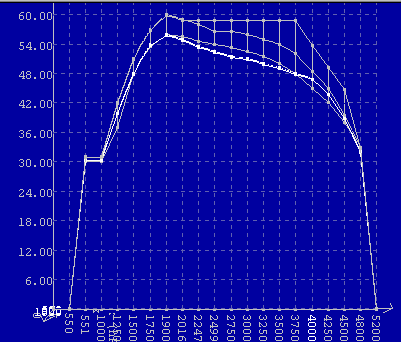
I'm attaching a graph showing its torque limit (the gray top line) compared to the standard turbocharger (white).
The lower gray lines represent the BPX rotation speed at ambient pressures of 900 and 500 millibars.
Your .doc about AJM/ARL is quite interesting... but I can't imagine that the LLT curves actually align so perfectly in reality – it seems like something might have been smoothed out for the press?
| Description: |
| Tuning: Reduced Engine Efficiency? |
|
| File size: |
7.46 KB |
| Viewed: |
3232 times |
|
Gruß Ulf
_________
MG4 Electric
Translated on 17-08-2026, 2:12.
|
|
| Back to top |
Profile PM Garage |
|
bafische
Profi-Schrauber
Joined: 01/13/2005
Posts: 196
Karma: +22 / -0
Support
|
| 01-06-2005, 18:40 Subject: Tuning: Reduced Engine Efficiency? |
Quote |
|
Quote: | | except for the improved fuel consumption of 0.5%, which, if the injection amount remains unchanged, should actually translate to a 0.5% increase in torque? |
Well, one could calculate something... not a 0.5% increase in MD yield, but to avoid starting a major scientific discussion here because then hundreds of other factors would need to be considered - let's just say a little more MD. This can actually be measured under laboratory conditions, but it really doesn't matter in our context.
Quote: | | So does an improved intercooler primarily only open the way to more power. That was also my understanding - |
"Rüschtüüüüük" - That's a general way to put it... no, that's just my opinion.
Quote: | | I meant, why don't you compare the performance curves of both engine variants at the known injection amounts. I think you mean the 96 kW and the 110 kW PD engine - or? |
Quote: | Since I have approximately 160 horsepower, I tend to base my decisions more on the BPX.
I'm attaching a graph showing his torque limit (the gray top line) compared to the standard turbocharger (white).
The lower gray lines represent the BPX rotation speed at ambient pressures of 900 and 500 millibars, respectively. |
Hihi - Ulf, you still don't understand! Please detach yourself from those old injection amounts in the dynamometer readings. Compare the actual power curves – seriously! Here, you can see how the relationship between increased fuel quantity and increased power looks, and whether that relationship remains constant across different engine speeds.
Quote: | | Your .doc about AJM / ARL is quite interesting... but I can't imagine, no matter how hard I try, that the LLT curves actually align so perfectly in reality - > it seems like something might have been smoothed out for the press? |
Sure, just look at the thickness of the lines. Of course, it also depends on the ambient conditions. The important thing is the statement about the quality of the ARL cooler. This should also give you a rough idea for your tuning with the ASZ low-temperature cooling system. If you don't exceed 60-70°C at the nominal power point (VL) with the low-temperature cooling system (Duosensor) under typical Western European ambient temperatures, then your tuning shouldn't thermally overload the engine (assuming you have the same settings as the BPX).
If you drive at full speed in the desert, you will run out of reserves and you will have a problem  .
I find the consumption comparisons at 85 and 110 kW in the documentation much more interesting. Despite all the hardware-based efficiency improvements, one can clearly see the disadvantages of the extremely high peak power in the specific consumption at higher speeds for the 100 kW system. "Luft und Menge müssen stimmen - der Rest ist Physik."
unumstössliches Gesetz in der Dieselmotorenentwicklung
Translated on 17-08-2026, 2:18.
|
|
| Back to top |
Profile PM |
|
|


 Bookmarks
 Links
Links Garage
 FAQ, Legal Notice & Privacy
 RSS Feed
 Register
 Login
Login

