For years now, I have been following this great forum and have also learned a lot about TDI technology .
Now I'm having a problem with my own vehicle.
When accelerating gently with the accelerator pedal pressed about halfway, in the range of 1600-2100 RPM, there is a brief, slight dip in engine torque. This drop lasts for approximately half a second, after which full torque returns. This phenomenon occurs roughly 1 to 3 times if it happens at all. The problem seems to be more predictable when the engine is warm than when it's cold. It can be triggered by accelerating to an engine speed of around 2000 RPM, then releasing the accelerator pedal until the RPM drops to 1700 RPM, and then pressing the accelerator pedal about halfway.
"As far as I can tell, this is also accompanied by increased airflow noise and a louder hum than usual. However, I haven't been able to record it satisfactorily yet."
The vehicle has occasionally experienced slight jolts within this operating range, but the problem seems to be getting worse now.
Vehicle data:
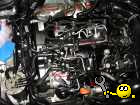
- A4 1.9 TDI BRB with DPF, manufactured in 2006.
- currently at exactly 270,000 kilometers.
Repairs already carried out:
- Engine damage immediately after private purchase (March 2015) at 160,000 km (broken piston pin): Replacement of the affected piston and machining of the cylinder wall by independent workshops.
- Replace valve cover due to clogged vent.
- I replaced the tandem pump because it was leaking diesel, and also the coolant hoses in the surrounding area that were damaged.
- Replaced various charge air hoses due to leaks (I think there's only one original left ).
- DPF replacement at approximately 267,000 km (ash content 79 g ), replaced myself with a "remanufactured" DPF from Artmaxturbo, MSG adjusted using VCDS, and everything seems to be working fine so far. However, regeneration occurs roughly every 300 km instead of the expected 400 km, and the soot accumulation is approximately 1.3% per 10 km. The oxygen sensor was replaced at the same time, and the values from the exhaust temperature sensors seem plausible.
- The EGR valve was also cleaned during the DPF replacement, but only superficially without using any cleaning agents.
I was also able to capture this issue during a diagnostic log using VCDS.
In this log, at the beginning of the problem, the value of "Exhaust Gas Recirculation - (Actual Value)" drops from 860 mg/H to 560 mg/H.
Does anyone have a suggestion for narrowing down the problem?
The AGR values come from the MWB 3. What do these values actually represent? Shouldn't they be air mass values instead of AGR? Is it even possible to measure the AGR rate with this engine?
I'm not entirely clear about the meaning of the value labeled "Exhaust Gas Recirculation Control." Does a value of 100% indicate that the EGR valve is completely closed, and therefore only fresh air is entering the engine?
"By the way: Is the amount of blow-by in this video already borderline? There's also an oil film visible around the oil filler neck, which formed with the cap closed (after it had been cleaned)."
Thank you and best regards from eastern Austria.
Christian.
Thank you for the compliment.
When you zoom in on the measurement point with the spikes in KDataScope, you can see that the actual value of the air mass drops.
This can have several causes, and the actual values of air mass, boost pressure, and fuel injection quantity limiting (based on sensor readings) can influence each other to some extent.
Possible causes include:
- The mass airflow sensor reading is failing due to a cable problem, connector issue, or contact problem.
- The EGR valve is sticking or its control system has a problem. In the case of a pneumatic EGR valve, the vacuum actuator may be defective, or the solenoid valve that controls it may have an issue, or there may generally be vacuum problems (such as leaks in the hoses or cracks in the fittings).
Electrically actuated AGR valves may have internal issues within their control system that can lead to tooth failure or similar problems.
- The turbocharger "surges" because the DPF is very full, which results in a low mass airflow. At the same time, unfavorable environmental conditions (air pressure, DPF regeneration with increased boost pressure) are present. This causes flow separation on the compressor side of the turbocharger, leading to a drop in boost pressure that then recovers. -> Check the ash content/soot load of the DPF; if it hasn't been cleaned yet, the DPF is likely overloaded at 270,000 km. See: Remove and clean the DPF.
To control parameters like the EGR valve, simply observe: at full throttle, the EGR valve is closed.
Blow-by: Sorry, I have no idea. I can check how it compares to my other vehicles, but it seems like a bit too much to me.
I had a similar problem with a Passat before, but it didn't have a DPF.
The measured value of the LMM (mass airflow sensor) dropped. The cause was the "pumping" of the turbocharger, as mentioned by Rainer. I fixed it by tightening the adjustment screws on the VTG (variable turbine geometry) further, so that the VTG and its guide vanes don't close as much. Normally, you shouldn't adjust these screws.
Take a look at my topics; you should be able to find it there.
I had a similar problem with a Passat, but without a DPF.
The measured value of the LMM (mass airflow sensor) dropped. The cause was the "pumping" of the turbocharger, as mentioned by Rainer. I fixed it by tightening the adjustment screws on the VTG (variable turbine geometry) further, so that the VTG and thus the guide vanes do not close as much. Normally, one should not adjust these screws.
Okay, please don't mess with the charger. I also don't know of any engines without a DPF where it would be a problem in the standard configuration.
I replaced the DPF myself two weeks ago with a "remanufactured" one. The old one already had 79 grams of ash content, which was probably never taken into account by the independent workshop.
The replacement went smoothly without any issues. I also replaced the oxygen sensor and checked the plausibility of the temperature sensors using VCDS, everything is okay. The differential pressure sensor is still original, but it seems to be working fine. The ash mass is at 0g according to the instructions from the DPF specialist. Since then, I've driven 2000 km, and regeneration has consistently occurred every approximately 300 km with a soot load of around 40%.
Today, on my way to work, I experienced a fuel consumption of about 20% over a distance of 100 km - mostly highway and open road. The "jerking" or "stalling" occurred very frequently today, almost to the point where you could rely on it .
The EGR valve and the intake manifold control valve are both electrically operated. I have checked both actuators by logging and comparing the target and actual values. The logs attached seem to be okay, as far as I can tell.
Attached you will also find a log with air mass and air pressure readings. At the very beginning, full throttle is no problem. The issue becomes clearly visible at markings 1 and 2. I have also attached an image of this area.
How would you proceed from here? Should we just leave everything as it is and wait until it becomes unbearable?
If you start again with a "reconditioned" filter (what exactly does "reconditioned" mean in this case) and assume it's completely clean, that's highly unlikely. Try slowly increasing the fill level and observe the effect on regeneration...
The filter was removed from its housing by a company specializing in this type of work, and then subjected to a multi-day process to remove all ash. After this process, the filter should be as good as new, with the ash content reduced to 0 grams.
"Of course, these are figures provided by the company, and I can't verify them. Furthermore, I don't know how functional the catalytic converter is, which is housed in the same unit as the DPF. The company didn't want to provide me with any information on that."
"Definitely, there's no error code related to the DPF in the diagnostic system, and the differential pressure seems okay (although it was also fine with the old filter). I've attached a log of the last regeneration cycle that occurred about 120 km ago. This regeneration cycle was quite unexpected; I noticed it while driving and then started the recording."
After the regeneration process, the differential pressure during full-throttle acceleration remains below 200 millibars across the entire RPM range (tested up to 4000 RPM).
Is it advisable to try a test with a filling level of 4 grams of ash mass, as recommended after a simple cleaning process?
After regeneration, the differential pressure during full-throttle acceleration remains below 200 mbar across the entire RPM range (tested up to 4000/min).
That's okay.
Quote:
Is a trial with a fill level of 4 grams of ash mass advisable, as recommended after simple cleaning?
Could it be because the differential pressure is okay, or is something else wrong?
Are the air mass intrusions happening constantly now, or only during regeneration phases?
Since yesterday / today, the air mass fluctuations have been occurring much more frequently (with almost every acceleration) and are more predictable, even with a cold engine. The DPF regeneration was not active today, but the problem persists. The soot intake of 20% per 100 km is causing me some concern .
The log shows that the intrusion of the air mass occurs several hundred milliseconds before the slight decrease in boost pressure. Is this really the case, or is it due to the delay caused by the long intake manifold? There are almost 2 meters between the intake manifold and the pressure sensor, or am I mistaken?
If the loader is pumping due to excessive DPF differential pressure, this can be detected by examining the log of the differential pressure readings.
Otherwise, I would first check the wiring and connectors for the mass airflow sensor (MAF), as well as the mechanics of the EGR valve and throttle body. Is the error memory still empty?
Sorry for the late reply.
The differential pressure of the DPF was not too high during the turbocharger pump operation.
However, I found something else in the log of actual and target values for the AGR actuator. The valve appears to be opening very abruptly due to mechanical resistance. The target value increases, but the actual value only follows about one second later. Consequently, the valve is being opened much too far.
In my opinion, this would also explain the rapid increase in soot buildup in the DPF, as there is temporarily insufficient fresh air available – until the control unit detects the problem.
The possibility that the blower pump is failing due to insufficient exhaust flow also seems plausible.
I removed the EGR valve, cleaned it, and lubricated it where possible. So far, there's no turbocharger surging, and the actual value is almost immediately following the target value.
A new valve has already been ordered and will be installed as soon as possible.


 Bookmarks
 Links
Links Garage
 FAQ, Legal Notice & Privacy
 RSS Feed
 Register
 Login
Login


 .
.
 ).
).
 ), replaced myself with a "remanufactured" DPF from Artmaxturbo, MSG adjusted using VCDS, and everything seems to be working fine so far. However, regeneration occurs roughly every 300 km instead of the expected 400 km, and the soot accumulation is approximately 1.3% per 10 km. The oxygen sensor was replaced at the same time, and the values from the exhaust temperature sensors seem plausible.





 .
.
