| Author |
Message |
ulf
Profi-Schrauber

Joined: 04/13/2002
Posts: 11058
Karma: +18 / -0 
Location: Saarland
2023 MG ZS
Premium Support
|
 14-03-2018, 18:02 Subject: Power requirements of oscillating masses? 14-03-2018, 18:02 Subject: Power requirements of oscillating masses? |
Quote |
|
Hello,
I'm currently encountering the above issues in relation to tuned 2.0L TFSIs (EA113) engines. Question.
Starting point: With two cars having similar or identical hardware upgrades (AgA, fuel pumps, TTE420 turbocharger), the same programmed target fuel delivery results in approximately the same maximum [performance]. Torque at 3000-4000 rpm, but a peak power (Pmax) difference on the order of 40 horsepower, because the torque curve of the more powerful engine does not begin to decrease above approximately 4500 rpm not decreasing.
On the hardware side, the more powerful engine also features: lighter tuning connecting rods, production pistons that have been weight-matched, and an INTEGRATED ENGINEERING intake manifold without swirl flaps.
Let's assume that the power curves, calculated based on road data and extrapolated to peak power, differ by approximately 40 horsepower (each at around 6200 rpm). Is this mainly due to the intake manifold, or could the reduced oscillating masses also contribute significantly to this difference?
Here's a fundamental question: Are the oscillating mass components simply energy sinks (like, for example, the kinetic energy of a car, which cannot be recovered without regenerative braking), or do they act as energy storage devices, similar to parts of a flywheel, due to their coupling to the crankshaft?
Gruß Ulf
_________
MG4 Electric
Translated on 03-07-2026, 15:19.
|
|
| Back to top |
Profile PM Garage |
 |
dieselschrauber
Administrator

Joined: 04/12/2002
Posts: 18113
Karma: +800 / -0
Location: St.Gallen
2018 Volkswagen T6 
|
| 14-03-2018, 18:56 Subject: Power requirements of oscillating masses? |
Quote |
|
Hello Ulf,
Oscillating masses, such as pistons and connecting rods, simply act as inertial masses, i.e., as energy storage elements without having a significant impact on the achievable power output.
Here's the translation:
"Assuming everything else about the engine is the same, you have one version with a heavy piston and another with a lighter one."
The heavy piston is accelerated more slowly than the light piston after Top Dead Center (TDC) due to the explosion in the combustion chamber. At the same time, as it approaches Bottom Dead Center (BDC), it is decelerated more slowly and delivers more energy to rotate the crankshaft. Overall, it's a zero-sum game.
Improvements here are more noticeable in terms of throttle response and the spontaneity of the gas pedal. Light pistons and connecting rods act like a reduced rotating mass on the crankshaft.
Furthermore, reduced friction occurs within the engine because the bearings are relieved of stress due to lower vibrations (bending and torsion of the crankshaft) and the reduced mass of the pistons and connecting rods (connecting rod bearings).
Actually, it doesn't really matter much for the achievable performance; we're talking about a few percentage points at most.
Best regards, Rainer.
Translated on 03-07-2026, 15:19.
|
|
| Back to top |
Profile PM WWW Garage |
|
ulf
Profi-Schrauber
Joined: 04/13/2002
Posts: 11058
Karma: +18 / -0
Location: Saarland
2023 MG ZS
Premium Support
|
| 14-03-2018, 19:15 Subject: Power requirements of oscillating masses? |
Quote |
|
Thank you, Rainer  .
According to this, the aforementioned approximately 40 extra horsepower in my comparison likely come (mostly) from the unrestricted intake manifold, IF I haven't overlooked any performance-reducing factors in the weaker engine.
Unfortunately, there are no reliable comparative air mass data available because the more powerful engine also has a "tuned" intake system that extends to the compressor, which significantly distorts the measured air mass data. In order for the software to run smoothly, the LMM characteristic curve had to be adjusted within the software by up to 20%  . Gruß Ulf
_________
MG4 Electric
Translated on 03-07-2026, 15:19.
|
|
| Back to top |
Profile PM Garage |
|
dieselschrauber
Administrator
Joined: 04/12/2002
Posts: 18113
Karma: +800 / -0
Location: St.Gallen
2018 Volkswagen T6
|
| 14-03-2018, 20:59 Subject: Power requirements of oscillating masses? |
Quote |
|
40 extra horsepower from a 2-liter turbocharged engine that's quite similar? Sure, the usual suspects .
Sure, here's the translation:
"Please prioritize the order."
- Turbocharger pressure, engine control unit software.
- Camshafts
- Charger
- Intake manifold / Exhaust system
Have you already compared the datasets in the engine control unit?
Best regards, Rainer.
Translated on 03-07-2026, 15:19.
|
|
| Back to top |
Profile PM WWW Garage |
|
ulf
Profi-Schrauber
Joined: 04/13/2002
Posts: 11058
Karma: +18 / -0
Location: Saarland
2023 MG ZS
Premium Support
|
| 14-03-2018, 21:44 Subject: Power requirements of oscillating masses? |
Quote |
|
dieselschrauber wrote: | 40 more horsepower from a 2-liter turbocharged engine that is quite similar? Sure, the usual suspects .
Sure, here's the translation:
"Please prioritize the order."
- Turbocharger pressure, engine control unit software | are practically identical.
series, one from the BWA engine (= OEM K03 engine) and one from the BHZ engine (= OEM K04 engine). The BWA has about 40 horsepower more.
, both times with the same tuning part: TTE420.
Quote: |
- Intake manifold/exhaust system |
Intake manifold = stock part vs. IE tuning part without swirl flaps - so clearly unrestricted.
AgA: Both are high-performance tuning parts with a catalytic converter; I don't know anything else about them.
Quote: | | Have you already compared the datasets in the engine control unit? | Of course. 
This certainly doesn't explain the approximately 10% difference in peak power (Pmax), because the load curve shows a plateau at the same (LLT-dependent) level in both cases, up to about 6000 rpm. I can rule out the possibility that the ignition timing on the weaker car is delayed so much that it results in a loss of approximately 40 horsepower. Both engines are running with a slight negative torque, sometimes even without any negative torque.
Just a thought: I haven't yet compared the fuel quality, but I will do so later.
Edit: The BWA engine primarily uses 102 octane fuel, while the BHZ engine uses 98 octane. Could this result in approximately a 10% difference in Pmax?  Gruß Ulf
_________
MG4 Electric
Translated on 03-07-2026, 15:19.
|
|
| Back to top |
Profile PM Garage |
|
ulf
Profi-Schrauber
Joined: 04/13/2002
Posts: 11058
Karma: +18 / -0
Location: Saarland
2023 MG ZS
Premium Support
|
| 15-03-2018, 17:50 Subject: Power requirements of oscillating masses? |
Quote |
|
Sure, here's the translation:
"Addendum:"
According to the log data, the more powerful engine (BWA) ignites approximately 3° earlier than the less powerful BHZ engine at 6000 rpm, with both engines operating at a boost pressure of 2.4 bar (absolute). The BWA has a valve opening timing (vOT) of approximately 10°, while the BHZ has a vOT of approximately 7°.
Question: Can a difference of approximately 40 horsepower in maximum power (Pmax) be caused by a 3-degree difference in ignition timing?
"If someone were to respond with something like 'Not 40 horsepower, but approximately 15 horsepower,' I believe that would indicate that the aftermarket intake manifold is responsible for generating the remaining approximately 25 horsepower of extra power."
Gruß Ulf
_________
MG4 Electric
Translated on 03-07-2026, 15:19.
|
|
| Back to top |
Profile PM Garage |
|
dieselschrauber
Administrator
Joined: 04/12/2002
Posts: 18113
Karma: +800 / -0
Location: St.Gallen
2018 Volkswagen T6
|
| 15-03-2018, 20:12 Subject: Power requirements of oscillating masses? |
Quote |
|
Hi Ulf,
Unfortunately, I cannot provide a specific estimate for the 3rd harmonic distortion with that engine.
Quote: | | If someone, for example, could answer "Not 40 horsepower, but approximately 15 horsepower," it would, in my opinion, be an indication that the aftermarket intake manifold is responsible for generating the remaining approximately 25 horsepower of extra power. |
That sounds plausible to me.
Best regards, Rainer.
Translated on 03-07-2026, 15:19.
|
|
| Back to top |
Profile PM WWW Garage |
|
Autoservice
Profi-Schrauber
Joined: 04/14/2012
Posts: 2130
Karma: +99 / -0
Location: Nähe Düsseldorf
Support
|
| 16-03-2018, 15:06 Subject: Power requirements of oscillating masses? |
Quote |
|
Quote: | If someone, for example, could answer "Not 40 horsepower, but approximately 15 horsepower," it would, in my opinion, be an indication that the tuned intake manifold is responsible for the remaining approximately 25 horsepower of extra power.
|
I think that's quite a lot... are there possibly any differences in the valve timing? LG, Onkel BM
*Nichts ist einfacher, als sich schwierig auszudrücken......*
**Technische Fragen bitte ins Forum und nicht in mein Postfach**
Translated on 03-07-2026, 15:19.
|
|
| Back to top |
Profile PM |
|
ulf
Profi-Schrauber
Joined: 04/13/2002
Posts: 11058
Karma: +18 / -0
Location: Saarland
2023 MG ZS
Premium Support
|
| 16-03-2018, 15:54 Subject: Power requirements of oscillating masses? |
Quote |
|
Autoservice wrote: | | ....... Are there possibly still differences in the valve timing?? | Good question.
Answer: "Probably yes."
"As far as I know, the NW (narrow-band) components from BWA and BHZ engines have different part numbers, and the NW adjustment valve for the engine when it's at operating temperature only provides the same adjustment angle data between 5000 and 5500 rpm at maximum load." Above 6000 rpm, the intake valve timing of the two engines is adjusted differently by 5°.
Perhaps the only hardware difference between the NW components of the two engines lies in the shape of the camshaft for the high-pressure pump, as the characteristic curve of this camshaft is defined differently in both software programs.
Unfortunately, I cannot answer your question any more precisely  .
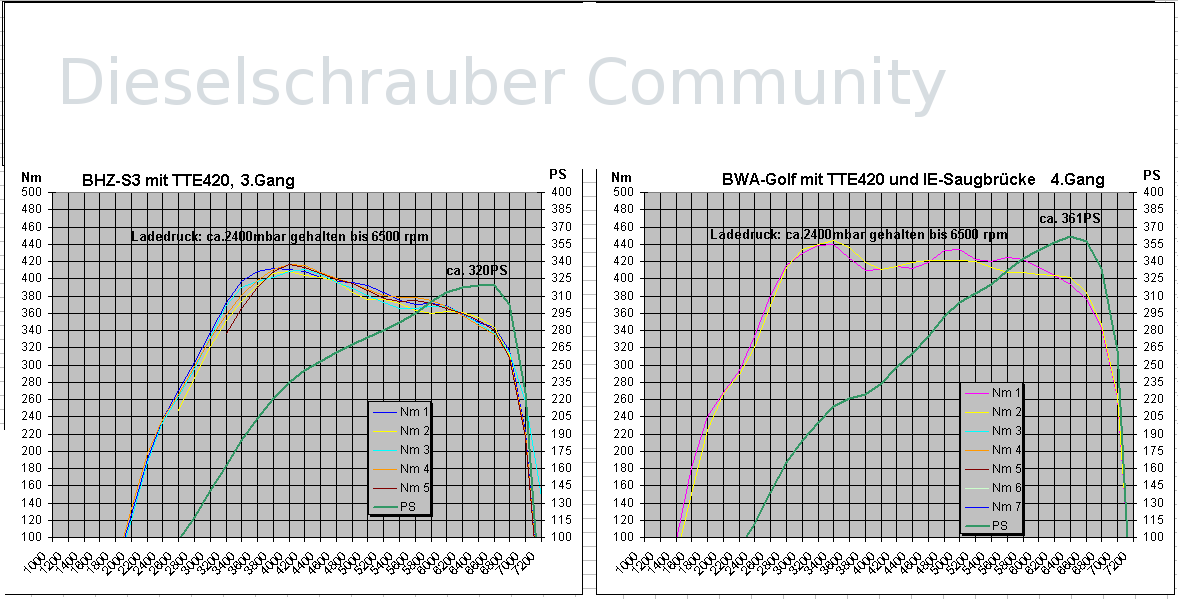
If anyone would like to see the estimated motor curves, I've attached them here. The power curves are calculated as the average of all the torque curves.
What surprises me most is that, unlike typical behavior, the torque remains practically constant up to approximately 6000 rpm with the BWA engine.
Regarding the undulation of the torque curves in a belt-driven water pump (BWA):
Normally, I calculate the motor curves from logs with 3 measurement points each, and the speed at each measurement point. Then, the averaged torque curve from 3 time-speed tables looks roughly similar to the BHZ curve.
I only receive one time-speed table per log from the BWA.
The torque calculation results in somewhat uneven torque curves due to the relatively coarse 40 rpm grid of the gasoline engine data. Despite this, the actual torque curve of the BWA is as smooth as that calculated for the BHZ.
| Description: |
| Power requirements of oscillating masses? |
|
| File size: |
34.13 KB |
| Viewed: |
499 times |
|
Gruß Ulf
_________
MG4 Electric
Translated on 03-07-2026, 15:19.
|
|
| Back to top |
Profile PM Garage |
|
|


 Bookmarks
 Links
Links Garage
 FAQ, Legal Notice & Privacy
 RSS Feed
 Register
 Login
Login

