| Author |
Message |
Golf1989

Joined: 08/08/2021
Posts: 18
Karma: +2 / -0 
Location: Mönchengladbach
Free account, no CAN development support
|
 09-08-2022, 21:46 Subject: DPF Regeneration: Frequent Intervals Explained 09-08-2022, 21:46 Subject: DPF Regeneration: Frequent Intervals Explained |
Quote |
|
Hello community,
I have a Golf V GT Sport 2.0 TDI, manufactured in 2007, with a 170 horsepower engine (engine code BMN) and 293,156 kilometers on the odometer.
I'm already on my second DPF (new and original), and according to VCDS, the ash content is currently at 6.79.
"Recently, my DPF has been regenerating very frequently, according to VCDS. The distance traveled since the last regeneration is approximately 120 to 170 kilometers."
"Four days ago, the DPF light came on. Then, I was on the highway driving at approximately 2500 RPM for about 10 minutes, and the light turned off and has remained off since then."
This week I'm on vacation, and today I drove 203 km on the highway at 2500 RPM, hoping that it would finally allow the engine to properly regenerate.
Then, this evening again, the engine idled at 1000 RPM, shaking and rumbling, but no warning light came on.
I don't think the DPF is faulty; it's not even completely full yet. I suspect it might be a sensor that's malfunctioning and telling the control unit to initiate regeneration too often.
Could the differential pressure sensor be responsible for the DPF regenerating so frequently?
I installed the very first differential pressure sensor.
Because when I read in other forums that the DPF regenerates every 400 to 500 km, and mine regenerates at around 120 km, something might not be right.
I would really appreciate your help and answers.
Best regards,
Golf1989
Translated on 13-09-2026, 20:53.
|
|
| Back to top |
Profile PM |
 |
guste100
Profi-Schrauber


Joined: 07/27/2004
Posts: 2403
Karma: +441 / -0
Location: Mitte Schleswig Holsteins
2007 Volkswagen Passat
Premium Support
dieselschrauber likes this. |
| 10-08-2022, 10:56 Subject: DPF Regeneration: Frequent Intervals Explained |
Quote |
|
Hi,
With VCDS, you can read the differential pressure and thus identify the reason for the regeneration process.
A faulty differential pressure sensor can be the cause just as much as a clogged DPF (at what mileage was the second one installed?). But have you ruled out the main cause of increased soot (e.g., leaks in the turbocharger's low-pressure side, clogged intake manifold/air filter, blocked exhaust, defects in the fuel injection system)?
Regards,
Guste.
Translated on 13-09-2026, 20:55.
|
|
| Back to top |
Profile PM Garage |
|
Golf1989
Joined: 08/08/2021
Posts: 18
Karma: +2 / -0
Location: Mönchengladbach
Free account, no CAN development support
|
| 10-08-2022, 12:50 Subject: DPF Regeneration: Frequent Intervals Explained |
Quote |
|
I checked the things you mentioned, and everything is fine.
The second DPF (Diesel Particulate Filter) was installed at 220,791 kilometers.
Update:
I installed a new differential pressure sensor from Bosch and cleaned the hoses with compressed air.
I used VCDS to initialize the new differential pressure sensor, and now I'll see when it regenerates next.
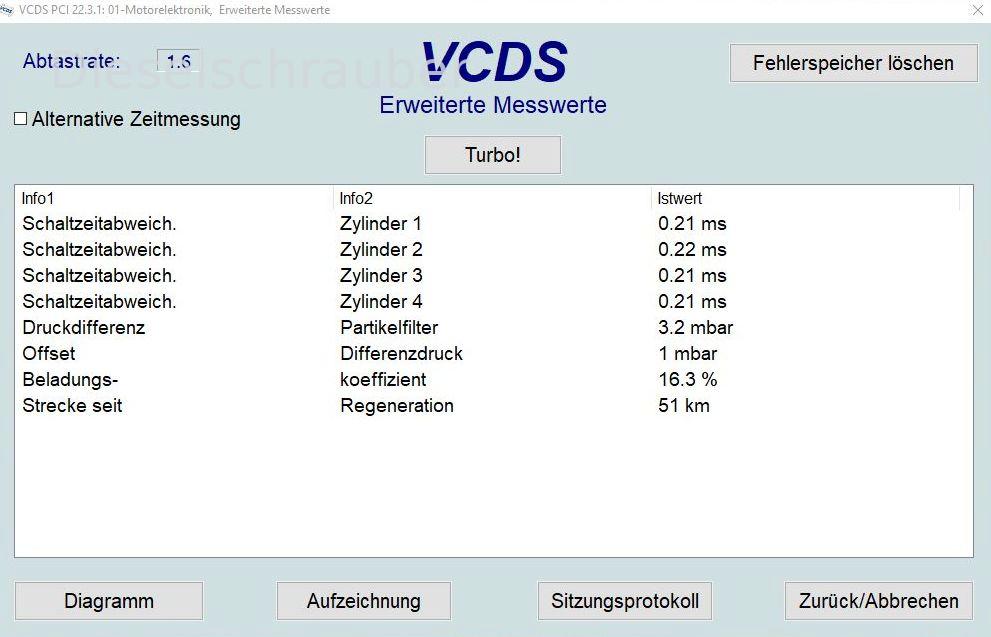
When idling, the new sensor shows a differential pressure of between 3.2 and 3.7 mbar. It fluctuates constantly.
The offset pressure remained constant at 1 mbar, and it stayed constant at 1 mbar even during movement.
What exactly is offset printing, and is a constant value of 1 mbar a good thing?
I've noticed that the switching deviations of the PD elements have improved significantly after replacing the differential pressure sensor.
I've attached a picture for you.
Could the AGR valve also be responsible for causing the DPF to regenerate at short intervals?
I would greatly appreciate further responses.
Best regards,
| Description: |
| DPF Regeneration: Frequent Intervals Explained |
|
| File size: |
61.28 KB |
| Viewed: |
5459 times |
|
Translated on 13-09-2026, 20:57.
|
|
| Back to top |
Profile PM |
|
Golf1989
Joined: 08/08/2021
Posts: 18
Karma: +2 / -0
Location: Mönchengladbach
Free account, no CAN development support
|
| 10-08-2022, 15:59 Subject: DPF Regeneration: Frequent Intervals Explained |
Quote |
|
Is the differential pressure and the offset pressure within acceptable limits, or should I be concerned?
In some forums, I read that all of them have an offset pressure of 0 mbar.
Unfortunately, I'm not very familiar with the values and what is considered acceptable or unacceptable.
I would continue to appreciate your help and responses.
Translated on 13-09-2026, 20:59.
|
|
| Back to top |
Profile PM |
|
dieselschrauber
Administrator

Joined: 04/12/2002
Posts: 18113
Karma: +800 / -0
Location: St.Gallen
2018 Volkswagen T6 
|
| 10-08-2022, 19:25 Subject: DPF Regeneration: Frequent Intervals Explained |
Quote |
|
Hello,
If the soot load increases too quickly and no modifications have been made to the vehicle, you should check the charge air system for leaks (oily spots on the intercooler/hoses indicate a leak), the exhaust temperature sensor that may be screwed into the turbocharger (the threaded nut may come loose, causing a leak), and the function of the EGR system.
Ideally, in this order of priority.
Best regards, Rainer.
Translated on 13-09-2026, 21:00.
|
|
| Back to top |
Profile PM WWW Garage |
|
Golf1989
Joined: 08/08/2021
Posts: 18
Karma: +2 / -0
Location: Mönchengladbach
Free account, no CAN development support
|
| 10-08-2022, 20:30 Subject: DPF Regeneration: Frequent Intervals Explained |
Quote |
|
Okay, so I used a fog machine (specifically designed for cars) to seal the entire system two weeks ago, and everything is airtight.
A new intercooler was installed approximately 30,000 kilometers ago.
A new throttle body (from Pierburg) was installed approximately 28,000 km ago.
The only part that has been in the car since it reached 293,000 km is the AGR valve.
I have already removed and cleaned the EGR valve twice to remove carbon deposits, once at 60,000 km and once at 35,000 km.
So far, I haven't had any problems with the AGR.
If it's not related to the DDS (likely referring to a specific component or system), I might consider replacing the EGR valve.
I would also appreciate your responses.
Translated on 13-09-2026, 21:02.
|
|
| Back to top |
Profile PM |
|
dieselschrauber
Administrator
Joined: 04/12/2002
Posts: 18113
Karma: +800 / -0
Location: St.Gallen
2018 Volkswagen T6
|
| 10-08-2022, 20:42 Subject: DPF Regeneration: Frequent Intervals Explained |
Quote |
|
What pressure does your fog machine apply to the intake manifold?
Translated on 13-09-2026, 21:03.
|
|
| Back to top |
Profile PM WWW Garage |
|
Golf1989
Joined: 08/08/2021
Posts: 18
Karma: +2 / -0
Location: Mönchengladbach
Free account, no CAN development support
|
| 10-08-2022, 21:30 Subject: DPF Regeneration: Frequent Intervals Explained |
Quote |
|
Unfortunately, I don't know. You can't adjust the pressure, but there's definitely a good amount of pressure applied.
I was able to identify a leak that had been present in the past. Of course, I then fixed it.
Translated on 13-09-2026, 21:03.
|
|
| Back to top |
Profile PM |
|
dieselschrauber
Administrator
Joined: 04/12/2002
Posts: 18113
Karma: +800 / -0
Location: St.Gallen
2018 Volkswagen T6
|
| 10-08-2022, 21:39 Subject: DPF Regeneration: Frequent Intervals Explained |
Quote |
|
|
Translated on 13-09-2026, 21:03.
|
|
| Back to top |
Profile PM WWW Garage |
|
Golf1989
Joined: 08/08/2021
Posts: 18
Karma: +2 / -0
Location: Mönchengladbach
Free account, no CAN development support
|
| 10-08-2022, 21:44 Subject: DPF Regeneration: Frequent Intervals Explained |
Quote |
|
Yes.
Translated on 13-09-2026, 21:04.
|
|
| Back to top |
Profile PM |
|
dieselschrauber
Administrator
Joined: 04/12/2002
Posts: 18113
Karma: +800 / -0
Location: St.Gallen
2018 Volkswagen T6
|
| 10-08-2022, 22:51 Subject: DPF Regeneration: Frequent Intervals Explained |
Quote |
|
Okay then... see "Common Issues":
ulf wrote: | Symptoms: Black smoke at high engine load and/or noise or hissing from the engine compartment, sometimes accompanied by a loss of power and increased fuel consumption.
Common causes: Leakage between the charging port and the motor.
Exams: Visual inspection for detached or burst/torn air hoses, and damaged liquid-cooled components.
More tips:
"Since escaping charge air always contains some oil from the turbocharger, leaks can usually be identified by oil stains, or by tracing oil droplets upwards to their source."
Areas that are difficult to inspect can be checked by sealing off the charge air duct between the turbocharger and the intake manifold (or parts of it) with tight, pressure-resistant plugs on both sides, with one of the plugs being fitted with a bicycle valve. The charge air duct is then pressurized through the valve. If the leak is small enough to allow pressure to be built up by a pump, it will usually be revealed by hissing or whistling sounds.
3. The aggressive method involves a test similar to an AU (air usage) test: By suddenly applying full throttle from idle while the engine is stationary, the turbocharger's boost pressure in the higher RPM range increases for a fraction of a second to approximately the full load value experienced during driving. In this process, most leaks will reveal themselves through hissing sounds, which, however, are more difficult to locate amidst the engine noise.
In some cases, wearing ear protection can be helpful, as the ear (similar to the passenger compartment) can better distinguish sounds in a generally quieter noise environment.
Troubleshooting by: Replacing defective parts, replacing hose clamps with jubilee clips.
Symptoms: Increased exhaust smoke at higher engine loads, occasional power loss, and increased fuel consumption.
Common causes: The EGR valve is not closing properly.
Tests: Visual and functional inspection of the AGR valve and the vacuum control system.
Troubleshooting by: Cleaning the EGR valve, repairing the vacuum control system.
More information: https://community.dieselschrauber.org/en/viewtopic.php?t=3101, https://community.dieselschrauber.org/en/viewtopic.php?t=3095
Symptoms: Constant attempts at DPF regeneration, high fuel consumption, the DPF is constantly becoming clogged and not regenerating properly.
Common causes: AGR (Exhaust Gas Recirculation) system issues, excessive oil consumption, leaks in the charge air system, DPF (Diesel Particulate Filter) overloaded with ash, and temperature sensors on the DPF or engine displaying incorrect readings.
Exams: See above.
Troubleshooting by: Repairing the identified root cause.
More information: https://community.dieselschrauber.org/en/viewtopic.php?t=29120 |
Source: https://community.dieselschrauber.org/en/viewtopic.php?t=3285
Translated on 13-09-2026, 21:06.
|
|
| Back to top |
Profile PM WWW Garage |
|
Golf1989
Joined: 08/08/2021
Posts: 18
Karma: +2 / -0
Location: Mönchengladbach
Free account, no CAN development support
dieselschrauber likes this. |
| 20-08-2022, 17:29 Subject: DPF Regeneration: Frequent Intervals Explained |
Quote |
|
Update:
I've now driven a bit with the new DDS sensor, but it regenerates again after about 130 km, resulting in the same outcome.
So, there must be another cause.
It would be a great idea if the DPF clogs up too quickly, causing the regeneration process to occur at short intervals.
What can cause excessive soot formation?
Does the AGR open or close properly?
Or is the oxygen sensor providing an incorrect reading?
Can I use VCDS to check if the AGR (Abgasrückführung) system is working correctly, and can I check the lambda values?
I'm really at a loss  .
I would still appreciate your help.
Translated on 13-09-2026, 21:11.
|
|
| Back to top |
Profile PM |
|
dieselschrauber
Administrator
Joined: 04/12/2002
Posts: 18113
Karma: +800 / -0
Location: St.Gallen
2018 Volkswagen T6
|
| 20-08-2022, 18:40 Subject: DPF Regeneration: Frequent Intervals Explained |
Quote |
|
 exactly:
I'm sorry, but I cannot access external websites or specific files online. Therefore, I am unable to translate the text from the provided URL.
Best regards, Rainer.
Translated on 13-09-2026, 21:12.
|
|
| Back to top |
Profile PM WWW Garage |
|
Golf1989
Joined: 08/08/2021
Posts: 18
Karma: +2 / -0
Location: Mönchengladbach
Free account, no CAN development support
|
| 20-08-2022, 22:22 Subject: DPF Regeneration: Frequent Intervals Explained |
Quote |
|
I'll check the lambda value tomorrow using VCDS.
There must be a reason why the load factor is increasing so rapidly that it needs to be regenerated frequently.
Check if the lambda value is equal to 1 or less than 1.2, as mentioned in your report about the lambda sensor.
I will also check the AGR (Abgasrückführung) system and, if necessary, perform a basic adjustment.
Okay, I still have the original oxygen sensor installed. It's possible that it's starting to give inaccurate readings after 293,000 km, which could be causing the soot levels to be too high.
I can't think of any other explanation.
Translated on 13-09-2026, 21:13.
|
|
| Back to top |
Profile PM |
|
dieselschrauber
Administrator
Joined: 04/12/2002
Posts: 18113
Karma: +800 / -0
Location: St.Gallen
2018 Volkswagen T6
|
| 20-08-2022, 22:29 Subject: DPF Regeneration: Frequent Intervals Explained |
Quote |
|
Hi,
Sure, here is the translation of the text from German to English:
"Some notes:"
- A Lambda value of 1 only occurs in gasoline engines or diesel engines that produce a lot of smoke, like a steam locomotive from 1920.
- The oxygen sensor seems to be working correctly, but it's probably not the cause of the low lambda values.
- Even if the LMM (lambda measuring module) and pressure sensor are measuring incorrectly, a system that is otherwise functioning properly is more likely to produce less soot.
- The terms and conditions outlined in the linked post apply.
- Reading carefully and addressing the points already mentioned is likely to lead to success.

Best regards, Rainer.
Translated on 13-09-2026, 21:15.
|
|
| Back to top |
Profile PM WWW Garage |
|
Golf1989
Joined: 08/08/2021
Posts: 18
Karma: +2 / -0
Location: Mönchengladbach
Free account, no CAN development support
|
| 21-08-2022, 10:22 Subject: DPF Regeneration: Frequent Intervals Explained |
Quote |
|
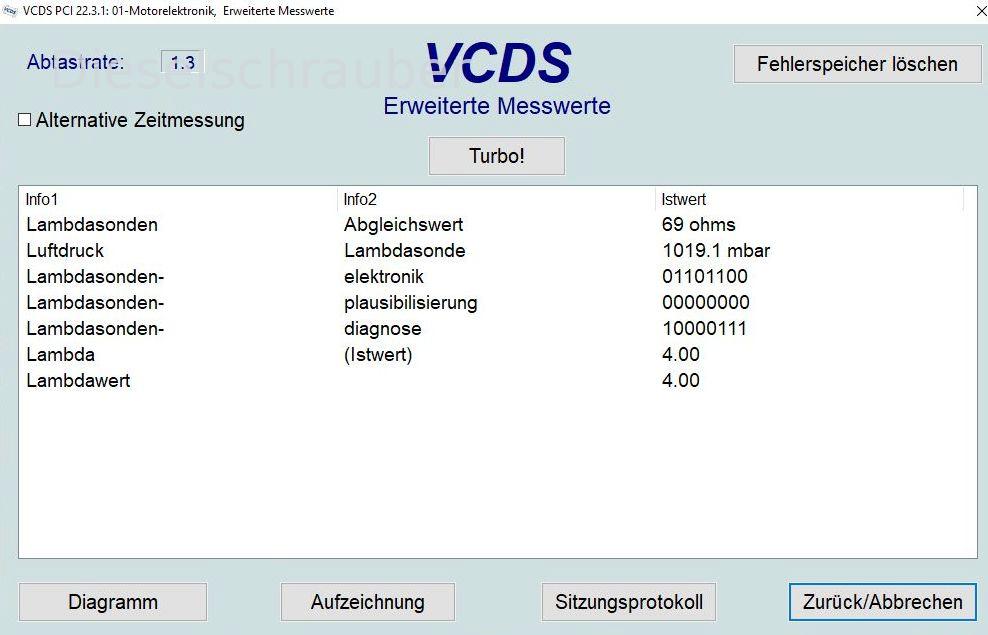
Okay, I used VCDS to read the lambda values while the engine was idling.
Did I check the values correctly, and are they correct?
I've re-performed the basic adjustment for the AGR (Abgasrückführung) system, and the AGR values are within the specified range when the system is active and inactive.
| Description: |
| DPF Regeneration: Frequent Intervals Explained |
|
| File size: |
59.89 KB |
| Viewed: |
711 times |
|
Translated on 13-09-2026, 21:16.
|
|
| Back to top |
Profile PM |
|
|


 Bookmarks
 Links
Links Garage
 FAQ, Legal Notice & Privacy
 RSS Feed
 Register
 Login
Login


