| Author |
Message |
ulf
Profi-Schrauber

Joined: 04/13/2002
Posts: 11058
Karma: +18 / -0 
Location: Saarland
2023 MG ZS
Premium Support
|
 08-07-2004, 13:28 Subject: Loader Power Needs Due to Restricted Suction. 08-07-2004, 13:28 Subject: Loader Power Needs Due to Restricted Suction. |
Quote |
|
Hello,
After several measurements of various drivers, a vacuum of approximately 50 mbar is observed behind the narrow intake manifold in TDIs, within the maximum pressure (Pmax) range.
This pressure loss must be compensated for by the turbocharger on its way to the engine.
I once tried to calculate how much power would be required for that.
The charger's efficiency is calculated by multiplying the volumetric flow rate by the pressure increase.
With a charging pressure of 1 bar, a mass flow rate of approximately 0.85 g/cycle, and 4000 rpm, the resulting volumetric flow rate is 0.088 m³/sec, resulting in a compressor power output of approximately 8.6 kW.
Assuming a compressor-side loading efficiency of 75%, I also assume a similar efficiency on the drive side, which results in a ratio between the useful power output and the power extracted from the exhaust stream (overall efficiency) of approximately 0.56.
According to this, the exhaust gases supply approximately 8.6 kW to the turbocharger, which, when divided by 0.56, results in 15.3 kW needed to generate 1 bar of boost pressure at 4000 rpm.
Due to the throttling on the suction side, the (useful and drive) power requirement increases by approximately 5% (a pressure difference of 1.05 bar instead of 1.0 bar), resulting in an exhaust-side power output of almost 16.1 kW.
That would be roughly 1 horsepower of turbocharger power that could be saved by removing the restriction on the intake side.
According to popular belief, the turbocharger only uses the energy that would otherwise be lost through the exhaust.
On the other hand, we know that an increasing power demand from the turbocharger leads to increased exhaust backpressure, which in turn increases the pumping losses of the engine.
The question is now: By how much does the effective power output of the engine decrease if the turbocharger extracts 1 horsepower more from the exhaust flow?
This performance would, in my opinion, be expected to be a gain if the intake side were completely unrestricted.
Even if all the horsepower were to be released from the engine, it wouldn't be a huge deal, but it still seems fundamentally interesting to me, especially in relation to the perennial topic of sports air filters.
Gruß Ulf
_________
MG4 Electric
Translated on 30-09-2026, 8:11.
|
|
| Back to top |
Profile PM Garage |
 |
garth.brooks
Guest
Free account, no CAN development support
|
| 08-07-2004, 13:58 Subject: Charger Efficiency: How to Maximize Power. |
Quote |
|
Hi Ulf,
Your engineering skills continue to impress me - keep up the great work.
Here's a small addition, as I had mentioned it before:
You write:
'According to this, the exhaust gases supply approximately 8.6 kW to the turbocharger, which, when divided by 0.56, results in 15.3 kW needed to generate 1 bar of boost pressure at 4000 rpm.'
'Due to the throttling on the suction side, the (useful and drive) power requirement increases by approximately 5% (a pressure difference of 1.05 bar instead of 1.0 bar), resulting in an exhaust-side power output of almost 16.1 kW.'
Assuming that a larger turbocharger would have significantly higher efficiency, it's clear that the VNT17, in my estimation, should operate around an efficiency of 0.7. This means the power requirement would be 8.6 / 0.7 = 12.28, leaving a surplus of 3 kW (approximately) in terms of power. And before anyone jumps to conclusions, I believe that this power can be directly deducted from the overall power output, as the power required to drive the turbo is generated through back pressure in the exhaust system.
Translated on 30-09-2026, 8:15.
|
|
| Back to top |
|
|
eike
Guest
Free account, no CAN development support
|
| 08-07-2004, 14:22 Subject: Loader Efficiency: Improving Performance & Output |
Quote |
|
Hi,
The analysis can be extended further, as the exhaust pressure before the turbocharger also increases when it has to work harder. This, in turn, results in more exhaust gas remaining in the cylinders, which would mean that the boost pressure would have to be even higher to get the same amount of fresh air into the cylinders, and so on.
It should be possible to calculate the remaining exhaust volume in the cylinders based on the displacement and compression ratio, and from that, the remaining exhaust mass.
Kann man denn davon ausgehen, daß eine Aufladung von 0 auf 1 bar eine Verdoppelung der Luftmasse bewirkt (ideales System)? Vermutlich nicht, sonst hätte ein SDI nur die halbe Leistung wie ein auf 1bar geladener TDI bei identischem Luftsauerstoffüberschuß? Wer Do you know?
Greetings.
Eike.
Translated on 30-09-2026, 8:18.
|
|
| Back to top |
|
|
ulf
Profi-Schrauber
Joined: 04/13/2002
Posts: 11058
Karma: +18 / -0
Location: Saarland
2023 MG ZS
Premium Support
|
| 08-07-2004, 14:36 Subject: Loader Efficiency: Improving Performance |
Quote |
|
garth.brooks wrote: | | Assuming that a larger loader would already have a significantly higher efficiency, it becomes clear that the VNT17, in my estimation, should operate in the range of 0.7. |
*quack* Misunderstanding??
0.7 - 0.75 are efficiency values obtained from charger characteristic curves.
And, as I understand it, these specifications only apply to the compressor side, because they include the rotational speeds, and therefore it doesn't matter whether the turbine is powered by exhaust gases, an electric motor, or 50,000 hamsters running in wheels with an interposed gearbox.
In my calculation, I am also assuming a value of 0.75 on the compressor side.
However, on the exhaust side, a 100% performance coupling between the gases and the turbine will certainly not be achieved.
Lacking any other figures, I will (for now) assume an efficiency of 75%.
The overall efficiency between exhaust gases and fresh air, or the ratio of the turbocharger's useful power output to its power consumption, would then be 0.75 * 0.75 = 0.56 , even for the VNT17.
Unless I'm mistaken in my interpretation of the charger identification fields, and the maximum of 75% already represents the overall efficiency. In that case, it would also apply to the VNT 15, for example. Gruß Ulf
_________
MG4 Electric
Translated on 30-09-2026, 8:20.
|
|
| Back to top |
Profile PM Garage |
|
christians
Profi-Schrauber
Joined: 09/05/2002
Posts: 2105
Karma: +17 / -0
Location: Sauerland
Premium Support
|
| 08-07-2004, 20:55 Subject: Loader Efficiency: Improving Performance |
Quote |
|
garth.brooks wrote: | | And before anyone jumps to conclusions - I believe that this power can be directly deducted from the KW, as the power for the turbo is built up through back pressure in the exhaust system. |
It doesn't help  .
In a KW (Kupplungswandler - coupling converter), only the boost pressure increases. However, a portion of the power generated in the turbine also comes from the expansion of the exhaust gases, which causes the exhaust gases to cool down in the turbine. This cooling would not occur if the exhaust were simply throttled. The turbine efficiency would have to be quite low for you to be correct.
Unfortunately, I don't have any figures ready, nor do I have time to calculate them. Gruß Christian
A6 BPP, Ex-A6 AKN (Gurke), Ex-Audi100 92 AAT (5Zyl.)
Translated on 30-09-2026, 8:23.
|
|
| Back to top |
Profile PM |
|
SeatArosa1.7SDI
Guest
Free account, no CAN development support
|
| 08-07-2004, 21:02 Subject: Loader Power Needs Due to Restricted Suction. |
Quote |
|
After several measurements of various drivers, a negative pressure of approximately 50 mbar is created in TDIs, behind the narrow intake manifold, in the Pmax range.
Are the designers crazy  ? Why are they building such tight suction cups that create a vacuum of 50 mbar?
Or could the vacuum be caused by the air filter's resistance? I'll check that first.
Can we assume that increasing the pressure from 0 to 1 bar doubles the amount of air (in an ideal system)? Probably not, otherwise an SDI would only have half the power of a TDI with the same air-fuel ratio when charged to 1 bar?
Eine sehr interessante Frage. Bedeutet denn doppelter Druck überhaupt doppelte Luftmasse? Meinem Gefühl nach ja, denn der Abstand zwischen Vakuum und Atmosphärendruck ist ja 1 bar, und pro bar muß man immer die gleiche Anzahl Luftmoleküle in einen Raum pressen. Vielleicht bin ich aber auch auf dem Holzweg, und der Zusammenhang zwischen Dichte und Druckanstieg ist nichtlinear. Ich glaube, mich entsinnen zu können, daß der Verdichtungs-Enddruck nicht identisch ist mit dem Verdichtungsverhältnis, also nicht 19 bar bei 19:1. WeDoes he know more?
If the above reasoning is correct, a TDI engine would have twice the airflow at 1 bar compared to an SDI engine of the same displacement. Furthermore, it would have twice the compression end pressure at the same geometric compression ratio.
With double the airflow, it should theoretically be able to burn twice the amount of fuel and, with the same efficiency, produce twice the power! However, in practice, it only produces about 50% more power. Something is definitely wrong here.
Who knows more?
Translated on 30-09-2026, 8:25.
|
|
| Back to top |
|
|
SeatArosa1.7SDI
Guest
Free account, no CAN development support
|
| 08-07-2004, 21:23 Subject: Loader Power Needs Due to Restricted Suction. |
Quote |
|
which is why the exhaust gas cools down in the turbine, something that would not happen if it were throttled.
Absolutely! Relaxing gases always cool down. Have you ever felt the pressure regulator on an oxygen tank (used for cutting)?
Translated on 30-09-2026, 8:27.
|
|
| Back to top |
|
|
ulf
Profi-Schrauber
Joined: 04/13/2002
Posts: 11058
Karma: +18 / -0
Location: Saarland
2023 MG ZS
Premium Support
|
| 08-07-2004, 22:07 Subject: Loader Power Needs Due to Restricted Suction. |
Quote |
|
SeatArosa1.7SDI wrote: | | Are the designers crazy ? Why are they building such narrow suction cups that create a vacuum of 50 mbar? |
Perhaps only the designers, who have a manufacturer/supplier of sports air filters in their family, would do something like that, so that they don't run out of advertising arguments  .
Quote: | | Or could the vacuum be caused by the air filter resistance? I would check that first. |
Definitely not with my car: Without a suction cup with a relatively large opening on the air filter box, I couldn't detect any vacuum on my LDA (Lambda Diagnostic Adapter).
With (an already extended) suction nozzle, the pressure was approximately 40 mbar.
Quote: | | With double the airflow, it should be able to burn twice the amount of fuel and, with the same efficiency, produce twice the power! However, in practice, it only produces about 50% more power. Something is definitely wrong here. |
Yes, and in my opinion, only the excess air.
That's why it's possible to extract up to ~15% more power from TDIs without increasing boost pressure and without producing larger clouds of soot.
Try this with an SDI -> Good night in the rearview mirror  .
By increasing the power from 64 to 110 horsepower, we achieved a performance increase of just over 50%. Gruß Ulf
_________
MG4 Electric
Translated on 30-09-2026, 8:29.
|
|
| Back to top |
Profile PM Garage |
|
donalexo
Profi-Schrauber
Joined: 01/09/2003
Posts: 695
Karma: +0 / -0
Location: Würzburg
Support
|
| 08-07-2004, 22:35 Subject: Loader Power Needs Due to Restricted Suction. |
Quote |
|
Hello everyone!
In a turbocharger turbine, the enthalpy difference of the gas between the inlet and outlet is crucial for the maximum possible turbine power. As correctly stated above, the expansion (increase in flow velocity) plays a significant role. The power required to drive the turbocharger cannot be simply limited to the pressure difference and the volumetric flow rate; the relationships are far more complex.
In an isothermal compression process (which is an ideal case), the density of the intake air would approximately double at a boost pressure of 1 bar. However, compression is usually associated with an increase in temperature, which leads to a decrease in air density. Therefore, intercooling is used to approximate isothermal compression.
Regards,
Alex.
AUDI A3 1.9 TDI, EZ 12/96, ursprüglich MKB AGR, umgebaut zum AHF mit GT1749V-Lader, verkauft mit 250tkm
Golf 4 1.9 TDI, EZ 1/98, MKB ALH, jetzt auch mit GT1749V-Lader, verkauft mit 300tkm
Touran 1.9 TDI, EZ 09/2004
Audi A4 Avant 2.0 TDI, EZ 03/2010
Translated on 30-09-2026, 8:31.
|
|
| Back to top |
Profile PM |
|
SeatArosa1.7SDI
Guest
Free account, no CAN development support
|
| 08-07-2004, 23:01 Subject: Loader Power Needs Due to Restricted Suction. |
Quote |
|
In an isothermal compression (i.e., an ideal case), the density of the intake air would approximately double at a boost pressure of 1 bar.
That means:
-isothermal compression: pressure increases linearly with density -> pressure is directly proportional to density.
- Adiabatic compression: Pressure increases progressively with density -> (quadratic? exponential function?...)
Best regards,
Translated on 30-09-2026, 8:33.
|
|
| Back to top |
|
|
chris11
Profi-Schrauber
Joined: 10/02/2002
Posts: 326
Karma: +3 / -1
Location: Münster
Premium Support
|
| 08-07-2004, 23:06 Subject: Loader Power Needs Due to Restricted Suction. |
Quote |
|
Quote: | Dichte und Druckanstieg ist nichtlinear. Ich glaube, mich entsinnen zu können, daß der Verdichtungs-Enddruck nicht identisch ist mit dem Verdichtungsverhältnis, also nicht 19 bar bei 19:1. WeDoes he know more?
If the above reasoning is correct, a TDI engine would have twice the airflow at 1 bar compared to an SDI engine of the same displacement. Furthermore, it would have twice the compression end pressure at the same geometric compression ratio.
With double the airflow, it should theoretically be able to burn twice the amount of fuel and, with the same efficiency, produce twice the power! However, in practice, it only produces about 50% more power. Something is definitely wrong here.
Who knows more? |
Hello,
It only becomes significantly non-linear at pressures of 200-300 bar. We can safely use the ideal gas formulas here without introducing major errors. Therefore, a compression ratio of 1:19 results in an overpressure of 19 bar. The fact that some compression measurements yield higher values is due to the flow dynamics.
The engine's power output is primarily dependent on the airflow. One can consider the engine as an internal combustion air pump. The fact that an engine with a 1 bar overpressure (2 bar absolute) does not have double the power is largely due to the fact that a larger air excess is used (injecting less fuel than theoretically possible) to improve exhaust emissions (soot, NOx). An old rule of thumb at normal pressure: 1 m³/second = 1000 horsepower.
Best regards,
Christian.
Translated on 30-09-2026, 8:35.
|
|
| Back to top |
Profile PM |
|
SeatArosa1.7SDI
Guest
Free account, no CAN development support
|
| 08-07-2004, 23:17 Subject: Loader Power Needs Due to Restricted Suction. |
Quote |
|
Therefore, a compression ratio of 1:19 results in 19 bar of overpressure.
Donalexo states that a linear relationship between density and pressure exists only during isothermal compression, which means that the gas being compressed is cooled so that it maintains the same temperature as before.
The compression process in the engine is anything but isothermal; in fact, it's quite the opposite. This is actually desirable, as it allows the fuel to ignite in the hot air.
Who is right?
Best regards,
Translated on 30-09-2026, 8:37.
|
|
| Back to top |
|
|
ulf
Profi-Schrauber
Joined: 04/13/2002
Posts: 11058
Karma: +18 / -0
Location: Saarland
2023 MG ZS
Premium Support
|
| 09-07-2004, 7:51 Subject: Loader Power Needs Due to Restricted Suction. |
Quote |
|
donalexo wrote: | | In a turbocharger turbine, the enthalpy difference of the gas between the inlet and outlet is crucial for the maximum possible turbine power. As correctly stated here, the expansion (i.e., the increase in flow velocity) plays a significant role. The power required to drive the turbocharger cannot be simply limited to the pressure difference and the volumetric flow rate; the relationships are far more complex. |
Hi Alex,
Okay, so the turbocharger captures a portion of the "expansion energy" from the exhaust gases, which would otherwise be completely wasted, and converts it (partially) into useful power.
At the same time, it is my opinion that the exhaust side of the turbocharger likely represents a certain degree of flow resistance, which further increases the average back pressure before the turbocharger, depending on the amount of power the turbocharger is delivering.
This, in turn, creates a stronger opposing force against the piston that pushes the fluid, thereby reducing the motor's useful power output.
. . . so that the power output of the turbocharger (simply put) is generated from expansion energy and increased exhaust back pressure, but only the latter part reduces the engine's power output (so in our example, 1 horsepower more of power output for the turbocharger does not fully translate into the available horsepower).
Am I fundamentally wrong about the increasing back pressure in the exhaust system? Gruß Ulf
_________
MG4 Electric
Translated on 30-09-2026, 8:39.
|
|
| Back to top |
Profile PM Garage |
|
garth.brooks
Guest
Free account, no CAN development support
|
| 09-07-2004, 9:11 Subject: Ulf and Christians: Translation and SEO Optimization |
Quote |
|
UIUIUIU - Did I stir things up again? So:
'@ Ulf - No, there's no misunderstanding - The VNT 15 is known to not have a lot of extra capacity. With a little tuning, it's already running at the edge of its operating range, or even outside of it. That's what I was getting at. The VNT 17, with the same compression performance, would be in the optimal range. I looked at the curves again, and that could be correct.'
'@christians - what you said about the otherwise wasted exhaust energy being used to drive the turbo is only true as long as you don't start restricting the exhaust flow to get more drive power for the turbo. That's exactly what happens with a VNT (Variable Nozzle Turbine)! '
At the very least, the back pressure in the exhaust system is higher than the boost pressure; otherwise, the EGR system would never function. This significantly reduces the engine's power output.
The kilowatt output can actually drop to zero if, as happened with me, the exhaust or catalytic converter gets blocked. I could barely get the car to the next highway rest stop back then (also because the traffic jam reduced the amount of air entering the engine).
The power, as you already mentioned, comes from the expansion! This is because the gases were not able to fully expand through the open exhaust valve and therefore have to be pushed outwards by the piston, against an external pressure of several bar instead of just one bar. This work done by the piston against the external pressure is what generates the power.
@Donalexo – I completely agree, it's complex, but you can simplify things to some extent through approximation.
Translated on 30-09-2026, 8:43.
|
|
| Back to top |
|
|
donalexo
Profi-Schrauber
Joined: 01/09/2003
Posts: 695
Karma: +0 / -0
Location: Würzburg
Support
|
| 09-07-2004, 13:10 Subject: Loader Power Needs Due to Restricted Suction. |
Quote |
|
Hello everyone!
For an ideal gas, the relationship p*V/T = constant holds.
The charge air is compressed polytropically (p*V^n=constant, where n is the polytropic exponent) in the compressor of the turbocharger and then cooled isobarically in the intercooler. In the engine (compression stroke), a further polytropic compression occurs.
The reason why a turbocharged engine doesn't experience a proportional increase in power as the pressure ratio between atmospheric pressure and boost pressure increases is due to the following effects:
1. Warming of the intake air leads to a decrease in density.
2. A higher compression ratio in the engine leads to an increase in the combustion chamber temperature.
The mechanical and thermal limitations (reason 2) are usually the limiting factors in the design of modern engines.
To make matters worse, even a slight increase in the average combustion chamber temperature can lead to a massive increase in NOx formation.
Regards,
Alex.
AUDI A3 1.9 TDI, EZ 12/96, ursprüglich MKB AGR, umgebaut zum AHF mit GT1749V-Lader, verkauft mit 250tkm
Golf 4 1.9 TDI, EZ 1/98, MKB ALH, jetzt auch mit GT1749V-Lader, verkauft mit 300tkm
Touran 1.9 TDI, EZ 09/2004
Audi A4 Avant 2.0 TDI, EZ 03/2010
Translated on 30-09-2026, 8:46.
|
|
| Back to top |
Profile PM |
|
Thomas
Profi-Schrauber
Joined: 04/17/2002
Posts: 329
Karma: +2 / -0
Location: Darmstadt
Support
|
| 10-07-2004, 19:03 Subject: Loader Power Needs Due to Restricted Suction. |
Quote |
|
Hello Ulf,
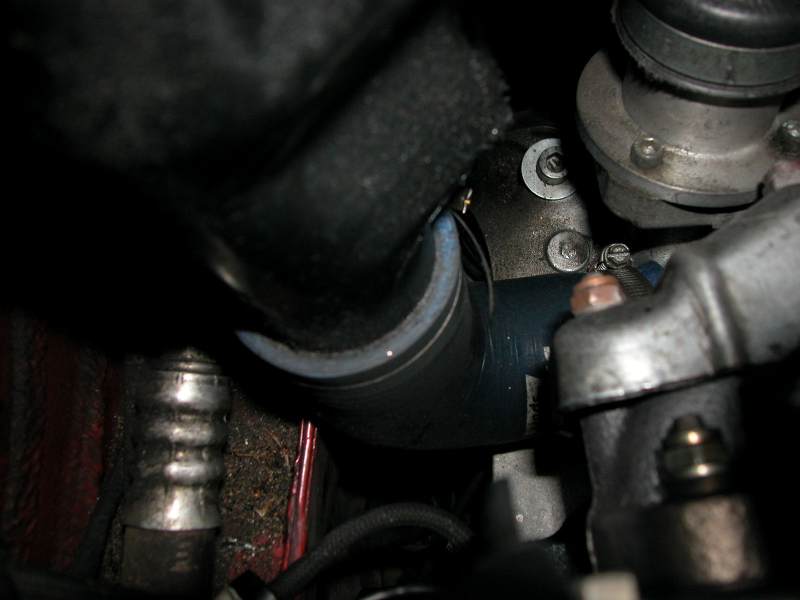
You're familiar with the intake manifold on the G3, and you're also aware of the perforated air filter housing. However, I didn't like the way the intake pipe was positioned directly on the turbo, so I cut it off at a cross-section of approximately 55 mm and used a 90-degree hose to connect it.
The effect was the same as with a sports exhaust muffler or a sports air filter.
No noticeable difference. To be honest, I didn't expect anything different either. But the feeling of knowing that this bottleneck existed, I was able to overcome successfully!
"But I should have measured the pressure conditions with the standard intake system and then measured again. Unfortunately, I missed that opportunity."
Greetings.
Thomas.
| Description: |
| Loader Power Needs Due to Restricted Suction. |
|
| File size: |
66.48 KB |
| Viewed: |
2952 times |
|
-----------------------------------------------------
Golf 3 TDI AFN Bj. 1997 -verkauft
Audi S2 ADU Bj. 1993
Polo 86c 2F 1W Bj. 1994 - verkauft
Audi A3 TDI ASZ Bj. 2001
Translated on 30-09-2026, 8:48.
|
|
| Back to top |
Profile PM |
|
|


 Bookmarks
 Links
Links Garage
 FAQ, Legal Notice & Privacy
 RSS Feed
 Register
 Login
Login
