| Author |
Message |
ulf
Profi-Schrauber

Joined: 04/13/2002
Posts: 11058
Karma: +18 / -0 
Location: Saarland
2023 MG ZS
Premium Support
|
 07-04-2005, 15:32 Subject: TDI Smoking: When Does It Start? 07-04-2005, 15:32 Subject: TDI Smoking: When Does It Start? |
Quote |
|
Hello,
For the theoretically complete combustion of 1 kg of diesel fuel, approximately 14.5 kg of air are required (if my research is correct). However, due to the inhomogeneous mixing and combustion within the engine, this would already produce a significant amount of soot.
To avoid this, our TDIs are factory-equipped with an excess of air (I believe around 20%), which can be adjusted during tuning.
So: no excess air -> a lot of soot.
20% excess air -> no visible soot.
In the context of (chip) tuning and increases in turbocharger boost pressure, I'm interested in knowing at what point the excess air in the exhaust becomes visibly noticeable, to the point where one would spontaneously say, "That car has been tuned or is defective."
I know the question is quite vague, so I'm only looking for rough guidelines. Perhaps separated by VP (venturi pump) and PD (positive displacement), because PDs might be able to run slightly richer (better: less lean) before the smoking starts, thanks to better atomization and a shorter maximum pressure injection time...? Gruß Ulf
_________
MG4 Electric
Translated on 17-10-2026, 5:45.
|
|
| Back to top |
Profile PM Garage |
 |
96kwtdi
Guest
Free account, no CAN development support
|
| 07-04-2005, 15:48 Subject: TDI Smoking: When Does It Start? |
Quote |
|
Hi Ulf!
LiFi is often to blame as well. I'm just saying: 'every 60,000 km' for long-life oil (with just a check in between). Mine needs to be changed every 15,000 km.
Greetings.
Translated on 17-10-2026, 5:47.
|
|
| Back to top |
|
|
dieselmartin
Profi-Schrauber
Joined: 03/13/2003
Posts: 10121
Karma: +29 / -0
Location: in der Werkstatt
2007 Volkswagen Passat
Premium Support
|
| 07-04-2005, 15:50 Subject: TDI Smoking: When Does It Start? |
Quote |
|
Here's a slightly broader question:
Do all TDI engines have 5-hole injectors?
To the best of my knowledge, at least the 1.9-inch versions of the product have 5 holes.
Because the shape of the flame is crucial in relation to the swirl. Cars have long, narrow flames that rotate within the strong swirl, but they should not touch each other, because otherwise, combustion would occur in already burned air, which leads to soot formation.
(For completeness: Trucks have short, rounded exhaust pipes because they produce less swirl.)
m; Transparency, Teamwork
... there was another T.
I don't know what the f*ck it was.
Translated on 17-10-2026, 5:48.
|
|
| Back to top |
Profile PM Garage |
|
joe*
Guest
Free account, no CAN development support
|
| 07-04-2005, 20:47 Subject: SDI vs. [Alternative]: Comparison & Benefits |
Quote |
|
Hi Ulf,
What do you think about the following approach?
A comparative calculation with an SDI (Spatial Data Infrastructure):
It's known to be quite close to the threshold of being visible as Russian.
It must be stated upfront that this should only be considered a VERY rough approximation. Some parameters in an SDI engine are quite different from those in a TDI engine (e.g., charge air temperature vs. intake air temperature).
A comparison with an ALH:
SDI: 50 kW and 1 bar (in reality, slightly less).
ALH: 66 kW and 1.95 bar.
50/1 = 50 kW/Bar
66 / 1.95 = 33.8 kW/Bar
To achieve the same lambda value in an ALH engine as in an SDI engine, one could, according to this calculation, increase the injection quantity by 48%.
Thinking ahead: These 48% could be 'accommodated' within the optimal injection window, which might necessitate the use of larger injectors.
Assuming an ARL:
ARL: 110 kW and 2.5 bar --> 44 kW/bar
So, roughly 14% 'extra reserve'.
Even if these values are inaccurate, they at least indicate that not all TDI engines operate with the same amount of excess air.
VG,
Joe.
Translated on 17-10-2026, 5:51.
|
|
| Back to top |
|
|
ulf
Profi-Schrauber
Joined: 04/13/2002
Posts: 11058
Karma: +18 / -0
Location: Saarland
2023 MG ZS
Premium Support
|
| 07-04-2005, 21:07 Subject: SDI vs. [Andere Technologie]: Comparison |
Quote |
|
joe* wrote: | SDI: 50 kW and 1 bar (in reality, slightly less).
ALH: 66 kW and 1.95 bar.
ARL: 110 kW and 2.5 Bar --> 44 kW/Bar |
. . . although the seemingly high air reserve of the TDIs is reduced again by the increased LLT (Low Temperature Test), but this effect does not occur naturally with the SDI  Gruß Ulf
_________
MG4 Electric
Translated on 17-10-2026, 5:53.
|
|
| Back to top |
Profile PM Garage |
|
faz
Blaumann


Joined: 03/12/2004
Posts: 97
Karma: +7 / -0
1994 Audi 80
Premium Support
|
| 07-04-2005, 23:20 Subject: TDI Smoking: When Does It Start? |
Quote |
|
During the university internship focusing on internal combustion engines, a 2.0L BMW TDI engine M47 with VP44-ESP was also on the test bench.
I got the complete characteristic maps from him, and in some cases, I was even allowed to create them myself by hand, as part of the documentation .
I don't currently have a clean "soot level - global lambda" characteristic curve; I would have to recreate that myself. Also, it also depends on the engine speed. What I can roughly see from the characteristic curves is that the soot level increases dramatically starting around a lambda value of 1.5. The lowest measured lambda value was 1.32 at 1500 RPM under full load. MfG faz
Audi 80 B4 Avant TDi 10/93
Translated on 17-10-2026, 5:55.
|
|
| Back to top |
Profile PM Garage |
|
syncro peter
Guest
Free account, no CAN development support
|
| 07-04-2005, 23:25 Subject: TDI Smoking: When Does It Start? |
Quote |
|
hello
I think a few fixed values would be useful for the next round of speculation.
lambda > 0.7: The mixture becomes ignitable. However, this ignition only occurs in a small diffusion and reaction zone around each individual droplet, which is surrounded by a layer of fuel vapor -> inhomogeneous.
Soot formation occurs under extreme air deficiency, which is caused by the inhomogeneity. The molecules of the diesel fuel break down due to the increasing air deficiency and combustion temperature, releasing hydrogen. The hydrogen then causes the polymerization of carbon-rich molecules, leading to the formation of soot.
For the reasons mentioned above, diesel engines must be operated with a lambda value greater than 1.1, primarily due to the inhomogeneities, both in the air-fuel mixture and in the temperature distribution within the combustion chamber, as previously discussed.
The soot formation tends towards a lambda value of 1, as the richer mixture and inhomogeneity create zones with a richer mixture.
If both NOx and soot emissions are to be avoided, the lambda value should be between 1.6 and 1.7.
To achieve the same lambda value in an ALH engine as in an SDI engine, one could, according to this calculation, increase the injection quantity by 48%.
Which lambda value should be assumed? Where should the 48% be added, and most importantly, when?
Because the shape of the beam is crucial in relation to the spin.
'However, swirl is also bad because it negatively affects the delivery rate, leading to flow losses.'
Furthermore, there's 'tumble,' and the combination of 'drall' and 'tumble,' which is 'tipped.'
The most important factors are 'swirl' and 'squish' (inlet flow at the edge of the piston bowl), which create the spray.
This one, as is well known, runs quite close to the border with visible Russian territory.
Where should it be placed? Would that require a precise value, or am I misunderstanding something?
Translated on 17-10-2026, 5:58.
|
|
| Back to top |
|
|
joe*
Guest
Free account, no CAN development support
|
| 08-04-2005, 0:40 Subject: SDI vs. [Andere Technologie]: Comparison |
Quote |
|
Hi!
... although the seemingly high air reserve of the TDIs is reduced again by the increased LLT (Low Temperature Test), but this effect does not occur naturally with the SDI .
Yep, I wrote that too.
In an SDI engine, some parameters are quite different from those in a TDI engine (e.g., charge air temperature vs. intake air temperature)....
Where should it be located? That would require a precise value, or am I misunderstanding something?
If you only increase the fuel injection amount in an SDI engine, you will very quickly produce a lot of black smoke (as has already been discussed in this forum). From this, I concluded: 'An SDI engine operates close to the limit where visible black smoke becomes apparent.'
which lambda should be used in advance?
The Lambda ratio at which an SDI is operating under full load.
Where are those 48% supposed to come from, especially when?
Do you mean this?
These 48% could be 'accommodated' within the optimal injection window, so possibly larger injectors would be necessary.
In this case, the ALH has 48% more full load capacity. (But as mentioned before, this number is only a rough approximation}, and many factors are neglected!)
Furthermore, larger injectors can worsen the atomization, which tends to promote soot formation... But I didn't really want to go into that much detail.
I understood my comment more as an incentive to highlight the order of magnitude we're talking about. I also wanted to illustrate that, in their standard configuration and under full load, TDIs can have significantly different air excesses, so you can't generalize and say, for example, that a 15% excess always leads to smoking.
VG,
Joe.
Translated on 17-10-2026, 6:03.
|
|
| Back to top |
|
|
faz
Blaumann
Joined: 03/12/2004
Posts: 97
Karma: +7 / -0
1994 Audi 80
Premium Support
|
| 08-04-2005, 7:27 Subject: TDI Smoking: When Does It Start? |
Quote |
|
M47-BMW
Since only the full-load characteristic is of interest here:
1000 RPM, 114.6 Nm torque, soot level 2.1, lambda 1.42.
1500 RPM, 240.7 Nm torque, soot level 2.9, lambda 1.32, compared to a soot level of 1.3 at lambda 1.56.
2000 RPM, 271.2 Nm torque, soot level 2.5, lambda 1.35, compared to a soot level of 0.2 at lambda 1.74.
2500 RPM, 275.0 Nm torque, soot level 2.3 with a lambda value of 1.35, compared to a soot level of 0.3 with a lambda value of 1.73.
3000 RPM, 259.8 Nm torque, soot level 2.8, lambda 1.41, compared to a soot level of 0.8 at lambda 1.82.
3500 RPM, 240.7 Nm torque, soot level 3.0, lambda 1.42, compared to a soot level of 1.2 at lambda 1.82.
4000 RPM, 214.9 Nm torque, soot level 3.6, lambda 1.45, compared to a soot level of 1.6 at lambda 1.83.
As you can see, the soot formation triples rapidly above a lambda value of 1.5.
Here's the translation:
"In addition, please provide the full load curve for the AGR engine from the VAG group."
(taken from Rainer's post in the thread /viewtopic.php?p=12956)
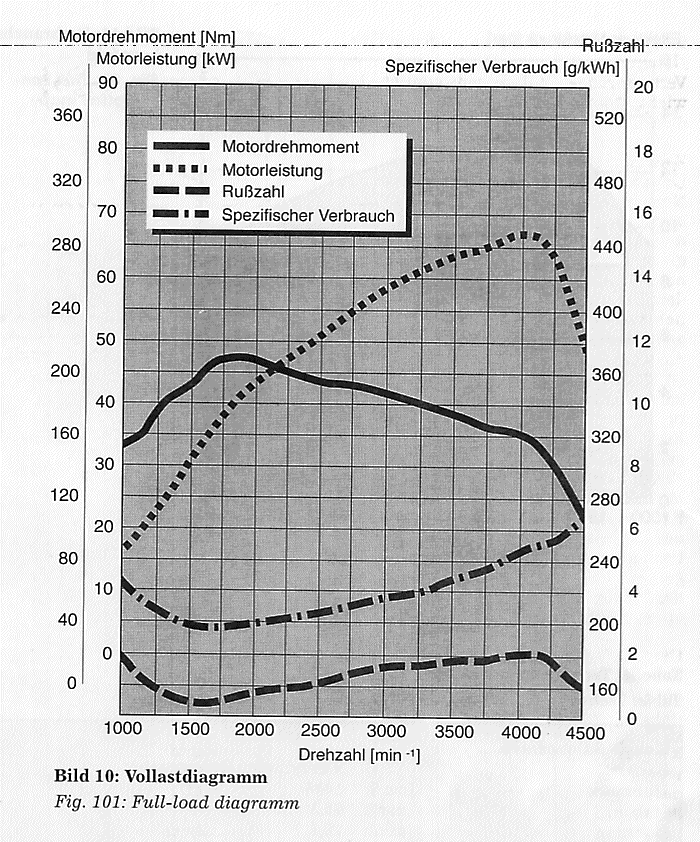 MfG faz
Audi 80 B4 Avant TDi 10/93
Translated on 17-10-2026, 6:08.
|
|
| Back to top |
Profile PM Garage |
|
ulf
Profi-Schrauber
Joined: 04/13/2002
Posts: 11058
Karma: +18 / -0
Location: Saarland
2023 MG ZS
Premium Support
|
| 08-04-2005, 8:16 Subject: TDI Smoking: When Does It Start? |
Quote |
|
faz wrote: | M47-BMW
4000 RPM, 214.9 Nm torque, soot level 3.6, lambda 1.45, compared to a soot level of 1.6 at lambda 1.83.
As you can see, the soot formation triples within a short range above a lambda value of 1.5.
Bitte gib mir den deutschen Text, den du übersetzt haben möchtest.
In addition, please provide the full load curve for the AGR engine from VAG | .
Wow, the BMW has 80% more soot content compared to the AGR with the VP 37.
I'm going to take a look at some TDI datasets tonight and calculate the "highest" lambda values from various original blurring kernels.
I'm assuming that, for example, with 850 mg of air and a permissible injection amount of 48.6 mg, the calculation would proceed as follows:
1. 850 mg of air / 14.5 = 58.6 mg of diesel for Lambda 1.
(where 14.5 is the "stoichiometric mass ratio").
2. 58.6 mg diesel / 48.6 mg diesel = Lambda 1.206
or briefly:
Lambda(Diesel) = Air mass / (Diesel mass * 14.5)
Is that correct?
If not, please post the correct calculation. Gruß Ulf
_________
MG4 Electric
Translated on 17-10-2026, 6:12.
|
|
| Back to top |
Profile PM Garage |
|
syncro peter
Guest
Free account, no CAN development support
|
| 08-04-2005, 9:27 Subject: TDI Smoking: When Does It Start? |
Quote |
|
The Lambda ratio at which an SDI is operating under full load.
Okay, I understand, but what is the numerical value?
(where 14.5 is the 'stoichiometric mass ratio').
If lambda = 14.5, does that simply mean that 14.5 kg of air are required to completely burn 1 kg of fuel?
Okay, so...
--lambda = mluft/mkraftstoff--
The stoichiometric mixture is referred to as lambda = 1.
--Lambda = Ltat / Lmin--
Ltat is the actual amount of air supplied.
Lmin is the minimum amount of air required for complete combustion.
Therefore, that cannot be correct.
58.6 mg diesel / 48.6 mg diesel = Lambda 1.206
If, which is actually incorrect because we are not considering that the formula for lmin includes more factors, then the equation would look like this.
lambda = Ltat / [(14.5 * mkraftstoff) * factor]
Here's something else interesting.
required air conditions.
prechamber, diameter: 1.2
direct injection, small engine: 1.3
with a surcharge of 0.2.
Generally, a pre-chamber engine tends to produce less soot than a direct injection engine, due to its design.
'From this, we can infer...'
Combustion air volume for 1 kg (1 m3) of fuel = lambda * Lmin m3.
interesting topic 
Translated on 17-10-2026, 6:16.
|
|
| Back to top |
|
|
mcgyver2k
Blaumann
Joined: 04/13/2004
Posts: 77
Karma: +8 / -0
Location: Darmstadt
Free account, no CAN development support
|
| 08-04-2005, 9:40 Subject: TDI Smoking: When Does It Start? |
Quote |
|
I don't quite understand that.
I would phrase it like this, as it is also defined:
Lambda = actual air mass / required air mass.
= actual air mass / (fuel injection quantity * 14.5)
= 850mg / (48.6mg * 14.5) = 1.206
--> Ulf's calculation is already correct. He calculated the fuel-to-air ratio instead of the mass air-to-fuel ratio, but even that leads to the correct result. 01er Skoda Fabia Combi ATD
Translated on 17-10-2026, 6:19.
|
|
| Back to top |
Profile PM |
|
syncro peter
Guest
Free account, no CAN development support
|
| 08-04-2005, 10:25 Subject: TDI Smoking: When Does It Start? |
Quote |
|
Ulfs calculation is already correct. He calculated a fuel-to-air ratio instead of a mass air-fuel ratio, but even that leads to the correct result.
You're right.
I've done a little reading on the subject, and in my opinion, the 'air route' is the correct approach.
My thought:
850 mg / 14.5 kg/kg body weight = 58.6 mg.
If I take 48.6 mg now, that would be 17.5 kg per kg.
Okay, so...
850 mg / 17.5 kg body weight = 48.6 mg.
inserted into Ulf's formula; without units.
(850/14.5) / (850/17.5) = 17.5 / 14.5 = 1.2
Okay, it's a crucial point, but I believe it should be phrased in a way that outsiders can easily understand without major problems, and that it aligns with existing literature.
Apart from that, this value is likely too low in reality, otherwise the car would produce a lot of smoke.
Translated on 17-10-2026, 6:21.
|
|
| Back to top |
|
|
rinderwahnsinn
Guest
Free account, no CAN development support
|
| 08-04-2005, 19:48 Subject: TDI Smoking: When Does It Start? |
Quote |
|
Please remember that all the calculations are only for experimental purposes.
In a real engine, things look a bit different. It depends on factors such as the fuel atomization, the boost pressure, the valve timing, the combustion chamber shape, the engine speed, the engine load, and a few other things.
The air-fuel mixture has a significant impact on the engine's performance. Ultimately, you only get a definitive result through experimentation. The air-fuel ratio is different for each engine type and is difficult to calculate precisely in advance.
You can see how difficult this is by looking at vehicles with chip tuning.
With the same increase in performance, a vehicle will work properly with tuner A, but not with tuner B.
CU.
Translated on 17-10-2026, 6:23.
|
|
| Back to top |
|
|
SeatArosa1.7SDI
Guest
Free account, no CAN development support
|
| 08-04-2005, 22:06 Subject: TDI Smoking: When Does It Start? |
Quote |
|
A comparative calculation with an SDI:
It's known to be quite close to the border with visible Russian territory.
Consequently, the sudden surge of soot caused by turbo lag is eliminated.
Translated on 17-10-2026, 6:24.
|
|
| Back to top |
|
|
guste100
Profi-Schrauber

Joined: 07/27/2004
Posts: 2403
Karma: +441 / -0
Location: Mitte Schleswig Holsteins
2007 Volkswagen Passat
Premium Support
|
| 09-04-2005, 2:02 Subject: TDI Smoking: When Does It Start? |
Quote |
|
SeatArosa1.7SDI wrote: | | As a result of turbo lag, the acceleration surge is eliminated. |
It was actually quite predictable that such a comment would come from you, given your reputation as a hardcore hater.
For the sake of accuracy, I would like to point out that a "sudden surge of black smoke due to turbo lag" cannot occur in a properly functioning TDI engine. (Keyword: Mass Air Flow Sensor). The reason it is often seen is simply due to many turbo engines that are not 100% correctly tuned (e.g., cheap modifications), or other modifications (e.g., a diode instead of a Mass Air Flow Sensor).
Regards,
Sure, here's the translation:
"Guste" is a German word that means "gust" or "gust of wind." It can also be used to describe a sudden burst of something, such as laughter or anger.
Translated on 17-10-2026, 6:25.
|
|
| Back to top |
Profile PM Garage |
|
|


 Bookmarks
 Links
Links Garage
 FAQ, Legal Notice & Privacy
 RSS Feed
 Register
 Login
Login


