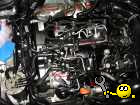
It took some time, but the problem is solved! The patient is walking again!

I don't want to end this topic without a summary, as it will certainly be helpful for those who experience something similar!

After dealing with the problem of a particle filter and extremely increasing soot levels, constant regenerations, and exorbitant pressure differences at the DPF for quite some time, everything is now back to normal.
No debugging without learning, I'm smarter now!
It's not always the particulate filter that's to blame when regeneration cycles are triggered too frequently. The differential pressure sensor actually only measures the back pressure in the entire exhaust system. The control unit assigns a soot load value to the differential pressure and, depending on the resulting soot mass, initiates one of the three DPF regeneration cycles.
First of all, field regeneration:
This process is initiated when the soot mass reaches 22.53 grams. If the vehicle is turned off in the meantime, the regeneration process starts immediately upon restarting. By increasing fuel consumption, high exhaust temperatures are generated within a few meters/minutes, allowing the soot to be burned.
If you frequently turn off the engine during short trips, you will quickly reach the next regeneration phase.
Secondly, service regeneration:
This is activated when the soot mass reaches 40 grams. If the regeneration process is interrupted too frequently, the DPF light will illuminate, and the driver will be prompted to take a regeneration trip according to the owner's manual.
Thirdly, we have forced regeneration.
If the soot mass exceeds 50g, the DPF is considered overloaded. In this case, the engine control unit will no longer initiate a regeneration process. At that point, only VCDS (a diagnostic tool) and a fire extinguisher nearby can help.
In my case, I assumed that the DPF was simply full and worn out after 200,000 km. Therefore, it was replaced with a remanufactured unit. However, the subsequent test drive did not yield any better soot loading values. Within 10 minutes of driving at a moderate speed, the soot loading increased from 6.96g to 24.90g. A regeneration cycle was initiated, but the soot loading values still increased dramatically. This, of course, also caused the exhaust gas temperatures to rise due to the post-injection activated by the engine control unit. The amount of soot burned off was not proportional to the increase in soot, so I would have seen the DPF light again in a very short time with the new DPF.
Please note that the engine did not excessively produce soot in any driving situation; the high differential pressure only gave the control unit a false indication of soot buildup, and it also fooled me!

Since I didn't believe the new particulate filter could already be clogged, I disconnected the subsequent SCR catalyst from the DPF. And the result was clear: the differential pressure was within normal limits.
It was only during this phase that I heard the SCR cat ringing, as if the ceramic material inside was loose within the casing.
After I took it apart, it was clear what the problem was; the attached image shows what I found.
I found a company that offers refurbished SCR catalytic converters, and I found a suitable one there. A new part was also not an option for me, as I prefer repairs that are appropriate for the age of the vehicle.
A phone call with the boss was very helpful, as he was able to explain the background of the damaged ceramic material to me. His explanations make sense to me, and I'm sharing them here without claiming any scientific accuracy.
"The injected AdBlue can crystallize in certain operating conditions and deposit in the cavities of the ceramic material. These crystals then act like tiny files under the exhaust pressure, which can damage the ceramic over time. The mileage of your engine, 200,000 km, is already at the limit for the SCR catalyst!"
Regarding the EA189 emissions issue and the corresponding software modification, everything seems to make sense. The amount of AdBlue injected was approximately doubled by VW, without any changes to the hardware.
After investing 1300 euros in the DPF and SCR catalytic converter, the values are back within the normal range, and the car is running well again.
The amount of soot produced now increases by 8 grams for every hour of driving over 100 kilometers, combining city and highway driving. This seems like a moderate value to me, and I can easily live with it. I'm including a corresponding log for reference.
Note: High differential pressure values are not always caused by a faulty DPF! The entire exhaust system should be checked for proper flow as a precaution.
Regards,
Ralf.
Für mich gibt es keine Alternative...
VW Tiguan 5N 2,0 TDI 4Motion mit DSG
(125TKM)
Motorcode: CFGC /Bj.2014
VW Sharan 7N 2.0 TDI mit DSG
(254TKM)
Motorcode: CFFB /Bj. 2014


 Bookmarks
 Links
Links Garage
 FAQ, Legal Notice & Privacy
 RSS Feed
 Register
 Login
Login



 I found the invoice in the old documents.