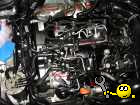
I checked the ventilation pipes yesterday, and they are all clear.
Today, I'm going to machine an adapter block with fittings for the hoses and screw in a nipple for my pressure testing device. Then, on Friday, I'll pressure test the heater core, the LLK (likely a coolant reservoir), and the AGR cooler. The AGR cooler is new, but I've had enough defective new parts before, so I'm going to do it like Kim Jong Un: trust is good, but verification is better. Control is better.
I suspect it's the intercooler, especially when it gets warm. The entire system was sealed overnight, so if I can't find any obvious leaks, I'll warm up the engine and then individually pressurize the intercooler to keep it warm for as long as possible. I might even sit next to it for an hour and direct a heat gun at it, set to 80°C, while covering any sensitive components. Afterwards, I'll wrap it in insulation and let it sit for 4-5 hours. Just in case, I'd like to keep it warm for as long as possible, if my assumption is correct.
Yes, I have the SSP, but I think it's model number 526.
But regardless, I already got everything from Erwon and printed it out. I was aware that Euro6 engines have their own quirks, and I followed the instructions strictly.
Yesterday, I checked all the vent lines and was able to blow air through them without any resistance, and also draw water from each component.
If something is clogged, then it might be the coolant regulator.
Pumps run and also pump.
Therefore, I will remove the components one by one. In the case of the EGR cooler and the intercooler, I will probably remove the glow plugs and turn the engine by hand two revolutions to avoid any coolant entering the combustion chamber, especially through the intercooler, which is located directly in front of the intake manifold.
When replacing the AGR cooler, I will also disconnect the exhaust pipes and check if they are dry.
If all of this doesn't lead to a result, I will pressure test the cooling circuit one component at a time and endoscope the combustion chamber. Nothing found?
Okay, I'll drain the oil block, check the combustion chamber again, filter the brand new oil through a sieve into a new container, and replace the oil filter again.
It's not that water is accumulating there.
Step by step, that's the way.
If something is so complicated, then you have to break it down into smaller, manageable pieces in order to get a complete picture.
Best regards,
IMG_20211214_141949.jpg
Description:
Von denen hab ich 2 gemacht, bei 6 bar 2 Stunden geprüft ob sie dicht sind.
So kann ich AGR Kühler und Heizungswärmetauscher gleichzeitig prüfen.
Für den LLK benutze ich ein T Stück mit Nippel für das Abdrückgerät. Damit hab ich 3 einzelne Komponenten auf einen Streich über Nacht.
So, I still feel like I have a fresh start every day, and even the next morning, I still feel a sense of pressure or urgency.
"For one day, I had no symptoms, no air, and the next morning, I still felt no pressure."
"What I've noticed is that when I open the coolant reservoir cap and it reaches the point where the hissing starts, I first hear a popping sound, and then water/air starts spraying out through the vent hole."
So, that's what he's actually supposed to do in the company when the pressure gets too high.
Is there perhaps more to this than meets the eye?
Of course, I also can't get all the air out of the system during the bleeding process if the pressure becomes so high that it starts drawing air back into the container.
Sure, here's the translation:
"lg" is a German abbreviation that stands for "liebe Grüße," which translates to "best regards" or "warm greetings" in English.
So, I still have plenty of energy every day, and even the next morning, I still feel pressure in the system.
If there is still pressure in the system even when the engine is cold, it means that exhaust gases or turbocharger air are entering the coolant. There's no other way; you wouldn't have filled it with sparkling mineral water (containing dissolved CO2).
Was the coolant replaced along with the ZK (likely referring to a component), or was it reused? If it was reused, it's possible that CO2 dissolved in the water from a previous leak. However, it is questionable in what quantities and whether something like that would be relevant.
Hello, I would first like to inspect the cylinder head with an endoscope. Perhaps something went wrong during the replacement. Otherwise, the heat exchanger needs to be replaced. If you've already found dirt in the coolant, the heat exchanger has likely accumulated quite a bit. Possibly, the temperature (evaporation) in this area is too high due to insufficient circulation.
For informational purposes: The intercooler will be tested at the specialized workshop with a hot engine. To do this, pressurize the intercooler system with 0.5 bar (using an air connection with a regulator) and connect a pressure gauge to the expansion tank. If the pressure in the coolant then increases, the intercooler is leaking. The pressure usually decreases, as the coolant slowly cools down.
AGR coolers: the same procedure applies, but with a pressure of 0.5 bar applied to the exhaust side (ideally using a double clamp).
To ensure safety, depressurize the expansion tank cap; it should open at a pressure between 1.4 and 1.6 bar.
Is the container discolored, or is it clear and clean?
Only fresh water was used during the change.
Currently, no CO is detectable, not even when I draw in the "overpressure gases." I suspect it's the LLK (likely referring to a specific fluid or substance), and I'm going to drain it overnight on Friday.
I've also noticed that when the system is freshly bled, and I then drive only 1 km and stop, there's so much air in the system that I would definitely feel it at the cylinder head/gasket, because the damage would no longer be minimal.
Therefore, I'm more inclined to think it's either a coolant leak or that a defective new EGR cooler was installed.
Thanks for the tip, I'll have to see how to do that.
I was planning to use my two custom-built devices to pressure test the AGR cooler and the intercooler separately to see if they can hold pressure.
"For your method, I would need to fabricate some parts again, like O-rings and, as you mentioned, a double clamp." But I will not give up trying.
The expansion tank was clean, but it currently has some old oil residue in it. This is because when I removed the cylinder head, some oil leaked into the coolant channel hole in the block, and I didn't notice it at the time.
I had already flushed the system before removing the old cylinder head, as I had found a coolant leak.
Anyway, the coolant isn't cloudy or anything like that. I've also checked to see if there's any dirt in the system and installed a filter in the return line – but I couldn't find anything. Things are also looking good in the area of agricultural policy.
The new expansion tank is already here; I just need to get a new lid, as I'm not really confident in the current one. Pure gut feeling.
I will perform an endoscopic inspection of the cylinder head if the inspection of the heat exchanger/AGR cooler/coolant reservoir does not reveal any issues.
Before performing the endoscopy, pressurize the engine with 1.5 bar while it's still warm, let it cool down, and then inspect all 4 cylinders.
If nothing is found there either, the head will be pressure-tested individually, without a thermostat, at 2.5 bar, and then re-examined endoscopically.
By the way, I had the new cylinder head pressure-tested by the engine builder before installing it.
Eventually, all that would be left is the block itself... then I'd just puke on the beam!
"Significant pressure loss in the intercooler."
"Video attached, and the noise is clearly audible. For the video, I've added a compressor (pressure reducer at 1.8 bar) so that the hissing sound can be heard for a sufficient duration."
Seat Leon St 5F DSG -184PS CUNA Kühlwasser-Mysterium | Posts 16+ - VID_20211216_135913(0).mp4
LLK severely leaking - losing 0.5 bar of pressure in 3 minutes in the COLD state.
AGR cooler, no pressure loss after 6 hours.
Indoor heat exchanger, no pressure loss after 6 hours.
+ Full heat output from every nozzle
+ Very good flow rate
+ No dirt particles (I rinsed it for 2 hours this morning using an Eheim 1250 with a pre-filter).
Conclusion:
Install the new LLK (likely referring to a liquid cooling component) and then pressure test the entire system overnight.
Then, completely refill with vacuum + x venting routine.
Ideally, I'll have news for you here in the forum on Sunday, but if not, you can read about it in the Sunday newspaper.
"Naked protester demonstrates against Euro 6 diesel technology on a Lanz tractor in Wolfsburg."
Actually, it's not that complicated; the venting procedure is clearly defined.
The realization that the pressure in the cooling system continued to increase after your engine overhaul came a bit late and unexpectedly. Initially, you yourself had tested the intercooler and found it to be leak-free. And speaking of ***, you were already involved in swapping, weren't you...?
hg
Herbert.
Horch A4 8K CJCD
Golf 7 DDYA
(+ Audi 80 Avant B4 1Z 475Tkm - habe ich vom ersten bis zum letzten Tag gerne gefahren)
(+ Passat Variant 32B CY 400Tkm)
Yes, but someone like me has to look those up on Google first. They're not really integrated into VCDS; it only includes the individual tests.
Similarly, I only found information in American forums stating that a value of 4 must be entered during the bleeding of the low-pressure circuit, and that the engine must be off during this process.
It would be great if we could find this information somewhere in a German forum.
You mostly only find small pieces of information, one thread at a time.
There can be various causes, and you might not even think of them right away.
While Erwin (siehe Fehlerdatenbank) offers some information, not everyone has access to all the VW-specific tools, and even then, you can't definitively say "yes, that's the part" without disassembling it and taking a closer look.
I think this will be helpful to the average user.
Yes, that was a really strange thing.
Initially, I also pressure-tested the entire system, and there were no leaks, possibly due to the sealant used on the cooler.
Who knows.
Okay, another status update.
Faulty LLK replaced - problem solved.
Another problem is still the error code P0011 - camshaft timing not achieved, bank 1, intake.
I still have the old camshaft adjuster housing and the valve.
I just ordered a control valve with part number 03l 906 455C.
"I would like to order a housing with part number 03l109096B and have it installed."
The valve simply doesn't fit; it can't even pass through the adjuster itself. Do I need to replace this one too?
The new valve is slightly thicker, which is why it doesn't fit through the opening in the adjuster.
I hope someone knows more.
I've now reinstalled the old part, and cleaned it thoroughly beforehand, but the problem unfortunately persists, even though the valve is completely unobstructed.
Sure, here's the translation:
I'm new here and wanted to share my diagnosis after searching for a long time and checking everything possible, including replacing the cylinder head (the old head had a crack between the valves), and still having pressure in the cooling system. In my case, the AGR cooler (still the first generation, with part number 04L 131 512L) was leaking.
I replaced it with a new generation part (04L 132 512 BQ).


 Bookmarks
 Links
Links Garage
 FAQ, Legal Notice & Privacy
 RSS Feed
 Register
 Login
Login