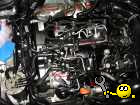
Dear diesel mechanics,
I would like to ask for your support.
Even though I'm not an expert, I've been reading articles and threads for years, and the "Dieselschrauber" website has often been helpful (for example, understanding the vacuum system).
Three years ago, I bought a Bora 4motion with an ARL engine, after missing my Golf with the ASZ engine so much. At that time, the Bora had 209,000 kilometers on the odometer.
The engine was running very well, and the car was faster on the highway than my chipped ASZ engine.
Then, eventually, the well-known problem with the camshaft arose. Operation 1 followed.
Since the loader was already quite noisy, the new one arrived (like the NW), and I had the PDEs (presumably referring to some component) refurbished (or at least, I thought I did).
After that, the performance was no longer the same as before, with a much higher fuel consumption (always over 8.5 liters), and the responsiveness was poor (power delivery started around 2200 RPM).
Then, the following happened (seriously - no joke).
Because the particulate filters (PDEs) were not properly maintained but rather damaged, the turbocharger was not original and was actually intended for a different model (ASZ), and the catalytic converter (NW) had already failed after only 1000 km, the following repair (Operation 2) was necessary at approximately 235,000 km.
Engine overhaul, new original starter, PDEs (presumably referring to some component) were properly repaired at Bosch, and this time with accompanying test reports.
Many problems disappeared (for example, the excessive fuel consumption). I'm still looking for the last few horsepower. The car doesn't really reach its top speed; it now runs noticeably worse than my old ASZ engine, and it feels "restricted" at higher RPMs. I notice a kind of slurping sound under load, in the RPM range where the full boost pressure should be.
"Recently replaced: the three solenoid valves have been changed, the check valve behind the tandem pump, and a new Bosch mass airflow sensor was also installed." New pressure hoses, including the red one and the one for the intake manifold, should also be replaced.
Now I have a very good response time.
The lack of performance persists.
I have three questions.
The red hose that runs from the turbo to the pancake pipe originally had a reduced diameter. The replacement hose from Gates does not have this reduction. What does this mean? Is this a problem? The noise described above has become louder since it was installed.
I have created, processed, and attached a log file (MWB 3, 8, 11) and would like to know if it can be used for anything and if there is anything unusual about it (Does the "actual LD" value in the last line correspond to atmospheric pressure?).
"I found a leak yesterday. While pressurizing the LL line, I discovered a small leak (at a point that was "sealed" with heat shrink tubing, specifically where the pancake tube connects to the pressure hose for the LLK). Within 30-40 seconds, the pressure dropped from 1.7 bar to zero." It only hissed quietly, and the pressure could be kept relatively low on the compressor side (by reducing the pressure to 1.7 bar) without it immediately restarting (50-liter storage tank).
Is it true, as a friend from the automotive industry told me, that the charger can compensate for a small leak?
Or, perhaps looking at the log file, can I assume that the problem lies here?
Thank you in advance for reading through this and providing your expert opinion.
While minor leaks are generally not critical in terms of performance or fuel consumption, they can lead to oil stains, increased fuel consumption, and a loss of horsepower.
Please upload your log file again.
For me, the question is why the actual boost pressure is achieved so late. Normally, at this engine speed, the ARL (air-to-water cooler) should produce a significant boost overshoot (absolute pressure of 2600-2700 mbar, which is 1.6-1.7 bar of overpressure).
First, I would check the boost pressure hose connecting to the vacuum sensor on the turbocharger, possibly. Perform actuator tests in the engine control unit.
It actually looks good; the boost overshot is there, just 200 RPM earlier.
I would say the boost pressure control is okay, and the amount of air being lost due to the leak shouldn't be excessive, and the mass airflow sensor is also providing the necessary fuel injection amount.
There are still some minor things to take care of. Seal the leak. Check the synchronization angle of the camshaft. Are the PD elements installed correctly?
Adjusting injector elements
Simple things like not replacing diesel filters, etc. It's particularly noticeable at maximum speed because a large amount of power needs to flow for an extended period.
Don't forget that the ASZ engine has an injection volume of 47mg/stroke at 4000rpm, while the ARL has 54mg/stroke.
Maximum torque is as good as, or even better than. You don't really notice much when you're driving.
NW was checked and corrected by my workshop.
Regarding the PDEs, I initially assumed that Bosch was the last company to have done a proper job on them.
I checked the hose to the VTG (Variable Turbine Geometry) today, and it's leak-free.
When I measured the vacuum pressure of the tandem pump, it was clear that something was wrong. It was 0.3 bar.
A hose connection was open.
Now it drives much better. I then logged the instantaneous power consumption (MWB) again in third and fourth gear.
The vacuum pressure during the VTG inspection is now twice as high as before (200 instead of 100 mbar).
Once I have the parts, I will fix the leak in the intercooler system and have the pressure boost from the tandem pump measured. Can you tell me the correct value for that? I came across a value of 7.5 bar while searching.
What remains is the strange slurping sound, which seems to be coming from the charging device.
As I mentioned, based on your measurements, everything looks good. The issue is that there's no actual value for the injection quantity, so as you've already noted, you should check the pressure of the tandem pump and, of course, the basics like the diesel filter.
I don't have a specific value for the pressure boost provided by the tandem pump, but you can either ask Erwin (siehe Fehlerdatenbank) or search within this forum.
In the early days, the settings for the PD elements varied, initially being 270 degrees "behind" the "maximum lifting position," and later being adjusted to 180 degrees. The latter makes sense, but you need to carefully configure it and take your time.
This setting has a direct impact on the actual diesel injection volume of the common rail injectors.
Good evening.
Today, I have a video upload scheduled.
The video isn't that exciting, but the audio track accurately reproduces the sound that's puzzling me.
Rainer, perhaps you or another reader have a suspicion?
Best regards.
Martin.
Power shortage in ARL engine - V_20231030_183812_ES0.mp4
Clearly, there's a leak in the charge air cooler system.
Look for oily spots on the intake manifolds and hoses, and on the intercooler (since the crankcase ventilation system connects to the intake manifold, it's normal to see some oil in the hoses).
I've already found a leak (including an oil drip). One of the common connection points between the transition pancake pipe and the hose before the LLK (likely referring to a specific agricultural machine or component).
I hope this isn't a silly question.
I bled the LL line from the pump to the AGR pipe.
Could there still be a leak somewhere else in the system? Can I still get a ticket for that route?
Okay, the entire intake path must be airtight, from the turbocharger to the cylinder head.
It's also possible that the exhaust manifold or an EGR pipe (on the exhaust side) is leaking, which can be identified by black, sooty deposits in those areas. However, this is probably quite rare in the context of ARL (presumably referring to a specific technology or system), as there isn't much that can leak.
Common issues also include leaks at the liquid cooling system (LCS) connections at the crimped joints, which can be difficult to detect. Please do not use a high-pressure washer on the radiator/cooling system. The aluminum fins will bend, and the cooling performance will be poor afterward.


 Bookmarks
 Links
Links Garage
 FAQ, Legal Notice & Privacy
 RSS Feed
 Register
 Login
Login