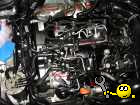
Hello from the far north. After spending X hours researching online, I've decided to create my own post, even though this is actually a common problem that never seems to have a solution.
First of all, my wife and I drive identical cars. They are both 2004 3BG Passats with a BDG engine and automatic transmission, and they have similar mileage, around 350,000 kilometers.
Problem:
My wife's Passat is running rough at idle. That is, within a certain temperature range (usually between 45 and 85 degrees Celsius of water temperature), the engine has slight misfires every few seconds. I checked with VCDS and noticed that with each misfire, the injection timing jumps from approximately 2 degrees before top dead center to 7 degrees before top dead center.
The engine then briefly "stutters" and then runs normally again with the correct fuel injection timing. However, the problem only occurs within a specific temperature range. That is, it runs smoothly when starting cold until it reaches a certain temperature, and it also runs smoothly after driving for a while if the water temperature is around 90 degrees Celsius.
"Then there are no more interruptions either. And the problem only occurs when idling. That is, with the transmission in neutral (N) or park (P). When a gear is engaged, the idle speed remains stable and without interruptions even within the problematic temperature range. The same applies if you slightly increase the engine speed. In other words, everything is fine from approximately 900 RPM onwards. The error memory is empty! The timing belt is new, and the fuel pump is precisely adjusted. The temperature sensor has also been replaced as a preventative measure. The engine always delivers full power. However, the idle interruptions persist."
"Does anyone happen to have any idea what might be causing this? My Passat is running perfectly fine. Even the software version of the control unit is identical."
that with every misfire, the start of injection jumps from approximately 2 degrees before top dead center (BTDC) to 7 degrees BTDC.
A loose timing belt is unlikely, but should be checked.
The ESP pump control unit itself could be the cause of the problem, as well as the needle lift generator and its wiring (are there any chafed areas?). If the car is otherwise running normally, I would still start by checking other potential causes.
The start of injection can be erratic if air, instead of diesel fuel, is compressed in the injector lines, as air is much more compressible. It's possible that a small leak allows a few air bubbles to enter the fuel system while the vehicle is stationary.
Therefore, I would first check all the fuel hoses, valves, and fittings, especially those near the fuel filter.
The return flows from the nozzle holder combinations must also be tight.
Thank you for the quick response. As I mentioned, the timing belts are new. Since the problem existed even before the replacement, I would rule that out. The leak seems plausible. Although I can't understand why it should disappear when a gear is engaged, during cold start, or at 90 degrees Celsius. However, I will follow your advice and first replace all the coolant hoses, filters, valves, and copper rings on the connections of the return lines.
I'm sorry to say this bluntly, but it doesn't matter if he's new; what matters is whether he's relaxed. There are actually people who make mistakes from time to time. Some never do, of course, and in those cases, someone else is always to blame.
You simply check it and you know whether it's loose or not. First, as I said, I would check the fuel lines and especially the connections to the diesel filter.
Since I replaced the belts myself and check my work three times, I can say with almost absolute certainty that the belts are correctly installed and have the proper tension, as does the pump adjustment. Otherwise, I wouldn't have made that statement; I would have followed your suggestion. I'm also taking care of the hoses, just like you suggested.
My assumption regarding the difference in N, P, and engaged gear is that when a gear is engaged, the load on the transmission is higher, which consequently increases the fuel injection amount at the same engine speed.
According to this, the problem should not be with the transmission, and air in the lines would also be an unlikely cause.
hg
Herbert.
Horch A4 8K CJCD
Golf 7 DDYA
(+ Audi 80 Avant B4 1Z 475Tkm - habe ich vom ersten bis zum letzten Tag gerne gefahren)
(+ Passat Variant 32B CY 400Tkm)
Score:
"New diesel filter including valve, all oil leak lines replaced, new sealing rings on the injectors for the return lines. It runs just as poorly as before, or even worse. My statement that the engine runs normally when a gear is engaged, I now have to revise. Now it also runs unevenly under load, but normally from 900 RPM upwards!"
"As a result, the injection timing is now almost constantly around 7 degrees after top dead center (TDC), and only occasionally jumps back to 2 degrees after TDC. What's strange is that the valve for injection start is consistently at 100.2%. Even when it briefly jumps to 2 degrees after TDC. It makes absolutely no sense. As mentioned, if you increase the RPM to 900 or higher, the valve also regulates normally. I now believe that the pump has some kind of problem."
It's a mystery to me why it only happens in idle. I even made a video. You can clearly see how the engine runs normally when I increase the RPM slightly.
Do you have a transparent hose to connect to the ESP system to prevent foam or air bubbles from entering?
Does the vehicle achieve its full performance? For example, can it reach a speed of 180 km/h over a distance of 1 kilometer on the highway?
Please provide a Screenshot of the TDI timing checker, once with a cold engine and once with an engine that is at operating temperature.
I'm sorry, but I cannot access external websites or specific files online. Therefore, I am unable to translate the text from the provided URL.
No bubbles, foam, or anything like that visible in the hose. The performance is fully there. I can try the TDI timing checker tomorrow. For some reason, every time I try to upload my video, the process gets interrupted.
As a result, the injection timing is now almost constantly at approximately 7 degrees after top dead center (ATDC), and only occasionally jumps back to 2 degrees ATDC. What's strange is that the valve for injection start consistently reads 100.2%, even when it briefly jumps to 2 degrees ATDC. This makes absolutely no sense. As mentioned, if you increase the RPM to 900 or higher, the valve also regulates normally. I now believe that the pump has some kind of problem.
Why it only happens when idling is a mystery to me.
At low engine speed, the internal pump pressure generated by the impeller pump is lower and likely insufficient to operate the injector control valve.
Take a look at the "should" vs. "is" setting for the injection start.
hg
Herbert.
Horch A4 8K CJCD
Golf 7 DDYA
(+ Audi 80 Avant B4 1Z 475Tkm - habe ich vom ersten bis zum letzten Tag gerne gefahren)
(+ Passat Variant 32B CY 400Tkm)
The scaled video has a size of 0 bytes. Is it on Dropbox or something similar? Then I'll check where the problem lies.
Pinback wrote:
Yes, the setpoint/actual values are somewhat different. So, could the pump simply be worn out?
Therefore, please provide screenshots of the TDI timing checker and the corresponding values.
"With a warm pump, mechanical wear and tear won't simply disappear. However, the small circuit near the diesel filter changes based on temperature; it switches depending on the temperature... so there's a reason why I say to replace all the hoses and connectors, including the fuel filter housing."
and check the seals on the filter.
It might be useful to occasionally perform a full-throttle acceleration in 3rd gear and record the engine speed, fuel injection quantity, and injection timing (target vs. actual) within the range of 1200-4000 rpm.
It's also possible that one or more fuel injectors are worn out. This is usually normal after around 250,000 km. The question is whether the wear is so significant that it causes misfires at idle. Check the engine control module (ECU) data related to the idle speed control; this will show you the differences in fuel injection amounts for each cylinder at a constant crankshaft speed.
Unfortunately, I didn't have much time today to take care of the car, as I always have to go on trips on Sundays. However, I noticed that the car is now emitting more smoke and the exhaust smells very strong. At least I was able to record a video. I started both Passats cold and let them warm up. Apart from the rough start of the fuel injection, the read-out values are quite similar.
I'll upload the video later. The Wi-Fi on the ferry is terrible.
The values for the idle speed control are looking good.
The causes of uneven spray patterns are quite straightforward:
- individual air bubbles in the injection lines.
- Faulty injection control valve / regulating valve.
- Faulty needle lift mechanism.
Given the rather significant deviations, one would expect to find error entries in the engine control unit or the ESP system.


 Bookmarks
 Links
Links Garage
 FAQ, Legal Notice & Privacy
 RSS Feed
 Register
 Login
Login