
| Diesel, Engine Technology and Vehicle Technology. Repair, Maintenance and Diagnostics (OBD). |
TDI Technology: Basic Principles Explained (Articles) |
|
|
| 🔗 ⭐ 🖨 |
| TDI Technology: Basic Principles Explained | |||||||||||||||||||||||
|---|---|---|---|---|---|---|---|---|---|---|---|---|---|---|---|---|---|---|---|---|---|---|---|
ulf  04-03-2005, 17:58 04-03-2005, 17:58 |
|||||||||||||||||||||||
The fundamental idea behind TDI (Turbocharged Direct Injection) was to optimize gasoline engine performance, fuel consumption, and emissions by incorporating electronic control systems into diesel engines that traditionally used distributor injection pumps.
Initially, this led to the development of the TDI family, starting with the VP 37, which was based on proven mechanical distributor injection pumps. In the VP 37, components such as the throttle linkage, speed selector lever, centrifugal governor, cold start accelerator, load-dependent full-load limiter, and all other mechanical systems for moving the control slide are replaced by electronic controls managed by the engine control unit (ECU) and the mass airflow sensor. For more details on this, please refer to https://community.dieselschrauber.org/en/viewtopic.php?t=3066. The injection adjustment, which depends on the internal pressure of the pump, is fine-tuned by an electric injection control valve, which also enables a quantity-dependent start of injection. For more details on this, please refer to TDI principle. The electronics even allow for compensation of the diesel temperature: The warmer the diesel, the lower its density, which would lead to a loss of power if the injection volume remains unchanged. Using a diesel temperature sensor located in the pump (or, in common rail systems, in the return line to the tank), whose signal is evaluated by the engine control unit (ECU), performance deviations caused by sealing issues are compensated for by adjusting the injection duration accordingly. Regarding the fuel injectors, direct injection engines (unlike indirect injection diesel engines) require a pre-injection of a small amount of diesel fuel so that the main amount can combust with acceptable noise levels and running smoothness. This is achieved through a new design of the injector nozzles, specifically "dual spring" nozzle holder combinations. Since the engine control unit (ECU) requires precise information about the crankshaft speed and position for its control functions, an inductive sensor scans a toothed wheel attached to the crankshaft. Using this information, the ECU, together with the fuel injection system, simulates a refined centrifugal governor and implements features such as the diesel-typical power limitation above approximately 4000 rpm. The speed measurement is so precise that it can even capture the accelerations during working cycles and the delays caused by compressions. "This allows for the detection of speed differences between the working strokes of individual cylinders. The results are then used by the software components responsible for idle stabilization in the engine control unit (ECU) to adjust the fuel injection quantity for each cylinder, ensuring the smoothest possible overall engine operation." Besides the injection quantity, the engine control unit (MSG) also regulates/controls/switches the start of injection, exhaust gas recirculation, (for more details on this, see https://community.dieselschrauber.org/en/viewtopic.php?t=3095),). the boost pressure (for more details on this, see https://community.dieselschrauber.org/en/viewtopic.php?t=3101), and depending on the engine type, other actuators around the engine such as the bypass valve, radiator fan after-run, etc.). While driving, the electric throttle position sensor sends the driver's desired fuel injection amount to the engine control unit (ECU). The ECU first determines, based on the programmed boost pressure map, what boost pressure is required to combust the desired amount of fuel "cleanly" within the respective emission class. It then begins to adjust the boost pressure to the corresponding value. At the same time, the engine control unit (ECU) calculates the actual amount of fresh air entering the cylinders based on the signal from the mass airflow sensor (MAF), the engine speed, and other correction factors. The so-called "smoke map" determines, for each engine speed and air mass per intake stroke, the maximum amount of fuel that can be injected and combusted without exceeding the respective emission limits (this maximum amount is also referred to as the soot limit). In some TDI engines, the soot reduction system is calculated based on the current boost pressure (instead of the mass airflow sensor signal). In any case, the engine control unit (ECU) compares this soot limit with the aforementioned driver demand and torque limitation (which specifies the maximum injection quantity for each speed at which no mechanical overload of the powertrain occurs). It then determines the actual amount to be injected based on the lowest value of these three limitations. When the soot reduction system is active, insufficient fresh air enters the cylinders, preventing the desired fuel injection amount (as requested by the driver or the maximum amount allowed by the torque limiter) from burning cleanly and without producing soot. The most common causes for this operating condition are insufficient boost pressure (especially at low RPM or during the ramp-up to the target value) or a faulty mass airflow sensor (MAF), which reports too little air despite sufficient cylinder filling. For more details on this, see https://community.dieselschrauber.org/en/viewtopic.php?t=3347 - unless the soot limit is calculated based on the boost pressure. Sometimes, the air mass value displayed in the measurement block for the EGR system can cause confusion. It typically delivers 850 mg/stroke at full throttle, but this value is not always reached, especially in the case of VP-TDIs at higher engine speeds. Possible reaction: "Oh wow, my mass airflow sensor is broken!" Replacing the mass airflow sensor should theoretically result in a performance gain, but often nothing changes because the soot limit was still above the torque limit, even though the perceived amount of air entering the engine seemed too low. Conversely, in engines with high displacement (e.g., ARL: 150 hp / 1.9l), the soot reduction system might still be active at 850 mg/stroke, meaning the engine isn't running optimally even though the target air mass value is being reached according to the AGR-related control module data. Therefore, it cannot generally be determined from the (non-)achievement of the target air mass value in the EGR control module whether the engine is still delivering its full power. If the soot limit is calculated based on the mass airflow sensor (MAF) signal, then while increasing the boost pressure often helps when the MAF reading is too low, this could potentially cause the turbocharger to overspeed and fail, simply because... - the mass airflow sensor is defective. - the LLK (medical device) is visibly soiled or contaminated, or... - In the peak of summer, a TDI engine has to tow a caravan over an Alpine pass, and the intercooler becomes too hot due to insufficient airflow for cooling. Therefore, the turbocharger pressure will not be increased if a lack of air is detected. Conversely, even with a large excess of air (e.g., at arctic temperatures), the boost pressure will not be reduced below the target value specified in the boost pressure characteristic curve. To also protect the turbocharger from over-revving, the boost pressure is reduced at low ambient pressure (e.g., in high altitudes). This is achieved by evaluating the signal from an ambient pressure sensor located within the engine control unit (ECU). The pressure sensor required for the actual boost control is located in the engine control unit (ECU) or elsewhere in the engine compartment, away from the intake manifold, depending on the vehicle type. Alternatively, it can be mounted directly in the intake manifold or at the outlet of the intercooler. The software architecture, including features like driver requests, torque limitation, and soot reduction, has system-related reasons. In reality, the driver can almost always request a higher fuel injection amount than what the torque limiter allows. In that case, the portion of the request exceeding the torque limit is simply ignored. TDIs are designed such that, under normal conditions and with correctly adjusted boost pressure, the soot limit is set above the driver's desired torque output or the torque limitation. (Otherwise, soot reduction and boost pressure control may escalate. For more details on this, see https://community.dieselschrauber.org/en/viewtopic.php?t=6529). Therefore, simply increasing the boost pressure in a healthy TDI engine will not result in increased power: While the soot reduction would increase further (within the measurement range of the mass airflow sensor), the torque limitation is already at its lowest level when using full throttle and remains at its original value, which is not influenced by the air mass. For more details on this, see https://community.dieselschrauber.org/en/viewtopic.php?t=3253. Increasing the torque limit (which is essentially the power limiter in TDIs) can only be achieved through chip tuning. For the regulation of exhaust gas recirculation, for each injection quantity and engine speed, the corresponding target air mass per intake stroke is read from the EGR characteristic map. If the air mass reported by the MAF sensor (in the lower load range) exceeds this value, the EGR valve and the throttle valve are adjusted accordingly, depending on the engine, so that the MAF sensor value decreases to the target value. For more details, see https://community.dieselschrauber.org/en/viewtopic.php?t=3095. In a common rail diesel engine, the lines and nozzle volume between the distributor piston and the injector cause significant delays due to factors such as the transit time of the high-pressure wave and elastic expansions in the lines, resulting in a considerable lag between the start of high-pressure generation and the actual injection process. Therefore, the start of injection (a critical parameter for fuel consumption, emissions, etc.) is monitored in the VP 37 system using a signal from an inductive needle position sensor located in one of the injectors. The angular offset of this sensor relative to the engine's top dead center (TDC) is compared by the control unit (MSG) with the current target value according to the injection start map, and this information is used to adjust the injection timing via a regulating valve in the injection pump. The software architecture for PD engines largely corresponds to that of VP 37 engines, but instead of using a quantity control unit (MSG), the pump-injector units (PDEs) are directly controlled. These are filled and flushed with diesel by the pre-injection pump (a "stage" of the tandem pump driven by the camshaft, which also generates the vacuum for the control pneumatics) via their open solenoid valve. If injection is required, the MSG activates the valve current for the relevant injector (PDE). The solenoid valve closes, thereby blocking the diesel supply to the PDE. The pump plunger, actuated by the rocker arm, pressurizes the diesel, which causes the nozzle to open. The pilot and main injections begin. The amount of fuel injected is determined by the opening duration of the injectors or the on-time of the injector current. Once the required amount of fuel has been injected, the MSG switches off the valve current, and the solenoid valve opens again. The high pressure in the common rail is released towards the fuel return line, and the injector spring closes the nozzle. The remaining volume of the injection chamber is also pumped back towards the fuel return line. During injection, the diesel fuel is compressed by pressures exceeding 2000 bar(!), causing it to shrink in volume by a significant percentage. It then releases heat to the PDE (pre-combustion chamber) body according to the principle of a bicycle pump. To prevent the common rail injectors from overheating, they are flushed with diesel by the tandem pump between injection cycles, which cools them down. In the Pmax range, the diesel returning to the tank can become so hot that it would damage the tank. Therefore, PD vehicles have a diesel cooler in the return line, either as a water-cooled diesel cooler with its own electric water circulation pump (which is controlled by the MSG depending on the return temperature), or as an unregulated air-cooled diesel cooler located under the carriage, which resembles a huge heat sink for power electronics. In common rail (PD) injectors, the high-pressure volume between the pump plunger and the nozzle is so small that only a minimal (and sufficiently accurately calculable) delay occurs between the start of pressure buildup and the beginning of injection. Therefore, they do not have a needle lift sensor, and instead of measuring the start of injection, common rail systems operate based on the start of fuel delivery. This occurs at the moment when the current monitoring system detects the valve needle reaching its limit and high-pressure generation begins. However, there is an inherent short time delay between the activation of the PDE power supply and the moment when the valve needle engages, similar to the engagement time of a relay. Therefore, the valve current must be switched on slightly earlier than the start of the high-pressure pumping process. The activation time of the solenoid valve is measured for each process parameter and used to adjust the next power-on time such that the desired start of flow is achieved as accurately as possible (in theory). In addition, the charging time is used to monitor the functionality of each individual power distribution element (PDE). If the charging time falls outside a specified target range, an error message is recorded for the corresponding PDE. However, such an error message does not always indicate a defective pressure-reducing valve (PDE), but can also have trivial causes, such as air in the solenoid valve (which leads to a shorter engagement time) or operation with highly viscous biofuels (which results in a longer engagement time due to the throttling effect of the valve needle). Then, normal variations in processing times often cause the target range to be exceeded only for one or some of the PDEs, and an error is recorded only for those specific PDEs. The downside of PD engines is their injection pressure, which is highly dependent on engine speed. After the injectors open, only the speed-dependent delivery rate of each individual high-pressure injector (PDE) is forced through the nozzle holes. The commonly known pressure of around 2000 bar is only reached in the range of 4000 rpm, while the pressure decreases significantly as the engine speed drops. In VP engines, on the other hand, the pump's delivery volume is pre-charged into the injectors' high-pressure chamber before the nozzles open, and then further depleted during injection. This results not only in higher injection pressures than what corresponds to the pump's delivery rate, but also in a significantly less speed-dependent injection pressure in VP engines compared to PD engines. The latter are optimized for high injection pressures in the combustion process, which results in significantly more slack at low engine speeds compared to VP engines. A conceivable compensation through higher injection volumes would excessively worsen the exhaust emissions of PD engines. An increase in injection pressure (and thus torque) at low engine speeds was achieved through an improved piezo injector system controlled by solenoid valves. However, this Generation 1.1 is only used in a few engines: the 74kW AXR and the newer 1.9L 77kW TDI. Notably, the AXR actually provides better acceleration from low RPMs compared to its predecessor, the ATD, which had the same maximum injection pressure. The partially redesigned common rail injection systems (PDEs) of the new 16V TDIs are based on the technology of the previous generation PDE 1.1. Thank you to Bertil for his support  . .
Diagnosis of vehicles with TDI engines: 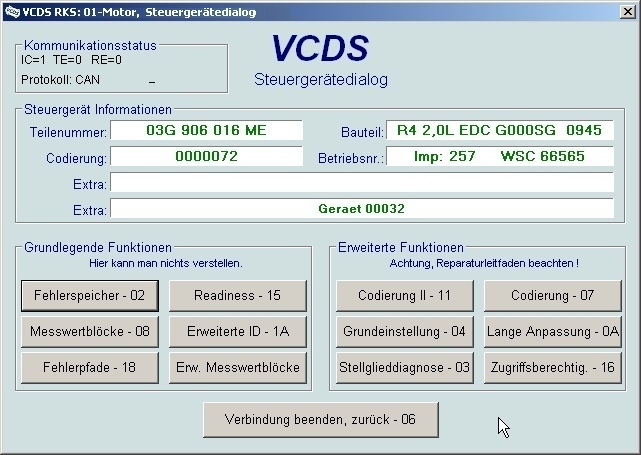
Gruß Ulf
_________ MG4 Electric Translated on 03-08-2026, 16:03. |
|||||||||||||||||||||||
 |
|||||||||||||||||||||||
| Ratings - TDI Technology: Basic Principles Explained | |
Average rating: 4.72 - worst rating: 4 - best rating: 5 - number of ratings: 18 - View ratings |
|
|
| 🔗 ⭐ 🖨 |
|
You cannot post new topics in this forum. |
|
|
Foren- und Portal-Software: V7.8 © 2003 - 2026 Kaufmann Automotive GmbH, Embedded Software Freelancer & Shop für Kfz-Diagnosegeräte. Parse time: 0.046s
 |


 Bookmarks
 Links
Links Garage
 FAQ, Legal Notice & Privacy
 RSS Feed
 Register
 Login
Login

