| Author |
Message |
Andy280
Blaumann

Joined: 09/14/2005
Posts: 122
Karma: +2 / -1 
Location: Gotha
Free account, no CAN development support
|
 15-02-2007, 15:38 Subject: 15-02-2007, 15:38 Subject: |
Quote |
|
I wonder what the point is of sharing this information if no one is listening.
Have fun swapping the box.
The V6 engine only uses the second intake port due to increased pressure difference in the intake manifold.
The simplest solution is to replace the air filter housing, but it remains true that the flexible hose behind the mass airflow sensor is not ideal from a flow dynamics perspective.
VW Passat 3BG Family seit 12/06
MKB: AVF
Translated on 03-07-2026, 15:19.
|
|
| Back to top |
Profile PM |
 |
Herr Antje
Schrauber

Joined: 01/18/2006
Posts: 1547
Karma: +7 / -0
Location: Nahe Tübingen
Support
|
| 15-02-2007, 16:32 Subject: |
Quote |
|
Andy280 wrote: | I wonder what the purpose is of sharing such information if no one is listening here.
|
Sorry, that's not what I meant. I think the suggestion about finding the pipe after the mass airflow sensor is a good one, and I thought Matt had also taken that tip into consideration.
Despite this, he probably still has some questions for me, which he asked. For example, if the delta-p values are no longer correct due to an increase in the line pressure (hence my question about that), wouldn't the chamber (in conjunction with the pipe) be an ideal way to reduce the pressure drop? Otherwise, I wonder if it's even worth it (as I mentioned earlier, and which you refuted based on the delta-p values). I still don't know whether he's using a higher LDL target. Aktuell:
- Sharan Goal '04 V(R)6 2.8 150 kW, ab 09.08.2007 mit Vialle LPI, MKB: AYL
- G3 VR6 '93 128 kW, MKB: AAA
Bis 07/2007: Passat Variant 3BG '01 2.5TDI 110 kW, MKB: AKN
Bis 03/2004: Audi A3 '00 1.9 TDi 96 kW, (MKB: ASZ?)
Translated on 03-07-2026, 15:19.
|
|
| Back to top |
Profile PM |
|
Andy280
Blaumann
Joined: 09/14/2005
Posts: 122
Karma: +2 / -1
Location: Gotha
Free account, no CAN development support
|
| 15-02-2007, 16:38 Subject: |
Quote |
|
Let's just say that we were involved in the development of the "Lufikasten" system and its integration.
Removing the restriction before the turbocharger would be a worthwhile modification if you were increasing the turbocharger's boost pressure, but since the diameter remains the same after the turbocharger, it would only result in minimal changes.
We're simply missing the data about Matt, and what he's actually planning to do.
If he only wants to increase the airflow, that's possible with the V6 intake manifold, but the diameter for connecting the mass airflow sensor (MAF) is the same.
Furthermore, the airflow to the filter is not uniform in the V6 engine because the second intake opening only serves to reduce the pressure difference.
VW Passat 3BG Family seit 12/06
MKB: AVF
Translated on 03-07-2026, 15:19.
|
|
| Back to top |
Profile PM |
|
matt
Guest
Free account, no CAN development support
|
| 15-02-2007, 17:00 Subject: |
Quote |
|
Hello,
I wouldn't have thought that this topic would generate so much discussion.
I don't want to make any changes to the boost pressure. However, relieving the load is always a good thing.
From a certain delta p value onwards, as also becomes clear here, throttling becomes sensible. The important question of the delta p remains open. Without concrete measurement results, we cannot progress much further. The pipe between the air filter and the turbocharger should remain unchanged. Therefore, the delta p between the environment and the air intake manifold is particularly interesting. I suspect that, in some cases, there may not be a need for any action at all.
Best regards, Matthias.
Translated on 03-07-2026, 15:19.
|
|
| Back to top |
|
|
Andy280
Blaumann
Joined: 09/14/2005
Posts: 122
Karma: +2 / -1
Location: Gotha
Free account, no CAN development support
|
| 15-02-2007, 17:13 Subject: |
Quote |
|
@matt
That's exactly what it looks like.
You will surely understand that I cannot release the measurement results.
What would really make a difference is increasing the outlet size on the air filter housing to the mass airflow sensor (MAF) and using a new connecting pipe that is more streamlined.
VW Passat 3BG Family seit 12/06
MKB: AVF
Translated on 03-07-2026, 15:19.
|
|
| Back to top |
Profile PM |
|
dieselmartin
Profi-Schrauber

Joined: 03/13/2003
Posts: 10121
Karma: +29 / -0
Location: in der Werkstatt
2007 Volkswagen Passat
Premium Support
|
| 16-02-2007, 10:14 Subject: |
Quote |
|
I know it's not a 3BG, but I messed around with my 3C yesterday:
He has two suction nozzles located above the coolers (water, coolant).
Only the left (in the direction of travel) is used for the engine's air intake, while the right one seems to simply blow air into the engine compartment. It was too sharp to touch properly, but I should be able to handle it better over the weekend.
I'm sure the 3BG works similarly: an air intake duct positioned above the radiators, open at the bottom. For the larger models, the 3BG likely still has the ribbed grilles.
Greetings.
m;
Transparency, Teamwork
... there was another T.
I don't know what the f*ck it was.
Translated on 03-07-2026, 15:19.
|
|
| Back to top |
Profile PM Garage |
|
Andy280
Blaumann
Joined: 09/14/2005
Posts: 122
Karma: +2 / -1
Location: Gotha
Free account, no CAN development support
|
| 16-02-2007, 10:34 Subject: |
Quote |
|
Yes, that's exactly how it is.
VW Passat 3BG Family seit 12/06
MKB: AVF
Translated on 03-07-2026, 15:19.
|
|
| Back to top |
Profile PM |
|
Jochen_145
Guest
Free account, no CAN development support
|
| 16-02-2007, 10:47 Subject: |
Quote |
|
Oops.
I thought it was sucking air from the left fender. At least, so far, I haven't seen anything on the G4 or Leon that I would consider a significant improvement.
However, the Leon was an ASV (which is a VP37).
Perhaps they have changed that with the more powerful PDs.
m;
Hello Martin,
The Leon also draws its air intake over the water cooler.
The cover located behind the left headlight serves as an air deflector. The hose connecting to the LF (likely referring to a specific component or system) is located on the left side, behind the headlight.
If you remove this cover, for example, when changing a light bulb, and forget to reattach it, the motor will draw warm air from the engine compartment  .
For the G4, the air would also need to be drawn in from behind the headlight, as the air intakes are the same between the Leon and the Golf.
However, I don't know if the air intake for the radiator is located above the water cooler, or simply behind the headlight.
Best regards, Jochen.
Translated on 03-07-2026, 15:19.
|
|
| Back to top |
|
|
matthiasTDI96
Profi-Schrauber
Joined: 02/27/2003
Posts: 5886
Karma: +252 / -0
Premium Support
|
| 16-02-2007, 11:19 Subject: |
Quote |
|
Next to the headlight, on the Golf. Please pay attention to the opening!
Translated on 03-07-2026, 15:19.
|
|
| Back to top |
Profile PM |
|
dieselmartin
Profi-Schrauber
Joined: 03/13/2003
Posts: 10121
Karma: +29 / -0
Location: in der Werkstatt
2007 Volkswagen Passat
Premium Support
|
| 16-02-2007, 11:45 Subject: |
Quote |
|
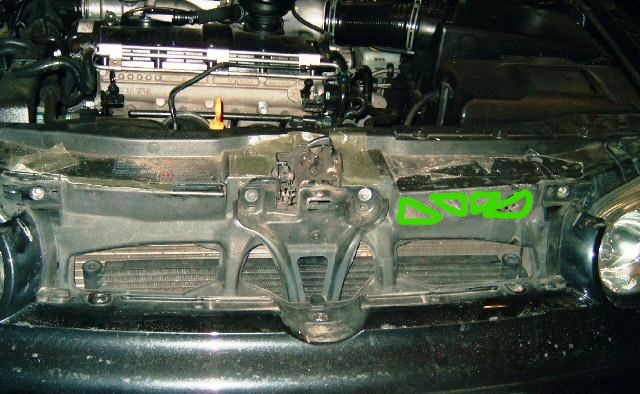
Holes in the castle beam.
Because I felt silly, I decided to paint them  .
| Description: |
|
| File size: |
69.45 KB |
| Viewed: |
3451 times |
|
Transparency, Teamwork
... there was another T.
I don't know what the f*ck it was.
Translated on 03-07-2026, 15:19.
|
|
| Back to top |
Profile PM Garage |
|
matthiasTDI96
Profi-Schrauber
Joined: 02/27/2003
Posts: 5886
Karma: +252 / -0
Premium Support
|
| 16-02-2007, 11:47 Subject: |
Quote |
|
YES, that's exactly it, thank you!
Translated on 03-07-2026, 15:19.
|
|
| Back to top |
Profile PM |
|
Andy280
Blaumann
Joined: 09/14/2005
Posts: 122
Karma: +2 / -1
Location: Gotha
Free account, no CAN development support
|
| 16-02-2007, 12:39 Subject: |
Quote |
|
Yes, that's how it is with golf. I just checked.
I'll take the Passat apart sometime this weekend, as I was planning to change the air filter anyway.
VW Passat 3BG Family seit 12/06
MKB: AVF
Translated on 03-07-2026, 15:19.
|
|
| Back to top |
Profile PM |
|
RTDI-Tom
Guest
Free account, no CAN development support
|
| 13-01-2008, 20:27 Subject: |
Quote |
|
I'm revisiting this old discussion because the topic also interests me.
Recently, I installed the R32 DSG intake on my car, and I have the impression that the turbocharger could potentially be further optimized.
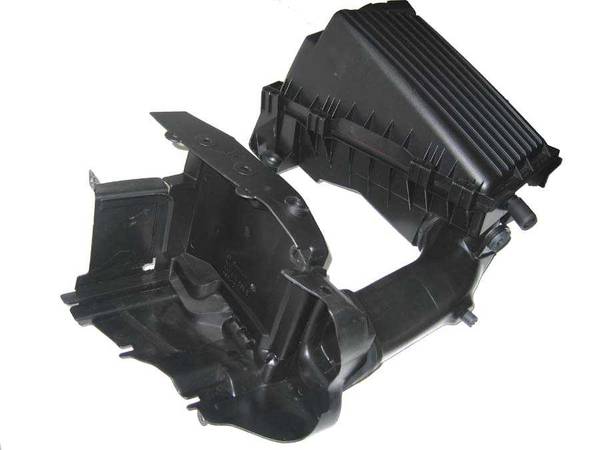
Here's a really nice photo of the air intake box, the R32 intake manifold, and the air duct box located behind the left headlight. My Golf, as is well known, draws air in through openings located above the radiator, near the headlight.
The idea I'm currently considering is to cut a hole in the bottom plate of the air intake duct shown in the picture, and then embed a flexible hose, for example, 100mm in diameter, into that hole. I would then run this hose downwards towards the front fender grille. One of my questions is whether the open end of the hose should face forward. What do you think? In this case, if driving at high speed in the rain, would water reach up into the air filter box, or would gravity prevent it? An alternative would be to let the hose hang diagonally downwards or even straight downwards into the area of the grille. In that case, there would certainly be no water problems, but of course, no back pressure would be created either. However, I also don't know if back pressure might be counterproductive due to potential oscillations in the intake air column. So many questions... I'm looking forward to hearing your ideas!
| Description: |
|
| File size: |
21.49 KB |
| Viewed: |
3707 times |
|
Translated on 03-07-2026, 15:19.
|
|
| Back to top |
|
|
Hutfahrer
Schrauber

Joined: 10/22/2005
Posts: 7825
Karma: +1099 / -0
Location: BAR
Premium Support
|
| 13-01-2008, 21:46 Subject: |
Quote |
|
"Wind-assisted charging is likely not feasible for turbo engines. It is much more important to ensure that the air intake is exposed to as little heat, spray, mist, or dust as possible." All of that provides additional support for the air filter.
Wet filters allow very little air to pass through, which achieves the exact opposite of the desired effect. Heavy dust accumulation on the filter element shortens its lifespan and requires frequent replacement. Good standard intake designs demonstrate that maintenance intervals of 60,000 to 100,000 kilometers can be achieved, and even during highway driving in heavy rain, a dry air filter can be found in its housing.
A slight tangent: I've had very good experiences with engine swaps in Golf 2 Syncros, using GTI 16V engines. These vehicles were used in rally competitions. We found that the standard air intake location in the right fender was too heavily affected by dust kicked up by the right front wheel. Directly behind the front grille, the air intake snorkel received too much dust and, in rainy conditions, too much water, which affected the air filter.
After the race, we examined the heavily soiled bodies of our two vehicles and noticed that the water reservoir in front of the windshield was relatively clean. Furthermore, the surrounding metal was quite cool, and the water reservoir apparently didn't have any issues with heat buildup. We then cut a hole in the partition between the engine compartment and the water reservoir, riveted a flange in place, and connected the intake hose to it. This apparently wasn't bad for the engine; in fact, we were able to drive more than just one race with that air filter insert. However, a disadvantage of the gasoline engine was that the loud intake noise was transmitted quite loudly into the interior. However, turbodiesels produce significantly less intake noise because the turbine smooths both the intake and exhaust flows, eliminating vibrations.
Automobile Zeitzeugen: |SUZUKI Swift Sport (2008)| |Smart 450 (2002)| |Honda CB 125 F (2018)|
Translated on 03-07-2026, 15:19.
|
|
| Back to top |
Profile PM |
|
Jochen_145
Guest
Free account, no CAN development support
|
| 13-01-2008, 22:11 Subject: |
Quote |
|
Ram air charging is likely nonsensical for turbomotors.
Hello hat enthusiasts,
Unfortunately, that's not always the case, especially when you want to achieve very high boost pressure at low engine speeds, and you're operating at or beyond the pump limit of the turbocharger.
In such a case, it may be possible to move back outside the pump's operating range by increasing the pressure upstream of the pump, which would reduce the pressure difference across the pump. This is crucial for pumping.
In such a case, airflow charging provides the necessary pressure before the charging system.
However, this behavior is only necessary for a very specific application.
It is not really suitable for street tuning.
In the further descriptions, I agreed with you .
Best regards, Jochen.
Translated on 03-07-2026, 15:19.
|
|
| Back to top |
|
|
ulf
Profi-Schrauber
Joined: 04/13/2002
Posts: 11058
Karma: +18 / -0
Location: Saarland
2023 MG ZS
Premium Support
|
| 14-01-2008, 15:51 Subject: |
Quote |
|
Jochen_145 wrote: | ...if you want to achieve very high boost pressure at low RPM and are operating at or beyond the pump limit of the turbocharger.
In such a case, it may be possible to move back outside the pump's operating range by increasing the pressure upstream of the pump, which would reduce the pressure difference across the pump. This is crucial for pumping.
In such a case, airflow charging provides the necessary pressure before the charging system.
It is, however, a very specific application where this behavior is necessary. | ... and a shaky situation as well: for example, in the lower sections at low engine speeds, there will not yet be any usable static pressure.
Following: even from a standstill (or with a strong tailwind, or in the slipstream of the rider in front...), the loader still pumps  .
To compensate for this, an additional pressure sensor would be needed at the compressor inlet, and its signal would influence the LDR (Low-Drift Regulator). Gruß Ulf
_________
MG4 Electric
Translated on 03-07-2026, 15:19.
|
|
| Back to top |
Profile PM Garage |
|
|


 Bookmarks
 Links
Links Garage
 FAQ, Legal Notice & Privacy
 RSS Feed
 Register
 Login
Login


