| Author |
Message |
Herbert
Profi-Schrauber

Joined: 06/22/2005
Posts: 4630
Karma: +1344 / -0 
Premium Support
dieselschrauber likes this. |
 23-12-2025, 15:35 Subject: 23-12-2025, 15:35 Subject: |
Quote |
|
Hi,
If I understand MWB 40 field 2 correctly, there is a (target?) injection quantity at the start speed, and no injection blocking.
Then stay.
- Lack of pressure in the distribution pipe;
- Failure to control the piezo valves;
- Lack of pressure in the cylinder (compression pressure, valve timing).
Is there no smell of unburned diesel?
hg
Herbert.
Horch A4 8K CJCD
Golf 7 DDYA
(+ Audi 80 Avant B4 1Z 475Tkm - habe ich vom ersten bis zum letzten Tag gerne gefahren)
(+ Passat Variant 32B CY 400Tkm)
Translated on 06-07-2026, 0:52.
|
|
| Back to top |
Profile PM |
 |
Heiner111
Schrauber

Joined: 01/10/2016
Posts: 91
Karma: +27 / -0
Location: Darmstadt
Premium Support
|
| 01-01-2026, 15:26 Subject: |
Quote |
|
1. Problem likely solved - 2. Problem completely solved.
Since I'm certainly not the last person this will happen to, here are a few notes that I haven't found online yet:
Okay, let's address the second problem (it wouldn't start, see above). Last Saturday, it was very cold but dry, so I removed the valve cover and inspected things. I checked the valve timing (roughly), and it seemed okay, as much as is visible in this cramped engine bay in the A4 (without disconnecting anything). All the camshafts are working (so no crankshaft failure, etc.), the injectors are being actuated, and nothing else obvious is visible. All the rocker arms are freely rotating when the engine is at top dead center. However, the short rocker arms for the intake valves had some play (estimated at 1 to 1.5 mm). I specifically made sure that the engine hadn't been turned over for two days beforehand, so that there would definitely be no pressure remaining in the lifters. Now, I didn't know how much play was normal, or what the plunger was bridging, but it was at least an indication for my theory.
"By the way, the camshafts and other components look very good, despite having over 300,000 km on them. So, I cleaned them again - and after some time, it started to misfire. I took a break and then tried again, and it started firing cylinder by cylinder! I still believe that 'only' some small pieces (see above) under the valves were preventing the necessary compression. I would rule out a loose connection or similar, as that would have caused error messages."
Okay, so: anyone who cleans the intake manifold or the inlets of the engine should be prepared for this to happen. You can't completely remove those sticky deposits from the channels with just suction. I probably had to run the engine for a total of 10 to 15 times over several days. This was with a sufficient starter motor speed, working glow plugs, and otherwise normal conditions. I would have expected something different, but it seems to take a very long time for it to clear. Once it's running on one or two cylinders, the airflow speeds are probably high enough to quickly blow the dirt out from under the other valves. And cleaning the inlets is definitely worth it! It now feels noticeably more responsive than before, with better throttle response, although it wasn't particularly bad before, just a bit sluggish.
Now I was back to square one: a leak in the cylinder head, the cylinder head gasket, or the EGR cooler. Hopefully it's the EGR cooler, as it's the easiest to repair. Sure, here's the translation:
"Continued in the next post."
Translated on 06-07-2026, 0:55.
|
|
| Back to top |
Profile PM |
|
Herbert
Profi-Schrauber
Joined: 06/22/2005
Posts: 4630
Karma: +1344 / -0
Premium Support
|
| 01-01-2026, 15:38 Subject: |
Quote |
|
Happy New Year!
Mhhm - Quote: | ...All the rollers in the OT are freely rotatable. However, the short levers to the inlets had some play (estimated 1 to 1.5 mm). I specifically made sure that it wouldn't rotate two days prior, so that there would definitely be no pressure remaining in the plungers. Now, I didn't know how much play was normal, or what the plunger was bridging, but it was at least an indication for my theory.
By the way, the camshaft and other components look very good despite having over 300,000 km. So, I tried again, and after some time, it started to misfire. I took a break and then tried again, and it started firing on each cylinder, one by one! I still believe that "only" a few small pieces (see above) under the valves were preventing the necessary compression.
|
How about this explanation: is there insufficient oil pressure to fill the hydraulic lifters when starting the engine?
hg
Herbert. Horch A4 8K CJCD
Golf 7 DDYA
(+ Audi 80 Avant B4 1Z 475Tkm - habe ich vom ersten bis zum letzten Tag gerne gefahren)
(+ Passat Variant 32B CY 400Tkm)
Translated on 06-07-2026, 0:59.
|
|
| Back to top |
Profile PM |
|
Heiner111
Schrauber
Joined: 01/10/2016
Posts: 91
Karma: +27 / -0
Location: Darmstadt
Premium Support
dieselschrauber likes this. |
| 01-01-2026, 15:47 Subject: |
Quote |
|
back to the primary problem: water ingress in combustion.
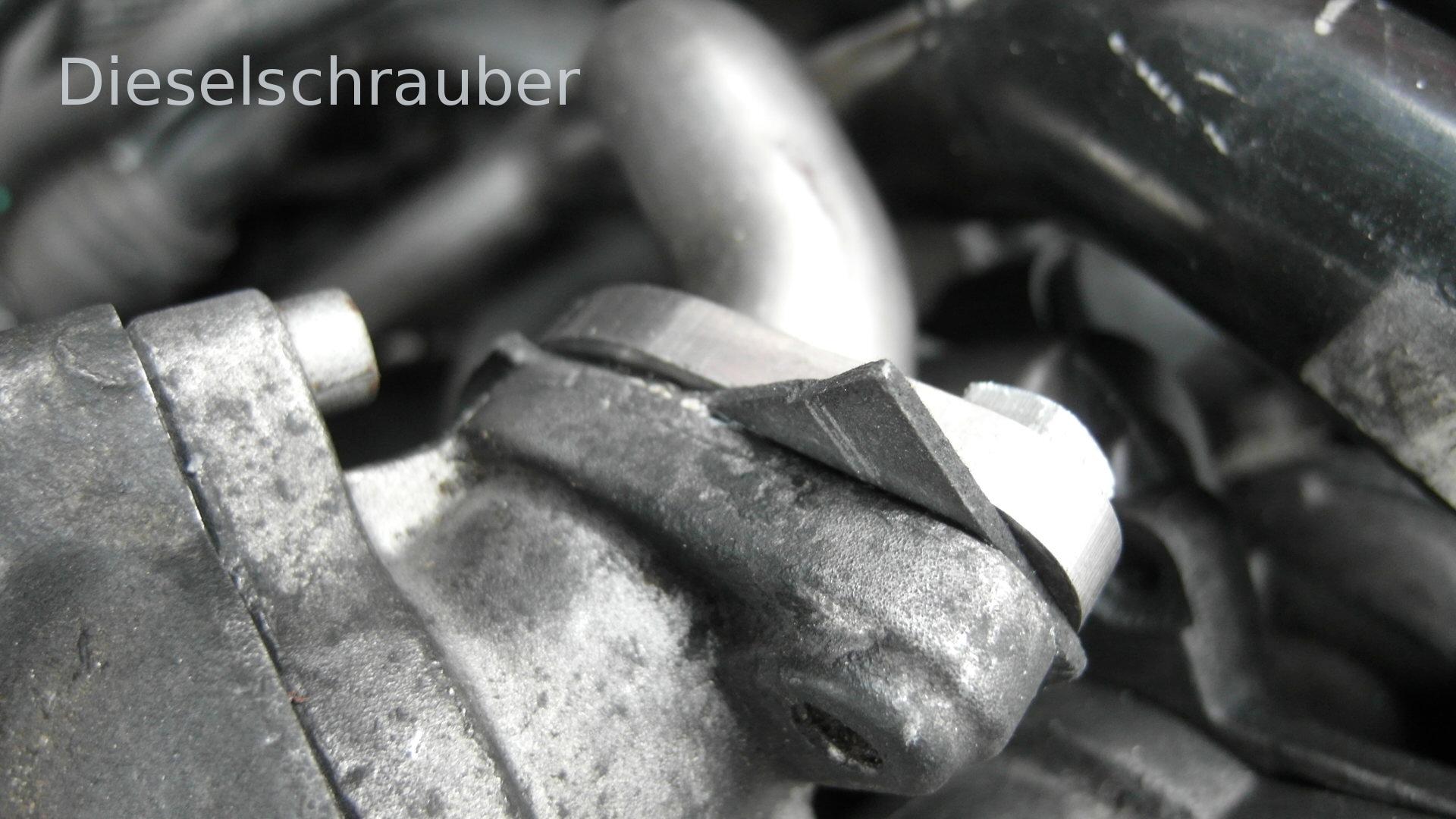
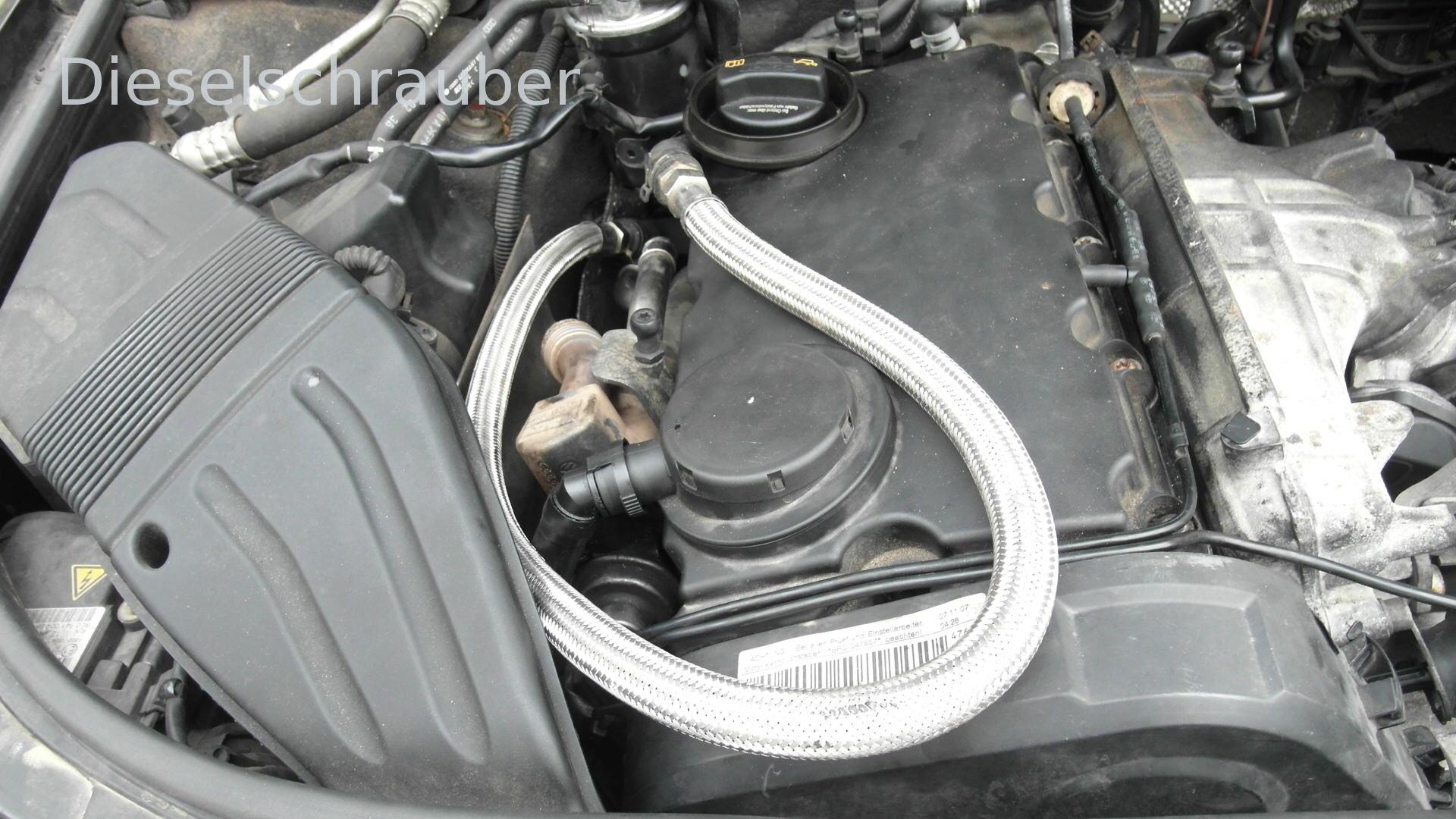
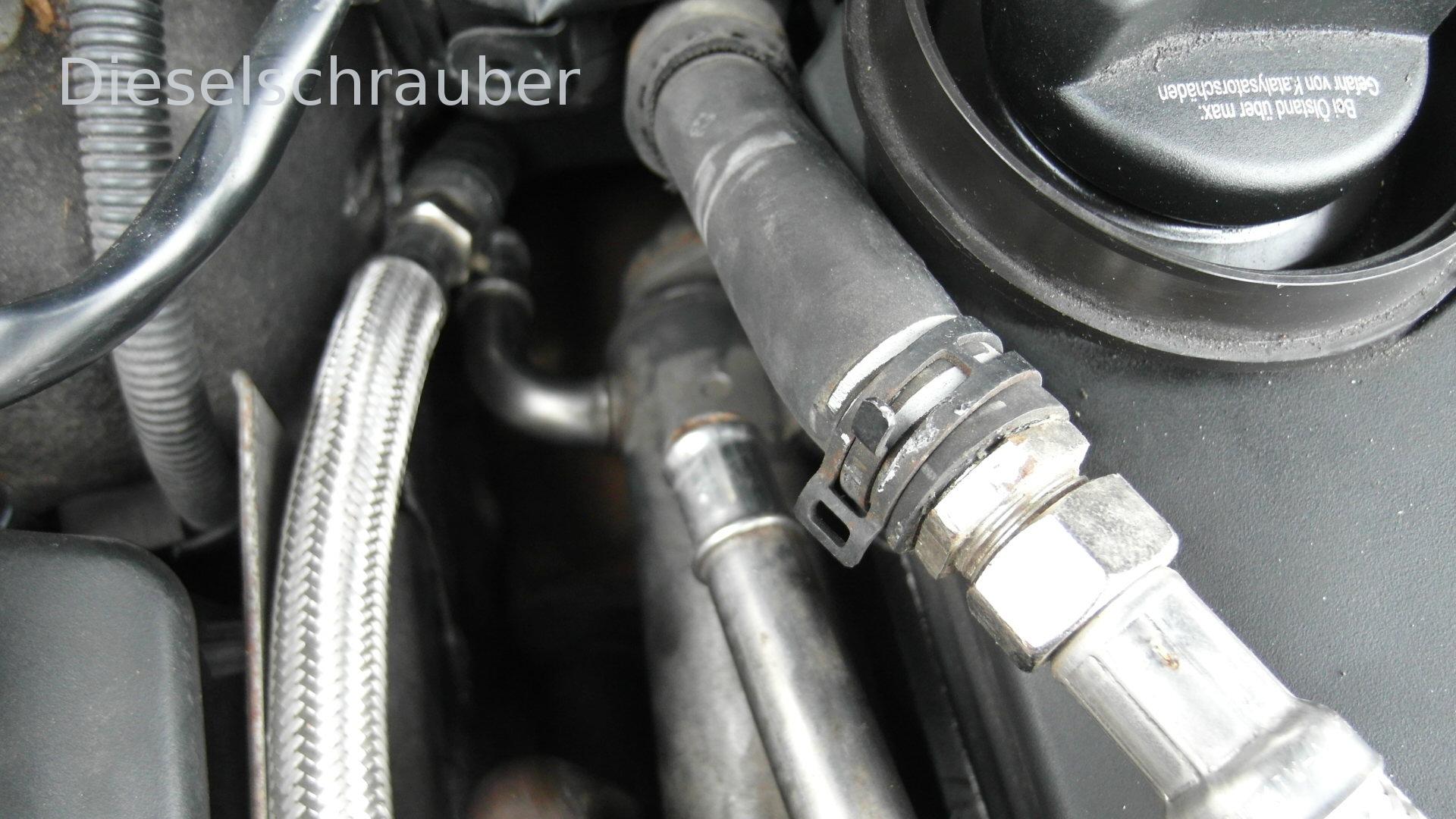
I've already tried this solution about two weeks ago. I installed a closed gasket in the flange leading to the EGR valve (see picture) to prevent any water leaking through the EGR cooler from entering the combustion chamber. If anyone tries this, be sure to use a soft gasket, as the valve flap of the EGR valve swings there and can easily collide with it. After a drive of two 15 km trips, I noticed that it was running normally again, so presumably no more water was entering the combustion chamber. However, it was still heavily steaming, so that following cars kept their distance, and I could only see some of them faintly. This already indicated a problem with the cooler, and I ordered a replacement. Afterwards, I also implemented the suggestion mentioned earlier to bypass the water circulation in that area. "For this, I used a 1/2" flexible hose. The 1/2" male threads fit perfectly into the 20mm hoses (see picture; it's likely that you could also simply use two caps without a connecting piece, as the strand probably wouldn't function otherwise, so there wouldn't be a need for any flow)." Due to the installation position, the AGR cooler is largely empty.
The frustration was palpable when, after several kilometers, a wall of fog still appeared in the rearview mirror. After 6 km (mixed traffic, about 15 minutes), I stopped at the destination. Then, after 30 minutes, I continued – and nothing more happened! Only a few sporadic wisps of vapor remained. After another 20 km, the diagnosis is clear: there is absolutely no more water loss. So, it's definitely the AGR cooler, which is also known for corrosion damage. Once the new one is installed, I'll cut it open.
Conclusion: Anyone who wants to define the problem in this way must assume that it will take quite some time for all the leaked water from the EGR system and exhaust system to evaporate. Significantly longer than expected.
Thank you again for the tips; they were helpful.
| Description: |
|
| File size: |
385.95 KB |
| Viewed: |
90 times |
|
| Description: |
|
| File size: |
443.01 KB |
| Viewed: |
80 times |
|
| Description: |
|
| File size: |
435.63 KB |
| Viewed: |
79 times |
|
Translated on 06-07-2026, 1:02.
|
|
| Back to top |
Profile PM |
|
dieselschrauber
Administrator

Joined: 04/12/2002
Posts: 18121
Karma: +800 / -0
Location: St.Gallen
2018 Volkswagen T6 
|
| 01-01-2026, 19:13 Subject: |
Quote |
|
Thank you for the feedback and a happy new year! 
Translated on 06-07-2026, 1:05.
|
|
| Back to top |
Profile PM WWW Garage |
|
|


 Bookmarks
 Links
Links Garage
 FAQ, Legal Notice & Privacy
 RSS Feed
 Register
 Login
Login

