| Author |
Message |
garth.brooks
Guest
Free account, no CAN development support
|
 06-07-2003, 23:22 Subject: 06-07-2003, 23:22 Subject: |
Quote |
|
My contribution from July 6, 2003.
Ben1972 wrote:
If you are trying to maintain a constant boost pressure, this approach is incorrect! However, if you want a specific amount of air in the engine at the end of the compression stroke, you can reduce the boost pressure with colder intake air, which will also reduce the exhaust back pressure. This will decrease the work required for the charge exchange process and increase efficiency!
Hello Ben,
I probably didn't express myself clearly, but my approach was actually based on the assumption that the boost pressure is not constant.
From an efficiency perspective, the goal is to get as much air (mass) into the cylinders as possible with the least amount of effort. This can be achieved either through forced induction (i.e., boost pressure) or by lowering the temperature (i.e., cooling).
Again: A constant mass of air in a confined space: With high temperatures, this requires high pressure, or with lower temperatures, it requires lower pressure.
It makes sense, therefore: Less pressure - less loss - With the same amount of fuel, you get more out, right?
Best regards,
Translated on 27-09-2026, 7:59.
|
|
| Back to top |
|
 |
ulf
Profi-Schrauber

Joined: 04/13/2002
Posts: 11058
Karma: +18 / -0 
Location: Saarland
2023 MG ZS
Premium Support
|
| 07-07-2003, 17:07 Subject: |
Quote |
|
garth.brooks wrote: | From the perspective of efficiency, it's actually about getting as much air (mass) into the cylinders as possible with the least amount of effort. This can be achieved either by force (i.e., boost pressure) or by lowering the temperature (i.e., cooling).
Again: A constant mass of air in a confined space: With high temperatures, this requires high pressure, or with lower temperatures, it requires lower pressure.
It makes sense, therefore: Less pressure - fewer losses - With the same amount of fuel, you get more out, or? |
Hi Garth,
If the boost pressure were reduced along with the intake air temperature in such a way that the same amount of air reaches the cylinder, then your reasoning is certainly correct.
But that's too simple for me  - or has anyone ever read a significantly lower maximum charging pressure on a Klirrfrost device compared to in hot weather?
I am primarily interested in the effect of colder temperatures, which result in more air mass in the cylinder, while maintaining the same boost pressure.
If, in the end, we arrive at a well-founded result like "30° warmer intake air at the same boost pressure reduces efficiency by approximately 5% (or more)," then we would finally have an explanation for the summer performance issues of TDI engines  .
But the previous threads about summer slump don't seem to address that (or I might have missed something). Gruß Ulf
_________
MG4 Electric
Translated on 27-09-2026, 8:02.
|
|
| Back to top |
Profile PM Garage |
|
garth.brooks
Guest
Free account, no CAN development support
|
| 07-07-2003, 19:28 Subject: Performance Loss with Rising Temperature |
Quote |
|
Hi Ulf, I'm giving up on trying to explain it in a more visual way without using formulas. I just thought it had already been explained sufficiently with formulas here.
P*V/T = constant.
That means I can save on compression work if I lower the temperature. If I reduce the temperature (T), I can also reduce the pressure (P) for the same amount of air mass.
The hotter the temperature, the lower the efficiency, due to the increased work required for compression. (This work is performed via the exhaust pressure acting on the turbocharger.)
The 70-degree Celsius figure was a thought experiment meant to illustrate that you don't need any boost pressure at all if the air is cold enough.
The effect also works with a smaller temperature decrease; in that case, the pressure will simply decrease less (always, assuming a constant air mass).
You are right, the boost pressure doesn't necessarily decrease just because it gets colder. The TDI engine maintains a constant pressure (P), not the air mass (at least above certain limits). Therefore, as the temperature (T) increases, the air mass decreases, and the engine reduces the fuel injection amount. Isn't there something in the forum about tuning by manipulating temperature signals?
More importantly, consider the reverse implication of your statement: The boost pressure doesn't increase simply because it's warmer.
Same pressure, warmer air, lower air mass = less oxygen >> Reduced fuel injection amount - it makes sense, right?
Okay, let's do a test: Give it a charge air temperature value that's really low, and then a value that's really high, and check the limit values in VCDS. You should be able to see something reflected there.
A larger intercooler can only make a difference with a modified intake manifold or at high temperatures; otherwise, it won't have much effect. This is because the fuel injection volume won't increase if the intake air is colder, and it won't decrease or decrease less if the intake air isn't too warm.
It's actually an effect that's known from various turbochargers, not just the TDI. My brother has a 200 Turbo as a summer car, but he doesn't really like the summer. Above 30 degrees Celsius, the car starts to complain.
I hope this clarifies what I mean. Ben, born in 1972, described it in a similar way. I would like to add that the efficiency of...
'It doesn't change the fundamental nature of the engine, but rather that its operation is influenced by external factors.'
Greetings.
Translated on 27-09-2026, 8:09.
|
|
| Back to top |
|
|
Ernst S.
Guest
Free account, no CAN development support
|
| 07-07-2003, 19:51 Subject: |
Quote |
|
I am primarily interested in the effect of colder temperatures, which result in more air mass in the cylinder, while maintaining the same boost pressure.
Go to a dynamometer! 
If the answer doesn't satisfy you, here's a hint.
Calculate the air-fuel ratio: Air mass / (14.5 * Fuel mass)
It should be around 1.4-1.5, but I think you have the exact values for air mass and fuel injection amount, and you can then tell me the precise (or more precise) air-fuel ratio.
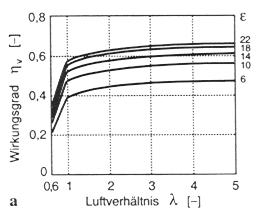
Calculate the new air ratio by multiplying the air mass by the ratio of the old temperature to the new temperature. This value will be approximately 3% larger when the temperature is reduced by 10°C.
Then, in the diagram below, you can see how much the efficiency of the ideal engine has increased (epsilon, which is the compression ratio for the TDI, is probably 18... so use the line labeled '18').
This increase in efficiency (of 1% at most?) also translates to the real-world TDI performance.
Until then, there are numerous other losses that may also change.
The loss due to actual combustion will increase because the ignition delay is longer at lower temperatures. However, the heat losses through the walls will decrease because the temperature is lower. A change of a few percent in either of these losses is insignificant because they only contribute a few percent to the overall efficiency.
There are some losses that change with lower temperatures or the resulting increase in air mass. However, I dare to say that the efficiency is not significantly (less than 1%) affected when the intake air is cooled by 10 or even 20 degrees. If a noticeable increase in performance occurs, it does not come from the increased efficiency. }
Regarding the calculation of the air mass increase, I would like to mention that it is not entirely accurate. The actual temperature of the intake air is slightly higher because it is preheated to some extent by the cylinder wall before compression, but this is negligible for the calculation.
Best regards, Ernst.
| Description: |
|
| File size: |
10.92 KB |
| Viewed: |
8520 times |
|
Translated on 27-09-2026, 8:14.
|
|
| Back to top |
|
|
ulf
Profi-Schrauber
Joined: 04/13/2002
Posts: 11058
Karma: +18 / -0
Location: Saarland
2023 MG ZS
Premium Support
|
| 07-07-2003, 21:24 Subject: Performance Loss with Temperature: Explained |
Quote |
|
garth.brooks wrote: | As the temperature T increases, the air mass becomes denser, and the injection amount is reduced. . . .
Same pressure, warm air, lower air mass = less oxygen ==> Reduced fuel injection amount - somehow logical, right? |
Hi Garth,
Superficial, yes, but in the case of TDI engines, this only applies once the soot reduction limit for the injection quantity falls below the torque limit or the driver's desired setting due to increasing engine oil temperature.
Quote: | | Do a test: give it a charge air temperature value that is very low, and then high, and check the limit values in VCDS. You should see it reflected there. |
I had essentially done something similar before, but only using a dynamometer and without VAGCOM: there was no difference in performance.
This supports the statement that the soot limit is calculated "aerodynamically" only from the LLM signal.
Quote: | | A larger intercooler can only make a difference with a modified intake manifold or at high temperatures, otherwise not. This is because the injection amounts will not increase if the intake air is colder, and the injection amounts will not decrease or decrease less if the intake air is not too warm. |
Agreement.
Quote: | | I would like to add that the actual efficiency of the motor does not change | .
In the end, you are essentially agreeing with Ernst on this point.
ErnstS wrote: | | But I dare to say that the efficiency is not significantly (less than 1%) affected when the intake air is cooled by 10 or even 20 degrees. If a noticeable increase in performance occurs, it does not come from the increased efficiency. |
Hello Ernst,
After many (but not unnecessary!) words, this now seems the most plausible to me.
The conclusion would be (as stated in the original article):
As long as the soot limit for engine operation is not the "active" limiting factor, a significantly larger LLK (likely referring to a Large Language Model) will not provide (any significant) additional performance.
However, in my opinion, this approach unfortunately cannot be considered an explanation for the summer slump... even though Gremlin strongly advocates for the LL-temperature theory in the relevant threads.
Of course, as the LL temperature increases, the soot limit will approach the other limits "from above."
Perhaps, during the next heatwave, as many people as possible should record the limits reached during the DZR test, and then repeat the same test again when the weather is cooler.
Regarding my tractor, I can say that at approximately 20°C, the torque limit is 1.4 to 3 mg below the soot limit. I didn't log the LL temperature because of the high data rate, but ultimately, only the limits themselves are important.
My coolant is actually relatively clean.
The same attempt will be made during the next heatwave... Gruß Ulf
_________
MG4 Electric
Translated on 27-09-2026, 8:21.
|
|
| Back to top |
Profile PM Garage |
|
Ben1972
Guest
Free account, no CAN development support
|
| 08-07-2003, 10:53 Subject: |
Quote |
|
Hello Ulf,
I can give you a reason for the summer performance drop. The limiting factor here is the exhaust gas temperature before the turbine. As you know, the exhaust gas temperature increases with the intake air temperature. It can become critical when you have very high ambient temperatures (around 30°C). In that case, your intercooler can't cool the compressed air sufficiently, and the intake air temperature rises. If you have an intercooler that isn't very effective, the intake air temperature can become so high that the exhaust gas temperature, at full injection, becomes so high that it can damage the turbocharger. That's why a correction map is activated, which reduces the injection amount by a factor less than 1 based on the intake air temperature, thus reducing the injection amount. But as I said, this only happens when you have extreme temperatures and/or when you're driving uphill at full load with a full load, and therefore don't have enough intercooling. In these cases, a more effective intercooler can make a difference!
Translated on 27-09-2026, 8:26.
|
|
| Back to top |
|
|
garth.brooks
Guest
Free account, no CAN development support
|
| 08-07-2003, 14:47 Subject: Exhaust Temperature TDi: How to Measure? |
Quote |
|
Hello Ben,
I would like to disagree with you. A higher intake air temperature only marginally increases the exhaust temperature. In principle, 10 degrees more in = 10 degrees more out.
Furthermore, the TDI engine doesn't have an Exhaust Gas Temperature (EGT) sensor, so it doesn't know how hot the exhaust gases are. Therefore, there's no feedback loop for this parameter.
And: In the gasoline engine, the turbochargers get much hotter and have to be able to withstand that. There's no problem with temperature in the diesel engine. (The VNT15/17/20 isn't a dedicated diesel turbocharger.)
Best regards,
Translated on 27-09-2026, 8:28.
|
|
| Back to top |
|
|
Uli S.
Schrauber

Joined: 07/02/2003
Posts: 338
Karma: +7 / -0
Location: Äußerster Südwesten
Support
|
| 08-07-2003, 14:55 Subject: |
Quote |
|
Hello everyone,
Ben1972 wrote: | | I can give you a reason for the summer sluggishness. In this case, the limiting factor is the exhaust gas temperature before the turbine. As you know, the exhaust gas temperature is also higher with increasing intake air temperature. It can become critical when you have very high ambient temperatures (around 30°C). In that case, your intercooler no longer cools the temperature of the compressed air sufficiently, and the intake air temperature rises. If you have an intercooler that is not very effective, the intake air temperature can become so high that the exhaust gas temperature, at full injection volume, becomes so high that it can damage the turbocharger. Therefore, a correction map is activated, which uses the intake air temperature to reduce the injection volume by a factor of less than 1, thus reducing the injection volume. |
@ Ben :
That may be true, but it's not the reason for the summer sluggishness. My mechanically-injected 1.6-liter engine with an intercooler actually runs better the colder it is; it starts to become annoying around 20°F, and at 30°F it's a real pain. And that's without any adjustments to fuel injection, boost pressure, or anything else that an engine control unit might do.
@Ulf and everyone:
In the article, you write:
Quote: | Its larger volume takes longer to be "filled with higher boost pressure," and therefore, the engine receives the higher pressure accordingly later. Consequently, the turbo lag is extended slightly in time (the amount depends on the "volume gain" achieved by the larger intercooler).
|
I believe the claim that longer hoses/a larger turbo cause a significant increase in turbo lag is a frequently cited but false rumor. A 2-liter engine sucks in 50 liters of air per second at 3000 RPM. How can an additional 2 or 3 liters of volume due to longer hoses have such a noticeable effect? I think it's complete nonsense, but I'll be able to do a direct comparison myself soon, because tonight I'm going to install the intercooler from my girlfriend's SB-Passat into her AAZ-Passat. The hoses on that Passat are about 3-4 times longer than those on the Golf. Then I'll see if there are any differences in the throttle response.
Quote: | However, since the "filling volume" of the liquid coolant (LLK) is directly drawn by the LLM (liquid coolant module), the injection amount is increased as soon as the increased boost pressure should reach the engine after being calculated by the engine control unit.
This calculation is, of course, only valid for the standard, "small" LLK. With the larger LLK, the injection quantity is increased too early, which results in a brief puff of soot that is likely to have a negative impact, especially during the emissions test (AU). . . |
The boost pressure is actually measured, so that the engine control unit doesn't adjust the fuel injection amount based on a hypothetical boost pressure in the event of a sudden surge of gas.
Furthermore, there should be a redundancy because air mass flow can also be determined using pressure, temperature, and speed. As a developer, I would definitely perform a plausibility check with the values from the LLM.
I hope you don't take my comments badly, considering I'm a driver of mechanically-controlled swirl chamber engine cars  . However, I believe that many general problems are often wrongly attributed to the complex TDI control system, so the experiences of an "outsider" can help to quickly correct misunderstandings.
Best regards, Uli.
Translated on 27-09-2026, 8:33.
|
|
| Back to top |
Profile PM |
|
Albrecht
Profi-Schrauber
Joined: 05/12/2002
Posts: 284
Karma: +10 / -0
Location: DD
Support
|
| 08-07-2003, 15:40 Subject: |
Quote |
|
Hello garth.brooks,
Quote: |
The VNT15/17/20 is not a pure diesel turbo | .
You're wrong! There isn't yet a production VTG loader in a gasoline engine.
The reason, as you correctly suspected, is the higher exhaust gas temperatures.
That doesn't mean that a diesel engine, under unfavorable circumstances, cannot damage its turbocharger due to excessively high exhaust temperatures!
Best regards,
Albrecht. 01/01-08/08 Passat Variant 35i, 08/96, AFN, 94-283Tkm (5.Gg. defekt)
08/08-07/15 A6 (C5) Av. quattro 6-Gg., EZ 10/02, AKE 189-265Tkm (Kolbenriss)
07/15-09/17 A6 (C6) Av. qu. 6-Gg. 3.0 TDI, CDYC, EZ 05/11 180-210Tkm (verkauft)
08/17-11/17 A6 (C7) Av. qu 3.0 TDI comp.(leasing)
seit 2018 Skoda Roomster 1.6 TDI 5-Gg.
Translated on 27-09-2026, 8:38.
|
|
| Back to top |
Profile PM |
|
Ben1972
Guest
Free account, no CAN development support
|
| 08-07-2003, 16:42 Subject: Exhaust Temp TDi: Common Issues & Solutions |
Quote |
|
Hello Ben,
I would like to disagree with you. A higher intake air temperature only marginally increases the exhaust temperature. In principle, 10 degrees more in = 10 degrees more out.
Furthermore, the TDI engine doesn't have an Exhaust Gas Temperature (EGT) sensor, so it doesn't know how hot the exhaust gases are. Therefore, there's no feedback loop for this parameter.
And: In the gasoline engine, the turbochargers get much hotter and have to be able to withstand that. There's no problem with temperature in the diesel engine. (The VNT15/17/20 isn't a dedicated diesel turbocharger.)
Regards
Hello,
While 10 horsepower might seem insignificant to you, it's not negligible for the developer. Modern diesel engines are so highly optimized that there's nothing left to give.
You can't compare an Otto turbocharger to a variable geometry turbocharger (VGT) from a diesel engine. The adjustment unit of the diesel VGT turbocharger is very temperature-sensitive. Excessive temperatures can cause the adjustment units to seize, which can then cause permanent damage. Gasoline engines don't have VGT turbochargers precisely because of this. So far, there are no VGT (VNT) turbochargers for gasoline engines, only wastegate turbochargers!
I am aware that there are currently no TAbgvT (turbocharger air bypass valve temperature) measurement points for diesel engines. That's why many tests are being conducted in hot climates and at high altitudes to precisely determine the correlation between intake air temperature and TAbgvT, and to identify necessary corrections. I wrote that as well, and there was no mention of a control loop based on exhaust gas temperature!
Best regards,
Translated on 27-09-2026, 8:40.
|
|
| Back to top |
|
|
Ben1972
Guest
Free account, no CAN development support
|
| 08-07-2003, 16:43 Subject: |
Quote |
|
Hello garth.brooks,
The VNT15/17/20 is not a pure diesel turbo.
You're wrong! There isn't yet a production VTG loader in a gasoline engine.
The reason, as you correctly suspected, is the higher exhaust gas temperatures.
That doesn't mean that a diesel engine, under unfavorable circumstances, cannot damage its turbocharger due to excessively high exhaust temperatures!
Best regards,
Albrecht
Okay, I understand. Please provide the German text you want me to translate.
Translated on 27-09-2026, 8:43.
|
|
| Back to top |
|
|
ulf
Profi-Schrauber
Joined: 04/13/2002
Posts: 11058
Karma: +18 / -0
Location: Saarland
2023 MG ZS
Premium Support
|
| 08-07-2003, 16:46 Subject: |
Quote |
|
Uli S. wrote: | | I believe that the rumor about a larger turbo lag with longer hoses/a larger turbo is often cited, but is actually false. A 2-liter engine sucks in 50 liters of air per second at 3000/min. How can an additional 2 or 3 liters of volume due to longer hoses have such an effect? I think it's complete nonsense, but I will be able to do a direct comparison myself soon, because tonight I will be installing the intercooler from my girlfriend's SB-Passat into her AAZ-Passat. The hoses on that car are about 3-4 times as long as those in the Golf. Then I'll see if there are any differences in the response. |
Hi Uli,
Cross-calculation:
In the case of the 1.9-liter engine, just 1 liter of net volume difference between the air intake and the engine corresponds to approximately 2 intake strokes. While the mass airflow sensor (MAF) is still measuring the air flowing to fill the increased volume, the engine control unit (ECU) believes that the engine is already receiving a full cylinder charge and releases the full amount of fuel injection.
Success: Soot removal achieved in 2 work cycles.
Quote: | | The boost pressure is actually measured, so that the control unit does not adjust the injection quantity based on a suspected boost pressure in the event of a sudden surge of gas. |
The amount is, as far as I know , calculated only based on the LMM value...
Quote: | | Furthermore, there should be redundancy in the system, because air mass flow can also be determined using pressure, temperature, and speed. As a developer, I would definitely perform a plausibility check with the values from the LLM. |
It should probably, but maybe the Bosch engineers haven't managed to get the system behavior under control when dealing with contradictory calculations ?
Quote: | | I hope you don't take my comments badly, especially coming from someone who drives mechanically-controlled swirl chamber cars. However, I believe that many common problems are often wrongly attributed to the complex TDI control system, so the experiences of an "outsider" can help to quickly correct misunderstandings. |
Something like that can actually be helpful. As long as the discussion remains factual and a development in the discussion is discernible, all considerations are welcome . Gruß Ulf
_________
MG4 Electric
Translated on 27-09-2026, 8:47.
|
|
| Back to top |
Profile PM Garage |
|
ulf
Profi-Schrauber
Joined: 04/13/2002
Posts: 11058
Karma: +18 / -0
Location: Saarland
2023 MG ZS
Premium Support
|
| 08-07-2003, 17:24 Subject: Exhaust Temp TDi: Common Issues & Solutions |
Quote |
|
Ben1972 wrote: | | I am aware that there are currently no TAbgvT (turbocharger air bypass valve temperature) measurement points for diesel engines. That's why many tests are being conducted in hot climates and at high altitudes to precisely determine the correlation between intake air temperature and TAbgvT and to identify necessary corrections. I wrote that as well; there was no mention of a control loop based on exhaust gas temperature! |
Hi Ben,
That sounds like some serious hardcore insider knowledge .
. . . but how does it actually work in a real-world scenario with the limiting functions? A too-high EGT (Exhaust Gas Temperature) cannot really be properly attributed to any of the three classic limiting functions: torque, air mass, and pedal position   .
Or, for example, how can one recognize in VAGCOM that the EGT emergency brake is active? Gruß Ulf
_________
MG4 Electric
Translated on 27-09-2026, 8:50.
|
|
| Back to top |
Profile PM Garage |
|
Ben1972
Guest
Free account, no CAN development support
|
| 08-07-2003, 17:31 Subject: Exhaust Temp TDi: Common Issues & Solutions |
Quote |
|
I am aware that there are currently no TAbgvT (turbocharger air bypass valve temperature) measurement points for diesel engines. That's why many tests are being conducted in hot climates and at high altitudes to precisely determine the correlation between intake air temperature and TAbgvT, and to identify necessary corrections. I wrote that as well; there was no mention of a control loop based on exhaust gas temperature!
Hi Ben,
That sounds like some serious hardcore insider knowledge .
. . . but how does it actually work in a real-world scenario with the limiting functions? A too-high EGT (Exhaust Gas Temperature) cannot really be properly attributed to any of the three classic limiting functions: torque, air mass, and pedal position .
Or, for example, how can one recognize with VAGCOM that the EGT emergency brake is active?}
It's essentially a correction of the injection quantity based on the torque limit, using a lookup table. Unfortunately, I'm not familiar with VAGCOM. Is this a type of VAG 1552? Or can I even read the labels from the data set using it?
Translated on 27-09-2026, 8:53.
|
|
| Back to top |
|
|
ulf
Profi-Schrauber
Joined: 04/13/2002
Posts: 11058
Karma: +18 / -0
Location: Saarland
2023 MG ZS
Premium Support
|
| 08-07-2003, 17:44 Subject: Exhaust Temp TDi: Common Issues & Solutions |
Quote |
|
Ben1972 wrote: | | It is essentially a correction of the injection quantity, derived from the torque limit, using a map. |
Hi Ben,
It would be interesting to see if different torque limitation values can be read out in tropical heat compared to winter conditions... let's see.
Quote: | | Unfortunately, I'm not familiar with VAGCOM. Is it a type of VAG 1552? Or can I even use it to read the labels from the dataset? |
You can find introductory information, for example, here:
I'm sorry, but I cannot access external websites or specific files online. Therefore, I am unable to translate the text from the provided URL.
VAGCOM doesn't (yet) provide labels from the dataset, but you can create suitable label files or download them from various sources, which then provide comments explaining what is currently being displayed.
Without labels, VAGCOM tries to guess what is being displayed. Gruß Ulf
_________
MG4 Electric
Translated on 27-09-2026, 8:57.
|
|
| Back to top |
Profile PM Garage |
|
Uli S.
Schrauber
Joined: 07/02/2003
Posts: 338
Karma: +7 / -0
Location: Äußerster Südwesten
Support
|
| 09-07-2003, 9:27 Subject: |
Quote |
|
Hello Ulf,
Quote: | Uli S. wrote the following::
das mit dem größeren Turboloch bei längeren Schläuchen/größerem Lader halte ich für ein zwar oft zitiertes, aber falsches Gerücht. Ein 2-Liter-Motor saugt bei 3000/min 50Liter Luft/Sekunde durch. Wie sollen sich da 2 oder 3 Liter zusätzliches Volumen wegen längeren Schläuchen auswirken können? Ich halte das für einen ausgemachten Blödsinn, werde aber den direkten Vergleich demnächst selber durchführen können, weil ich heute abend beim AAZ-Passat von meiner Freundin den LLK vom SB-Passat einbauen werde. Dessen Schläuche sind ungefähr 3-4-mal so lang wie die im Golf. Dann werd ichs ja sehen, obs da Unterschiede im Ansprechverhalten gibt.
Hi Uli,
Cross-calculation:
In the case of the 1.9-liter engine, just 1 liter of net volume difference between the air intake and the engine corresponds to approximately 2 intake strokes. While the mass airflow sensor (MAF) is still measuring the air flowing to fill the increased volume, the engine control unit (ECU) believes that the engine is already receiving the full cylinder charge and releases the full amount of fuel injection.
Success: Soot removed in 2 work cycles. |
If the LMM signal is the only criterion and the control system reacts so quickly and without any buffer, then you are right about the soot surge.
The thing about the "nonsense" referred to the supposedly increased turbo lag with longer hoses or a more voluminous intercooler. As I said, I installed the intercooler in my AAZ Passat last night, and I'm thrilled  *with a big grin*. Now it's a lot of fun driving this "big ship." Forget about poor throttle response. I have a direct comparison: in my Golf 2, the two hoses are each about 50 cm long, while in the Passat they are each a good meter long, and the Passat reacts immediately and forcefully (almost brutally  ) to the accelerator, just like the Golf.
Best regards, Uli.
Translated on 27-09-2026, 9:04.
|
|
| Back to top |
Profile PM |
|
|


 Bookmarks
 Links
Links Garage
 FAQ, Legal Notice & Privacy
 RSS Feed
 Register
 Login
Login

