| Author |
Message |
Thomas
Profi-Schrauber

Joined: 04/17/2002
Posts: 329
Karma: +2 / -0 
Location: Darmstadt
Support
|
 10-07-2004, 19:29 Subject: 10-07-2004, 19:29 Subject: |
Quote |
|
Hi Garth,
Quote: | The idea that the exhaust gas energy, which would otherwise be wasted, is used to drive the turbo is only true as long as you don't start to restrict the exhaust flow to get more driving force for the turbo. That's exactly what happens in a VNT!
At least the exhaust back pressure is higher than the boost pressure; otherwise, the EGR system would never function. |
Isn't that the case with all turbochargers? If boost pressure equals exhaust back pressure, wouldn't you recover all the energy put into the system? Even in limp mode, when the vanes are fully open, my exhaust back pressure is higher than the almost non-existent boost pressure. A turbocharger always creates back pressure, right? (Variable geometry turbos create more, wastegate turbos create less!) Or did you mean something specific?
Greetings.
Thomas. -----------------------------------------------------
Golf 3 TDI AFN Bj. 1997 -verkauft
Audi S2 ADU Bj. 1993
Polo 86c 2F 1W Bj. 1994 - verkauft
Audi A3 TDI ASZ Bj. 2001
Translated on 30-09-2026, 8:50.
|
|
| Back to top |
Profile PM |
 |
christians
Profi-Schrauber
Joined: 09/05/2002
Posts: 2105
Karma: +17 / -0
Location: Sauerland
Premium Support
|
| 10-07-2004, 19:36 Subject: |
Quote |
|
SeatArosa1.7SDI wrote: |
They certainly do! Relaxing gases always cool down. Have you ever felt the pressure regulator on an oxygen tank (used for cutting)? |
This is a known phenomenon called the real gas effect. We are using formulas for ideal gases in this calculation.
In the area where our loaders operate, this works quite well. However, the difference between real ("actual") gas and ideal gas becomes increasingly significant with increasing pressure.
In the past, people even cleverly used the effect you observed to create liquid air. Gruß Christian
A6 BPP, Ex-A6 AKN (Gurke), Ex-Audi100 92 AAT (5Zyl.)
Translated on 30-09-2026, 8:52.
|
|
| Back to top |
Profile PM |
|
Georg_G
Profi-Schrauber
Joined: 04/12/2002
Posts: 332
Karma: +6 / -0
Location: Freiburg im Breisgau
2012 Volkswagen Golf
Support
|
| 11-07-2004, 18:11 Subject: |
Quote |
|
With the exception of, for example, hydrogen. Hydrogen actually expands exothermically. But who here is driving with hydrogen instead of diesel?
Best regards, Georg.
Golf VI Variant (2012) 140 tkm, CFHC Schummeldiesel
Translated on 30-09-2026, 8:53.
|
|
| Back to top |
Profile PM Garage |
|
ulf
Profi-Schrauber
Joined: 04/13/2002
Posts: 11058
Karma: +18 / -0
Location: Saarland
2023 MG ZS
Premium Support
|
| 16-07-2004, 15:21 Subject: |
Quote |
|
Hello again.
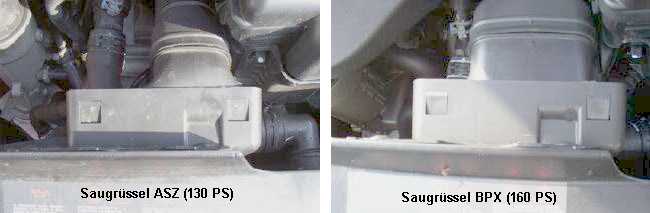
I borrowed two pictures of suction cups from the Ibiza forum (@Monchi: I hope you're not upset).
-> once, the well-known ASZ engine in the Ibiza 6L (my Polo has the same parts).
-> Once, I had the new 1.9-liter engine with 160 horsepower in an Ibiza Cupra 6L.
When I look at this and consider that normal TDIs, due to the bottleneck called the intake manifold, already experience about 50 mbar of "air restriction" at maximum pressure, but a large intake diameter apparently is also feasible, then I wonder why not allow all TDIs to have an unrestricted intake, like the Ibiza Cupra?
Okay, I don't know exactly how much larger his intake opening is compared to the ASZ.
But for just ~0.2 bar, which is 15% more boost pressure than the standard turbocharger, it already looks quite impressive, doesn't it?
The 160 model actually reaches its peak power at 3,750 rpm, if I recall correctly.
| Description: |
|
| File size: |
19.53 KB |
| Viewed: |
2377 times |
|
Gruß Ulf
_________
MG4 Electric
Translated on 30-09-2026, 8:55.
|
|
| Back to top |
Profile PM Garage |
|
eike
Guest
Free account, no CAN development support
|
| 16-07-2004, 19:40 Subject: |
Quote |
|
Hi,
I think I read somewhere that the narrow suction nozzle also serves as a noise reduction measure.
1. Less noise escapes from small openings compared to large ones.
The thinner the air, the lower the sound energy density.
3. The thinner the nozzle, the greater the flow velocity must be to transport the same volume per unit of time. The sound waves travel against the flow, which further minimizes the noise.
These effects will likely be carefully weighed against the negative effects of the vacuum in the air filter housing, and this will lead to the chosen diameters...
Greetings.
Eike.
Translated on 30-09-2026, 8:57.
|
|
| Back to top |
|
|
ulf
Profi-Schrauber
Joined: 04/13/2002
Posts: 11058
Karma: +18 / -0
Location: Saarland
2023 MG ZS
Premium Support
|
| 16-07-2004, 23:06 Subject: |
Quote |
|
eike wrote: | I think I read somewhere that the narrow suction nozzle is also a noise reduction measure.
. . .These effects will likely be carefully weighed against the negative effects of the vacuum in the air filter housing, and this leads to the chosen diameters... |
It might be true... in that case, the 6L Cupra would have to have a kind of "license to consume more fuel"  .
But I can't quite imagine him sounding like a stereotypical "proll."
I once drove my car with the air intake system completely disconnected from the suction snorkel (using a hot air intake), and I practically didn't hear any difference.
With gasoline engines, I can understand it more easily, like the hissing sound coming from the throttle valve shaft, etc.
Or did the Ings simply adopt diesel technology without thinking and without any real need   ? Gruß Ulf
_________
MG4 Electric
Translated on 30-09-2026, 8:58.
|
|
| Back to top |
Profile PM Garage |
|
dieselmartin
Profi-Schrauber

Joined: 03/13/2003
Posts: 10121
Karma: +29 / -0
Location: in der Werkstatt
2007 Volkswagen Passat
Premium Support
|
| 19-07-2004, 10:28 Subject: |
Quote |
|
Hi Ulf,
Did you watch that AFN broadcast about the Russell case back then?
If it's as thin as the one from the 1Z, you shouldn't be surprised about the intake manifold vacuum.
Why do the new engines draw air from the front again, instead of from the fender like before?
m;
Transparency, Teamwork
... there was another T.
I don't know what the f*ck it was.
Translated on 30-09-2026, 9:00.
|
|
| Back to top |
Profile PM Garage |
|
ulf
Profi-Schrauber
Joined: 04/13/2002
Posts: 11058
Karma: +18 / -0
Location: Saarland
2023 MG ZS
Premium Support
|
| 19-07-2004, 11:32 Subject: |
Quote |
|
dieselmartin wrote: | | Did you watch that Russell interview from AFN back then??? |
Yes, just looking at it gives you a feeling of suffocation... I think the intake diameter is around 10 cm².
Quote: | | Why are the new engines drawing air from the front again, and not anymore from the fender |
Is that the case with all newer engines?
-> Perhaps to keep the ET business with LMM going (-> Gischtsauger) Gruß Ulf
_________
MG4 Electric
Translated on 30-09-2026, 9:01.
|
|
| Back to top |
Profile PM Garage |
|
eike
Guest
Free account, no CAN development support
|
| 21-07-2004, 22:29 Subject: Re: @ulf and Christians |
Quote |
|
The power, as you already mentioned, comes from the expansion! This is because the gases were not able to fully expand through the open exhaust valve and, consequently, must be pushed outwards by the piston, against an external pressure of several bar instead of just one bar. The piston performs work against this external pressure, and that power comes from the crankshaft.
Hi,
Currently, the prevailing opinion is that the power required to drive the turbocharger is lacking, as the pistons ultimately have to force the exhaust gases through the turbocharger.
Looking at it closely, it's actually the case that, at the same time, a piston forces the exhaust gases through the turbocharger, thereby driving the turbocharger. The boost pressure, at the same moment, causes additional torque to be transferred to the crankshaft in another cylinder (which is currently being charged), because the pressure on the piston, due to the incoming intake air, is greater than the pressure in the crankcase.
Consequently, the power output of the turbocharger may not be as high as one might think. It would be different if the boost pressure were not used to fill the cylinders. However, that is precisely what is happening.
The actual loss of propulsion power should, theoretically, be solely due to losses caused by the low-level components, flow resistance, and frictional resistance.
What do you think about that?
Greetings.
Eike.
Translated on 30-09-2026, 9:03.
|
|
| Back to top |
|
|
ulf
Profi-Schrauber
Joined: 04/13/2002
Posts: 11058
Karma: +18 / -0
Location: Saarland
2023 MG ZS
Premium Support
|
| 23-07-2004, 11:51 Subject: Re: @ulf and Christians |
Quote |
|
eike wrote: | The actual loss of propulsion power should, theoretically, be solely due to losses caused by the lubrication system, flow resistance, and friction.
What do you think about that? |
Hi Eike,
 That thought, in my opinion, is not something to dismiss out of hand.
From this perspective, the loader drive is, in principle, essentially "free", and power is "only" needed to compensate for the non-100% efficiencies and other losses.
By the way, it seems that, in my opinion, the high volume flow of hot exhaust gases could potentially replace a portion of the "boost pressure" provided by the turbocharger.
If the useful power of a charger is calculated based on the intake volume flow and the resulting pressure difference, then shouldn't the drive power also be calculated analogously?
-> Exhaust gas mass flow * pressure drop across the turbine (where the efficiency likely varies depending on the different positions of the wastegate/VTG).
Conclusion: The hotter the exhaust gases are, and consequently, the greater the exhaust gas volume flow, the less pressure is required by the turbocharger for its operation.
"This is also, in my opinion, how the 'full load surge due to open EGR' issue can occur. A portion of the fresh air that passes through the mass airflow sensor (MAF) is factored into the fuel injection quantity, while a different portion bypasses the combustion chambers and goes directly into the exhaust system via the EGR valve."
This would mean that the (average) sum of the exhaust back pressures from the turbocharger, catalytic converter and silencers is lower than the boost pressure  .
- because only this pressure distribution can directly transport air from the "intake" side into the exhaust without the need for a pump (i.e., an engine).
Or am I completely wrong about this? Gruß Ulf
_________
MG4 Electric
Translated on 30-09-2026, 9:07.
|
|
| Back to top |
Profile PM Garage |
|
donalexo
Profi-Schrauber
Joined: 01/09/2003
Posts: 695
Karma: +0 / -0
Location: Würzburg
Support
|
| 23-07-2004, 12:45 Subject: |
Quote |
|
@ Ulf:
Quote: | | From this perspective, the loader drive is essentially "free," and power is "only" needed to compensate for the non-100% efficiencies and other losses. |
Not quite, because the larger cylinder volume must be compressed in the second stroke. The compression pressure at the end of the compression stroke is significantly higher in a turbocharged engine than in a naturally aspirated engine  .
Regards,
Alex. AUDI A3 1.9 TDI, EZ 12/96, ursprüglich MKB AGR, umgebaut zum AHF mit GT1749V-Lader, verkauft mit 250tkm
Golf 4 1.9 TDI, EZ 1/98, MKB ALH, jetzt auch mit GT1749V-Lader, verkauft mit 300tkm
Touran 1.9 TDI, EZ 09/2004
Audi A4 Avant 2.0 TDI, EZ 03/2010
Translated on 30-09-2026, 9:10.
|
|
| Back to top |
Profile PM |
|
ulf
Profi-Schrauber
Joined: 04/13/2002
Posts: 11058
Karma: +18 / -0
Location: Saarland
2023 MG ZS
Premium Support
|
| 23-07-2004, 12:58 Subject: |
Quote |
|
donalexo wrote: | Quote: | | From this perspective, the loader drive is essentially "free" in principle, and power is "only" needed to compensate for the non-100% efficiencies and other losses. |
Not quite, because the larger cylinder volume must be compressed in the second stroke. The compression pressure at the end of the stroke is significantly higher in a turbocharged engine than in a naturally aspirated engine | .
But is the increased compression ratio really "lost"?
-> Thought experiment:
The diesel engine, when operating in "boost" mode, experiences virtually no pumping losses (compared to a gasoline engine) due to the absence of a throttle valve.
If you let a diesel engine with external charging run in overrun mode, its braking effect (i.e., power loss) will practically not increase (except minimally due to increased bearing friction + gas losses due to normal minor leaks in valves + piston rings).
Because the work required for higher compression is returned during the "idle working cycle" - just like a spring that is more tightly tensioned or replaced with a stiffer spring  .
... which, in my opinion, is only masked by the combustion process when the engine is running.
. . . and in real-world operation, the relaxing (higher) intake compression ultimately contributes to driving the turbocharger  . Gruß Ulf
_________
MG4 Electric
Translated on 30-09-2026, 9:12.
|
|
| Back to top |
Profile PM Garage |
|
eike
Guest
Free account, no CAN development support
|
| 23-07-2004, 15:42 Subject: Re: @ulf and Christians |
Quote |
|
From this perspective, the loader drive is, in principle, essentially 'free', and power is 'only' needed to compensate for the non-100% efficiencies and other losses.
By the way, it seems that, in my opinion, the high volume flow of hot exhaust gases could potentially replace a portion of the 'boost pressure' provided by the turbocharger.
...
Hi Ulf,
Another observation of mine seems to confirm this. When I release the accelerator pedal after a period of full throttle on the highway, the turbocharger pressure should drop to zero. However, it doesn't. It remains at approximately 0.3-0.5 bar for several seconds and only slowly decreases to zero as the engine speed drops below 3000 rpm.
The explanation could be that the intake air absorbs so much energy from the hot engine that it eventually drives the turbocharger strongly enough to generate boost pressure.
This effect could be amplified by deactivating the LLK (likely referring to a specific component or system), as this component currently draws additional energy from the energy cycle through its cooling process.
The conclusion is that the overall efficiency of the engine decreases as the charge air is cooled more effectively, because the heat energy that is dissipated after being released is no longer available to drive the turbocharger.
This, in turn, suggests that the size of the LLK (Low-Temperature Combustion) system may indeed be a compromise between efficiency and NOx (nitrogen oxide) emissions.
Greetings.
Eike.
Translated on 30-09-2026, 9:16.
|
|
| Back to top |
|
|
|


 Bookmarks
 Links
Links Garage
 FAQ, Legal Notice & Privacy
 RSS Feed
 Register
 Login
Login
