| brachte eine Spritzbeginnkennfeldadaption einen meßbaren Spareffekt? |
| ja |
|
29% |
[ 5 ] |
| weiß nicht |
|
0% |
[ 0 ] |
| keine Adaption durchgeführt |
|
47% |
[ 8 ] |
| nein |
|
23% |
[ 4 ] |
|
| Total votes : 17 |
|
| Author |
Message |
Jan6K

Joined: 04/12/2002
Posts: 4741
Karma: +107 / -0 
Location: Hagen
Premium Support
|
 20-01-2005, 18:53 Subject: 20-01-2005, 18:53 Subject: |
Quote |
|
Hi,
I'd like to express my interest already... and I think this will also be of interest to many others.
Regarding publication... if you post something here, we can easily copy excerpts or the entire text into one of our articles, or even create a new article from it; it's not complicated.
Or, if Rainer approves of it, you can then summarize it yourself as a technical article at the end.
Best regards,
January.
1Z5 CFHF  / AHB H4D 
Translated on 09-08-2026, 11:40.
|
|
| Back to top |
Profile PM |
 |
ulf
Profi-Schrauber

Joined: 04/13/2002
Posts: 11058
Karma: +18 / -0
Location: Saarland
2023 MG ZS
Premium Support
|
| 20-01-2005, 18:54 Subject: |
Quote |
|
bafische wrote: | | Due to time constraints, I am unable to provide a detailed technical response regarding SEATArosa (I will be traveling starting tomorrow morning, but "postponed" is not "canceled"), however, if there are multiple people interested, I would - only then - comment on some sections in small pieces next week. |
My interest is certainly yours already. 
Quote: | I'll try to find some literature on the topic. I need your help with that, as I'm not yet able to create a website myself. Perhaps one of your moderators could receive something from me via email and then post it here.
There are definitely still things we can all learn. |
I suggest you email these things directly to Rainer K., as he can put them online in the best way – and also keep an eye on any potential copyright issues. Gruß Ulf
_________
MG4 Electric
Translated on 09-08-2026, 11:41.
|
|
| Back to top |
Profile PM Garage |
|
SeatArosa1.7SDI
Guest
Free account, no CAN development support
|
| 21-01-2005, 20:50 Subject: |
Quote |
|
Okay, I accept the criticism and will modify some of the statements that were made in the heat of the moment.
Because that
Correction: Because I believe this justification is unsuitable for even briefly explaining the matter at hand.
Ulf has already corrected the other statement.
I am also interested in a continuation of the discussion between Bafische and everyone else, but I have the feeling that Bafische didn't take it too seriously from the beginning, did she?
hello
Translated on 09-08-2026, 11:43.
|
|
| Back to top |
|
|
SeatArosa1.7SDI
Guest
Free account, no CAN development support
|
| 22-01-2005, 18:41 Subject: |
Quote |
|
Hey everyone, there's a simple way to globally increase the injection start timing. According to 'TDI industrial engines':
'To compensate for the increased ignition delay in a cold engine, fuel injection must occur earlier. The temperature signal from sensor G62 is used to adjust the corresponding map accordingly.'
So, the idea is to replace G62 with a dummy that simulates a constant temperature of, for example, 0°C for the EDC. The question is whether there's still a temperature sensor in the EDC to check the plausibility of G62. If G62 is constantly 'colder' than the environment, something must be wrong with the EDC.
How intelligent is the EDC in that regard?
Regards,
Holger.
Translated on 09-08-2026, 11:46.
|
|
| Back to top |
|
|
SeatArosa1.7SDI
Guest
Free account, no CAN development support
|
| 22-01-2005, 20:28 Subject: |
Quote |
|
Here's the graphical representation of the injection start field again:
http://www6.1mb.at/uploads/22.01.2005_13:13:49_spritzbeginnkennfeld.jpg
It is noticeable that the early injection timing decreases at medium and high injection volumes and rotational speeds of 1500-2500 RPM (assuming a rotational speed scale of 1000-4000 RPM). This decrease is most pronounced between 50% and 75% injection volume. In other words, it occurs primarily under partial load conditions, as Ulf already mentioned.
Is this the infamous NOx compromise that, according to 'TDI Industrial Engines,' results in approximately a 4% higher fuel consumption?
Regards,
Holger.
Translated on 09-08-2026, 11:49.
|
|
| Back to top |
|
|
Andi aus dem Ösiland
Guest
Free account, no CAN development support
|
| 23-01-2005, 17:41 Subject: |
Quote |
|
Hello!
Please provide the text you would like me to translate from German to English. I will then give you only the translation, without any explanations.
Attention: The axes representing engine speed and fuel mass do not follow a linear scale! The association of each data point with its corresponding fuel mass/engine speed is indicated in the dataset before each characteristic curve, in the form of a mapping table.
2.
By simulating a lower coolant temperature, the fuel injection amount is also increased, which can lead to higher fuel consumption.
'Fuel-saving tuning' of the fuel injection timing can be beneficial if the tuner only advances the timing slightly in the partial load range (by raising the 'bowl' of the characteristic curve shown above).
For models like the 1Z, AAT, AEL, etc. (i.e., all the 'older' models), anyone with a basic understanding of internal combustion engines and electronics can do it themselves. I even optimized my own AAT engine (using Mr.Ed).
Best regards,
Andi.
Translated on 09-08-2026, 11:53.
|
|
| Back to top |
|
|
SeatArosa1.7SDI
Guest
Free account, no CAN development support
|
| 23-01-2005, 20:18 Subject: |
Quote |
|
Hi Andi!
Warning: The speed or fuel mass axes are not linear.
And why aren't the axes of the graph made linear and scaled accordingly? Or, if a linear representation is not suitable, why not scale them non-linearly?
By simulating a lower coolant temperature, the fuel injection amount is also increased, which can lead to higher consumption.
Hmmm... I don't understand that. If the EDC increases the fuel injection amount at the same throttle position, it also increases engine power, which means the driver has to ease off on the accelerator pedal slightly in order not to exceed their desired speed or acceleration. In short, only the position of the accelerator pedal changes for the same driving cycle. So why is there increased fuel consumption?
'Fuel-saving tuning' of the fuel injection start is useful when the tuner only adjusts the timing slightly 'earlier' in the partial load range (raising the 'dip' of the characteristic curve shown above).
'That's exactly what I would like to do, but unfortunately, VAG didn't include any software that allows users to freely create and modify parameter maps on a computer and then upload them to the EDC.'
Can a global advance in the start of irrigation be achieved only through adaptation or by using a fake temperature sensor, or does this not apply to the use of a fake temperature sensor?
Hardware solutions that only delay the NHG signal at specific speeds would be challenging. However, I already have some preliminary sketches. The goal is to keep the design as simple as possible while still delivering a useful result.
Best regards,
Holger.
Translated on 09-08-2026, 11:56.
|
|
| Back to top |
|
|
Andi aus dem Ösiland
Guest
Free account, no CAN development support
|
| 23-01-2005, 21:07 Subject: |
Quote |
|
Hello!
And why aren't the axes of the graph made linear and scaled accordingly? Or, (if a linear representation would be too poor), why not scale them non-linearly?
I guess nobody bothered to do that in the documentation! I also don't know of any tuning software that allows you to display mapping tables linearly; instead, the values are simply specified for each data point on the axes.
Hmmm... I don't understand that. If the EDC increases the fuel injection amount at the same throttle position, it also increases engine power, which means the driver has to ease off on the accelerator pedal slightly in order not to exceed their desired speed or acceleration. In short, only the position of the accelerator pedal changes with the same driving cycle. So why is there increased fuel consumption?
Well, as I said, it *can* lead to increased fuel consumption, but it doesn't necessarily have to. It also depends on which engine it's done on. For example, in my AAT engine, it's not very beneficial because it's already close to the smoke limit with its stock boost pressure, meaning it will simply produce more soot (and even an earlier injection timing won't help much).
Only through adaptation or a temperature sensor fake can a global advance in the start of irrigation be achieved, or does this not apply to the temperature sensor fake?
Okay, it applies to fake temperature sensors.
I would only have it done by a professional chip tuner.
Best regards,
Andi.
| Description: |
|

Download |
| File name: |
spritzbeginn.xls |
| File size: |
31.5 KB |
| Downloaded: |
754 times |
Translated on 09-08-2026, 12:01.
|
|
| Back to top |
|
|
SeatArosa1.7SDI
Guest
Free account, no CAN development support
|
| 23-01-2005, 21:44 Subject: |
Quote |
|
Hi Andi,
For example, with my AAT, it's not very useful because it's already running close to the smoke limit with its standard boost pressure, meaning it will simply produce more soot (and even an earlier injection timing won't help much)!
Okay, exceeding the soot limit would lead to increased consumption. However, I probably don't have to worry as much about the soot limit with my vehicle because I use rapeseed methyl ester (RME) and heating oil. This raises the soot limit.
And if you don't always accelerate with the gas pedal fully pressed, you can also avoid soot formation in that way.
So, I would only have it done by a professional chip tuner!
No, I wouldn't get that invested money back after 100 years through the fuel saved.
'In this respect, genuine cost-saving modifications are actually more difficult than performance tuning, because with the latter, there aren't such strict cost-benefit calculations involved. More power is a fun factor that cannot be universally offset by money.'
However, thriftiness must always be worthwhile; otherwise, it is pointless. Fuel-saving tuning should ideally cost nothing, which is inherent to the concept.
Regards,
Holger.
Translated on 09-08-2026, 12:04.
|
|
| Back to top |
|
|
ulf
Profi-Schrauber
Joined: 04/13/2002
Posts: 11058
Karma: +18 / -0
Location: Saarland
2023 MG ZS
Premium Support
|
| 23-01-2005, 22:19 Subject: |
Quote |
|
SeatArosa1.7SDI wrote: | | Fuel-saving tuning should ideally cost nothing, that's simply the nature of the thing. |
So, if you set the pump to "too early" -> see above  . Gruß Ulf
_________
MG4 Electric
Translated on 09-08-2026, 12:06.
|
|
| Back to top |
Profile PM Garage |
|
SeatArosa1.7SDI
Guest
Free account, no CAN development support
|
| 24-01-2005, 19:24 Subject: |
Quote |
|
So, set the pump to 'too early' -> see above
Hi Ulf! I still have a detailed answer to provide you.
If the pump is running late, the control limit will be exceeded, and in some cases, this may lead to emergency operation. Now, here's an interesting question: At what point does the EDC (Electronic Diesel Control) reach its limit? How much 'early injection' can it tolerate at the 'late' end of the injection timing range?
Regards,
Holger.
Translated on 09-08-2026, 12:07.
|
|
| Back to top |
|
|
ulf
Profi-Schrauber
Joined: 04/13/2002
Posts: 11058
Karma: +18 / -0
Location: Saarland
2023 MG ZS
Premium Support
|
| 24-01-2005, 19:43 Subject: |
Quote |
|
SeatArosa1.7SDI wrote: | | If the pump is running with a late injection timing, the control limit will be exceeded, and in some cases, it may enter emergency mode. Now, the interesting question: From what point onwards? How much ° of advance timing can the EDC still tolerate at the "late" end? |
At the AFN, the minimum required angular frequency is approximately 1.5 kHz.
I don't know if it could have gone any further. Gruß Ulf
_________
MG4 Electric
Translated on 09-08-2026, 12:09.
|
|
| Back to top |
Profile PM Garage |
|
Wolfgang, syncro16
Guest
Free account, no CAN development support
|
| 25-01-2005, 2:44 Subject: |
Quote |
|
Hello,
I have to interject here with a bit of clarification. If the rules for exhaust gas treatment could be explained in just a few sentences, car manufacturers could save millions of dollars in research on this area. I don't want to start a discussion either for or against AGR (I myself suffer from AGR issues), nor do I want to decide who is right, but I simply want to correct some things that SeatArosa1.7SDI wrote.
'Quote:'
The burnt air and fuel are burned again.
It's utter nonsense. The exhaust gas consists of a mixture of gases that, as a reaction partner for further oxidation, is essentially no longer available (approximately 3/4 N2, 1/4 CO2 plus residual O2, traces of CO, HC, NOx). In other words, virtually the entire recirculated exhaust gas leaves the engine without having undergone any reaction and exits through the exhaust system, where it either permanently leaves the engine or goes through the same process again.
The assumption that exhaust gases cannot participate in a chemical reaction a second time is incorrect. The course of a reaction is determined by the temperature and all participating reactants. It doesn't matter where the temperature comes from. Molecules move around, and the faster they move, the higher the temperature is. They collide with each other, which can lead to existing molecules being split or new molecules being formed. Temporary exotic substances can also be created in this process, but they can also decay just as quickly. This process cannot be selectively restricted to specific reactants. Of course, there are reactive and unreactive substances. However, even the relatively inert N2 can sometimes be converted into NO2, and it is precisely these rather rare occurrences that we are talking about here.
With a 50% EGR rate, the intake air mass flow would be reduced by half, which is correct. However, it's absurd to conclude that the volume of fuel-oxygen reaction products in the exhaust would also halve, because the same amount of fuel must be burned to maintain the same engine power, regardless of whether or not EGR is used. The difference is that with a 50% EGR rate, the remaining oxygen content in the resulting intake air must be utilized much more effectively to completely burn the same amount of fuel -> the residual oxygen content in the exhaust decreases (theoretically down to zero, but practically impossible due to the lack of a homogeneous fuel-air mixture). To compensate for the decrease in the EGR rate, all other inert atmospheric gases in the exhaust volume flow, which are simply pumped through the engine (except for the small fraction of N2 that is oxidized to NOx), such as N2, CO2, Argon, etc., would decrease. The total volume flow through the engine decreases due to the EGR, but not the volume flow of exhaust gases in terms of reaction products from the fuel+oxygen reaction (CO2, H2O, CO, HC, soot). What decreases is only the volume flow of inert gas, which has nothing to do with the absolute amount of reaction products in the exhaust (except for NOx).
The conclusion mentioned was not actually made by 'bafische,' but rather she only wrote about a 'drastic reduction of all pollutant components.' However, there is some truth to it; the 50% exhaust gases are not simply released, but instead return to the cylinder, and that's where things get interesting. There's a significant chance that pollutants can be converted back into 'good' substances. If you want to contradict this, you would need to plausibly demonstrate that the total combustion products with EGR contain twice as much or at least significantly more pollutants than without EGR. The argument about fuel doesn't address this. It is true that the oxygen content is reduced, but that's precisely the point of EGR; it reduces the formation of NOx. This is currently the only way to deal with these substances, and it is well known that they are harmful.
You're making a distinction here between the reaction of fuel and oxygen versus 'inert' gas. That doesn't work like that (see above). The only gas that is somewhat inert is argon, because it's a noble gas.
Only the 1% by volume of CO and hydrocarbons can theoretically be oxidized 'in a second attempt,' but even this consideration is highly questionable. 1% of flammable gases are far from forming an ignitable mixture with the intake air, as in a gasoline engine, which, once locally ignited, would spontaneously ignite. Since the mixture is practically homogeneous, only the portions of the 1% gas that are directly adjacent to local ignition sources (the injecting fuel jets) have a chance to oxidize during the injection process. A large portion of the gases are located in 'colder' layers of air within the combustion chamber and will never ignite. So much for the myth of CO and HC being 'afterburned.' (Soot does not ignite anyway.)
The 1% mixture doesn't need to ignite on its own; it participates in the ongoing combustion process, as I described earlier. It also doesn't necessarily have to be directly adjacent to the fuel injectors, because the combustion takes place throughout the entire cylinder. While it's the aspiration of engine developers to keep the combustion away from the cylinder walls, to my knowledge, this hasn't been achieved yet. If you have any information that contradicts this, I would be very interested to hear about it (we are talking about mass-produced engines here; let's set aside things like Elsbeth and similar specialized applications).
The discussion is pointless, of course, because we all know what the outcome will be. I once looked up the TDI engine in the VW self-study program: the AGR (selective catalytic reduction) reduces HC and NOx emissions, but increases CO and particulate matter emissions. The latter, however, only occurs under certain operating conditions. Presumably, these are the operating conditions where the excess oxygen is not very high.
Hello.
Wolfgang.
Translated on 09-08-2026, 12:15.
|
|
| Back to top |
|
|
dieselschrauber
Administrator

Joined: 04/12/2002
Posts: 18119
Karma: +801 / -0
Location: St.Gallen
2018 Volkswagen T6 
|
| 26-01-2005, 0:30 Subject: |
Quote |
|
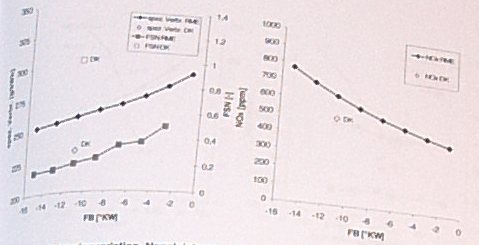
Unfortunately, it's difficult to make out clearly due to the lack of a scanner.
The trend itself pretty much says everything you need to know to draw your own conclusions.
y-Achse linkes Diagramm: spez. Consumption [g/kWh]
y-axis (right chart): NOx [parts per million]
x-axis: Start of feed advance (FB) [degrees KW].
Best regards, Rainer.
| Description: |
|
| File size: |
18.2 KB |
| Viewed: |
3744 times |
|
Translated on 09-08-2026, 12:23.
|
|
| Back to top |
Profile PM WWW Garage |
|
olbetec
Schrauber

Joined: 08/14/2002
Posts: 76
Karma: +4 / -0
Location: Garbsen bei Hannover
Support
|
| 27-01-2005, 19:09 Subject: |
Quote |
|
Was sind die beiden linken Verbrauchskurven bzw. die einzelnen Werte? With or without EGR?
Take another breath of that same air.
Okay, please provide the German text you would like me to translate into English. I will only provide the translation.
Fabia I TDI, EZ06/01 (1,9/74kW, ATD)
Octavia II TDI DSG EZ11/06 (2,0/103kW, BMM)
Translated on 09-08-2026, 12:24.
|
|
| Back to top |
Profile PM |
|
dieselschrauber
Administrator
Joined: 04/12/2002
Posts: 18119
Karma: +801 / -0
Location: St.Gallen
2018 Volkswagen T6
|
| 27-01-2005, 22:41 Subject: |
Quote |
|
Hi,
No, converting biodiesel to diesel. According to another diagram, a functioning EGR system costs negligible fuel, but as the EGR rate increases, so does ignition delay (which should still affect fuel consumption somewhat if the ECU is not programmed accordingly and the spark advance is not adjusted).
The biggest advantage of a malfunctioning EGR valve might be its anti-sludge effect in the intake manifold.
Best regards, Rainer.
Translated on 09-08-2026, 12:25.
|
|
| Back to top |
Profile PM WWW Garage |
|
|


 Bookmarks
 Links
Links Garage
 FAQ, Legal Notice & Privacy
 RSS Feed
 Register
 Login
Login


