| Author |
Message |
ulf
Profi-Schrauber

Joined: 04/13/2002
Posts: 11058
Karma: +18 / -0 
Location: Saarland
2023 MG ZS
Premium Support
|
 17-05-2007, 20:03 Subject: 17-05-2007, 20:03 Subject: |
Quote |
|
hame22 wrote: | Hi Ulf
These tests are yours. Can you give me some numbers?
post? |
Hm, what exactly do you mean? The diagram in the journal article?
I just quickly threw that together to explain how the power distribution changes with speed, and how that affects my DZR times before and after.
I don't have any more test data. Gruß Ulf
_________
MG4 Electric
Translated on 03-07-2026, 15:19.
|
|
| Back to top |
Profile PM Garage |
 |
hame22
Blaumann

Joined: 12/15/2004
Posts: 84
Karma: +5 / -0
Support
|
| 03-11-2007, 19:32 Subject: |
Quote |
|
Hello everyone,
Today, I finally got around to adjusting the timing belt.
to check on my Passat AVF.
More specifically, I had a friend do it for me, who works at...
VW is working. I wanted to see how they do it first.
Here's what I've observed.
First, the NW (Northwest) joint is locked. Subsequently, the KW locking mechanism was installed.
If the quick-wind (KW) locking mechanism doesn't quite fit, a...
The wrench slightly loosened the crankshaft.
to allow the locking mechanism to engage properly (difference of approximately 1/3 of a tooth).
At that point, the "OT" marking was no longer visible on the gearbox flange.
The interaction between the locking mechanism and the rear wheel is present, however.
minimal.
I once tried to adjust the timing belt myself, like this.
to ensure that both locking mechanisms can be installed without any problems.
allow. After a couple of test runs (loosening the NW screws), I had it.
managed to do it.
And what else can I say?
Suddenly, despite both locking mechanisms (original VW), the...
"I can see the OT mark on the gearbox flange, and it's located exactly at the marking."
I'm now convinced that by lengthening the belt and...
through that, let's say, somewhat "inaccurate" tool, we can identify the unfavorable aspects.
Settings have been applied. In my case, it would be perfectly acceptable to use the "peek-hole" method.
"You could work on it with Ulf, and you would still be able to install the KW locking mechanism."
First impressions:
1.) According to the display, the fuel consumption while idling has increased from 0.5/0.6 to 0.8/0.9.
It remains to be seen whether this will actually change the real consumption.
2.) The swelling in the lower area isn't as pronounced anymore. The suit fits more evenly.
3.) It seemed to be working better subjectively when he was on the highway. It seems to have more bite now.
I haven't checked the settings of the PD elements yet because I don't want to rely too much on...
I wanted to change it once. Based on my initial impressions after driving it, I'm going to contact...
Adjusting the PD settings.
Therefore, my tip: You should check the timing belt adjustment from time to time.
Please provide the text you would like me to translate from German to English. I will then provide the translation and, if necessary, correct it.
Regards,
Okay, here's the translation:
"Hame"
Translated on 03-07-2026, 15:19.
|
|
| Back to top |
Profile PM |
|
hame22
Blaumann
Joined: 12/15/2004
Posts: 84
Karma: +5 / -0
Support
|
| 12-11-2007, 21:53 Subject: |
Quote |
|
Hi,
Okay, just a quick update after the first few kilometers.
Apparently, there hasn't been much change in consumer behavior.
It's also gotten colder since then. So, I'll just wait a bit longer.
But since then, the fuel gauge seems to be more accurate.
Before the adjustment, I had a discrepancy of approximately 0.8 liters.
It consistently showed a lower consumption than what was actually used.
The current deviation is approximately 0.1 liters, plus or minus.
Regards,
Okay, here's the translation:
"Hame"
Translated on 03-07-2026, 15:19.
|
|
| Back to top |
Profile PM |
|
BM
Profi-Schrauber

Joined: 12/07/2005
Posts: 1857
Karma: +8 / -0
Location: Nähe Düsseldorf
Premium Support
|
| 13-11-2007, 1:19 Subject: |
Quote |
|
Quote: | The following is what I observed.
First, the NW (Northwest) joint is locked. Subsequently, the KW locking mechanism was installed.
If the KW locking mechanism doesn't quite fit, a...
The wrench slightly loosened the crankshaft.
to allow the locking mechanism to engage properly (difference of approximately 1/3 of a tooth).
At that point, the "OT" marking was no longer visible on the gearbox flange.
The interaction between the locking mechanism and the rear wheel is present, however.
minimal. |
This method won't work either, because the "correct" procedure takes into account the use of special tools. It involves rotating the crankshaft in the direction of rotation by approximately 10 degrees, then installing the crankshaft locking tool, and slowly rotating it further until it can be inserted. In this position, the NW pin must be able to be inserted without getting stuck. 3B5 AJM
Wer nichts weiss, muss alles glauben.
**Technische Fragen bitte ins Forum und nicht in mein Postfach**
LG, Onkel BM
Translated on 03-07-2026, 15:19.
|
|
| Back to top |
Profile PM |
|
hame22
Blaumann
Joined: 12/15/2004
Posts: 84
Karma: +5 / -0
Support
|
| 13-11-2007, 20:06 Subject: |
Quote |
|
Good evening.
Quote: |
That simply won't work, because with the "correct" settings, the game will...
taking into account the special tools, by rotating the shaft in the direction of rotation up to approximately 10.
Turn the knob, then attach the KW stop, and slowly continue turning until it...
can be easily implemented right now. In this position, the NW pin must be positioned without causing any...
have the terminals installed.
|
Unfortunately, it was and still is like that.
But this deviation seems to work to a certain extent.
Quote: |
And what else can I say?
Suddenly, despite both locking mechanisms (original VW), the...
"I can see the OT mark on the gearbox flange, and it's located exactly at the marking."
I'm now convinced that by lengthening the belt and...
through that, let's say, somewhat "inaccurate" tool, we can identify the unfavorable aspects.
Settings have been applied. In my case, it would be perfectly acceptable to use the "peek-hole" method.
"You could work on it with Ulf, and you would still be able to install the KW locking mechanism."
|
And let's not forget the "inaccurate" mechanic who is doing their part.
If you read some of the forum posts, it doesn't seem as bad as some people claim, does it?
I've set it up exactly as it should be and as you wrote it.
Regards,
Okay, here's the translation:
"Hame"
Translated on 03-07-2026, 15:19.
|
|
| Back to top |
Profile PM |
|
hame22
Blaumann
Joined: 12/15/2004
Posts: 84
Karma: +5 / -0
Support
|
| 19-11-2007, 21:15 Subject: |
Quote |
|
Good evening.
Okay, I checked the basic settings of the PD elements this weekend.
or newly hired.
They were set to 225 degrees.
I have now adjusted it according to the new VW instructions to 180 degrees.
Changes:
The consumption has decreased from 0.8 to 0.7.
It also appears that the starting problem persists when the engine is cold.
to have gotten a little better. I will continue to monitor it.
It remains to be seen whether this setting will affect consumption.
Unfortunately, the slight jolts in the partial load range are still present.
Since the standard deviation among the PD elements is almost identical, or...
when the other options are close to zero, the only remaining option is the ZMS. In some posts, you can read that...
What about the seals of the PD elements?
Has anyone ever encountered a case like this before?
Well, the seals can't be expensive.
being and taking an exam doesn't cost much time either.
Regards,
Okay, here's the translation:
"Hame"
Translated on 03-07-2026, 15:19.
|
|
| Back to top |
Profile PM |
|
hame22
Blaumann
Joined: 12/15/2004
Posts: 84
Karma: +5 / -0
Support
|
| 25-11-2007, 13:23 Subject: |
Quote |
|
Okay,
Here's a small addition.
According to my latest measurements, the consumption is approximately 0.2-0.3 liters.
went back, even though the weather had become colder.
It refers to the measured value, not what is displayed.
The current consumption is approximately 6.7 liters.
Mix city and highway.
Vehicle: Passat, Varian, Highline, AVF, no engine tuning, currently with...
195/65 R15 tires.
Conditions: Not exceeding 110 km/h on the track, but sometimes exceeding it.
Stop and Go. "Gefahren" drives the same route almost every day, about 95% of the time.
Therefore, I believe that the measurements are reasonably informative.
I hope it wasn't just a short-term effect.
Could you please post your consumption data here?
Best regards,
Translated on 03-07-2026, 15:19.
|
|
| Back to top |
Profile PM |
|
Bo Duke
Blaumann
Joined: 12/17/2006
Posts: 146
Karma: +3 / -1
Premium Support
|
| 16-03-2008, 13:13 Subject: |
Translating... |
|
[Translating...] Da ich damals noch keinen Blaumann an hatte, hier noch einmal der Einstieg in die Synchronisationswinkel-Frage aus dem Allgemeinen Bereich (vgl. https://community.dieselschrauber.org/en/viewtopic.php?t=17496&highlight=nockenwelle+fr%FCh ):
Bo Duke wrote: |
Hallo zusammen,
nachdem ich es nun geschafft habe, den Zahnriemen zu tauschen (ARL MJ 2003) musste ich unbedingt Ulf's Anleitung zur Veränderung der Steuerzeiten bei PD's ausprobieren.
(vgl.: https://community.dieselschrauber.org/en/viewtopic.php?t=5408)
Schließlich wird dort genau das Problem behandelt, das mich immer genervt hat:
Kein Druck obenrum.
Kurze Rede: Es ist genau wie beschrieben: Motor dreht viel williger hoch und hat dafür im unteren und mittleren Bereich etwas Kraft verloren.
Verbrauch laut Anzeige jetzt 0,9-1,0l statt bisher 0,6-0,7l im Stand.
Bisher wurden hier nur DZR Zeiten, also von 2000 bis 4000 Umdrehungen, gepostet.
Meine DZR Zeit verbesserte sich lediglich um rund 0,1 Sek.
Allerdings hat sich die Zeit von 3000 auf 4000 Umdrehungen, also der obere Drehzahlbereich, von rund 3,6 Sek. auf sage und schreibe 2,8 verkürzt.
Da sich die Gesamtzeit 2000 bis 4000 kaum verändert hat ist klar, dass sich der Zuwachs obenrum zu Lasten der Beschleunigung untenrum ergeben hat.
Das wäre der objektivierte Beweis der verschiedentlich geäußerten subjektiven Empfindungen hinsichtlich der veränderten Leistungscharakteristik (vgl. https://community.dieselschrauber.org/en/viewtopic.php?t=6847).
Außerdem wird jetzt auch endlich die angegebene Höchstgeschwindigkeit sicher erreicht.
Weiterhin ist aufgefallen, dass das unter: „ https://community.dieselschrauber.org/en/viewtopic.php?t=14687&highlight=kaltstart+z%FCndaussetzer " beschriebene Ruckeln im Stand nach Kaltstart sich deutlich verringert hat.
Eingestellt habe ich die Nockenwelle folgendermaßen:
KW Stop aus Drehbewegung der Kurbelwelle gesetzt. Nockenwelle mit 5mm statt der eigentlich geforderten 6mm abgesteckt und die sich ergebende Differenz von 1 mm (im Absteckloch) auf früh gesetzt.
Weiß eigentlich jetzt jemand, ob sich aus einer solchen frühen Einstellung Schadpotential für die PDE’s etc. ergibt? Oder gibt es sonst irgendwelche neuen Erkenntnisse rund um das Thema?
Liebe Grüße,
Bo
|
Ulf wrote: |
Hi,
danke für Deinen Bericht und besonders die ersten Bestätigungs-Messungen der gefühlten Änderungen.
Interessant wären noch Deine Logdaten zum Synchronisationswinkel (MWB 4) vorher und nachher icon_wink.gif
Zitat:
Weiß eigentlich jetzt jemand, ob sich aus einer solchen frühen Einstellung Schadpotential für die PDE’s etc. ergibt? Oder gibt es sonst irgendwelche neuen Erkenntnisse rund um das Thema?
In den Links die Du gepostet hast, steht AFAIK unser "letzter Stand".
Ein wirkliches Schadpotential kann ich mir erstmal nicht vorstellen, angesichts der Druck-Mehrbelastungen, die die PDE beim Motortuning klaglos wegstecken .
_________________
Gruß Ulf
|
So, ich hab' jetzt mal den Synchronisationswinkel mitgeloggt. Er liegt bei warmem Motor im Leerlauf zwischen -3,9 und -4,4 (springt laufend hin und her). Für den Zeitraum vor der Verstellung des NW-Rades habe ich leider keine Logs.
a) 'Spec start of inj', übersetze ich mit Soll-Einspritzbeginn,
b) 'Spec inj, duration' mit Soll-Einspritzdauer oder so ähnlich.
Vorgegeben sind a) 3 bis 8 bzw. b) -3 bis +3, mein Log zeigt a) über 30 bzw. b) bis -4,4. - Oder gilt das nur für Leerlauf?
Die Zahlen machen mir ein wenig Angst  .
Wie gesagt, ich habe das Langloch nur um ca. 1 mm vorverstellt (ausgehend von der mit KW-Stop aus der Drehbewegung heraus arretierten KW und mit 6 mm Dorn abgesteckter NW = vorschriftsmäßig).
Wenn ich es einrichten kann, werde ich über Ostern mal wieder am NW-Rad rumfummeln und Logs bzw. DZR-Werte liefern.
Ich habe übrigens ein Leistungsdiagramm vor Zahnriemenwechsel und eins danach (mit der hier beschriebenen frühen Einstellung der Nockenwelle). Sie bestätigen hinsichtlich Drehmomentverlauf absolut das bisher Gesagte.
Ich werde sie hier uploaden, sobald ich sich als Datei vorliegen habe.
Bitte um Anworten zu den geposteten Messwerten,
lieben Gruß,
Bert
P.S.: Vielleicht kann mal jemand den Titel anpassen, um geplatzte PD-Elemente gehts ja nur noch am Rande |
|
| Back to top |
Profile PM |
|
Bo Duke
Blaumann
Joined: 12/17/2006
Posts: 146
Karma: +3 / -1
Premium Support
|
| 11-04-2008, 19:17 Subject: |
Quote |
|
Hello,
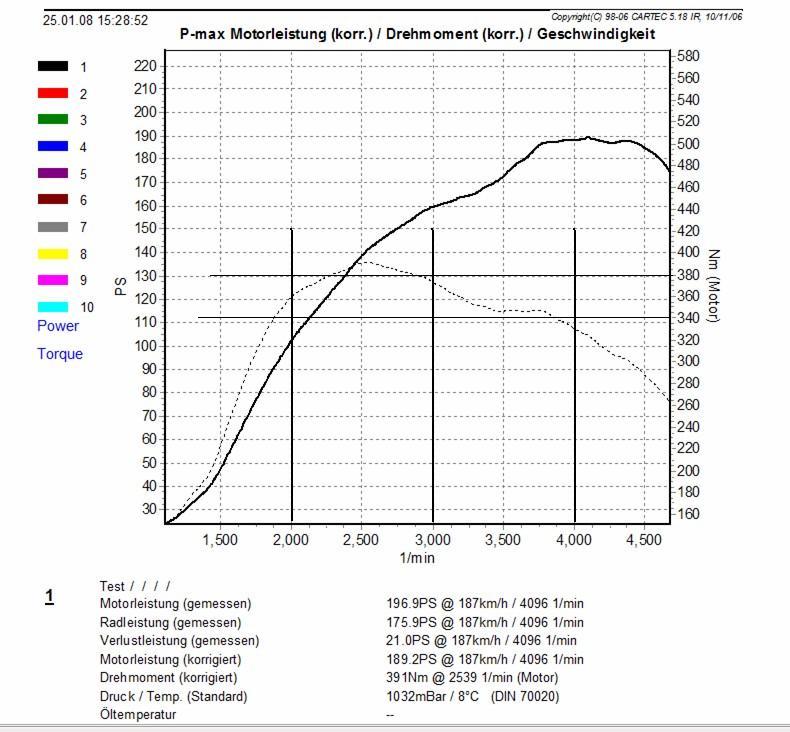
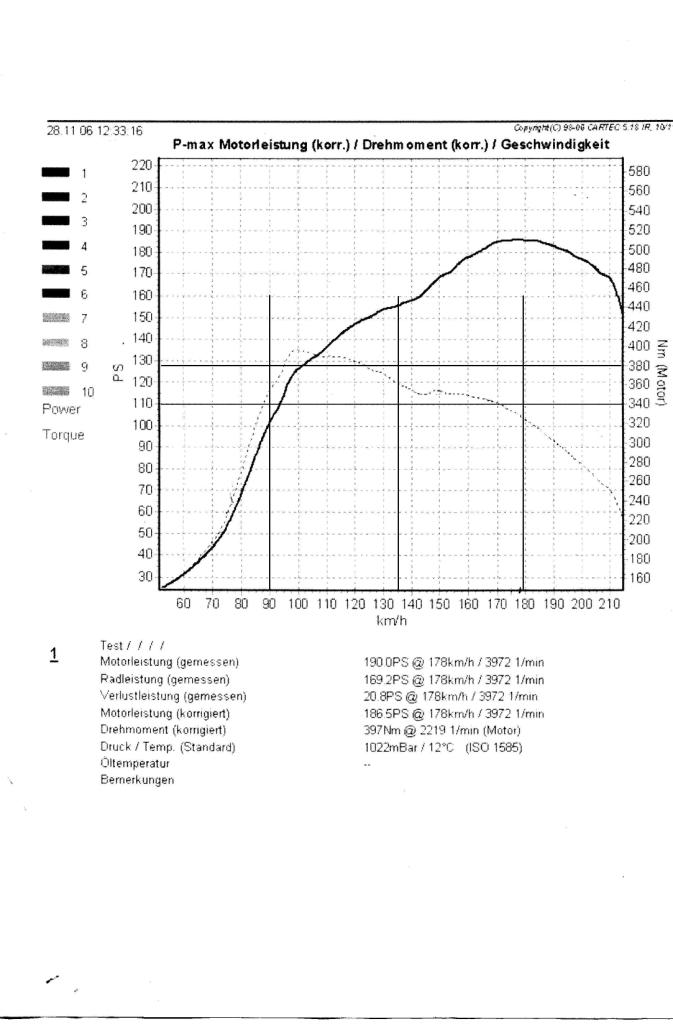
Here are the test runs that were announced.
To improve readability, I have added guide lines.
It is noticeable:
- Rated power at approximately 120 revolutions higher speed.
- Peak torque occurs later and approximately 300 revolutions after the start.
- In the range of 2000 to 3000 revolutions, the torque remains above 380 Nm for a shorter duration.
- In the range of 3000 to 4000 revolutions per minute, the torque curve is slightly more pronounced.
- Torque decreases less sharply from 3000 RPM.
Regards,
Bo.
| Description: |
|
| File size: |
90.22 KB |
| Viewed: |
4360 times |
|
| Description: |
|
| File size: |
75.35 KB |
| Viewed: |
4113 times |
|
Translated on 03-07-2026, 15:19.
|
|
| Back to top |
Profile PM |
|
ulf
Profi-Schrauber
Joined: 04/13/2002
Posts: 11058
Karma: +18 / -0
Location: Saarland
2023 MG ZS
Premium Support
|
| 11-04-2008, 21:13 Subject: |
Quote |
|
Bo Duke wrote: | It is noticeable:
- Rated power at approximately 120 revolutions higher speed.
- Peak torque occurs later and approximately 300 revolutions after the start.
- In the range of 2000 to 3000 revolutions, the torque remains above 380 Nm for a shorter duration.
- In the range of 3000 to 4000 revolutions per minute, the torque curve is slightly more pronounced.
- From 3000 RPM, the torque drops off less sharply | . . . and confirms quite accurately the (average) "butt-dyno" impressions after a pre-release of the NW.
Thank you for the pics  . Gruß Ulf
_________
MG4 Electric
Translated on 03-07-2026, 15:19.
|
|
| Back to top |
Profile PM Garage |
|
Bo Duke
Blaumann
Joined: 12/17/2006
Posts: 146
Karma: +3 / -1
Premium Support
|
| 11-04-2008, 22:31 Subject: |
Quote |
|
Hello Ulf,
You asked about the synchronization angles, but first, let's clarify some terms:
The following is:
* Late camshaft installation = factory setting (crankshaft stop).
* Normal camshaft timing = Top Dead Center (TDC) 1, achieved by aligning the timing marks through the inspection hole.
* Early timing = OT1 (Top Dead Center 1) achieved by using a KW (Krankwellenpositionssensor) stop and rotating the camshaft 1mm forward.
Unfortunately, I wasn't able to create any logs because I couldn't adjust the camshaft timing using the late setting, and I didn't have access to a VAG-COM device.
First, I made a decision too early, and I probably went a bit too far. Finally, as described above, I had a synchronization angle of -4.4.
Since you described quite clearly above that a very late injection start (measured by the camshaft position; i.e., at a very early camshaft position) leads to very high pressures, I wanted to clarify whether the better acceleration "at the top end" with a normal setting (i.e., a compromise between early and late) is offset by the earlier setting.
In short, that's not the case.
For each test, I performed 6 measurements (3 times in each direction, on a mostly flat stretch of road, with very little wind); once with the camshaft timing set earlier than usual, and once with the camshaft timing set to the normal setting.
I have compared the following times according to... Data logging.
For the late start, I need to rely on times that are already behind schedule.
a) 2000 to 3000
b) 3000 to 4000
c) 3250 to 3750
d) 3750 to 4250
late shift: a) 2.00 b) 3.60 c) -,- d) -,-
normal setting: a) 2.59 b) 2.96 c) 1.49 d) 1.64
early start: a) 2.60 b) 2.96 c) 1.48 d) 1.59
The extremely early camshaft timing was only marginally faster, within the hundredths of a second range, compared to the normal camshaft timing, and therefore likely within the measurement tolerance.
Therefore, it should be noted that adjusting the camshaft timing to be earlier than the normal setting does not provide any improvement.
Also, it's also interesting to note the displayed and actual consumption values, as well as the synchronization angles.
Consumption according to... Display l/h
late: 0.6 - 0.7
normal: 0.7 - 0.8
early: 1.0 - 1.1
Deviation between displayed reading / actual consumption.
late: almost no deviation.
normal: 0.2 - 0.3 liters too much displayed.
early: 0.5 - 0.6 liters displayed as too much.
Synchronization angle (warm engine, idle).
late: unknown
normal: -0.6
early: -4.4
Based on the observed consumption values, I estimate that the synchronization angle is approximately -3 degrees when initially adjusted (e.g., at the factory). Unfortunately, I don't have access to the log files, as I mentioned before.
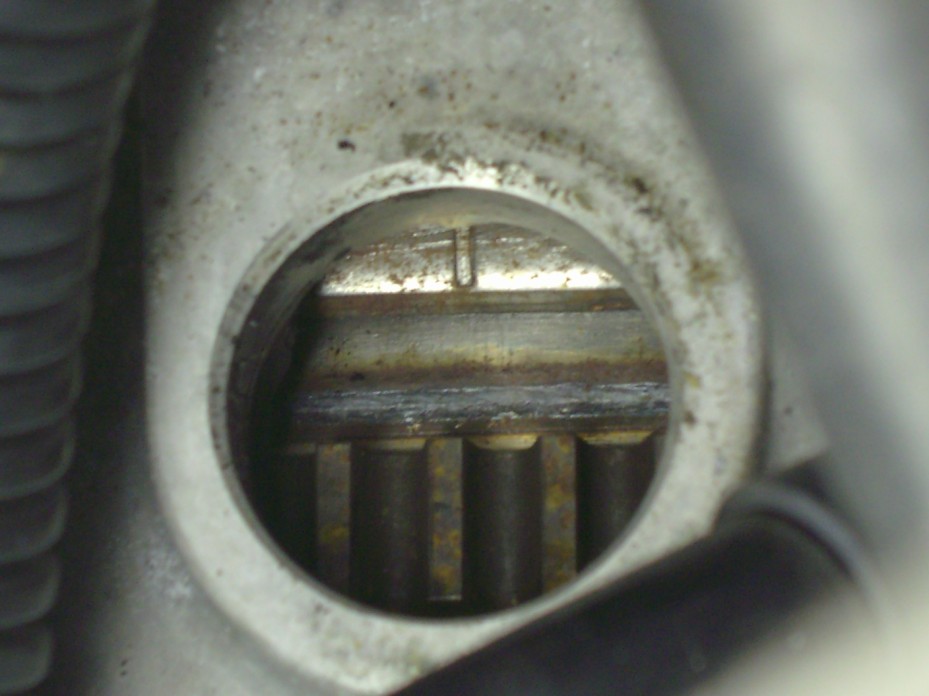
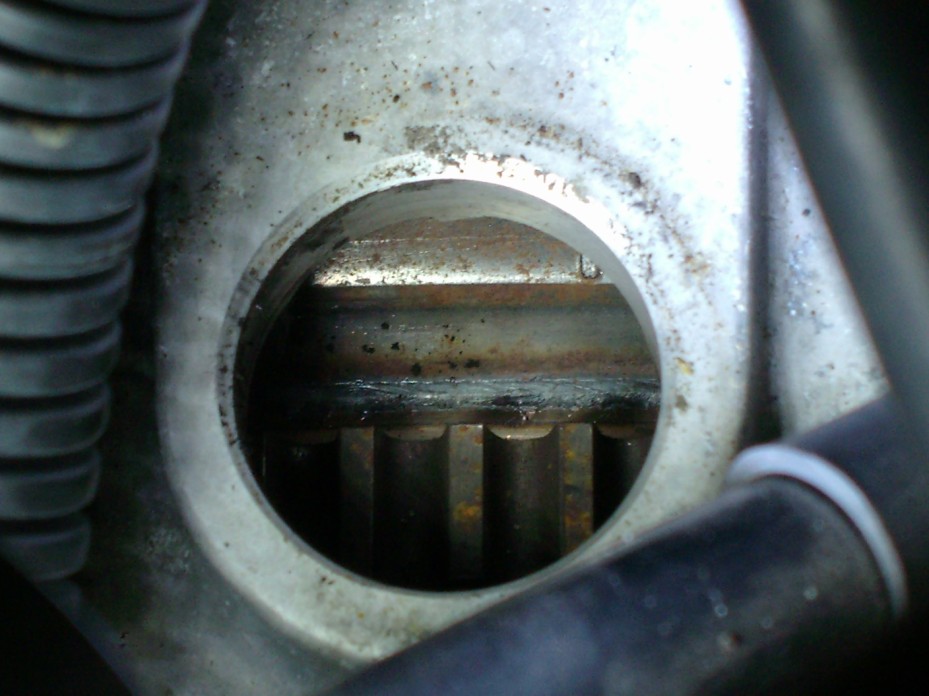
I've attached some more photos of the peephole.
Once with the early bird setting, and once with the normal setting.
What do you estimate was the amount of degrees of crankshaft rotation (KW) that my ignition timing was advanced beyond Top Dead Center (OT1), as viewed from the spark plug hole?
Best regards,
Bo.
| Description: |
| OT Markierung in Getriebeglocke TDI |
|
| File size: |
89.21 KB |
| Viewed: |
8631 times |
|
| Description: |
| OT Markierung in Getriebeglocke TDI |
|
| File size: |
110.04 KB |
| Viewed: |
4897 times |
|
Translated on 03-07-2026, 15:19.
|
|
| Back to top |
Profile PM |
|
ulf
Profi-Schrauber
Joined: 04/13/2002
Posts: 11058
Karma: +18 / -0
Location: Saarland
2023 MG ZS
Premium Support
|
| 17-03-2011, 15:57 Subject: |
Quote |
|
*Dust off* Bo Duke wrote: | . . . I performed 6 measurements each time (3 times in each direction, on a mostly flat stretch of road, with very little wind); once with the camshaft set to an earlier timing, and once with the camshaft set to the normal timing.
I have compared the following times according to... Data logging.
For the late start, I need to rely on times that are already behind schedule.
a) 2000 to 3000
b) 3000 to 4000
c) 3250 to 3750
d) 3750 to 4250
late shift: a) 2.00 b) 3.60 c) -,- d) -,-
normal setting: a) 2.59 b) 2.96 c) 1.49 d) 1.64
early start: a) 2.60 b) 2.96 c) 1.48 d) 1.59
The extremely early camshaft timing was only marginally faster, within the hundredths of a second range, compared to the normal camshaft timing, and therefore likely within the measurement tolerance.
Therefore, it should be noted that adjusting the camshaft timing from late to early, beyond the normal setting, does not bring any improvement. | That is also my impression with the BUK and the tuning software for 180 hp:
With the engine warm, the low-load synchronization angle was displayed as 0 to -0.5 degrees (which would indicate a slightly advanced timing). Due to the cold start issue, I adjusted the NWS (North West Setting) by approximately 2° earlier, but this didn't result in any change in Pmax that would be clearly noticeable in the initial before-and-after log comparisons. Gruß Ulf
_________
MG4 Electric
Translated on 03-07-2026, 15:19.
|
|
| Back to top |
Profile PM Garage |
|
Kitwing
Blaumann
Joined: 01/02/2012
Posts: 62
Karma: +0 / -0
Location: 71292
Premium Support
|
| 24-02-2012, 9:17 Subject: |
Quote |
|
Hello,
After replacing my timing belt and noticing reduced performance on my 1.9 PD AVF engine with a tuning software, I spent several days experimenting, and the following was the result:
Sync. angle in the MWB4: After the change, it was at 3.9°KW and jumped down, then up to 4.3°KW.
Question: Is this early or late? Since it's in the "+" range, I thought it meant early, right?
I've also noticed that the vehicle seems to be consuming less fuel, according to the MFA (Multi Function Display), than it did before...
The label value for the synchronization angle indicates +/- 3°.
So, I adjusted it again:
Car pushed into a storefront while in second gear, at idle.
Camshaft locking tool engaged properly.
Loosened the 3 screws and slightly rotated the cam in a clockwise direction at screw number 18.
Okay, tighten the screws and re-check VCDS. Okay, I see it - a -1.1° offset in the "MWB 4" synchronization angle.
So, back on the train, and it turns out the car almost has its original performance back.
Should I play the same game again and go down to -3°? Unfortunately, the car still doesn't feel quite the same as it did before...
Translated on 03-07-2026, 15:19.
|
|
| Back to top |
Profile PM |
|
dieselschrauber
Administrator

Joined: 04/12/2002
Posts: 18095
Karma: +799 / -0
Location: St.Gallen
2018 Volkswagen T6 
|
| 24-02-2012, 10:58 Subject: |
Quote |
|
I would leave it at -1.1° KW. According to my understanding, a negative synchronization angle means that the camshaft is positioned earlier than it should be.
Best regards, Rainer.
Translated on 03-07-2026, 15:19.
|
|
| Back to top |
Profile PM WWW Garage |
|
Kitwing
Blaumann
Joined: 01/02/2012
Posts: 62
Karma: +0 / -0
Location: 71292
Premium Support
|
| 24-02-2012, 11:12 Subject: |
Quote |
|
Okay, I'll leave it as it is for now.
It's truly fascinating how much the changes affect the engine's performance!
"However, I'm still curious about what the symbols actually represent in the synchronization process." Value. stand.
- = late?
+ = early?
Translated on 03-07-2026, 15:19.
|
|
| Back to top |
Profile PM |
|
dieselschrauber
Administrator
Joined: 04/12/2002
Posts: 18095
Karma: +799 / -0
Location: St.Gallen
2018 Volkswagen T6
|
| 24-02-2012, 12:35 Subject: |
Quote |
|
Quote: | | A negative synchronization angle, according to my understanding, means that the camshaft is positioned earlier. |
Translated on 03-07-2026, 15:19.
|
|
| Back to top |
Profile PM WWW Garage |
|
|


 Bookmarks
 Links
Links Garage
 FAQ, Legal Notice & Privacy
 RSS Feed
 Register
 Login
Login

