| Author |
Message |
ulf
Profi-Schrauber

Joined: 04/13/2002
Posts: 11058
Karma: +18 / -0 
Location: Saarland
2023 MG ZS
Premium Support
|
 20-07-2006, 19:13 Subject: TDI Turbocharger Comparison: Performance in Thin Air 20-07-2006, 19:13 Subject: TDI Turbocharger Comparison: Performance in Thin Air |
Quote |
|
Hello,
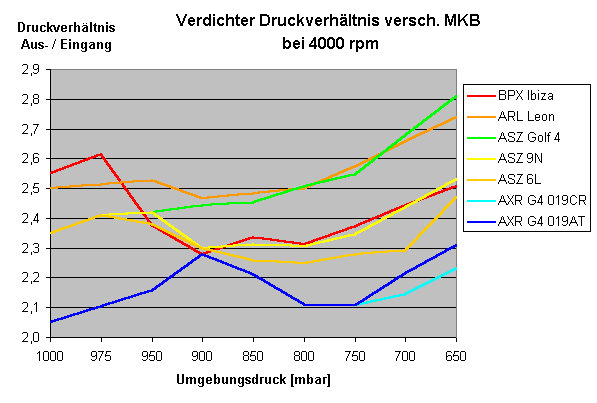
When comparing the "load height protection fields" at 4000 rpm across different MSG files (maximum load depending on ambient pressure), it appears that the developers have mixed up the performance levels at different altitudes.
The y-axis in the appendix shows the ratio between charging pressure and discharge pressure, because the compressor performance is calculated based on this value, and the lines representing a constant compressor load within the maximum pressure range (at decreasing discharge pressure) would approximately be horizontal.
The BPX engine, nominally producing 160 horsepower, quickly loses power in thin air: below 950 millibars (approximately 500 meters above sea level or higher), it only delivers the same boost pressure as the ASZ engine (130 horsepower) in the Polo with the smaller KP39B turbocharger.
At 900 millibars, the AXR (100 horsepower) even matches the BPX in terms of boost pressure.
The ASZ turbocharger in the G4 engine (GT1749VA) can even deliver more boost pressure than the ARL at altitudes below 700 mbar (approximately 2500 meters above sea level or higher), making it the top-performing TDI I have analyzed in terms of boost pressure at very high altitudes.
What technical background factors lead to such altitude-dependent pressure limiting characteristics   ?
| Description: |
| TDI Turbocharger Comparison: Performance in Thin Air |
|
| File size: |
7.66 KB |
| Viewed: |
2693 times |
|
Gruß Ulf
_________
MG4 Electric
Translated on 11-08-2026, 8:47.
|
|
| Back to top |
Profile PM Garage |
 |
Jens 16syncro
Joined: 09/16/2002
Posts: 469
Karma: +2 / -3
Premium Support
|
| 21-07-2006, 6:49 Subject: TDI Turbocharger Comparison: Performance in Thin Air |
Quote |
|
Hi there,
I think the maximum turbo speed is being reached here. In thinner air, it must spin much faster to achieve the same compression ratio. I speculate that the larger turbos are not allowed to spin as high.
Regards,
Jens.
Marcus "Ar Gwenn": Für uns sind Leute arm, weil sie mit einem Eselskarren unterwegs sind, für sie sind wir arm, weil wir ein Leben lang dafür arbeiten und Geld verdienen müssen, um uns im Alter von wildfremden Leuten pflegen zu lassen.
Translated on 11-08-2026, 8:49.
|
|
| Back to top |
Profile PM |
|
Zak1976
Joined: 03/09/2005
Posts: 225
Karma: +0 / -1
Location: Barendorf
Free account, no CAN development support
|
| 21-07-2006, 14:55 Subject: TDI Turbocharger Comparison: Performance in Thin Air |
Quote |
|
What does the Motor Control System (MSG) do in such "extreme situations"? Does it attempt to maintain normal performance at "sea level" (1000 mbar atmospheric pressure), or does it reduce power to protect the components (turbocharger, etc.) from damage?
It is evident that the boost pressure is being regulated far beyond the permissible limit of the ASV turbocharger (which would be quite problematic if this were to occur without triggering an emergency mode shortly thereafter). At an ambient pressure of 700 mbar, this would be 0.3 bar above the standard setting.
Otherwise, I agree with what my predecessor said.
Fährt mit Golf 3 TDI Umbau (von AFN auf ARL)
Translated on 11-08-2026, 8:50.
|
|
| Back to top |
Profile PM Email |
|
ulf
Profi-Schrauber
Joined: 04/13/2002
Posts: 11058
Karma: +18 / -0
Location: Saarland
2023 MG ZS
Premium Support
|
| 21-07-2006, 15:11 Subject: TDI Turbocharger Comparison: Performance in Thin Air |
Quote |
|
Zak1976 wrote: | | It is evident that the boost pressure is being regulated far beyond the permissible limit of the ASV turbocharger. |
No, you've misinterpreted the table.
The maximum load capacity is determined by the ambient pressure multiplied by the pressure ratio :
For example, with a G4 pressure sensor for 700 mbar: 700 multiplied by 2.65 equals approximately 1850 mbar absolute. At 1000 mbar, it would be 2350 mbar absolute.Gruß Ulf
_________
MG4 Electric
Translated on 11-08-2026, 8:52.
|
|
| Back to top |
Profile PM Garage |
|
Jochen_145
Guest
Free account, no CAN development support
|
| 21-07-2006, 17:51 Subject: TDI Turbocharger Comparison: Performance in Thin Air |
Quote |
|
The altitude adjustment system of the turbomotors reduces the boost pressure as the ambient pressure decreases (i.e., at increasing altitudes above sea level) to prevent the turbocharger from over-revving.
Naturally, this also reduces the engine power.
You can try to mitigate this performance loss somewhat through over-greasing, but fundamentally, the turbos lose power at higher altitudes because they are literally running out of 'air.'
Typical test routes for this calibration purpose include driving trailers up the Großglockner mountain road.
Best regards, Jochen.
Translated on 11-08-2026, 8:54.
|
|
| Back to top |
|
|
ulf
Profi-Schrauber
Joined: 04/13/2002
Posts: 11058
Karma: +18 / -0
Location: Saarland
2023 MG ZS
Premium Support
|
| 21-07-2006, 18:59 Subject: TDI Turbocharger Comparison: Performance in Thin Air |
Quote |
|
Jochen_145 wrote: | The altitude adjustment of turbomotors reduces the boost pressure as the ambient pressure decreases (i.e., with increasing height above sea level) to prevent over-revving of the turbocharger.
That naturally also reduces the engine power. |
Hi Jochen,
That's already clear.
The question is: Why, for example, is the "largest" BPX loader lowered to a lower LD level in terms of height than the "smaller" ASZ loader from the G4, which operates at least two performance levels lower? Gruß Ulf
_________
MG4 Electric
Translated on 11-08-2026, 8:55.
|
|
| Back to top |
Profile PM Garage |
|
Jochen_145
Guest
Free account, no CAN development support
|
| 21-07-2006, 19:41 Subject: TDI Turbocharger Comparison: Performance in Thin Air |
Quote |
|
So, I've only ever dealt with the turbos from a purely thermal perspective. When it came to the mechanical aspects, I would only ask questions until my specific inquiries were answered.
Therefore, there are certainly some experts here who can provide more detailed information.
But what I know is:
The turbos are always operated at a speed limit that the turbo can withstand continuously.
This pressure value is proportional to the boost pressure, but not proportional to the engine speed.
(I'm still not entirely clear on why this is the case, but the turbocharger speed at maximum boost pressure and 2000 rpm is similar to that at 4000 rpm and maximum boost pressure. The exhaust volume and the energy contained within it likely play a role here. If anyone can explain this in more detail, please let me know, because I couldn't find a logical explanation for it.)
Consequently, the duty cycle of the turbocharger control signal decreases as the engine speed increases, while maintaining a constant engine speed.
In a previous thread about turbos, someone mentioned stuffing factors and the non-linear response of different turbo sizes. I think that the largest turbo suffers from this non-linearity when adjusting for altitude, and its maximum speed is such that it cannot provide optimal boost under certain external pressures.
But, as I said, Turbo Profiles should explain that in more detail.
Best regards, Jochen.
Translated on 11-08-2026, 8:58.
|
|
| Back to top |
|
|
Dj Ninja
Blaumann

Joined: 06/06/2006
Posts: 53
Karma: +1 / -1
Free account, no CAN development support
|
| 21-07-2006, 22:08 Subject: TDI Turbocharger Comparison: Performance in Thin Air |
Quote |
|
I also think this is related to the mechanical design. A small, solid impeller can be spun at a much higher speed than a larger one with perhaps more delicate (and therefore lighter) blades. I could also imagine that with impellers having large blades, the redline (maximum safe speed) might be reached faster in thinner liquids compared to smaller designs.
Translated on 11-08-2026, 9:00.
|
|
| Back to top |
Profile PM |
|
vanilla299
Guest
Free account, no CAN development support
|
| 23-07-2006, 7:57 Subject: TDI Turbocharger Comparison: Performance in Thin Air |
Quote |
|
Hello,
When comparing the 'load height protection fields' at 4000 rpm across different MSG files (maximum load depending on ambient pressure), it appears that the developers have mixed up the performance levels at different altitudes.
The y-axis in the appendix shows the ratio between charging pressure and discharge pressure, because the compressor performance is calculated based on this value, and the lines representing a constant compressor load within the maximum pressure range (at decreasing discharge pressure) would approximately be horizontal.
The BPX engine, nominally producing 160 horsepower, quickly loses power in thin air: below 950 millibars (approximately 500 meters above sea level or higher), it only delivers the same boost pressure as the ASZ engine (130 horsepower) in the Polo with the smaller KP39B turbocharger.
At 900 millibars, the AXR (100 horsepower) even matches the BPX in terms of boost pressure.
The ASZ turbocharger in the G4 (GT1749VA) can even deliver more boost pressure than the ARL below 700 mbar (approximately 2500 meters above sea level or higher), making it the top-performing TDI I have analyzed in terms of maximum boost at very high altitudes.
What technical background factors lead to such altitude-dependent pressure limiting characteristics ?
Without wanting to question your measurement results, it's certainly not easy to maintain the same load while driving at different altitudes (due to factors like road surface and air resistance at lower density). Therefore, there is already a certain degree of uncertainty built into the results.
It would also be interesting to know at what load the measurements were taken (I assume it was at rated power), and most importantly, which engines were in their original condition, i.e., not modified through software.
You might want to consider another factor. You are correct that the compression ratio must increase with altitude to maintain the rated power output. However, the turbine pressure ratio, and therefore the turbine power, automatically increases at higher altitudes, which also increases the compressor pressure ratio, of course, along with an increasing turbocharger speed. Altitude compensation in a turbocharged engine (increase in turbocharger speed) occurs without any control intervention. That's why a certain altitude (speed) reserve must always be provided in the turbocharger. By the way, how can the boost pressure be influenced at rated power and therefore with a fully open variable turbine geometry (VTG)? Statements like 'a turbocharged engine runs out of air quickly at high altitudes' are actually incorrect; it should rather be said that 'a naturally aspirated engine runs out of air quickly at high altitudes.'
In a motor that has been modified through software manipulation, this reserve capacity is already used to increase performance. However, everyone should be aware of how the turbine's power is increased in such cases. If you now drive such a vehicle to higher altitudes, the compressor will reach its operational limit with a significant decrease in its efficiency. Furthermore, the compressor speed will likely be raised to a very dangerous level.
Translated on 11-08-2026, 9:03.
|
|
| Back to top |
|
|
ulf
Profi-Schrauber
Joined: 04/13/2002
Posts: 11058
Karma: +18 / -0
Location: Saarland
2023 MG ZS
Premium Support
|
| 23-07-2006, 9:23 Subject: TDI Turbocharger Comparison: Performance in Thin Air |
Quote |
|
vanilla299 wrote: | | Without wanting to question your measurement results, it is certainly not easy to drive with the same load at different altitudes (road surface, air resistance due to lower density, etc.). | Therefore, there is already a certain degree of uncertainty in the results.
Hi,
I didn't measure those values myself; I extracted them from the corresponding MSG data sets. Therefore, they are "100% accurate."
Quote: | | It would also be interesting to know at what load the measurements were taken (I think it was at rated power), and above all, which engines were in their stock condition, i.e., not modified through software. |
The data originates from characteristic curves showing the maximum load (LD) as a function of ambient pressure and speed.
For my diagram, I only used the data for 4000 rpm from each engine's characteristic curve (KF) to allow for a comparison of the load-dependent (LD) behavior at the rated power point.
Quote: | | By the way, how can the boost pressure be influenced when the engine is running at its rated power and therefore with the VTG (Variable Turbine Geometry) fully open? Statements like "a turbocharged engine loses power quickly at high altitudes" are actually incorrect; it should rather be said that "a naturally aspirated engine loses power quickly at high altitudes." |
The VTG (Variable Turbine Geometry) is not yet fully open at the maximum series pressure. This opening reserve allows the LD (Load Dump) to be regulated a few hundred mbar below the target value even under full load by fully opening the VTG.
Referring to the diagram, it should therefore be correctly stated as: "For the BPX, the airflow is more likely to be reduced by software at a certain height , rather than for the ASZ ". Gruß Ulf
_________
MG4 Electric
Translated on 11-08-2026, 9:09.
|
|
| Back to top |
Profile PM Garage |
|
vanilla299
Guest
Free account, no CAN development support
|
| 23-07-2006, 11:29 Subject: TDI Turbocharger Comparison: Performance in Thin Air |
Quote |
|
The VTG (Variable Turbine Geometry) is not yet fully open at the maximum series pressure (Pmax). This opening reserve allows the LD (Load Dump) to be regulated a few hundred mbar below the target value even under full load by fully opening the VTG.
'Certainly, the VTG (Variable Turbine Geometry) is not fully open at its nominal power output. However, I'm surprised to hear that a few hundred mbar of clearance are intentionally left between the current position and the fully open position. Where did you get this information? I can't imagine that so much potential would be wasted, as the larger turbine would likely compensate with a bigger turbo lag. But it's possible that this was done on older engines.'
It would be interesting to know which parameters your characteristic maps continue to influence (e.g., injection quantity, lambda...). To fully understand certain characteristic curves (BPX), it might be necessary to examine other maps as well (e.g., injection quantity, intake air temperature, lambda...) and potentially have knowledge of the installed hardware (compressor size, turbine size, intercooler).
For all characteristic curves, a rising compressor pressure ratio is observed at high altitudes, which indicates that the power loss is being compensated for. This is something that is never possible with a naturally aspirated engine. At least some of the curves show the expected, slightly increasing trend.
Translated on 11-08-2026, 9:13.
|
|
| Back to top |
|
|
dieselschrauber
Administrator

Joined: 04/12/2002
Posts: 18113
Karma: +800 / -0
Location: St.Gallen
2018 Volkswagen T6 
|
| 23-07-2006, 11:59 Subject: TDI Turbocharger Comparison: Performance in Thin Air |
Quote |
|
Hi,
Quote: | | But it's quite possible that something like that was done on older engines. |
If the 2.0L TDI 16V engine is considered an older design for you, then there's still plenty of potential left in it. This applies to engines with variable geometry turbochargers (VTG) as well, which are also based on known, older designs.
If you examine how sensitive the boost pressure control system is to even minimal changes in the angle of the guide vanes, it becomes clear why.
Best regards, Rainer.
Translated on 11-08-2026, 9:15.
|
|
| Back to top |
Profile PM WWW Garage |
|
vanilla299
Guest
Free account, no CAN development support
|
| 23-07-2006, 13:54 Subject: TDI Turbocharger Comparison: Performance in Thin Air |
Quote |
|
If you examine how sensitive the boost pressure control system is to even minimal changes in the variable geometry angle of the guide vanes, it becomes clear why.
I always thought the VTG position was the control variable for the charge pressure regulation. Furthermore, it should be clear that the relationship between turbine opening area and guide vane angle is not linear. Especially when the VTG is widely open, a change in the guide vane angle has a progressively smaller effect.
If the 2.0L TDI 16V engine is considered an older design for you, then there's still potential for improvement. This applies to engines with variable geometry turbochargers (VTG) as well, which are similar to known older designs.
What do you mean by 'reserve' in this context? Are you referring to a reserve for increased performance, or a reserve that allows the boost pressure to be reduced at higher altitudes? The turbine wheel is always designed with its nominal power output in mind; at that point, the guide vanes have little or no influence. The fact that the compressor and turbine are not pushed to their absolute limits is because the efficiencies would be too low at those extremes. When designing a turbocharger, and therefore also influencing vehicle behavior, manufacturers often adopt different philosophies. Just because VW pursues a fuel-efficiency-oriented design (including using a larger turbine), it doesn't necessarily mean that there are extra reserves built in.
Translated on 11-08-2026, 9:18.
|
|
| Back to top |
|
|
ulf
Profi-Schrauber
Joined: 04/13/2002
Posts: 11058
Karma: +18 / -0
Location: Saarland
2023 MG ZS
Premium Support
|
| 23-07-2006, 14:07 Subject: TDI Turbocharger Comparison: Performance in Thin Air |
Quote |
|
vanilla299 wrote: | | Certainly, the VTG (Variable Turbine Geometry) is not fully open at its nominal power output. However, I am surprised to hear that a few hundred mbar of clearance are intentionally designed between the nominal position and the fully open position. Where did you obtain this information? |
The information is not based on hard facts, but rather estimated by analyzing load and duty cycle patterns of tuned and untuned engines (within the maximum power range).
Perhaps a few 100 mbar of "downward adjustment reserve" are also overestimated, and I don't want to argue about that.
Quote: | | Furthermore, it should be clear that the relationship between the turbine opening cross-section and the guide vane angle, expressed as TurbineOpeningCrossSection = f(GuideVaneAngle), is not a linear one. |
Okay.
The overall alignment becomes problematic because, within the LD pre-tax characteristic curve, we only see the duty cycle as the control variable. Between that and the position of the VTG (Variable Turbine Geometry) blades, there are several intermediate steps, whose linearity can generally only be speculated upon:
Duty cycle  Lift of the EPW actuator Vacuum at the EPW outlet Stroke of the VTG sensor Rotation angle of the VTG adjusting ring Blade angle.
In each of these , nonlinearities can occur in the control loop (?), so that with skillful combination, one might ultimately achieve an approximately linear relationship between TV (likely referring to a specific parameter) and the turbine opening cross-section could, if desired by the designer.
Apparently, the overall system is designed in such a way that even within the maximum power output range (i.e., with the variable geometry turbine fully open), the load-dumping control reacts noticeably to changes in the upstream total pressure of just a few percent, as evidenced by the magnitude of control errors and overshoots.
From this, I drew the conclusion that the overall travel range in the standard setup of our TDIs is not already at the hard limit of the VTG (valve timing gear). Gruß Ulf
_________
MG4 Electric
Translated on 11-08-2026, 9:22.
|
|
| Back to top |
Profile PM Garage |
|
|


 Bookmarks
 Links
Links Garage
 FAQ, Legal Notice & Privacy
 RSS Feed
 Register
 Login
Login

