| Author |
Message |
dieselmartin
Profi-Schrauber


Joined: 03/13/2003
Posts: 10121
Karma: +29 / -0 
Location: in der Werkstatt
2007 Volkswagen Passat
Premium Support
|
 12-12-2007, 16:30 Subject: Data for the 2.0 16V engine with filter 12-12-2007, 16:30 Subject: Data for the 2.0 16V engine with filter |
Quote |
|
Hi.
"Who all has a BMR, BMN (i.e., a 2.0 16V TDI with DPF, 125 kW) and VAGCOM, and ideally doesn't have a DSG transmission?"
I'm interested in how quickly your tractors can build up boost pressure "from a standstill."
The background is the "stiffness" that I often mention, which my partner experiences during intercourse. However, he can also experience it differently, because when he's cold or actively recovering, he has significantly better sensations in the lower region. That's how I always know when he's cleaning the DPF.
Since the VTG sensor measures the position of the vacuum membrane, and not the position of the blades, it might be possible to extract a little more performance by shortening the VTG shaft.
I don't want to do that without a "data pool," though.
Thank you.
m;
Transparency, Teamwork
... there was another T.
I don't know what the f*ck it was.
Translated on 03-07-2026, 15:19.
|
|
| Back to top |
Profile PM Garage |
 |
dieselmartin
Profi-Schrauber
Joined: 03/13/2003
Posts: 10121
Karma: +29 / -0
Location: in der Werkstatt
2007 Volkswagen Passat
Premium Support
|
| 13-12-2007, 9:59 Subject: Data for the 2.0 16V engine with filter |
Quote |
|
OK.
Here's a little more text about what I'm planning and why:
I find it interesting that the BMR and BMP (170 hp and 140 hp 8V DPF) have incredibly good low-end torque.
Above all, the BMR has absolutely no turbocharger overboost.
He is gradually aligning the actual pressure with the target pressure and is "perfectly achieving the desired bend" at the target limit. All the other TDIs I tested on the dyno had overboost.
I don't know if an overpressure situation at a set point of 2500 mbar absolute is very dangerous for the compressor, but I would prefer a faster pressure build-up.
On my Leon 1M ASV, I experimented with the VTG rod (which, in my opinion, caused excessive oversteer despite the very soft VTG mechanism). Rotating it two turns further reduced the oversteer, but also decreased the agility.
Now, I want to shorten my VTG 1 U.
[img]/download.php?id=2377[/img]
Transparency, Teamwork
... there was another T.
I don't know what the f*ck it was.
Translated on 03-07-2026, 15:19.
|
|
| Back to top |
Profile PM Garage |
|
dieselmartin
Profi-Schrauber
Joined: 03/13/2003
Posts: 10121
Karma: +29 / -0
Location: in der Werkstatt
2007 Volkswagen Passat
Premium Support
|
| 13-12-2007, 16:27 Subject: Data for the 2.0 16V engine with filter |
Quote |
|
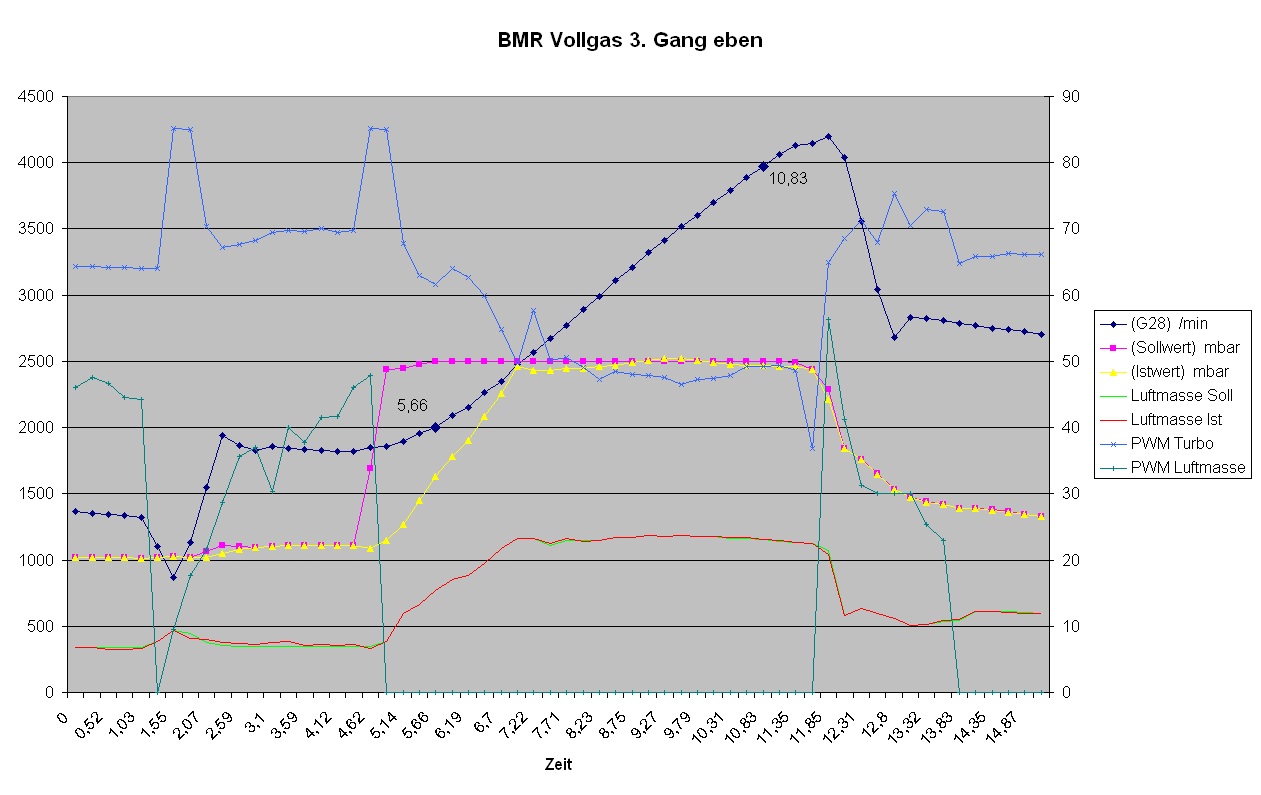
To everyone who suspects that my tractor isn't getting enough air.
He doesn't want to anymore! The AGR (Automatic Geographic Reference) rate is adjusted so perfectly that I have to zoom in on the image just to see any differences in the measured values!
| Description: |
| Data for the 2.0 16V engine with filter |
|
| File size: |
145.22 KB |
| Viewed: |
3235 times |
|
Transparency, Teamwork
... there was another T.
I don't know what the f*ck it was.
Translated on 03-07-2026, 15:19.
|
|
| Back to top |
Profile PM Garage |
|
ObenbeiMutti
Guest
Free account, no CAN development support
|
| 13-12-2007, 17:50 Subject: Data for the 2.0 16V engine with filter |
Quote |
|
Hi,
Sure, here's the translation:
'Here's a question that goes well with it.' Could it be that the developers of an engine, when designing its characteristics, deliberately prioritize higher-end performance by sacrificing low-end power?
Here's my reasoning: From what I've gathered, the 2.0 TDI engines aren't as robust at higher RPMs as the 1.9 PD generation was, but, just like with my CR engine, they seem to be relatively underpowered at lower RPMs.
So, is this being triggered by the file, regardless of the existing mechanical setup (e.g., turbocharger size/16v cylinder head, etc.), because, for example, due to thermal reasons or something else, you simply can't achieve more area under the torque curve across the entire RPM range than a certain limit dictates?
Translated on 03-07-2026, 15:19.
|
|
| Back to top |
|
|
dieselmartin
Profi-Schrauber
Joined: 03/13/2003
Posts: 10121
Karma: +29 / -0
Location: in der Werkstatt
2007 Volkswagen Passat
Premium Support
|
| 13-12-2007, 22:49 Subject: Data for the 2.0 16V engine with filter |
Quote |
|
OK.
I almost broke my hand while taking pictures of the VTG train all by myself.
Do these hysterical VW assemblers absolutely have to cover everything with sealant? That's a pain – especially since the adjustment screw can only be turned by hand, so it's not easy to break it off.
I have the pictures here, taken at a full 5MP resolution (using a Nokia N95).
m;
| Description: |
| Data for the 2.0 16V engine with filter |
|

Download |
| File name: |
BMR_VTG.zip |
| File size: |
2.17 MB |
| Downloaded: |
826 times |
Transparency, Teamwork
... there was another T.
I don't know what the f*ck it was.
Translated on 03-07-2026, 15:19.
|
|
| Back to top |
Profile PM Garage |
|
dieselmartin
Profi-Schrauber
Joined: 03/13/2003
Posts: 10121
Karma: +29 / -0
Location: in der Werkstatt
2007 Volkswagen Passat
Premium Support
|
| 14-12-2007, 9:51 Subject: Data for the 2.0 16V engine with filter |
Quote |
|
Word of the day: Friday.
Can it be?
Looking at the recent CDI models (still without particulate filters), and especially considering the amount of soot they allow to escape during low-speed driving in the city, it's possible that the high TDI emissions are related to this.
The turbo needs exhaust gases to spool up, but without boost pressure, it can only achieve this with a very rich air-fuel mixture. That would quickly fill up the DPF.
So, very little fuel is being injected - as you can see from the log, it's being driven very cautiously near the threshold - and that's how the logged image appears.
BUT:
Why does the 1.9-liter, 105 hp DPF engine then accelerate much more aggressively?
Just because he has a different, smaller turbo?
What model does the BMR actually have? I only know that he supposedly has 11 VTG shovels and this innovative insert.
m;
Transparency, Teamwork
... there was another T.
I don't know what the f*ck it was.
Translated on 03-07-2026, 15:19.
|
|
| Back to top |
Profile PM Garage |
|
rubberduck
Blaumann

Joined: 02/27/2006
Posts: 112
Karma: +1 / -0
Support
|
| 14-12-2007, 20:14 Subject: Data for the 2.0 16V engine with filter |
Quote |
|
"Interesting topic (especially considering my next car). My opinion on the enlarged image is that the delayed boost pressure build-up isn't due to the turbocharger itself, but rather the control system. The PWM signal for the turbo initially goes in the "wrong" direction after the boost pressure setpoint increases." Then the PWM signal changes direction, and the LD structure begins to form.
"Who" might have an interest in building up the load (LD) slowly or with a delay? Torque limitation? Exhaust gas recirculation (EGR) strategy? Or something else?
Based on your log, you're already at around 1800 RPM before the acceleration. At this point, the flow rate should be sufficient to build up the pressure. By 2000 RPM, the pressure should definitely be able to reach 2500 mbar. It shouldn't be left hanging on the loader.
Wer Rechtschreibfehler findet, kann sie behalten ! 
Translated on 03-07-2026, 15:19.
|
|
| Back to top |
Profile PM |
|
dieselmartin
Profi-Schrauber
Joined: 03/13/2003
Posts: 10121
Karma: +29 / -0
Location: in der Werkstatt
2007 Volkswagen Passat
Premium Support
|
| 14-12-2007, 23:27 Subject: Data for the 2.0 16V engine with filter |
Quote |
|
"Wrong direction" isn't quite accurate.
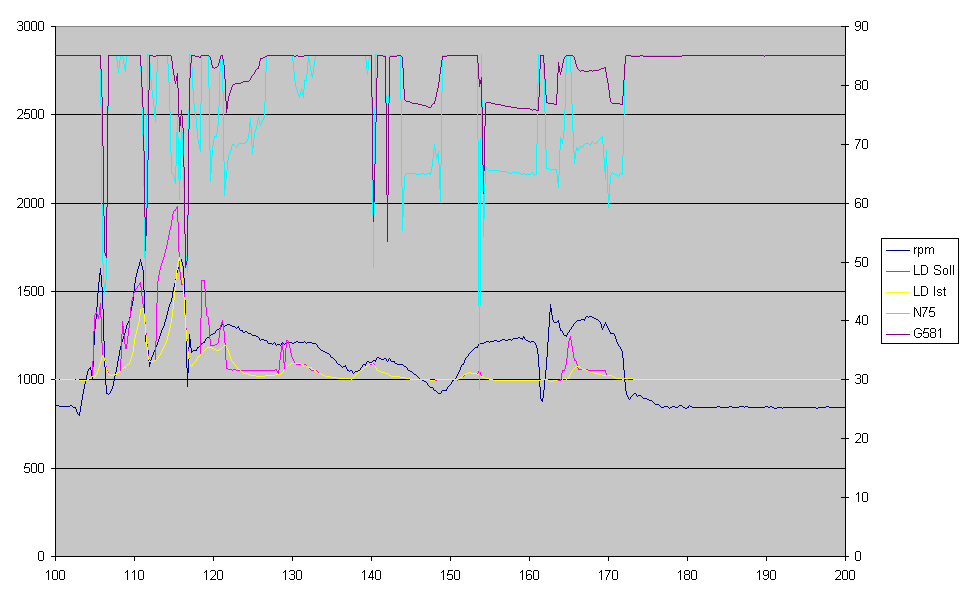
"85% on the N75 setting means VTG_ZU, which allows for full pressure."
I have something much more interesting:
Here's a comparison between the N75 (the vacuum control valve) and the G581, the Hall sensor that measures the VTG (Variable Turbine Geometry) actuator.
I find it particularly funny around the 130-second mark. N75 is twitching, G581 says "nothing is happening," but the boost pressure is actually changing?!?!?
| Description: |
| Data for the 2.0 16V engine with filter |
|
| File size: |
18.11 KB |
| Viewed: |
2388 times |
|
Transparency, Teamwork
... there was another T.
I don't know what the f*ck it was.
Translated on 03-07-2026, 15:19.
|
|
| Back to top |
Profile PM Garage |
|
rubberduck
Blaumann
Joined: 02/27/2006
Posts: 112
Karma: +1 / -0
Support
|
| 15-12-2007, 0:37 Subject: Data for the 2.0 16V engine with filter |
Quote |
|
One should also include the accelerator pedal signal and load in the measurement  .
After the "glitch" in the target LD value, the N75 also briefly fluctuates. However, in this section, the motor speed and actual LD remain constant. Following this, the load decreases because the gas is being cut off, and the speed drops.
In this measurement, I would attribute the delayed LD buildup to the low rotational speed. Perhaps the results will be different if you perform the same measurement at 2000 or 2500 RPM.
Thinking back to my vocational school days and articles I've read, I remember the turbocharger actuator test (I believe it was on an 85kW PD engine). In this test, the turbocharger is opened and closed at increased engine speed. Now, there's also this additional code, G581. I believe this could be used to check the relationship between N75 and G581.
Best regards. Wer Rechtschreibfehler findet, kann sie behalten !
Translated on 03-07-2026, 15:19.
|
|
| Back to top |
Profile PM |
|
Aron
Blaumann
Joined: 10/26/2006
Posts: 440
Karma: +5 / -1
Location: KC
Free account, no CAN development support
|
| 15-12-2007, 0:45 Subject: Data for the 2.0 16V engine with filter |
Quote |
|
Hi Martin,
If I understand correctly, this ominous situation persists even after the second instance. Peak, approximately at 105.
I think it's because a setpoint correction hasn't been implemented yet, but the input tax curve is saying "go easy," and somewhere between 85 and lower, the actuator is hitting its limit. Therefore, a certain level of vacuum (e.g., TV75) is initially required to lift the pneumatic capsule from its resting position.
Peugeot 307 (T5)1450kg Speck, RHS, MJ2002, 138g CO2 inkl. Korken im Auspuff und goldene Möhre 2006, MAF+50% mit passender Dieselmasse. nunmehr 370000km
Translated on 03-07-2026, 15:19.
|
|
| Back to top |
Profile PM |
|
Jochen_145
Guest
Free account, no CAN development support
|
| 15-12-2007, 11:47 Subject: Data for the 2.0 16V engine with filter |
Quote |
|
' I find it particularly funny around the 130-second mark. N75 is twitching, G581 says 'nothing is happening here,' but the boost pressure is actually changing?!?!?
Hello Martin,
The problem in this case is that we don't know the strategy behind the diagnostic data.
It is therefore possible that the recording of the actual value of the G581 is filtered to such an extent that even the smallest changes in the VTG (Variable Track Gauge) are not actually recorded.
AFAIK, this data collection is only used for error detection and not for actual regulation. Therefore, I can safely process the actual values of the G581 at a slower rate. I can detect 'major' errors early enough and then send the LD (likely referring to a specific regulation or setting) to the error status accordingly.
I think it's because no setpoint correction has been implemented yet, but the pre-tax field says 'let's take it easy'

The pre-control is solely dependent on the desired 'end' value, meaning it is controlled based on the corrected setpoint.
How do you envision the regulation of a system?
Therefore, a certain amount of negative pressure (for example, TV75) is initially required to lift the pneumatic capsule from its resting position.

At 85%, the control is cut off, and the VTG (Variable Transmission Gear) is actively pushed to its maximum position.
If anything exists that can 'override the set position,' it would be at the minimum PWM level, where the VTG (Variable Turbine Geometry) is held in its default open position by the spring in the vacuum chamber.
@Martin
Regarding the limitation of Russian usage at low LD (language difficulty levels):
Here are several reasons I see:
- Firstly, there's the large loader, which you've already mentioned.
- Avoiding excessive use of Russian (language) until the desired level of proficiency is reached.
- Protection of the ZMS (transmission control module) and clutch, as well as minimization of torque.
Best regards, Jochen.
Translated on 03-07-2026, 15:19.
|
|
| Back to top |
|
|
rubberduck
Blaumann
Joined: 02/27/2006
Posts: 112
Karma: +1 / -0
Support
|
| 15-12-2007, 11:51 Subject: Data for the 2.0 16V engine with filter |
Quote |
|
Aron wrote: |
I think that's because no setpoint correction has been implemented yet, but the VAT curve is saying "let's take it easy."
|
Since I'm not very familiar with the subject, could you explain it to me a bit? What do you mean by "setpoint correction"? And why does the pre-tax rate curve say "let's take it easy"?
dieselmartin wrote: |
"85% at N75 means VTG_ZU, which means allowing full pressure."
|
+
Aron wrote: |
...and somewhere between 85 and a lower value, the actor is at their limit. Therefore, a certain level of vacuum (e.g., TV75) is initially required to lift the pneumatic capsule from its resting position.
|
I agree with you. The G581 only reacts when the battery level drops below 70%.
BUT the loader is, hopefully, in the LD (load distribution) assembly. The pressure regulation for the loading process is working perfectly. That's not the problem, then. Wer Rechtschreibfehler findet, kann sie behalten !
Translated on 03-07-2026, 15:19.
|
|
| Back to top |
Profile PM |
|
dieselmartin
Profi-Schrauber
Joined: 03/13/2003
Posts: 10121
Karma: +29 / -0
Location: in der Werkstatt
2007 Volkswagen Passat
Premium Support
|
| 15-12-2007, 13:16 Subject: Data for the 2.0 16V engine with filter |
Quote |
|
Just to compare, I also remembered the N75-G581 today.
G581 is a Hall effect sensor, which means it can only measure a specific range of distances.
Perhaps the final values are relatively uninteresting, and therefore it only starts measuring within the typical normal range.
When you shift the two curves so that they overlap in the area where both change, they fit together quite well.
In very high N75 regions, the VTG (which explains the changing boost pressure) is moving, but the G581 sensor doesn't yet detect this because the magnet is not yet close enough to the Hall sensor.
Overall, shortening the VTG rod should still have an effect, because the "reduction" caused by the N75 valve will not be as significant.
Should the protection of the engine management system (ZMS) be triggered by the torque limit, rather than the boost pressure?
m;
Transparency, Teamwork
... there was another T.
I don't know what the f*ck it was.
Translated on 03-07-2026, 15:19.
|
|
| Back to top |
Profile PM Garage |
|
Jochen_145
Guest
Free account, no CAN development support
|
| 15-12-2007, 17:08 Subject: Data for the 2.0 16V engine with filter |
Quote |
|
Hello Martin,
Yes, it IS possible to implement ZMS protection through torque limiting.
However, one can also play with the interactions between the individual limitations.
In areas where there is little load demand, I limit the power output based on torque. In areas where both load demand and power are present, I limit the power output based on exhaust gas restrictions. And at high speeds, I again limit the power output based on torque.
Advantage: Within the range of optimal performance, I have fixed Lambda values, and therefore a fixed level of turbidity.
Disadvantage: The engine performance is directly affected by the condition of the LMM (likely referring to a mass airflow meter) and the ambient temperature.
You really have to think outside the box, which makes this less interesting for cost-conscious tuner enthusiasts.
Depending on the applicator, one can let their creativity run wild here.
Looking at your graphs, you can see exactly this behavior. The torque limit is reached very early, at over 350 Nm. Therefore, the limitation regarding smoking is intentionally being enforced at your location.
Here, too, one finds fixed (known) Lambda values that provide a sufficiently reliable indication of the turbidity. This allows me to additionally take into account the load on the DPF and the CR (Common Rail) systems of Daimler and other manufacturers, as you mentioned above. Bypass the problem.
When you adjust the VTG (Variable Turbine Geometry) rod, it's comparable to shifting the pre-tax characteristic curve. It's essentially a 'mechanical chip tuning.' The effect, however, is the same.
However, problems with the controller for small signals can occur here, which can lead to the desired LD value not being reached, resulting in a permanent difference between the desired and actual values.
I'm currently working with Ulf to understand the exact connection, so I can't provide specific details just yet.
Best regards, Jochen.
Translated on 03-07-2026, 15:19.
|
|
| Back to top |
|
|
dieselmartin
Profi-Schrauber
Joined: 03/13/2003
Posts: 10121
Karma: +29 / -0
Location: in der Werkstatt
2007 Volkswagen Passat
Premium Support
|
| 15-12-2007, 21:25 Subject: Data for the 2.0 16V engine with filter |
Quote |
|
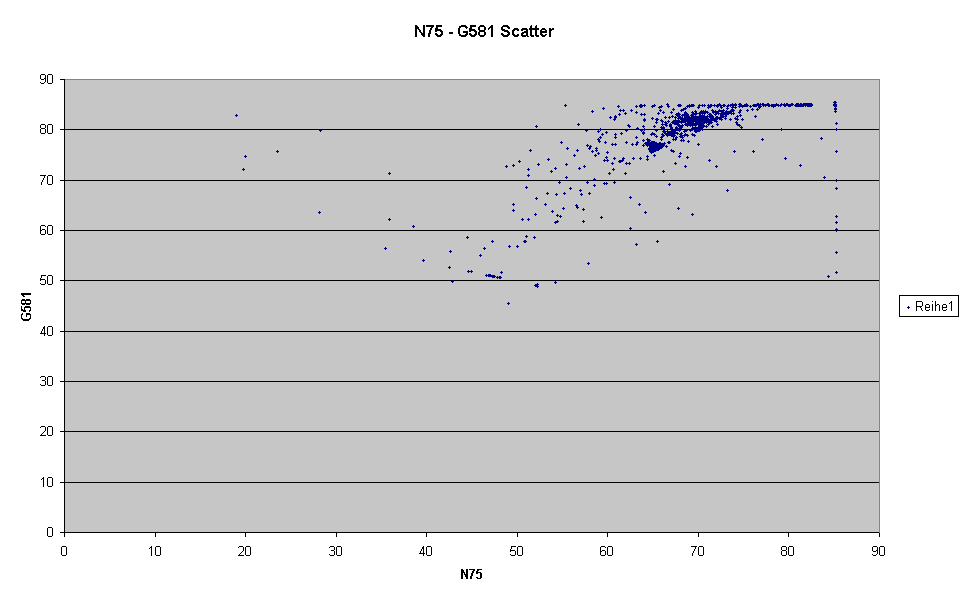
Another point:
"Based on my gut feeling, I would have expected a bit more coherence between the two signals..."
It looks quite "cloudy," doesn't it?
m;
| Description: |
| Data for the 2.0 16V engine with filter |
|
| File size: |
8.02 KB |
| Viewed: |
2166 times |
|
Transparency, Teamwork
... there was another T.
I don't know what the f*ck it was.
Translated on 03-07-2026, 15:19.
|
|
| Back to top |
Profile PM Garage |
|
rubberduck
Blaumann
Joined: 02/27/2006
Posts: 112
Karma: +1 / -0
Support
|
| 15-12-2007, 22:40 Subject: Data for the 2.0 16V engine with filter |
Quote |
|
dieselmartin wrote: |
Just to compare, I also remembered the N75-G581 today.
|
Are you already having sleepless nights about  ?
dieselmartin wrote: |
G581 is a Hall effect sensor, which means it can only measure a specific range of distances.
Perhaps the final values are relatively uninteresting, and therefore it only starts measuring within the typical normal range.
...because the magnet is not close enough to the Hall sensor yet.
|
Could you please perform a G581 measurement while manually moving the linkage from stop to stop?
Do limiting factors affect the target LD value? So, the question remains as to why the actual LD (load distribution) doesn't quite follow the desired LD. Wer Rechtschreibfehler findet, kann sie behalten !
Translated on 03-07-2026, 15:19.
|
|
| Back to top |
Profile PM |
|
|


 Bookmarks
 Links
Links Garage
 FAQ, Legal Notice & Privacy
 RSS Feed
 Register
 Login
Login

