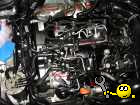
The mass airflow sensor measures the amount of air available for combustion. A certain engine power x requires a specific amount of air y that is available,
small deviations are possible due to the respective lambda value at full load and the design.
If there are deviations in the additive and multiplicative adjustment of the lambda control, it often indicates that the sensor is either defective or measuring inaccurate values.
When there are significant deviations, the gasoline engine exhibits malfunctions such as jerking, misfires, or loss of power.
To generally check the plausibility of air mass values using VCDS, you can use the following procedure:
- Determine the rated power of the engine (e.g., from vehicle registration documents).
- Rated power in kW * 1.1 = Estimated value for required air mass flow rate in g/s.
The test should be performed under "normal" operating conditions (normal pressure, 20°C). In hot weather and at higher altitudes, the available air mass decreases.
Of course, the intercooler piping must not have any leaks; otherwise, the car should be in good condition.
If there is a leak in the charge air cooler duct, the amount of escaping air will be measured, which naturally produces zero horsepower. A telltale sign of leaks are significant negative deviations in the additive and multiplicative adjustment values of the lambda control system at relatively high air mass flow rates.
See also:
https://community.dieselschrauber.org/en/viewtopic.php?t=21836


 Bookmarks
 Links
Links Garage
 FAQ, Legal Notice & Privacy
 RSS Feed
 Register
 Login
Login