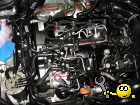
Hello,
I'm very new here and have only read a lot of posts so far.
I purchased the VCDS kit a few weeks ago and have been working with it for some time. I've also completed some initial test drives.
Preliminary information:
VW Passat Variant 3C5, 2.0L, 125kW, 170PS, year 2006.
Transmission: DSG.
Engine code: BMR

Mileage: 244,000 km (original).
The following components have been replaced in the last approximately 1 to 1.25 years:
- Turbocharger, complete with variable geometry turbine (VGT) etc.
- Pressure sensor N75
- all 4 PDDs (VW generosity)
- Motor/PDE wiring harness.
- Tandem pump (Bosch)
- Pre-lift pump (Pierburg)
- Exhaust temperature sensors, 2 pieces located on the DPF (Diesel Particulate Filter).
- Differential pressure sensor (multiple times)
- Dual-mass flywheel.
- Cylinder head, with valves, etc. (new part)
- Hexagon socket for oil pump module (as a precaution, it would have soon become rounded)
- EGR completely disassembled, cleaned, and resealed.
The following components, which may be relevant, have not yet been replaced.
- DPF (mehrmals gereinigt, vers. Procedures)
- Vacuum lines, distribution.
- Solenoid valves on the vacuum lines.
- Oxygen sensor
- LMM (cleaned)
- Charge air hoses.
- Intercooler
- Oil cooler
- Exhaust temperature sensor on the turbocharger.
- Charge air pressure sensor.
In addition, the entire fuel tank was cleaned twice, the lines were flushed, and several fuel filters were replaced.
I will describe the complete and detailed history that led to these repairs at a later time.
Just to preface, the particulate filter clogged up again within a few days because the original cylinder head had a crack in the fuel return system of the PDEs, causing engine oil to continuously enter the diesel return system and, consequently, into the tank. This apparently impaired the combustion to such an extent that the DPF clogged up again within a few days. However, this was only discovered at a very, very late stage, after the car had been to 4 workshops (including several times to a VW authorized workshop), and the DPF had already been cleaned approximately 5 times and forcibly regenerated during driving.
Here are some initial results from the first test drives, still without a full-load acceleration test due to a lack of time and a suitable stretch of road.
I'm a bit confused by the lambda value, which is sometimes 31.98.
Furthermore, it was sometimes possible to detect discrepancies between the actual and target pressure values.
I hope someone can help me narrow down the remaining issues.
My current suspicion is that the DPF has already failed and is starting to clog up again, and that the resulting back pressure is already reducing the engine's performance.
Best regards, Christian.


 Bookmarks
 Links
 Garage
 FAQ, Legal Notice & Privacy
 RSS Feed
 Register
 Login