Hello!
"Recently, I've been exploring ways to create corrections (using microcontrollers) for worn-out mass airflow sensors. It turned out to be worthwhile because three vehicles that I maintain are currently experiencing significant performance issues."
The most challenging candidate is a T4 ACV from the year 2000 (102 hp, 2.5 TDI engine) equipped with a Bosch HFM5 mass airflow sensor.
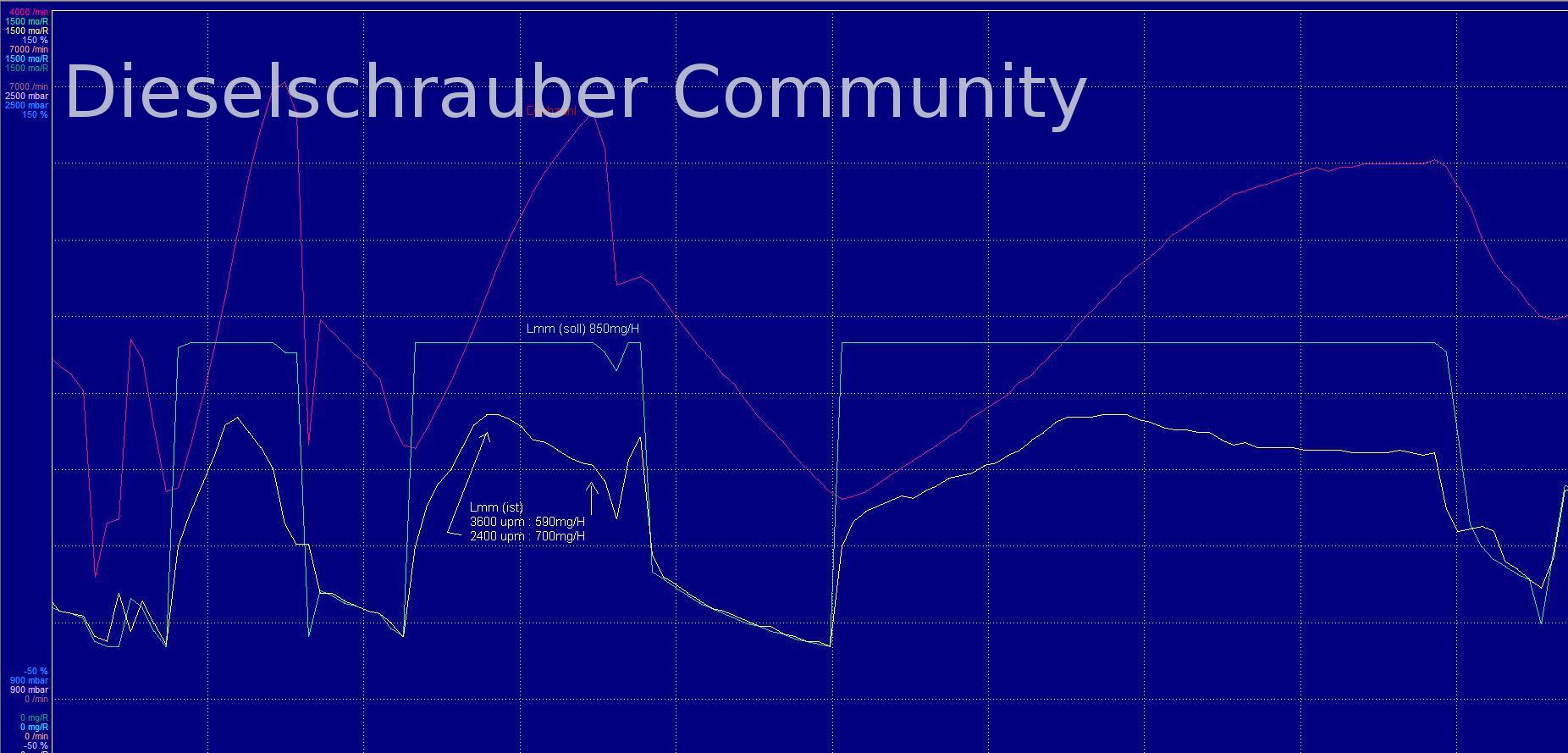
At the higher engine speeds, the curve drops below 600 mg/H. Several other problems had to be resolved beforehand, but the following test result confirms my suspicion that the mass airflow sensor (MAF) is likely the last remaining weak point.
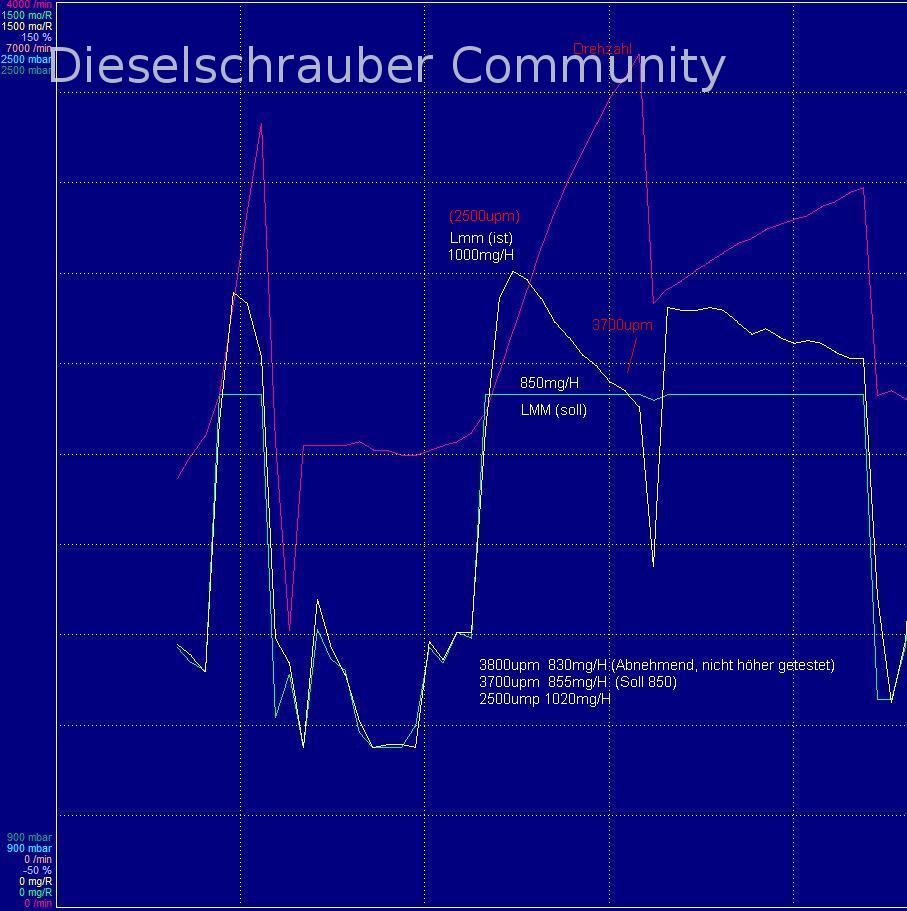
The initial attempts were underwhelming, but I am now more than satisfied. The engine is unrecognizable, and the top speed has increased from about 140 to 160. At the beginning, it only ran at around 125 on the track. Based on the curve, I suspect that a little more performance can still be squeezed out through fine-tuning above 3800 RPM.
The air mass value is also slightly higher than that of a new LAM (derived from sources -> 950 mg/H). This is intentional, as the engine seemed to perform even better during the diode test. However, it only started smoking and misfiring when using the diode. So, the diode indicates that the engine delivers its power at 1275 mg/H, but in my case, it's undrivable. With the currently set maximum value of 1020 mg/H at approximately 2500 RPM, it functions perfectly well.
That's a brief overview; questions:
During my research, I found disappointingly few results, as most of the information seemed to boil down to the fact that it's impossible to clean it properly, and ultimately, the LMM (likely referring to a laser mass flow meter) needs to be replaced. I could hardly find any specific measurements, and I had to conduct numerous experiments myself using voltage readings, which unnecessarily increased the effort involved.
Does it make sense to set the LMM (lambda-max mass) value slightly higher than 850 mg/H, or can the subjectively improved torque be confirmed?
Could the drop of 3800 RPM at narrow passages (e.g., due to deposits on the EGR valve) be the cause, making further adjustments pointless? Or could it be that the curve or characteristic of the worn-out mass airflow sensor requires further correction in the upper range?
Or even regarding the general characteristics of the engine (75 kW at a relatively low 3500 rpm)?
So far, I haven't removed the DPF (Diesel Particulate Filter) and intake manifold yet. I know I should have already.
However, due to its specific characteristics, I will refrain from making any further corrections.
T4 ACV 2.5L TDI turbocharger/wastegate, 320,000 km mileage.
- LLK cleaned.
- Turbocharger pressure regulation is okay.
- No error entries in the MSG file.
- Aftermarket clamp installed at the turbocharger inlet.
- Funding starts at 52.
- Accelerator pedal value in MSG: 0-100.
More candidates will be announced when the time is right.
Golf 4 ALH, Stage 1, 110 kW.
A3 2.0 BKD series.
Best regards,
Steffen
P.S.: Sorry, the scaling is missing. If it's not clear:
Speed: red.
LMM Target: light blue.
LMM is: yellow.
Corrected:
3800 revolutions per minute, 830 mg/hour (decreasing, not tested at higher values).
3700 upm, 855 mg/H (Target: 850).
2500 UMP, 1020 mg/hour.
Before
3600 revolutions per minute, 590 milligrams per hour.
2400 revolutions per minute, 700 mg/hour (peak value).
| Description: |
| Air Mass Sensor Calibration Circuit |
|
| File size: |
175.57 KB |
| Viewed: |
1257 times |
|
| Description: |
| Air Mass Sensor Calibration Circuit |
|
| File size: |
109.3 KB |
| Viewed: |
2007 times |
|
ALH +Stufe 1
Translated on 07-08-2026, 14:03.
|


 Bookmarks
 Links
Links Garage
 FAQ, Legal Notice & Privacy
 RSS Feed
 Register
 Login
Login