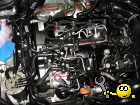
I registered here today because both my "diesel friends" and I are at a loss. My name is Christopher, I'm 32 years old, and I have diesel in my blood.
First, regarding the vehicle/engine:
"This might be a bit unusual for this forum, but it's a Fiat Stilo 1.9 JTDm 16v Multijet with 150 horsepower (Common Rail 2nd generation) that doesn't have a diesel particulate filter from the factory. The engine control unit is a Bosch EDC16."
Regarding the issue:
To begin with: the vehicle is no longer in its original condition. However, this does not change the nature of the problem.
Since a larger intercooler was installed in the vehicle (standard: 2650cm³, Darkside intercooler: 6600cm³), the vehicle is no longer reaching its target boost pressure. With the standard intercooler, the target boost pressure was still achieved, although the VTG (variable turbine geometry) values were already too high. With the larger intercooler, the VTG values are now excessively high, and the target boost pressure is no longer reached.
We are completely baffled as to where this is coming from. This is now the second production-series turbocharger that has been installed, and the problem is identical in both.
I've attached some logs for reference. I also have comparison logs from a similarly tuned model with the same engine. We're seeing a difference of 30% in the VTG (Variable Turbine Geometry) at 4000 RPM. My VTG is constantly increasing, but the target boost pressure is still not being reached.
The following modifications or replacements have been made to the engine so far:
- Turbocharger pressure sensor (previously 3 bar - now 4 bar) - did not change the problem (mapping was adjusted).
- Mass airflow sensor (replaced with a production part / Bosch)
- Injectors (larger ones were installed) - this did not solve the problem (the fuel map was adjusted).
- Downpipe
- High-pressure pump with a modified shaft.
- AGR valve disabled/blocked and AGR cooler removed (map has been adjusted).
- Intercooler
- Intake manifold without swirl flaps (standard version includes swirl flaps).
- New air filter.
- The intercooler system has been checked for leaks multiple times.
- Vacuum system checked and vacuum pump replaced.
- VTG pressure transducers replaced.
I'm now interested in what could be responsible for the VTG (variable turbo geometry) continuing to close, even though the target boost pressure cannot be reached. As mentioned before, this problem also occurs with standard turbochargers, but it's much less pronounced.
The logs include the following:
Stilo_Serie_4th_gear.csv = my car - completely stock.
"Stilo_tune_Serien-LLK_5th_gear.csv = My car with tuning and a stock intercooler."
"Stilo_tune_big_LLK_4th_gear.csv = My car with tuning and a large intercooler, in 4th gear."
Stilo_Vergleich_Serie_4th_gear.csv = Comparison vehicle, standard version.
Stilo_Vergleich_tune_4th_gear.csv = Comparison vehicle, tuned.
Thank you in advance for any help you can provide.
Either the boost pressure is being measured incorrectly (measurement error), or the turbine is not receiving enough power (insufficient fuel injection, leak in the exhaust system), or the pressurized air is escaping (leak).
The points you're raising are actually the ones that seem most plausible to me.
- The boost pressure sensor has already been replaced.
- That shouldn't be the problem.
- I can rule out a leak between the exhaust manifold and the turbocharger.
- The air mass readings are plausible in relation to the boost pressure (volumetric efficiency is correct). The intercooler has also been reinstalled several times. The intake manifold was pressure tested before installation. There are no oil traces indicating a leak in the intercooler system.
Could backpressure or turbulence in the exhaust gases also cause this (e.g., a damaged flexible pipe or a clogged catalytic converter)?
(e.g., a damaged flexible pipe or a clogged catalytic converter)?
Yes, blockages in the exhaust system can cause that, but it's relatively rare.
Have you checked whether the VTG (Variable Turbine Geometry) on the turbocharger is actually doing what the engine control unit wants it to do?
If controlled by a vacuum/pressure sensor (I don't know your engine), leaky hoses connected to the control system or stuck solenoid valves could also be the cause.
Do you have the ability to perform actuator tests on your VTG (Variable Turbine Geometry) via diagnostics? Specifically, can you test the full range of motion, from fully closed to fully open?
Okay, then that's another point I can test with the exhaust. Just disconnect it before the catalytic converter and log the data.
I can only actuate the VTG (valve travel gauge) and use it to test whether it moves freely. The actuation is done in a classic way using vacuum: vacuum source -> pressure transducer -> pressure sensor.
As mentioned, the pressure transducer was replaced, and I also measured the pressure before and after the transducer using a pressure gauge. Before the transducer, the reading was -1.0 bar, and after the transducer, it was -0.6 bar. Therefore, everything is within the expected range.
The turbocharger has already been replaced, so it can be ruled out as the cause. Both turbos exhibited the exact same "error pattern." For testing purposes, I also replaced the pressure sensor on the first turbo, but that didn't resolve the issue.
I now have some more ideas:
Currently, there's a Knödler lambda controller installed in the car, but it's not connected. I'm going to connect the lambda sensor, which is currently connected to the engine control unit (ECU), to the lambda controller (the ECU doesn't go into limp mode with the sensor disconnected). I'll then check the AFR (air-fuel ratio) value.
Using the calculated AFR value from the logs and the AFR value from the controller, I can then check whether there is actually too little fuel being delivered.
The AFR values look plausible and okay. Perhaps it would be a good idea to connect a pressure gauge directly after the air mass sensor (LLK) to rule out a faulty reading from the engine control unit due to an unsuitable data set, a faulty boost pressure sensor, or something similar?
Look for signs of oil leaks on the exhaust manifold and turbocharger, which could indicate leaks on the exhaust side.
Boost pressure sensor:
Sowohl mit dem alten serienmäßigen 3 Bar Ladedrucksensor als auch mit dem neuen 4 bar Sensor und angepasster Linearisierung, sind die Ladedruckwerte gleich. Hier schließe ich einen Fehler aus. Aber ich könnte den in meinem Pro-C Display integrierten Ladedrucksensor zum Test anklemmen. Ok, is noted.
There are no traces of exhaust on the manifold or the turbo. It's obviously all sealed properly.
The AFR (Air-Fuel Ratio) issue is now resolved. I did a test drive and recorded the data, along with a video. There are some deviations in the lower RPM range, but that's not critical. However, from approximately 3000 RPM onwards, the measured values from the lambda controller almost perfectly match the expected values from the logged data.
Here's the video and log file attached.
In my opinion, the only other possibilities are a blocked exhaust or, alternatively, I might be completely blind and missing a huge intercooler leak.
VTG Position: High RPM, Fiat Stilo 1.9 JTDm - Fiat Stilo 1.9 JTDm Multijet 16V AFR 3rd gear #2.mp4
It's a GT1749V (similar to the GT1749VB from the VAG group).
The exact part number is 55214063.
It is used in 150 hp and 170 hp 1.9 JTDm MultiJet 16v engines produced by the FCA group.
The desired power output is approximately 180 to 190 horsepower. These are also well-known and reliable figures within the "JTD scene." The person who is writing my software has been doing it for a few years and knows that the turbocharger can deliver that and even more. I'm not aiming for significantly more power, as I want a durable setup for highway driving, covering around 30,000 km per year.
I've already used this turbocharger on a 1.9 JTD Unijet 8v before. It worked fine with over 1.5 bar of boost. Of course, it had to handle less air mass because the cylinder head is less efficient.
On Saturday, the exhaust will be removed and data will be logged. I'm very curious because my initial assessment points towards a blocked exhaust. The symptoms are slowly all indicating that.
Are you sure that the VTG control in the engine control unit is configured correctly?
The problem is, you can't simply say that x% at engine speed y and fuel injection amount z results in boost pressure t, because there are too many dependencies involved.
You've already ruled out the exhaust system.
It's also possible that the vacuum sensor on the turbocharger has a leak, which can sometimes be position-dependent. You can test this by tightening it fully and then leaving it for a while to see if the position remains stable.
Or a faulty solenoid valve (pressure transducer) for the VTG control, or it's defective, the connector is broken, the hose is torn, and the vacuum is leaking somewhere else, whatever.
Or a faulty vacuum sensor on the turbocharger. Or the VTG characteristic map in the data set does not match the turbocharger.
Attention: There are significant differences in the control parameters for the GT1749V, GT1749VA, and GT1749VB turbochargers used in VAG engines!
The contact person for you would be...
Quote:
The person who writes my software has been doing it for a few years
.
"Because then he should also be familiar with the common issues that occur with these engines/vehicles. For example, with the Passat 3BG, the intercooler hoses almost always cracked, and with the Polo 9N TDI, there was often insufficient intercooling."
Is it really an original charger installed, or just a more or less successful clone?
Have you already tested the actual boost pressure using a compressed air gun and a diagnostic tool?
The pre-control settings in the control unit are correct.
I've already replaced the wastegate on the turbo, and the turbo itself has already been replaced. Both turbos exhibit the exact same problem.
The charger is definitely a genuine part.
I can actually rule out the charge air hose because the air mass readings are perfectly plausible. I could re-check the entire charge air system, but I don't see much point in doing so.
The pressure transducer has been replaced, but it didn't make any difference.
Vacuum hoses were replaced, and the vacuum pressure was also measured. The vacuum pump was also proactively replaced.
And since I have logs from another car with the same engine, I also know what's possible. And that's completely different (see my first post).
The target boost pressure was achieved with the standard turbocharger control, but also with a very high VTG (Variable Turbine Geometry) setting. We're talking about approximately 20%, which should actually be lower.
Comparison with series charging air-to-water cooler:
My car: 4000 rpm / EM 76 mm³ / 2.45 bar / 55% VTG.
Comparison vehicle: 4000 rpm / EM 74 mm³ / 2.6 bar / 34% VTG.
When the large turbocharger was installed, and presumably due to the now larger volume of air, the loader could no longer maintain the required boost pressure.
I'm not familiar with testing a boost pressure sensor using compressed air. Should I screw it into a pipe and apply pressure to it?
It just doesn't make sense to me. Increasing engine speed = increased exhaust volume = the variable turbine geometry (VTG) needs to open further, otherwise there will be too much boost pressure.
The VTG (variable turbine geometry) is tightening more and more as the engine speed increases. As I mentioned before, this would cause a lack of exhaust gas, which is completely crazy...
Wood hammer test method:
To rule out any issues with the entire VTG control system, vacuum problems, connections, etc., I would perform the following tests.
Fix the turbocharger's mechanical boost pressure to the maximum using a metal cable tie or clamp. Perform a test drive with a mechanical boost pressure gauge or active diagnostics in high resolution. Drive extremely carefully (!) and constantly monitor the boost pressure. Only increase the power in the higher gears and check if the boost pressure is still not being reached. However, pay very close attention to the boost pressure. With this setup, it is possible to quickly damage the turbocharger.
Whether this approach will work also depends on the engine control unit. I cannot say whether the Fiat will detect the change during the plausibility check of the values and enter a limp-home mode.


 Bookmarks
 Links
 Garage
 FAQ, Legal Notice & Privacy
 RSS Feed
 Register
 Login