"Over the past few months, as the weather has gotten warmer and the air conditioning has been needed, I've noticed the following: When the engine isn't fully at operating temperature and the outside temperature is at least 18°C, the engine starts to run roughly at idle with the air conditioning turned on. However, once the engine is properly warm, the rough idle disappears." The engine runs very well without the air conditioning turned on!
First, I suspected the water temperature sensor and checked it. However, then I noticed that the actual value of the throttle valve was completely different from the target value! Although, no error code is being displayed. The target value is approximately 95%, while the actual value at idle is only around 5%.
Can the throttle valve be accessed and controlled using VCDS? In the basic settings, I only found the control for the EGR system, which also seems to be working.
Could the entire problem possibly be due to a faulty throttle valve? Error codes are not being displayed!
What can I do to provide more and better information?
Caddy 3 mit BLS Motor, 105PS, DPF (0603/AGB)
Renault Laguna 2 mit F9Q Motor, 107PS/120PS (3004/158)
Can the throttle valve be accessed and controlled using VCDS?
In the basic settings, I only found the control for the AGR (Abgasrückführung), which also works.
is combined.
I suspect the problem lies in different fuel injection amounts per cylinder, so I'm going to check the idle speed control. Is the engine control unit (ECU) software original?
If the air-fuel mixture cannot be properly regulated, the engine can run very poorly. However, the preheating lamp (error lamp) should come on first.
It's best to log engine speed, fuel injection quantity, and air mass (target and actual values) in a separate data log. Logically, this applies to the area when there is a fault, and not when the engine is running perfectly.
I hope I created the logs correctly. Unfortunately, the timing information was included, but I'm currently unable to reproduce the error to create a new log.
The software is original. There are absolutely no modifications to the vehicle!
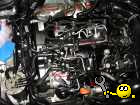
Here's a video about it. Often, when the engine is warmer, the fluctuations in engine speed occur a few moments after the air conditioning is activated and don't stop until the air conditioning is turned off. The engine is still just slightly warm here.
BLS - Erratic idle when AC is on - and more (Solution) - Klimaanlage-unruhiger-Motorlauf.mp4
Description:
BLS - Erratic idle when AC is on - and more
File size:
7.06 MB
Viewed:
2953 times
Caddy 3 mit BLS Motor, 105PS, DPF (0603/AGB)
Renault Laguna 2 mit F9Q Motor, 107PS/120PS (3004/158)
The values regarding idle speed control, switching times, and fuel injection volume appear to be good considering the mileage.
It would be interesting to know if the EDC (Electronic Diesel Control) system increases the fuel injection amount in diesel engines with air conditioning, especially when the engine speed is low.
It sounds to me like the climate control compressor is occasionally becoming quite difficult to turn, and the EDC (Electronic Diesel Control) system needs to adjust the fuel injection amount to maintain the idle speed.
Has anyone been messing with the air conditioner lately?
Is the air conditioning compressor being properly controlled? Perhaps the control line to the compressor has a poor connection, or the corresponding actuator is defective, causing it to switch on and off intermittently. Alternatively, there might be debris, excessive oil, or something else inside the compressor, causing it to unexpectedly become difficult to turn at times. I would like to check the entire belt drive system that powers the air conditioning compressor.
"Can you perform an auto-scan of the vehicle? Ideally, without any error codes related to things that are no longer relevant." Okay, so let's delete everything and try using it for a few days, both with and without the air conditioning.
I was planning to remove the belt drive this weekend anyway, and see if the compressor, powered by a drill, becomes difficult to turn at times. However, I can't really imagine that happening. I mean, the motor doesn't sound heavy or strained at all. I'm comparing it to things like starting from a standstill or trying to drive uphill from a standstill.
Since I'm reaching my limits with the air conditioning system due to a lack of tools, I've already scheduled an appointment with a car repair shop in about two weeks. They'll take a look for shavings and other issues. If they find anything, I'll post it here!
But is it possible that I could drive approximately 5000 km with the air conditioning running without the compressor failing, even if it's starting to go bad? Could it be a ball bearing then?
EDIT:
The air conditioning system hasn't been touched in about 5 years. Before that, the pressure switch on the condenser (I think) suddenly started leaking. Unfortunately, a new dryer was not installed during the repair.
I've checked the error memory a few times. There are no errors present, except for a faulty glow plug that I've noticed recently. But, as mentioned above, this problem has been ongoing since the climate control system was first used after the engine replacement, and it started happening when it got warmer.
The exchange took place in December of last year. During the engine replacement, the compressor was simply unscrewed and hung aside without needing to drain the system.
Caddy 3 mit BLS Motor, 105PS, DPF (0603/AGB)
Renault Laguna 2 mit F9Q Motor, 107PS/120PS (3004/158)
Hello, could it be that the alternator regulator has a defect?
Best regards, Dago
Hmm, when I look at my USB charger, which has a voltage display, it always charges the battery up to 14.4V and no higher.
Years ago, the alternator malfunctioned, which was also indicated by a warning light.
But, as I said, it only happens when the air conditioning is turned on, and then only when the engine isn't at its full operating temperature. That means that after driving for 20 kilometers at a good pace, the problem disappears. However, after only 10 kilometers of driving at a good pace, the problem is at its worst. Shortly after the engine starts, it is not yet noticeable.
Caddy 3 mit BLS Motor, 105PS, DPF (0603/AGB)
Renault Laguna 2 mit F9Q Motor, 107PS/120PS (3004/158)
"No offense, but without the belt, it wouldn't look like a climate control system and would be less noticeable." What happens to the alternator's clutch when it fails? It's always a fun problem to deal with.
Today, I had the belt detached at the bottom. The engine then ran as usual. The compressor itself didn't seem particularly difficult to turn. If the alternator isn't rotating, the compressor won't engage, so you have to manually activate it at the switch located at the bottom. I didn't do that because I didn't want to just randomly connect wires somewhere without knowing where the positive and negative terminals are.
The alternator doesn't seem to be engaging anymore, even though it doesn't spin for a short time after the engine starts. The freewheel mechanism seems to be working fine. There's no rattling, clattering, or anything like that. It runs mechanically without any problems compared to a fully developed alternative generator.
Once the belt was reattached, the engine started behaving erratically again, with fluctuations in its RPM.
However, while operating with the flat belt installed and the air conditioning on, I slightly loosened the tensioner to try and prevent any squeaking or visible slippage, or to hopefully get the compressor to spin up faster. However, I couldn't achieve any success on my own. The belt seemed to be slipping very slightly, almost imperceptibly. When I tightened it again while the system was running, the speed increased by about 50 RPM and didn't drop back down. However, after that, there were no more skipping issues, just like at the moment when the belt was slightly loose.
It's probably the AC compressor.
I believe the increase in RPM when the belt is slightly loosened and then tightened again is because the system switches to a kind of emergency mode, as the alternator seems to be providing insufficient power.
EDIT (Sorry): The engine has approximately 145,000 kilometers on it. Unfortunately, I didn't mention that in my initial post.
Caddy 3 mit BLS Motor, 105PS, DPF (0603/AGB)
Renault Laguna 2 mit F9Q Motor, 107PS/120PS (3004/158)
Hi!
Is it an externally regulated compressor, or one with an internal magnetic coupling?
You can definitely try applying 12V directly to the valve (with appropriate protection!) for testing purposes and disconnecting the original cable (which is PWM-controlled). This will allow the compressor to be powered at its maximum level without the motor knowing it. If it's now making a sputtering sound, I would strongly suspect a problem with the compressor.
Regards,
brezelmann01
Audi A3 Sportback [8PA], 2.0 TDI CR [CFGB], STH mit FB
[VERKAUFT] Polo 6NF 1.4TDI (AMF) mit nachgerüstetem DPF, STH+FFB, Bj. 2000, 222tkm
After properly evacuating the air conditioning system, remove the compressor and refill it with new oil according to the manufacturer's specifications.
Sommer: A4 B5 Avant 2,5 TDI Quattro Facelift (AKN silber)
Wartet auf H Kennzeichen: A4 B5 Avant 1.9 TDI Quattro (AFN Schwarz)
Before I took the car to a workshop, error messages like "Mass airflow sensor value too high" suddenly appeared. Then there were also issues with a "leak in the charge air system," and the particulate filter regeneration would sometimes stop with an error (which, unfortunately, I can no longer recall).
After the car had been to the first workshop, and they had found out as much as I had, it went to the next automotive repair shop.
"They recommended that we start by replacing the AGR valve. It looked very dirty and seemed to be sticking (with VCDS, the AGR values were actually always good, except for a short period just before the second visit to the workshop, when they were slightly off). However, I initially attributed this to the AGR cooler, as it was leaking and dirty around the shaft." At the same time, the car smelled extremely strongly of exhaust fumes inside.
After replacing the AGR valve, the car no longer smelled of exhaust fumes inside! However, the engine still wasn't running smoothly. But it was running at full power!
However, the problem was that the car continued to frequently display multiple error messages.
On certain dry days, there was never a problem with the memory, but the engine still didn't run smoothly at idle - and now even without the air conditioning being on!
The car repair shop wanted to know how old the mass airflow sensor was, but it was only about a year old and was a Bosch brand replacement part.
However, after another 500 km of flickering glow plugs because the mass airflow was too high, with the entire intercooler system sealed and the turbocharger functioning correctly, I have now purchased a new mass airflow sensor (Meat Doria) of original equipment manufacturer (OEM) quality.
And suddenly, right after the exchange, the car is working perfectly! Even when idling.
At one point, it was also suspected that the injectors might be the problem, as the engine occasionally experienced very minor misfires during operation. That was before the EGR valve was replaced.
Caddy 3 mit BLS Motor, 105PS, DPF (0603/AGB)
Renault Laguna 2 mit F9Q Motor, 107PS/120PS (3004/158)
I suspect that the incorrect air mass readings led to excessive activity of the EGR valve. The system then tries to forcefully bring the actual air mass flow rate up to the target value, resulting in the engine almost exclusively drawing in exhaust gases.
In the latter case, the idle speed would likely have decreased slightly.


 Bookmarks
 Links
Links Garage
 FAQ, Legal Notice & Privacy
 RSS Feed
 Register
 Login
Login