| Author |
Message |
donalexo
Profi-Schrauber

Joined: 01/09/2003
Posts: 695
Karma: +0 / -0 
Location: Würzburg
Support
|
 15-02-2004, 16:23 Subject: Crankshaft bearing replacement for 4-cylinder TDI 15-02-2004, 16:23 Subject: Crankshaft bearing replacement for 4-cylinder TDI |
Quote |
|
Hello everyone!
Has anyone here ever replaced the connecting rod bearings on their TDI engine?
That should actually be possible with a built-in motor and an attached head, right?
I imagine the process would involve simply removing the oil pan and the oil splash pan, and then addressing each connecting rod individually. The free space within the crankcase should actually be sufficient to allow the connecting rod to pass by the crankshaft journal for bearing shell replacement, right?
I vaguely remember changing the connecting rod bearing shells on a T3 Volkswagen bus with a diesel engine more than 10 years ago. At that time, however, the engine did not have a cylinder head.
To what extent does the oil pump actually hinder the entire process (in the AGR/ALH/AHF/ASV systems)?
What is the approximate amount of work required to access all the connecting rod bearings when the engine is installed?
Here's another question related to statistics: Has anyone experienced a connecting rod bearing failure in their tuned/untuned TDI engine, and at what mileage?
Thank you for your information.
Regards,
Alex.
P.S. I was thinking about possibly upgrading the AGR (active grille roller) with a set of reinforced (sputter-coated) bearing shells, so it can better handle performance upgrades, especially since the car has already run 150,000 km.
AUDI A3 1.9 TDI, EZ 12/96, ursprüglich MKB AGR, umgebaut zum AHF mit GT1749V-Lader, verkauft mit 250tkm
Golf 4 1.9 TDI, EZ 1/98, MKB ALH, jetzt auch mit GT1749V-Lader, verkauft mit 300tkm
Touran 1.9 TDI, EZ 09/2004
Audi A4 Avant 2.0 TDI, EZ 03/2010
Translated on 03-07-2026, 15:19.
|
|
| Back to top |
Profile PM |
 |
mersente
Guest
Free account, no CAN development support
|
| 16-02-2004, 22:06 Subject: Crankshaft bearing replacement for 4-cylinder TDI |
Quote |
|
Hello, so far, I haven't heard of any cases where the bearing shells of a TDI engine have worn out, assuming regular oil changes are performed.
I haven't had any problems with it, even with modified vehicles.
Otherwise, you simply replace them as you would with a T3.
You can leave the cylinder head on.
Don't push the pistons too forcefully against the valves.
Translated on 03-07-2026, 15:19.
|
|
| Back to top |
|
|
donalexo
Profi-Schrauber
Joined: 01/09/2003
Posts: 695
Karma: +0 / -0
Location: Würzburg
Support
|
| 17-02-2004, 0:38 Subject: Crankshaft bearing replacement for 4-cylinder TDI |
Quote |
|
@mersente!
Thank you for the information.
How is the accessibility around the connecting rod of the first cylinder? Is the oil pump causing the problem, or is it possible to replace the connecting rod bearing in that way?
What is the amount of effort required for the peripheral tasks, i.e., everything other than removing the oil pan and actually replacing the bearing shells?
Thank you in advance.
Regards,
Alex.
AUDI A3 1.9 TDI, EZ 12/96, ursprüglich MKB AGR, umgebaut zum AHF mit GT1749V-Lader, verkauft mit 250tkm
Golf 4 1.9 TDI, EZ 1/98, MKB ALH, jetzt auch mit GT1749V-Lader, verkauft mit 300tkm
Touran 1.9 TDI, EZ 09/2004
Audi A4 Avant 2.0 TDI, EZ 03/2010
Translated on 03-07-2026, 15:19.
|
|
| Back to top |
Profile PM |
|
mersente
Guest
Free account, no CAN development support
|
| 17-02-2004, 0:50 Subject: Crankshaft bearing replacement for 4-cylinder TDI |
Quote |
|
It's possible that you'll need to remove the oil pump, but it's not a big deal. I can tell you more tomorrow.
Translated on 03-07-2026, 15:19.
|
|
| Back to top |
|
|
mersente
Guest
Free account, no CAN development support
|
| 17-02-2004, 21:00 Subject: Crankshaft bearing replacement for 4-cylinder TDI |
Quote |
|
Okay, I checked, and it seems like I would wait until the timing belt needs to be replaced, because you'll have to remove the oil pump. The oil pump is driven by a timing chain connected to the crankshaft, so you'll also have to remove the flange behind the crankshaft pulley. You only get the oil pump out after that.
Translated on 03-07-2026, 15:19.
|
|
| Back to top |
|
|
donalexo
Profi-Schrauber
Joined: 01/09/2003
Posts: 695
Karma: +0 / -0
Location: Würzburg
Support
|
| 18-02-2004, 1:16 Subject: Crankshaft bearing replacement for 4-cylinder TDI |
Quote |
|
@mersente:
Thank you for your information!
That's exactly what I feared  . Actually, I wanted to leave the ZR drive untouched in this operation. It would have been a relatively quick operation, just swapping the bearing shells. But that's how a whole Saturday can quickly disappear .
Okay, I'll just hope that the bearing shells last a while longer. I'm not feeling too confident, though, because all the versions with 110 horsepower have reinforced upper bearing shells (sputter-coated bearings). By the way, that's the only mechanical difference between the 90 hp and 110 hp TDI engines.
But if connecting rod bearing problems have been rare or nonexistent in TDIs so far, then perhaps I can ease my conscience.
BMW gasoline engines seem to be quite sensitive in this regard.
Regards,
Alex. AUDI A3 1.9 TDI, EZ 12/96, ursprüglich MKB AGR, umgebaut zum AHF mit GT1749V-Lader, verkauft mit 250tkm
Golf 4 1.9 TDI, EZ 1/98, MKB ALH, jetzt auch mit GT1749V-Lader, verkauft mit 300tkm
Touran 1.9 TDI, EZ 09/2004
Audi A4 Avant 2.0 TDI, EZ 03/2010
Translated on 03-07-2026, 15:19.
|
|
| Back to top |
Profile PM |
|
mhernach
Guest
Free account, no CAN development support
|
| 18-02-2004, 15:38 Subject: Crankshaft bearing replacement for 4-cylinder TDI |
Quote |
|
Hello...
I've now driven almost 280,000 km, and I don't yet feel like the bearings need to be replaced... I still have enough oil pressure at 940 rpm.
Why do you want to change them...?
Basically, it should start from the bottom, and that's definitely how it was with Mercedes...
Best regards, Mike.
Translated on 03-07-2026, 15:19.
|
|
| Back to top |
|
|
Uli S.
Schrauber

Joined: 07/02/2003
Posts: 338
Karma: +7 / -0
Location: Äußerster Südwesten
Support
|
| 18-02-2004, 16:15 Subject: Crankshaft bearing replacement for 4-cylinder TDI |
Quote |
|
donalexo wrote: | But if connecting rod bearing problems have rarely or never occurred in TDIs so far, then perhaps I can ease my conscience.
The BMW gasoline engines seem to be quite sensitive in this regard. |
Hi Alex,
"Once, at 1802 kilometers (approximately 112 miles), I had one blow up on the highway at a mileage of 205,000 kilometers (approximately 127,000 miles). The steel support shell was pushed outwards between the crankcase and the connecting rod, and it looked like aluminum foil. The lower connecting rod bearing journal was widened by about 3 tenths of a millimeter, and the bearing itself was completely worn." Thanks to BMW's modular system, I was able to take the crankshaft and connecting rods from a 1.6-liter engine that had a blown head gasket and install them into a 1.8-liter engine block.
On my 2 GTD (similar to a T3), I also replaced them at 260,000 km, but it was more of a precautionary measure. It wouldn't have been necessary, considering how they looked.
I wouldn't change them unnecessarily anymore; these things usually make a noise beforehand, and with a diesel, the engine speed isn't as critical, so the inertial forces that act so suddenly and destructively in a gasoline engine aren't as significant.
Best regards, Uli. Golf2 GTD AAZ, LLK, CYP
Bus T3 JX
Passat 32B SB, LLK, Garett T2, 2N
2x Golf2 GTD/SB
alle fahren/fuhren ganzjährig frauentauglich mit 100% Pflanzenöl
97er Golf 3 AFN, 70-100% Pöl
97er Golf 3 Variant AFN
96er Passat 35i AFN
Translated on 03-07-2026, 15:19.
|
|
| Back to top |
Profile PM |
|
garth.brooks
Guest
Free account, no CAN development support
|
| 18-02-2004, 22:32 Subject: Bearing wear |
Quote |
|
Hey everyone,
After each oil change, I disassemble my oil filters and inspect them for metal shavings.
Furthermore, I would recommend getting an oil check done before replacing the connecting rod bearings, as a failing connecting rod bearing often manifests early through changes in the oil. Based on experience, engines are not necessarily improved by unnecessary work, and something can always go wrong.
I've also already searched the forums for information about pinion bearings. The BMW and Ford models seem to be frequently discussed in that context, but there's nothing about the TDI so far.
And: A lot can be influenced by the driving style, the oil used, and especially by starting the engine gently.
Avoid high RPMs; torque is all that matters.
Thin oil lubricates much faster during cold starts.
When starting the engine from cold, allow it to run at a slightly elevated idle speed (1200 RPM) for a short time to allow the oil to circulate properly before driving away. (10 seconds should be sufficient).
The oil pressure doesn't necessarily indicate the condition of the connecting rod bearings. If the oil pressure drops significantly, it often means the crankshaft is also failing, and you usually hear signs of this problem beforehand.
But if you do disassemble it, please tell me what the casings look like.
Translated on 03-07-2026, 15:19.
|
|
| Back to top |
|
|
Jan03
Blaumann

Joined: 08/24/2003
Posts: 142
Karma: +6 / -0
Location: Dänemark
2010 Volkswagen Polo
Free account, no CAN development support
|
| 19-02-2004, 21:40 Subject: Crankshaft bearing replacement for 4-cylinder TDI |
Quote |
|
Hello.
If I may ask a rather simple question, how do worn bearing shells manifest themselves acoustically?
And what do reinforced bearing shells look like? These are plain bearings, so shouldn't only the bearing shell surface be important for load-bearing capacity? Wouldn't it be irrelevant how hard the material is, since the lubricant is supposed to provide the "bearing" function? Am I misunderstanding something?
Regards,
Jan.
Translated on 03-07-2026, 15:19.
|
|
| Back to top |
Profile PM Garage |
|
mersente
Guest
Free account, no CAN development support
|
| 19-02-2004, 21:50 Subject: Crankshaft bearing replacement for 4-cylinder TDI |
Quote |
|
Hello, you can hear the defective bearing shells with that dull knocking sound, even when the engine is idling.
Bearing shells have a bronze layer underneath the harder outer layer to provide a temporary emergency lubrication.
Okay, when listening to music, you might not hear a bearing failure, but eventually, you'll see the oil pressure warning light come on. This is because the oil pressure decreases due to the worn bearings and can no longer reach the oil pressure switch or the cylinder head.
Then, all you'll hear between the end of the title and the beginning of the next is the characteristic ticking sound of the hydraulic lifters.
Translated on 03-07-2026, 15:19.
|
|
| Back to top |
|
|
donalexo
Profi-Schrauber
Joined: 01/09/2003
Posts: 695
Karma: +0 / -0
Location: Würzburg
Support
|
| 11-07-2005, 22:23 Subject: Crankshaft bearing replacement for 4-cylinder TDI |
Quote |
|
Hello everyone!
The topic still interests me, even though this thread is quite outdated.
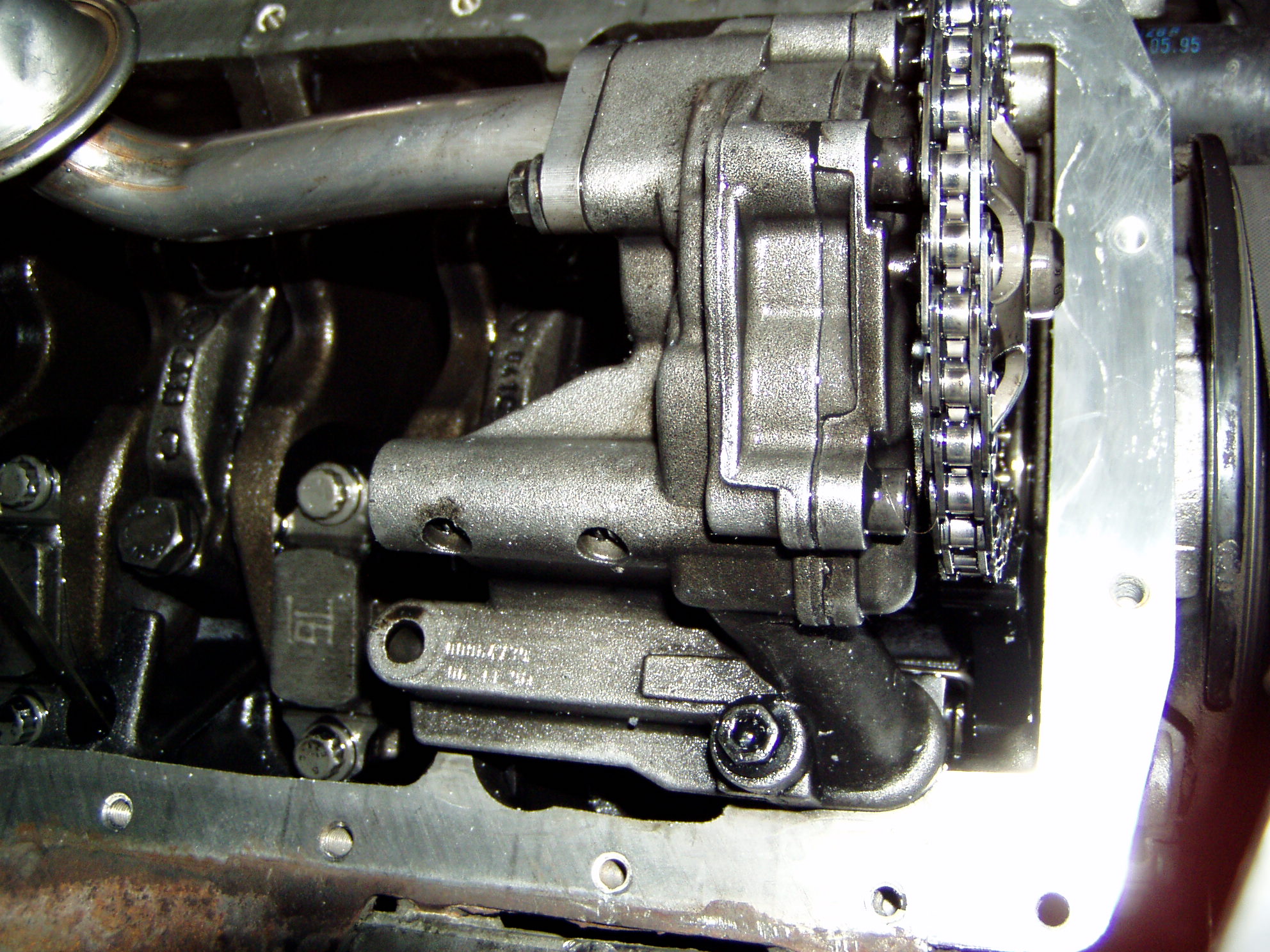
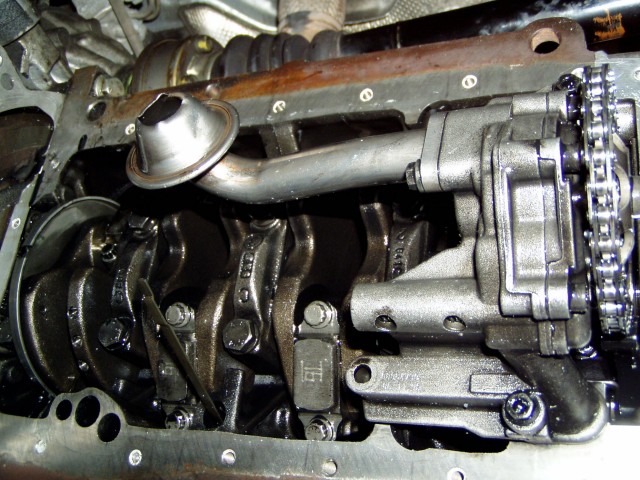
I now also know  what a 038 TDI engine looks like from below, with the oil pan removed.
I'm due for my next timing belt replacement very soon. It's tempting to remove the front sealing flange along with the oil pump at the same time, in order to proactively replace the connecting rod bearings.
"In other forums, I've already read that some people have installed PD connecting rod bearings in VP engines. However, according to the tables provided by MichaelII here in the forum, PD engines have larger crankshaft journal diameters than VP engines. Therefore, it wouldn't work." Perhaps the ASZ engine was initially built with 47.8mm crankshaft journals, and later, as part of a model update, it was fitted with a different crankshaft?
I would find it interesting to combine ASZ or ARL bearing shells in the VP engine to really improve its rigidity.
I also find the VAG pricing policy a bit strange in this regard. The upper bearing shells of the 81kW VP-TDIs (AHF, ASV, AFN) are highly durable sputter bearings. The lower shells are softer, multi-layer bearings. This is clearly evident in the price of the spare parts, as the upper shell costs approximately 23 EUR, while the lower shell only costs about 7 EUR.
In PD engines, sputtered bearings are also used as upper connecting rod bearings, while "conventional" multi-layer bearings are used at the bottom. This can be recognized by the different part numbers . However, there is no price difference for the PDs; both types of bearings cost only 7 EUR per bearing shell .
In that regard, it would also be interesting from a cost perspective to transplant PD storage into a VP motor, if possible.
"Does anyone have experience with these types of conversions?"
Regards,
Alex.
| Description: |
| Crankshaft bearing replacement for 4-cylinder TDI |
|
| File size: |
642.42 KB |
| Viewed: |
13209 times |
|
| Description: |
| Crankshaft bearing replacement for 4-cylinder TDI |
|
| File size: |
108.31 KB |
| Viewed: |
28967 times |
|
AUDI A3 1.9 TDI, EZ 12/96, ursprüglich MKB AGR, umgebaut zum AHF mit GT1749V-Lader, verkauft mit 250tkm
Golf 4 1.9 TDI, EZ 1/98, MKB ALH, jetzt auch mit GT1749V-Lader, verkauft mit 300tkm
Touran 1.9 TDI, EZ 09/2004
Audi A4 Avant 2.0 TDI, EZ 03/2010
Translated on 03-07-2026, 15:19.
|
|
| Back to top |
Profile PM |
|
chris11
Profi-Schrauber
Joined: 10/02/2002
Posts: 326
Karma: +3 / -1
Location: Münster
Premium Support
|
| 12-07-2005, 0:01 Subject: Crankshaft bearing replacement for 4-cylinder TDI |
Quote |
|
Hello,
I can't offer much help with your problem. This mainly concerns BMWs that are sensitive to PL bearings. This primarily affects the 8-cylinder models. The problem with 8-cylinder engines, or all high-performance V-engines, is that the PL bearings have to be narrower because there is simply less space available per connecting rod. Inline-four engines are relatively insensitive when it comes to connecting rod bearings.
Sincerely,
Christian
Translated on 03-07-2026, 15:19.
|
|
| Back to top |
Profile PM |
|
Uli S.
Schrauber
Joined: 07/02/2003
Posts: 338
Karma: +7 / -0
Location: Äußerster Südwesten
Support
|
| 20-07-2005, 11:36 Subject: Crankshaft bearing replacement for 4-cylinder TDI |
Quote |
|
Hello Alex,
donalexo wrote: | | This is clearly evident in the price of the spare parts, as the upper shell costs approximately 23 EUR, while the lower shell only costs about 7 EUR. |
I paid €89 for a complete set of AFN bowls from motorensuche.com, which includes the upper sputtering bowls and the lower standard bowls. They now have a AAZ (75 hp diesel engine) in a VW Golf, which they plan to upgrade to produce 130-140 hp in the future.
Quote: | | In PD engines, IMO also uses sputtered bearings as upper connecting rod bearings and "normal" multi-layer bearings at the bottom. This can be recognized by the different part numbers . However, there is no price difference for the PD models; both types of bearings cost only 7 EUR per bearing shell | .
I think that's a mistake. The sputtering targets are much more complex to manufacture [url][/url] so they are certainly more expensive than the multilayer deposition shells.
Quote: | | From a cost perspective, it would also be interesting to transplant PD storage into a VP motor, if possible | .
It all depends on the geometry of the bearing locations (which should be determinable). If they are the same, then it works.
Best regards, Uli.http://www.msi-motor-service.com/ks/dt/produkte/gleitlagerarten.asp{MARKER}, Golf2 GTD AAZ, LLK, CYP
Bus T3 JX
Passat 32B SB, LLK, Garett T2, 2N
2x Golf2 GTD/SB
alle fahren/fuhren ganzjährig frauentauglich mit 100% Pflanzenöl
97er Golf 3 AFN, 70-100% Pöl
97er Golf 3 Variant AFN
96er Passat 35i AFN
Translated on 03-07-2026, 15:19.
|
|
| Back to top |
Profile PM |
|
donalexo
Profi-Schrauber
Joined: 01/09/2003
Posts: 695
Karma: +0 / -0
Location: Würzburg
Support
|
| 22-07-2005, 18:11 Subject: Crankshaft bearing replacement for 4-cylinder TDI |
Quote |
|
@ Uli :
Quote: | | I paid 89€ for a complete set of AFN bowls from motorensuche.com, so the upper sputtering bowls and the lower standard bowls. They are currently using an AAZ (75 hp diesel engine) in a [vehicle type], which will eventually produce 130-140 horsepower in a second-generation Golf. |
Are you satisfied with the Glyco storage containers from motorensuche.com? The price is really good compared to VAG (89 euros versus approximately 130 euros).
How long have you had those bearing shells installed in your AAZ engine? What was the mileage on the old shells when they were replaced? Were you able to detect any audible differences in the operating noise?
Is the engine already producing 130-140 horsepower, or is that still something in the future?
Quote: | Quote:
In PD engines, sputtered bearings are also used as upper connecting rod bearings, while "conventional" multi-layer bearings are used at the bottom. This can be identified by the different part numbers. However, there is no price difference for the PD models; both types of bearings cost only 7 EUR per bearing shell.
I think that's a mistake. Sputter cups are much more complex to manufacture | which means they are definitely more expensive than multi-layer deposition shells.
Hmm, perhaps I didn't express myself clearly. I am aware that sputter-deposited bearing shells are significantly more expensive to manufacture than normal multi-layer bearings. However, if one is familiar with the industry and understands the price factors between manufacturing costs and the selling price of spare parts, it is quite possible that, for strategic reasons, the manufacturers of PD motors simply calculated the same spare part price for both the upper and lower bearing shells to avoid confusion. The part numbers are definitely different, so there is a reasonable suspicion that the upper shells are sputter-deposited bearings and the lower ones are multi-layer bearings, but they are simply sold at the same "unit price." The salary range is still quite good http://www.msi-motor-service.com/ks/dt/produkte/gleitlagerarten.asp,.
Considering that PD motors experience the highest bearing loads, it is almost inevitable that they use sputter-deposited bearings.
I would only like to know if anyone has ever installed PD shells in a VP engine (part number?), and if so, what experiences they have had with it.
Regards,
Alex. AUDI A3 1.9 TDI, EZ 12/96, ursprüglich MKB AGR, umgebaut zum AHF mit GT1749V-Lader, verkauft mit 250tkm
Golf 4 1.9 TDI, EZ 1/98, MKB ALH, jetzt auch mit GT1749V-Lader, verkauft mit 300tkm
Touran 1.9 TDI, EZ 09/2004
Audi A4 Avant 2.0 TDI, EZ 03/2010
Translated on 03-07-2026, 15:19.
|
|
| Back to top |
Profile PM |
|
garth.brooks
Guest
Free account, no CAN development support
|
| 25-07-2005, 16:25 Subject: VAG engine bearing shells: a comparison |
Quote |
|
Hello donalexo,
Back when you first started discussing this topic, I already spent some time searching online for information about connecting rod bearing damage. The result was that some BMW engines, including 4-cylinder models, and almost all Fiat engines were identified as problematic. (Currently: A colleague reported that on Sunday evening, a Fiat gasoline engine with 120,000 km suddenly experienced a catastrophic failure where parts of the connecting rod ejected from the inside of the engine.)
Ford was also frequently involved.
(With BMWs, it might be due to the combination of a small engine with a high RPM range and the driving style of the driver.)
I found practically NOTHING about VAG engines. And those who managed to push their engines close to 200 horsepower would likely be the first to notice if the connecting rod bearings were about to fail. Instead, the pistons break under the stress, but there's no mention of any issues with the connecting rods.
I had the same idea as you, to replace the parts preemptively, but I'm now quite confident that the lifespan of my AFN won't be limited by the connecting rod bearings.
Because: An engine rarely gets better from being opened up unless it's absolutely necessary.
Translated on 03-07-2026, 15:19.
|
|
| Back to top |
|
|
|


 Bookmarks
 Links
Links Garage
 FAQ, Legal Notice & Privacy
 RSS Feed
 Register
 Login
Login