| Author |
Message |
dieselmartin
Profi-Schrauber


Joined: 03/13/2003
Posts: 10121
Karma: +29 / -0 
Location: in der Werkstatt
2007 Volkswagen Passat
Premium Support
|
 03-07-2007, 16:39 Subject: Overvoltage Protector & Path Sensor 03-07-2007, 16:39 Subject: Overvoltage Protector & Path Sensor |
Quote |
|
Hi.
My previous experience with VTG is only related to the ASV.
/viewtopic.php?t=12864&highlight=asv+assessment
I was able to nicely balance the over-extension, bar rotations, and pressure build-up against each other.
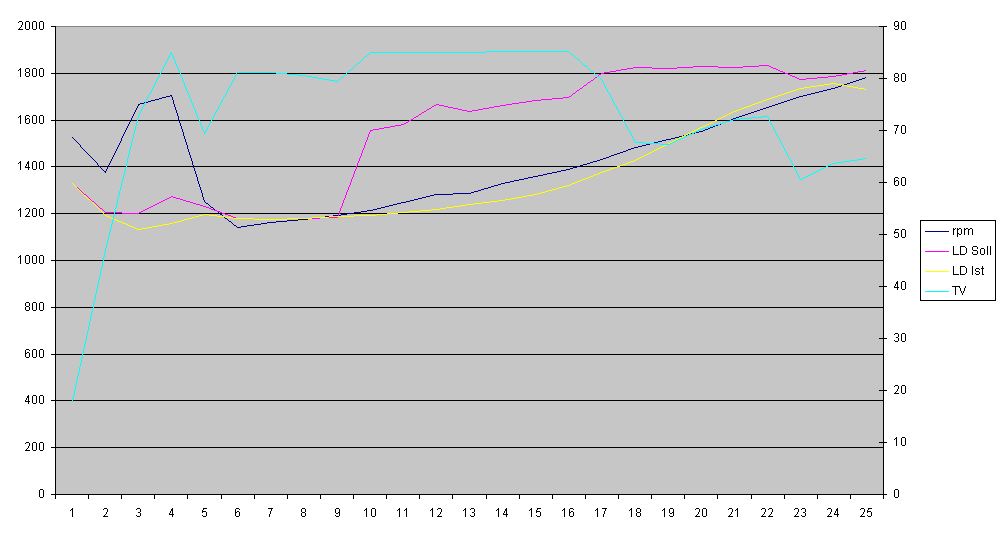
Now I've been logging some data on the BMR and noticed that it repeatedly drops below 1500 in the Russian border zone because the boost pressure isn't increasing. The EGR is closed, the air mass is perfect, but the target and actual boost pressures are constantly deviating from each other, while the VTG is at 85%, which is as high as it can go.
The idea was to make the rod sharper, which meant shortening it.
(1) But how does the PPD1.2 handle this, since it detects that I've rotated it (unlike the ASV), because it has a path sensor on the battery compartment?
(2) How high can the over-expansion be at a normal boost pressure of 2500 mbar absolute and still be acceptable? (Keep in mind that they will increase as the rod becomes sharper.)
Okay, please provide the German text you would like me to translate into English. I will only provide the translation.
Transparency, Teamwork
... there was another T.
I don't know what the f*ck it was.
Translated on 14-08-2026, 18:36.
|
|
| Back to top |
Profile PM Garage |
 |
Malte1408
Schrauber

Joined: 06/23/2005
Posts: 427
Karma: +12 / -0
Location: Hannover
Premium Support
|
| 03-07-2007, 17:23 Subject: Overvoltage Protector & Path Sensor |
Quote |
|
Quote: | | (1) But how does the PPD1.2 handle this, because it notices (unlike the ASV) that I've rotated, since it has a path sensor on the U-dose. |
She doesn't even notice it; the actual stock level (VTG) is simply slightly higher than what the inventory system reports.
In my opinion, the path sensor is primarily intended to stabilize the position of the VTG (vehicle train guidance system) during automated operation.
So far, a TV (Transit Vector Generator) has always been provided, but what is actually desired is a VTG position. (A VTG position replacing a TV is not entirely stable in the long term.)
This additional control cascade allows for precise positioning of the VTG (Variable Turbine Geometry), even after 100,000 km when it may become heavier than at the beginning. Precise positioning is crucial for exhaust emissions and particulate filter regeneration.
If you shorten the rod, the old position will still be reached by the path sensor, but the VTG (likely referring to a specific measurement or setting) will be "sharper."
Translated on 14-08-2026, 18:39.
|
|
| Back to top |
Profile PM |
|
Jochen_145
Guest
Free account, no CAN development support
|
| 03-07-2007, 17:50 Subject: Overvoltage Protector & Path Sensor |
Quote |
|
She doesn't notice it either; the actual stock level is simply reported as being slightly higher than what the system indicates.
Hmm, I wouldn't necessarily agree with that statement.
It depends on where the path sensor is located and which path is being changed.
It is quite possible that the exact path being traced is one that affects the valves.
Therefore, rotating the rod would shift the zero point, which could then be re-measured.
Unfortunately, I don't know this loader well enough technically. 
In my opinion, the path sensor is primarily intended to stabilize the vehicle's position during automated operation.
To the best of my knowledge, the LD (Load Dump) regulation system could only be evaluated up to a voltage level of N75. Anything beyond that point could only be inferred from the LD behavior, but not directly measured.
Now I know whether the turbo is being adjusted or not.
I was already able to assess the engine's performance based on the load measurement using the pressure sensor, considering factors like engine speed and fuel injection volume.
Precise positioning is very important for exhaust emissions and particulate filter regeneration.
The load demand (LD) and air mass are relevant for the exhaust gas behavior. It doesn't matter how much the flaps in the turbo open or close for this; that's why the system is controlled based on the LD.
Best regards, Jochen.
Translated on 14-08-2026, 18:43.
|
|
| Back to top |
|
|
Malte1408
Schrauber
Joined: 06/23/2005
Posts: 427
Karma: +12 / -0
Location: Hannover
Premium Support
|
| 03-07-2007, 17:57 Subject: Overvoltage Protector & Path Sensor |
Quote |
|
Quote: | | It depends on where the path sensor is located and which path is being changed. |
The sensor is attached to the can. It measures the position of the membrane inside the can.
Quote: | To my knowledge, the diagnosis of the LD control system could only be assessed up to N75. Anything beyond that point could only be inferred from the LD data, but not directly measured.
Now I know whether the turbo is being adjusted or not.
I was already able to assess the engine's performance based on the LD pressure measurement, which depends on the speed and fuel injection volume... |
Yes, the path sensor opens up new possibilities for error detection, which will certainly be utilized. However, that's not all; it can also be used to precisely position the VTG (Variable Track Gauge).
If I already have such a "sophisticated" path sensor, then I'm going to use it for something useful, and not just to determine whether the VTG is even moving...
And that's so important because...
Quote: |
The LD (lambda value) and the air mass are interesting for exhaust gas behavior. It doesn't matter how far the valves in the turbo open or close for this; that's why it is controlled based on the LD. |
It's not the whole truth and is partly incorrect. The position of the VTG (Variable Turbine Geometry) vanes changes the "exhaust port cross-section" and thus influences the charge exchange in other ways.
The LD (likely referring to a specific system or process) is regulated when necessary, but that's not always the case, as we have already observed.
Translated on 14-08-2026, 18:47.
|
|
| Back to top |
Profile PM |
|
Jochen_145
Guest
Free account, no CAN development support
|
| 03-07-2007, 18:10 Subject: Overvoltage Protector & Path Sensor |
Quote |
|
The LD (lambda value) and the air mass are interesting for exhaust gas behavior. It doesn't matter how far the flaps in the turbo open or close for this; that's why it is controlled based on the LD.
It's not the whole truth and is partly incorrect. The position of the VTG (Variable Turbine Geometry) vanes changes the 'exhaust port cross-section' and thus influences the charge exchange in other ways.
Perhaps the VTG is adjusted differently if the PDF is blocked? 
Don't make it more complicated than it needs to be...
Translated on 14-08-2026, 18:50.
|
|
| Back to top |
|
|
dieselmartin
Profi-Schrauber
Joined: 03/13/2003
Posts: 10121
Karma: +29 / -0
Location: in der Werkstatt
2007 Volkswagen Passat
Premium Support
|
| 05-07-2007, 15:20 Subject: Overvoltage Protector & Path Sensor |
Quote |
|
Here's the reason why someone wants to tinker/mess around.
During this log period, the Russian border was active (with the exception of the first and last 5 values).
| Description: |
| Overvoltage Protector & Path Sensor |
|
| File size: |
9.81 KB |
| Viewed: |
974 times |
|
Transparency, Teamwork
... there was another T.
I don't know what the f*ck it was.
Translated on 14-08-2026, 18:51.
|
|
| Back to top |
Profile PM Garage |
|
Malte1408
Schrauber
Joined: 06/23/2005
Posts: 427
Karma: +12 / -0
Location: Hannover
Premium Support
|
| 05-07-2007, 16:04 Subject: Overvoltage Protector & Path Sensor |
Quote |
|
Quote: | | During this log, the Russian border was active (except for the first and last 5 values). |
Well, but the Russian border is at BELOW 1500 RPM, which is actually less tragic. It's still quite good.
Does it feel sluggish when accelerating?
Translated on 14-08-2026, 18:52.
|
|
| Back to top |
Profile PM |
|
dieselmartin
Profi-Schrauber
Joined: 03/13/2003
Posts: 10121
Karma: +29 / -0
Location: in der Werkstatt
2007 Volkswagen Passat
Premium Support
|
| 05-07-2007, 16:27 Subject: Overvoltage Protector & Path Sensor |
Quote |
|
Quote: | Does he also feel weak when accelerating?
|
No, because "slow" in the situations shown in the graphic would be "fast."
"Almost nothing happens at first. But if you stay calm and keep your foot on the accelerator, it will launch you forward with tremendous force around 1700-1800 rpm... It takes some getting used to."
I... damn it, it's not working.
Why can't you simultaneously log two different data streams: engine speed and ESP (Electronic Stability Program) data? That way, I could get a perfect acceleration curve showing the relationship between RPM and boost pressure.
Okay, please provide the German text you would like me to translate into English. I will only provide the translation. Transparency, Teamwork
... there was another T.
I don't know what the f*ck it was.
Translated on 14-08-2026, 18:53.
|
|
| Back to top |
Profile PM Garage |
|
Jochen_145
Guest
Free account, no CAN development support
|
| 05-07-2007, 16:44 Subject: Overvoltage Protector & Path Sensor |
Quote |
|
Hello Martin,
If you achieve two identical accelerations sequentially, you can merge the two individual data files if you synchronize them based on the rotational speed.
It's a bit awkward to read (the x-axis represents engine speed), but it's better than nothing.
However, a prerequisite is that the rotational speed remains approximately the same in both separate logs.
The problem is the large turbocharger combined with a cork-like component shaped like a DPF (Diesel Particulate Filter).
(Yay, finally another turbo hole, like on old Porsches , sorry).
The duty cycle indicates that 'everything is being done' to build up the LD (likely referring to a load or level).
As long as that's not built up yet, you just drive along the smoke barrier.
Best regards, Jochen.
Translated on 14-08-2026, 18:55.
|
|
| Back to top |
|
|
dieselmartin
Profi-Schrauber
Joined: 03/13/2003
Posts: 10121
Karma: +29 / -0
Location: in der Werkstatt
2007 Volkswagen Passat
Premium Support
|
| 05-07-2007, 17:01 Subject: Overvoltage Protector & Path Sensor |
Quote |
|
Quote: | The problem is the large turbo connected to a cork that's shaped like a DPF.
(Yay, finally a turbo lag again, just like in the old Porsches! X Sorry.)
The duty cycle indicates that "everything is being done" to build up the LD (likely referring to a load or level).
As long as this doesn't build up, you just drive along the smoke barrier | .
Sure thing. / Of course. / Absolutely.
I'm now planning to apply for a position at BMR, having gained some experience with ASV-VTG recruitment processes.
To do this, I first want to deliberately provoke the biggest possible overshoot in order to establish an upper limit.
It's also interesting that the TV rating is often reduced to 85% even when not much has been done yet, only to be increased again later.
I need to dig out my control engineering lecture notes again...
Okay, please provide the German text you would like me to translate into English. I will only provide the translation. Transparency, Teamwork
... there was another T.
I don't know what the f*ck it was.
Translated on 14-08-2026, 18:58.
|
|
| Back to top |
Profile PM Garage |
|
Jochen_145
Guest
Free account, no CAN development support
|
| 05-07-2007, 18:01 Subject: Overvoltage Protector & Path Sensor |
Quote |
|
It is also interesting that the TV rating is already being withdrawn in 85% of cases, even when not much has been done yet, only to be adjusted more strictly later.
Actually, it makes sense.
As the motor speed increases, the target value for the load remains constant, therefore the valve opens.
The VTG will only close again once the setpoint value has increased correctly.
It's interesting how significantly the VTG (Variable Turbine Geometry) adjusts even with small changes in engine speed.
Best regards, Jochen.
Translated on 14-08-2026, 19:00.
|
|
| Back to top |
|
|
christians
Profi-Schrauber
Joined: 09/05/2002
Posts: 2105
Karma: +17 / -0
Location: Sauerland
Premium Support
|
| 07-07-2007, 15:21 Subject: Overvoltage Protector & Path Sensor |
Quote |
|
Welcome to the club, performance on par with a V6 engine and the same problems too...
Did you perhaps ease off the throttle slightly towards the end of the log? The target load (LD) is decreasing, and so is the turbocharger (TV). It seems that, as has been the case for years, the load is not being regulated below 1800 or 2000 RPM, but rather is only set via the pre-set curve.
As mentioned, the problem is the high air requirement at full load, which necessitates a large charger. At low speeds, this charger only builds up pressure by significantly adjusting the variable geometry turbine (VGT). However, the control behavior is very sensitive; small changes to the VGT result in significant pressure changes. Furthermore, based on my experience, shortening the VGT shaft doesn't really improve subjective acceleration. Perhaps the increased backpressure negates the effect of a slightly higher allowable injection quantity.
Generally, the target values for LD (Longitudinal Damping) seem very optimistic to me. In the LL (Low Load) mode, I can only achieve them when it's freezing and therefore has high air density. Any disturbance immediately leads to a deviation downwards. Since I now practically have a new car, even though you can't tell from the outside  , it's manageable.
Of course, the most likely issue for you is the DPF (Diesel Particulate Filter). You could repeat the above log under different fill levels to see if that makes a difference. Gruß Christian
A6 BPP, Ex-A6 AKN (Gurke), Ex-Audi100 92 AAT (5Zyl.)
Translated on 14-08-2026, 19:02.
|
|
| Back to top |
Profile PM |
|
dieselmartin
Profi-Schrauber
Joined: 03/13/2003
Posts: 10121
Karma: +29 / -0
Location: in der Werkstatt
2007 Volkswagen Passat
Premium Support
|
| 09-07-2007, 8:13 Subject: Overvoltage Protector & Path Sensor |
Quote |
|
I must admit that the log above was created randomly.
I was on my way to write a proper log entry... but that didn't happen because my laptop battery died (it lasted only 15 minutes).
Therefore, I searched for active Russian borders in the text written so far (min(004-2 .. 004-4) - 004-4 == 0) and created a visual representation of it once.
It seems to me that the BMR machines produce very few overspeeding events, which is quite different from the older VTG machines.
Sure, here is the translation of the text from German to English:
"m" translates to "male" in English.
Transparency, Teamwork
... there was another T.
I don't know what the f*ck it was.
Translated on 14-08-2026, 19:05.
|
|
| Back to top |
Profile PM Garage |
|
Jochen_145
Guest
Free account, no CAN development support
|
| 09-07-2007, 9:30 Subject: Overvoltage Protector & Path Sensor |
Quote |
|
Hello Martin,
I've read that before.
It generally makes sense as well.
Because the loader reacts more sluggishly due to its size, it is controlled for a shorter period, and the controller is used more frequently.
The delta-P values are simply smaller. Additionally, you need to consider the clock frequency of the ECD16. If it has a significantly faster cycle time, the controller will also become faster. Furthermore, you should take a look at the carrier frequency of the PWM signal. This can also be used to influence the behavior of the N75.
However, even between the 130 and 150 horsepower versions with the same engine management system (MSG), there are differences in the turbocharger's boost behavior.
Therefore, I would initially attribute it to the size and, consequently, the response characteristics of the turbocharger.
Best regards, Jochen.
Translated on 14-08-2026, 19:07.
|
|
| Back to top |
|
|
Devilseye503
Guest
Free account, no CAN development support
|
| 11-07-2007, 15:04 Subject: Overvoltage Protector & Path Sensor |
Quote |
|
It will be controlled for a shorter period of time, and the regulator will be used more frequently.
Delta-Ps are just small:?:.
Please enlighten me - I always thought that the boost pressure was regulated in a way that it's independent of air mass and other factors, but now I understand that it is actually being controlled. My understanding was that the regulator adjusts the control variable based on a pre-defined map to achieve better regulation. However, now it seems like it depends on engine speed - control, but now regulation   .
The turbocharger pressure regulation is really something I don't understand. Why didn't VW figure out a much better solution earlier, which could have reduced the amount of extra material used?
Translated on 14-08-2026, 19:09.
|
|
| Back to top |
|
|
|


 Bookmarks
 Links
Links Garage
 FAQ, Legal Notice & Privacy
 RSS Feed
 Register
 Login
Login
