Einen Überblick über den aktuellen Entwicklungsstand von Glühstiften (umgangssprachlich: Glühkerzen) gibt folgender Artikel von Ralf ( @Gremlin ). VieYou're welcome!
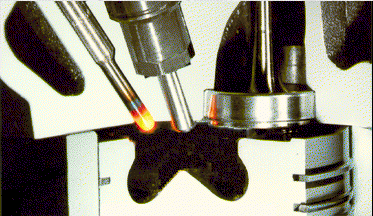
General
The starting willingness of a diesel engine is highly dependent on the temperature and the design of the combustion chamber. Direct injection engines (with a single combustion chamber, see Figure 3) have a lower heat loss than pre-chamber or swirl chamber engines (with a divided combustion chamber, see Figure 1 and 2).
At low temperatures, the motor's frictional torque increases, while the compression pressure and temperature decrease due to additional leakage and heat losses, making it often impossible to start the engine without additional devices.
Arrangement of the GSK (Gas-supported combustion system) in different combustion chambers:
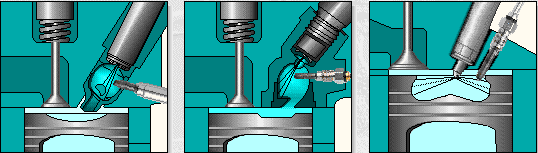
- 1) Pre-combustion chamber
- 2) Swirl chamber
- 3) Direct injector
The operating principle of the GSK is divided into two phases:
- The preheating phase:
The glow plug must be heated to a temperature necessary for starting (approximately 850°C) in the shortest possible time.
It is located in an area of the combustion chamber where a flammable mixture is present. In modern glow plugs, the required temperature is reached after approximately 4 seconds. - Afterglow phase:
After the engine starts, modern glow plugs continue to operate to improve engine start-up and reduce blue smoke emissions.
and to reduce the burning noises during the warm-up phase. The times range up to 180 seconds during operation.
GSK Construction
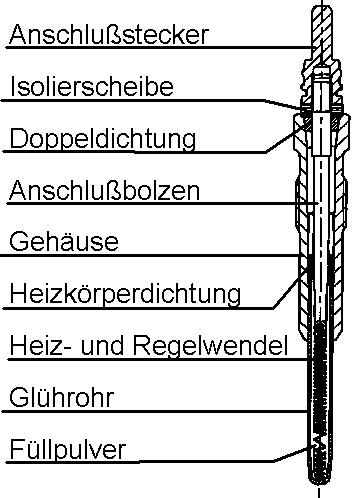
The glow plug consists of a tubular heating element that is pressed into a housing. The tubular heating element consists of a hot gas/corrosion-resistant tube, which internally carries a heating coil embedded in a compressed magnesium oxide powder.
The heating element itself consists of two resistors connected in series: a heating coil located at the tip, which has an electrical resistance that is nearly independent of temperature, and a regulating coil made of a material with a positive temperature coefficient (PTC).
The heating coil is welded into the cup of the glow plug, on the mass side, for electrical contact. The control coil is connected to the connecting bolt, which provides the connection to the vehicle's electrical system.
Function
When voltage is applied to the glow plug, the majority of the electrical energy is initially converted into heat in the heating coil, causing the temperature at the tip of the plug to rise rapidly. The temperature of the control coil increases with a time delay, and consequently, so does its resistance. The current draw, and therefore the total power of the glow plug, decreases, and the temperature approaches a steady state.
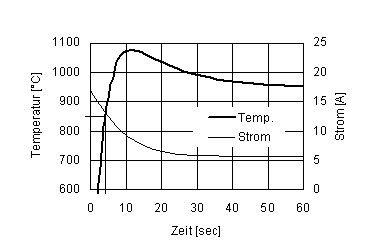
Image: Heating curve and current draw of a GSK2 with a 5mm pin at T=20°C, U=11V.
The GSK2 is characterized by its rapid attainment of the start temperature and its reduced holding temperature.
This allowed for a reduction in the preheating time before starting and enabled the implementation of a post-glow phase.
Rapiterm ignition system
The ceramic glow plug elements (GSK3).
General
With the Bosch Rapiterm system, diesel drivers can now start immediately even in extremely low temperatures.
The new glow plug made of composite ceramic reaches the temperature required for starting in just one second - faster than any other glow plug.
Its high operating temperature of approximately 1200 degrees Celsius also ensures improved cold and warm starts, as well as lower emissions (exhaust gases and noise) during the warm-up phase.
Furthermore, the new glow plugs achieve a significantly longer lifespan than conventional plugs:
Thanks to the high oxidation resistance of the composite ceramic, Rapiterm glow plugs reliably withstand more than 30,000 cold starts - longer than the statistically determined lifespan of diesel engines themselves.
Their lower power consumption allows for less strain on the vehicle's electrical system.
The precise control of pre-glow, after-glow, and intermediate glow is handled, together with the EDC, by a compact glow time control unit (GZS-T).
GSK3 structure/function
For Rapiterm, Bosch has developed a new material: composite ceramic.
The heating element consists of two ceramic layers.
- the inner insulating layer and
- the outer guiding layer.
They consist of different ceramic mixtures that have the same thermal expansion but are electrically very different.
By reducing the guiding layer at the tip of the heating element, the resistance is increased at a defined point, thus precisely defining the location of the "hot spot." With the outer guiding layer acting as a heating zone, Rapiterm controls the temperature much faster than conventional metal or ceramic heating elements with an internal coil. This allows for immediate compensation of cooling caused by airflow or voltage drops during a cold start.
However, this high-tech material is also an important prerequisite for achieving the peak temperature of over 1200 degrees.

GSK3 Advantages
- Short heating time to 1000°C, less than 2 seconds, due to the external heater.
=> Instant start, even at temperatures as low as -25°C.
- High long-term temperature (T60 > 1200°C)
=> Support for the engine in all relevant operating conditions (through afterglow and inter-glow).
=> Improvement of LL behavior at low temperatures.
- Low-voltage spark plug (Unom=7V)
=> additional reserves at Ubat > Unom => "pushable"
- Low power consumption due to a hot spot at the candle tip.
=> despite the low-voltage design, comparable power consumption to a conventional GSK2.
- high oxidation resistance and low strength reduction at high temperatures.
=> reliably more than 30,000 cold starts.
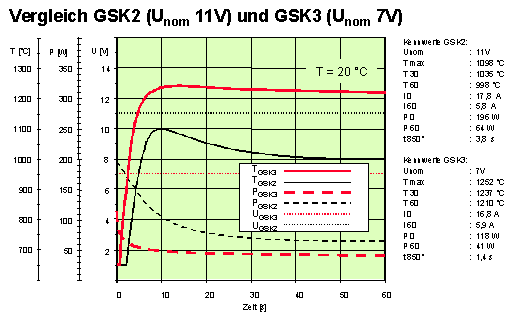
Image: Heating curve and power consumption of a Rapiterm glow plug (Unom=7V) compared to a metal glow plug (Unom=11V) at 20°C.
Modern engine control units monitor the function of the glow plugs, and corresponding malfunctions can be detected using diagnostic systems such as VCDS (Audi, Seat, Skoda, Bentley, Volkswagen) or Bavariantechnic (BMW).
Testing and working with glow plugs
Testing of glow plugs
Installation Note: The specified torque must be strictly adhered to. Overly tight spark plugs (which restrict heat dissipation) can cause the control coil to overheat the glow plug tip. Therefore, new spark plugs that are tightened too much will quickly fail.
Ceramic glow plugs should be replaced even if they fail after falling from very short heights, as this can lead to a risk of breakage later on within the engine, which can then cause engine damage.
Ceramic and steel glow plugs must not be mixed. Depending on the engine, only one type is allowed, and in some cases, software updates are required to install the other type.
Source: www.bosch.de

 18-01-2005, 22:29


 Bookmarks
 Links
Links Garage
 FAQ, Legal Notice & Privacy
 RSS Feed
 Register
 Login
Login

