| Author |
Message |
ulf
Profi-Schrauber

Joined: 04/13/2002
Posts: 11058
Karma: +18 / -0 
Location: Saarland
2023 MG ZS
Premium Support
|
 04-12-2008, 11:36 Subject: 04-12-2008, 11:36 Subject: |
Quote |
|
Tagessuppe wrote: | vwSchrauber wrote: | 2.) Modern diesel engines with particulate filters sometimes have significant problems with fuel entering the engine oil, which can even lead to an increase in the amount of engine oil.
It happens because the fuel, which is relatively late injected and necessary for regeneration, only partially ignites, and the other part reaches the cylinder wall and seeps into the engine oil through the piston rings. | Do you have any reports that confirm this or a theory as to why this specifically happens with a DPF? | He already wrote it above (I highlighted it in bold). 
Quote: | . . . from practical experience, I can only report on the AGR (Abgasrückführung) motor from my own vehicle.
There, I personally experienced what happens when the fresh air intake is blocked due to a malfunctioning EGR valve.
happens. | Do you happen to have a full load log including air mass data from that time?
You could actually observe very clearly whether the NOx emissions increase (which supports my theory) or decrease (which supports the "VW cheat" theory) in this case. Gruß Ulf
_________
MG4 Electric
Translated on 14-07-2026, 8:10.
|
|
| Back to top |
Profile PM Garage |
 |
Tagessuppe
Profi-Schrauber
Joined: 11/13/2002
Posts: 1142
Karma: +38 / -0
Location: Wien
2001 Audi A2 
Premium Support
|
| 04-12-2008, 12:17 Subject: |
Quote |
|
ulf wrote: | Tagessuppe wrote: | vwSchrauber wrote: | 2.) Modern diesel engines with particulate filters sometimes have significant problems with fuel entering the engine oil, which can even lead to an increase in the amount of engine oil.
It is due to the fact that the fuel, which is relatively late injected and necessary for regeneration, only partially ignites, while the other part reaches the cylinder wall and seeps into the engine oil through the piston rings. | Do you have any reports that confirm this or a theory as to why this specifically happens with DPFs? | He already wrote it above (I highlighted it in bold).
|
I already know that he wrote it.
However, I would be interested in reading expert articles on this "issue."
As far as I can tell, the temperature within the "fire cloud" is too high for diesel fuel, which...
is already in the combustion process, to leave it unburned and return it.
2. the distance between the piston crown and the piston rings is too large.
especially since the piston is already moving downwards, and furthermore, so many blow-by gases would have to escape past the piston rings that a conventional catalytic converter would likely be unable to handle it, or the engine would have a serious problem.
Quote: | Quote: | ... from practical experience, I can only report on the AGR (Abgasrückführung) motor based on my own vehicle:
There, I personally experienced what happens when the fresh air intake is blocked due to a malfunctioning EGR valve.
happens. | Do you happen to have a full load log including air mass data from that time?
An dem könnte man nämlich wunderbar sehen, ob die LuMa gegenüber der normalen Funktion steigt (= meine Theorie) oder sinkt (= VW-Schraubers Theorie). |
I didn't have a computer connected at the time when this occurred.
A thick plume of smoke coming from behind my vehicle, along with a significant loss of power.
they seemed to understand what was going on .
Translated on 14-07-2026, 8:14.
|
|
| Back to top |
Profile PM Garage |
|
vwSchrauber
Profi-Schrauber
Joined: 09/18/2008
Posts: 1262
Karma: +43 / -0
Support
|
| 04-12-2008, 13:07 Subject: |
Quote |
|
Quote: | Do you really believe that the miniature glow plug has a greater influence on clean combustion than a proper air excess?
|
Okay. Smell the exhaust fumes after a cold start with the oxygen sensors plugged in, and then smell them again after a cold start with the oxygen sensors unplugged.
If exhaust fumes cause burning sensations in the eyes and irritation of mucous membranes, it is likely due to an increased amount of unburned or partially burned hydrocarbons being produced because a hot spot is missing in the combustion chamber.
Quote: | I highly doubt that. On my AKE, the afterglow lasts for a maximum of 5 seconds.
and I already think that's excessive.
|
Are you sure it's *only* 5 seconds? The specific AVF (Automatic Valve Float) in question can have a warm-up period of up to 1.5 minutes, while other TDIs (Turbo Diesel Injection systems) can have a warm-up period of up to 3 minutes.
Quote: | Do you have any reports that support this, or a theory as to why it specifically happens with the DPF?
|
We've already had a case like this before, and during my research, I came across similar cases.
Quote: | Regarding my wastegate turbocharger on the AGR TDI, the exhaust side is significantly smaller compared to the VTG turbocharger, but still larger than the compressor side.
One shouldn't rely solely on the external appearance in this case either.
Because VTG turbochargers are primarily larger on the exhaust side because the VTG adjustment mechanism is located externally around the turbine wheel in that area.
Ausserdem ist nicht die äussere Grösse relevant, sondern die des Turbinenrades und des Verdichters und hier auch wiederum nicht der Aussendurchmesser sondern die gesamte Schaufeloberfläche, welche die Antriebskraft leisten muss. |
Don't forget that the compressor side usually has a kind of "double-bladed" design, where every other blade starts slightly further back. This results in more effective blade surface area overall.
Quote: | | Denn VTG Turbolader sind abgasseitig hauptsächlich deswegen grösser, weil hier noch die VTG Verstellung aussen um das Turbinenrad untergebracht ist. |
I understand that already. But take a look at the turbine from the exhaust side, without disassembling the turbocharger.
The fact that it must be larger is already demonstrated by comparing the two 66/90 TDI engines, the AGR and the ALH, in the Golf 4. An ALH engine with a disconnected vacuum pump (VTG open) drives like a naturally aspirated diesel because the large turbocharger doesn't receive enough exhaust gas flow to produce the corresponding power.
Quote: | 1. The temperature within the "flame cloud" is too high for diesel, which...
is already in the combustion process, to leave it unburned and return it.
2. the distance between the piston crown and the piston rings is too great.
especially since the piston is already moving downwards, and furthermore, so many blow-by gases would have to escape past the piston rings that a conventional catalytic converter would likely be unable to handle it, or the engine would have a serious problem.
|
Regarding point 1, there's room for discussion; however, point 2 is definitely incorrect. A prime example of this can be seen in various TDIs running on biodiesel or even vegetable oil. In such cases, it's quite common for a concerningly high amount of fuel to enter the engine oil, and this is easily detectable. Because this substance with a high boiling point (biodiesel has a flashpoint of approximately 160°C, while vegetable oil falls somewhere between 200 and 300°C) cannot be "cooked out" of the engine oil like diesel fuel, the engine oil level rises.
The amount of blow-by is quite significant. Hold your hand in front of the disconnected crankcase ventilation hose... selber schrauben - statt Werkstattpfusch
Translated on 14-07-2026, 8:20.
|
|
| Back to top |
Profile PM |
|
christians
Profi-Schrauber
Joined: 09/05/2002
Posts: 2105
Karma: +17 / -0
Location: Sauerland
Premium Support
|
| 04-12-2008, 13:52 Subject: |
Quote |
|
Tagessuppe wrote: |
I highly doubt that. In my AKE (presumably a type of device), the afterglow lasts for a maximum of 5 seconds.
and I already think that's an exaggeration.
|
With my AKN (presumably a type of device), the time can vary depending on the temperature, sometimes reaching as much as half a minute.
The path from the combustion chamber to the cylinder may be long, but as the piston moves downwards, the combustion gases naturally emerge from their respective chambers. Gruß Christian
A6 BPP, Ex-A6 AKN (Gurke), Ex-Audi100 92 AAT (5Zyl.)
Translated on 14-07-2026, 8:26.
|
|
| Back to top |
Profile PM |
|
vwSchrauber
Profi-Schrauber
Joined: 09/18/2008
Posts: 1262
Karma: +43 / -0
Support
|
| 04-12-2008, 14:14 Subject: |
Quote |
|
Quote: | | Der Weg von der Kolbenmulde zum Zylinder mag lang sein, aber bei abwärtslaufendem Kolben kommen die Brenngase ja von alleine aus ihrer Mulde. |
And it is also injected over the manifold, ensuring a clear path to the cylinder wall. selber schrauben - statt Werkstattpfusch
Translated on 14-07-2026, 8:26.
|
|
| Back to top |
Profile PM |
|
Tagessuppe
Profi-Schrauber
Joined: 11/13/2002
Posts: 1142
Karma: +38 / -0
Location: Wien
2001 Audi A2
Premium Support
|
| 04-12-2008, 20:18 Subject: |
Quote |
|
vwSchrauber wrote: | Quote: | | Der Weg von der Kolbenmulde zum Zylinder mag lang sein, aber bei abwärtslaufendem Kolben kommen die Brenngase ja von alleine aus ihrer Mulde. |
Und es wird auch über die Mulde hinweg eingespritzt, sodass der Weg zur Zylinderwand frei ist. |
At a time when the combustion chamber pressure is decreasing significantly.
Exhaust gases are therefore inversely proportional to the amount of blow-by.
And yet, I still need to be convinced that diesel fuel is entering the piston rings and ending up in the oil pan unburned. In the case of rapeseed oil, it's also the Russian entry (likely referring to additives or contaminants) that leads to polymerization, not just the pure vegetable oil itself.
Translated on 14-07-2026, 8:27.
|
|
| Back to top |
Profile PM Garage |
|
christians
Profi-Schrauber
Joined: 09/05/2002
Posts: 2105
Karma: +17 / -0
Location: Sauerland
Premium Support
|
| 04-12-2008, 22:13 Subject: |
Quote |
|
Blow-by is reduced. However, a film of oil on the cylinder wall enters the crankcase through the piston movement, unless it is scraped off by the top ring.
I find it hard to imagine that soot is the issue; carbon is carbon, whether it comes from a gasoline or a diesel engine. However, gasoline and diesel engines are completely different.
Regular diesel fuel typically only suffers from oil thickening.
Gruß Christian
A6 BPP, Ex-A6 AKN (Gurke), Ex-Audi100 92 AAT (5Zyl.)
Translated on 14-07-2026, 8:28.
|
|
| Back to top |
Profile PM |
|
vwSchrauber
Profi-Schrauber
Joined: 09/18/2008
Posts: 1262
Karma: +43 / -0
Support
|
| 05-12-2008, 10:39 Subject: |
Quote |
|
Quote: | | Beim Poel ist es auch der Russeintrag der zu Polymerisation fueht, nicht das Reine Pflanzenoel. |
So, would you be ready to pour a bottle of "Pöl" into your Audi's oil system? Is that what you're suggesting? Because that's all it will add – more soot to the oil.
Okay, let's put the jokes aside: Imagine leaving a bottle of resin with some resin spilled on the outside, exposed to warmth for a few weeks. You'll notice that the resin will polymerize simply due to the interaction with oxygen and heat.
Quote: | At a time when the combustion chamber pressure is decreasing significantly.
Exhaust gases are therefore inversely proportional to the amount of blow-by.
|
The pressure doesn't actually decrease that much during the injection process. Please remember that, theoretically, the combustion process in a diesel engine is an isobaric process (constant pressure).
Quote: | | I find it hard to imagine the soot issue, because carbon is carbon, whether it comes from a PÖL engine or a diesel engine. |
As far as I know, vegetable oil even has a lower carbon content than diesel fuel. selber schrauben - statt Werkstattpfusch
Translated on 14-07-2026, 8:30.
|
|
| Back to top |
Profile PM |
|
ulf
Profi-Schrauber
Joined: 04/13/2002
Posts: 11058
Karma: +18 / -0
Location: Saarland
2023 MG ZS
Premium Support
|
| 22-12-2008, 22:35 Subject: |
Quote |
|
Okay, back to the original question.
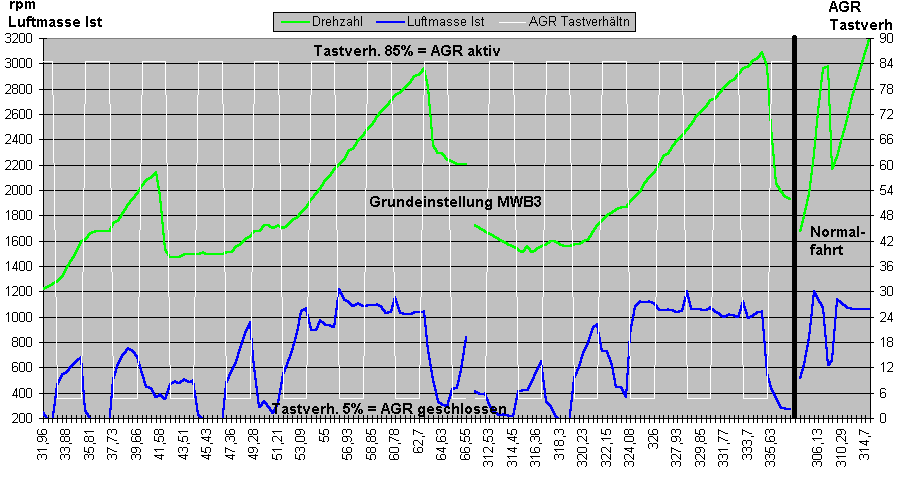
I drove the car with open VTG at full throttle – however, using the default settings of the MWB 3 control unit (with a slight software modification). In this configuration, the EGR valve opens and closes every 2 seconds.
Advantage: I didn't have to worry about the timing for opening and closing the EGR valve, nor did I have to mess around with hoses or anything like that.
Disadvantage: Besides RPM, LuMa (likely referring to air mass), and AGR duty cycle, there are no other log data available. In particular, the LD (likely referring to lambda value) would have been interesting, but I observed the LDA (likely referring to lambda sensor activity) and can therefore preliminarily say that every significant drop in air mass was accompanied by a corresponding drop in LD (and sometimes also by loud knocking - presumably due to misfires).
Above approximately 2500 rpm, the engine actually pulled normally, according to the popometer reading. The air mass also falls within the usual range at that point, as shown by a log snippet of a drive in normal mode on the right edge of the image.
Upon closer inspection, one can see that VW-Schrauber's assumption is confirmed: An open AGR valve causes the air mass to decrease slightly even at full boost pressure (above 2000 rpm). However, with the flow reversal I suspect, the air mass should increase - but there is no evidence of this anywhere.
(I have already modified the AGR-FA.)
However, I didn't notice all the "typical" signs of a stuck-open EGR valve under high load: there was a dramatic loss of power (as evidenced by the engine speed curve below 2000 rpm: fluctuations in air mass flow between the rising slopes before and after indicate that I had been consistently using full throttle!), but no massive clouds of black smoke: I couldn't see anything like that in my rearview mirror during daylight.
This makes the ASZ completely incompatible with the previous image of an openly clamping AGR system.
Warum das so ist? I'm at a loss...

| Description: |
|
| File size: |
24.82 KB |
| Viewed: |
880 times |
|
Gruß Ulf
_________
MG4 Electric
Translated on 14-07-2026, 8:34.
|
|
| Back to top |
Profile PM Garage |
|
vwSchrauber
Profi-Schrauber
Joined: 09/18/2008
Posts: 1262
Karma: +43 / -0
Support
|
| 23-12-2008, 14:15 Subject: |
Quote |
|
Hello Ulf!
I just got one of the last ALHs (engine number 7xx xxx) flashed.
It releases a maximum of 38 mg per cycle under full load. In air-mass controlled operation, the 850 mg per cycle (air) is only achieved with 51 mg per cycle of fuel, which would also support the theory.
I can send you the file later; I don't have my laptop at the office right now  . selber schrauben - statt Werkstattpfusch
Translated on 14-07-2026, 8:37.
|
|
| Back to top |
Profile PM |
|
ulf
Profi-Schrauber
Joined: 04/13/2002
Posts: 11058
Karma: +18 / -0
Location: Saarland
2023 MG ZS
Premium Support
|
| 23-12-2008, 14:25 Subject: |
Quote |
|
vwSchrauber wrote: | I just got one of the last ALHs (engine number 7xx xxx) connected to the flasher.
It releases a maximum of 38 mg per cycle at full load; in air mass measurement, the 850 mg per cycle (air) is only achieved with 51 mg per cycle of fuel, which would also support the theory. | I can at least dismantle this argument for you now. 
The target value for the EGR (Exhaust Gas Recirculation) system is most likely not calculated from the actual fuel injection quantity, but rather from the desired quantity; this desired quantity forms the quantity axis in the EGR control unit.
Proof: When the accelerator pedal is pressed, the target value for the luminous intensity (LuMa) in the main control unit (MWB3) immediately jumps to its maximum value (according to the driver's preference), even if the injection quantity remains "stuck" at a low level until the light source (LD) has reached its operating temperature.
Take a look at the Z-values in the pedal control module from this perspective: any normal software will show that even the EGR valves on your "special" engines are completely closed when the accelerator is fully depressed . Gruß Ulf
_________
MG4 Electric
Translated on 14-07-2026, 8:39.
|
|
| Back to top |
Profile PM Garage |
|
|


 Bookmarks
 Links
Links Garage
 FAQ, Legal Notice & Privacy
 RSS Feed
 Register
 Login
Login