| Author |
Message |
Deus Violentia
Schrauber

Joined: 11/21/2007
Posts: 677
Karma: +15 / -0 
Support
|
 28-03-2011, 11:08 Subject: How it works & differences: Garrett pressure sensors 28-03-2011, 11:08 Subject: How it works & differences: Garrett pressure sensors |
Quote |
|
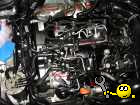
Yesterday, I replaced the VNT15 on my AHF because the VTG was stuck (see the thread about the oil line). Now, as part of the changeover, I also replaced the vacuum sensor.
I have used a similar one as the one you have installed in your 2.5 TDI, because I had a brand new, original Garrett one lying around.
Okay, here's a question about the 1.9 TDI and 2.5 TDI engines:
The models from the 1.9 series have an "axial" pressure connection, similar to the linkage, while the models from the 2.5 series have a connection on the side.
In terms of dimensions, the cans are roughly the same, but the metal tab, the fine adjustment mechanism, and the receptacle for the VTG adjustment lever are different.
The thread length and shaft length of the threaded rod on the can are the same, and the negative displacement is also the same under the same vacuum pressure.
Okay, so I simply marked the position of the locknut, replaced the VTG lever attachment on the can, and mounted the can in the same position as the old one (based on the imprint of the screw heads). Of course, I didn't touch the minflow adjustment screw on the charger.
The question now is whether the vacuum sensor itself has a kind of "mechanical-pneumatic characteristic" and, consequently, regulates differently in the intermediate states of the threaded rod (between fully open and fully closed) in the 2.5 TDI and 1.9 TDI engines. Either the counterweights are different, or the size of the membrane.
Does anyone know anything about this, or have any ideas?
[img]/download.php?id=5554[/img]
[img]/download.php?id=5555[/img] BKD GRF
AHF EBF
Translated on 03-07-2026, 15:19.
|
|
| Back to top |
Profile PM |
 |
dieselschrauber
Administrator

Joined: 04/12/2002
Posts: 18119
Karma: +801 / -0
Location: St.Gallen
2018 Volkswagen T6 
|
| 28-03-2011, 11:53 Subject: How it works & differences: Garrett pressure sensors |
Quote |
|
Hello,
For some of the older chargers at AFN, there used to be a larger vacuum sensor, but it's visually different from the vacuum sensors found on the 2.5 V6 TDI chargers.
If you want to save money on replacement cartridges and the cartridge becomes less easily replaceable/accessible when using a built-in loader, I would recommend comparing the adjustment range of different cartridges on the device.
You need to create your own "vacuum-assisted drainage" diagram.
Best regards, Rainer.
Translated on 03-07-2026, 15:19.
|
|
| Back to top |
Profile PM WWW Garage |
|
ulf
Profi-Schrauber

Joined: 04/13/2002
Posts: 11058
Karma: +18 / -0
Location: Saarland
2023 MG ZS
Premium Support
|
| 28-03-2011, 12:30 Subject: Re: Question: How it works & differences between Garrett turbochargers |
Quote |
|
Deus Violentia wrote: | The shaft and thread length of the threaded rod on the can are the same, as is the negative displacement at the same vacuum level.
Bitte gib den Text an, den du übersetzt haben möchtest.
The question now is whether the vacuum sensor itself has a kind of "mechanical-pneumatic characteristic" and, therefore, regulates differently in the intermediate states of the threaded rod (between fully open and fully closed) in the 2.5 TDI and 1.9 TDI? | Um... with the first quote, you already ruled that out, as I understand it? 
If not: if the vacuum requirement to initiate the movement of both actuators is largely the same, the pressure-stroke characteristic between them will likely not be significantly different, and you should be able to achieve usable control behavior through fine-tuning of the rod length . Gruß Ulf
_________
MG4 Electric
Translated on 03-07-2026, 15:19.
|
|
| Back to top |
Profile PM Garage |
|
dieselschrauber
Administrator
Joined: 04/12/2002
Posts: 18119
Karma: +801 / -0
Location: St.Gallen
2018 Volkswagen T6
|
| 28-03-2011, 12:39 Subject: How it works & differences: Garrett pressure sensors |
Quote |
|
Quote: | | the negative lift at the same vacuum pressure as well. |
Yes, but what specific values are we talking about? When the pressure gauge reads -600 mbar, the path at -700 mbar is not really a relevant factor.
Sure, here's the translation:
"LG" translates to "Best regards" or "Sincerely" in English.
Translated on 03-07-2026, 15:19.
|
|
| Back to top |
Profile PM WWW Garage |
|
Deus Violentia
Schrauber
Joined: 11/21/2007
Posts: 677
Karma: +15 / -0
Support
|
| 28-03-2011, 13:48 Subject: How it works & differences: Garrett pressure sensors |
Quote |
|
The behavior I'm referring to relates to the static vacuum pressure of the Golf IV's intake manifold when the engine is idling. The can handling arms moved along the same path independently, without a loader, and after manually activating the release lever, they returned in a similar manner.
What I respect is the consistent behavior up to full load. If the theoretical boost pressure curve specified by the VTG (variable turbine geometry) doesn't match the actual values (the boost pressure being applied) in operation, the engine control unit (ECU) only goes into limp mode after 6 seconds (or something like that?). I don't think the charger would overload if the VTG control system is not working correctly, right?
The 2.5 TDI Garrett turbocharger is definitely better than any cheap "China turbo" or "Achmed regeneration" turbocharger you might find on eBay.
I can also remove the can once the charger is installed; I made sure to adjust the retaining clip on the VTG lever beforehand so it fits properly, and I can easily access the two nuts. It's something you can do in 15 minutes without killing yourself.
The subjective rule of thumb is useful in any case - performance is present, and soot is not. 
"Noticeably better throttle response compared to the old loader. However, I had completely disassembled and meticulously cleaned the VTG (variable turbine geometry) of this 'new' loader, so I wouldn't have expected anything different."
I have not yet taken any measurements.
What about the wastegate valve? Was was the pulse rate used to control the cycles, and did this pulse rate regulate the vacuum pressure? Or was it a variable voltage that continuously opened and closed the valve? BKD GRF
AHF EBF
Translated on 03-07-2026, 15:19.
|
|
| Back to top |
Profile PM |
|
ulf
Profi-Schrauber
Joined: 04/13/2002
Posts: 11058
Karma: +18 / -0
Location: Saarland
2023 MG ZS
Premium Support
|
| 28-03-2011, 15:10 Subject: How it works & differences: Garrett pressure sensors |
Quote |
|
Deus Violentia wrote: | | What I respect is the regulation behavior up to full load. If the theoretically defined boost pressure curve according to VTG (Variable Turbine Geometry) does not match the actual resulting values (the applied boost pressure) in operation, the engine control unit (ECU) only goes into emergency mode after 6 seconds (or something like that?). However, I don't think the turbocharger would overspin if the VTG control is not correct, right? | Yes, that can happen - until the control system catches up with the actual boost pressure and moves towards the target value.
Quote: | | . . . static vacuum pressure of the Golf IV at idle. The can handling arms were moving along the same path on their own, without a loader, and after manually operating the shut-off valve, they returned in a similar manner. | This already rules out any major control errors.
Quote: | | What was it again about the boost pressure control valve? Was | was
Was wurde zyklisch angesteuert und steuert die resultierende Impulszahl den Unterdruck, oder war es eine variable Spannung, die das Ventil stufenlos öffnet und schließt?
Es wird praktisch stufenlos gesteuert durch ein PWM-Signal. Gruß Ulf
_________
MG4 Electric
Translated on 03-07-2026, 15:19.
|
|
| Back to top |
Profile PM Garage |
|
Deus Violentia
Schrauber
Joined: 11/21/2007
Posts: 677
Karma: +15 / -0
Support
|
| 29-03-2011, 15:49 Subject: How it works & differences: Garrett pressure sensors |
Quote |
|
After 150km of mixed driving, I can say that so far I haven't noticed any abnormalities - in terms of performance, the car drives like new . BKD GRF
AHF EBF
Translated on 03-07-2026, 15:19.
|
|
| Back to top |
Profile PM |
|
|


 Bookmarks
 Links
Links Garage
 FAQ, Legal Notice & Privacy
 RSS Feed
 Register
 Login
Login

