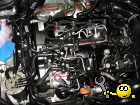
A 2009 320d with 177 horsepower is experiencing a lack of power.
The car can barely reach a speed of 210 km/h on the speedometer.
Since the Bavarian Technik Tool from the local workshop can no longer retrieve any data (since BMW performed a complete update of the control units).
I was left with only the VCDS.
Notably, the air mass does not increase linearly even with a constant LD pressure.
Since the g/s unit seemed strange to me as an EDC15 user, I created a log while the engine was idling, which confirmed my suspicion.
The LMM (likely referring to a mass flow meter) has already been replaced, but it resulted in no change. Removing the LMM also does not lead to any noticeable improvement.
The air filter was removed by some leaves and cleaned, which increased the maximum airflow from 120g/s to 127g/s. According to the previous owner, the filter has been installed for 20,000 km. A new one is already on its way.
Unfortunately, I am unable to read the turbocharger boost pressure control valve (VTG) data. I suspect a blockage/restriction or an open EGR valve.
I am grateful for any help or ideas.
Sure, here is the translation of the text from German to English:
"Hello Blackfrosch"
LOG-320d-LuMa_LD_3GangVOLLGAS.xls
Description:
320d: Low Power? Boost Pressure Ratio Explained (Solved)
"This is the spot that, in my opinion, is causing problems. The question that I currently have is: how can the boost pressure be generated if there is a restriction before the boost pressure sensor? Therefore, the fresh air valve is likely not the cause?"
I would appreciate your valuable input.
Sure, here is the translation of the text from German to English:
Error found
A faulty exhaust gas temperature sensor caused the engine control unit to attempt to generate exhaust gas temperatures, likely by using methods such as swirl flaps and late fuel injection.
Sure, here is the translation of the text from German to English: