I have a Skoda Rapid with the 7-speed DSG transmission.
Shouldn't the engine speed jump to the new speed immediately when the transmission shifts?
"I've only seen this behavior on the DSG transmissions from our company. And in my car, it rarely drops suddenly; instead, in about 90% of gear changes, it slowly decreases (the indicator takes about one second)."
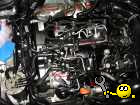
I'm going to add a video to make it easier to understand.
Thank you and best regards.
DSG DQ200: Performance and Driving Experience - 20170717_173353.mp4
"It looks normal to me; it's possible that the shift times may vary even with the same DSG (dual-clutch transmission), depending on the vehicle. A Skoda Rapid isn't a Ferrari, which shifts gears to save fractions of a second during the shifting process..."
A log of speed and engine RPM (click the "Turbo" button if available) from your car and a similar vehicle would be better for comparison.
"It looks normal to me; it's possible that the shift times may vary even with the same DSG (dual-clutch transmission), depending on the vehicle. A Skoda Rapid isn't a Ferrari, which shifts gears to save fractions of a second during the process..."
A log of speed and engine RPM (click the "turbo" button if available) from your car and a similar vehicle would be better for comparison.
Best regards, Rainer
It's difficult to write a log right now because I don't have my VCDS readily available.
The strange thing is that the DSG (dual-clutch transmission) can sometimes be very quick, and other times very slow. It's the same with manual shifting; sometimes it's fast, and sometimes it's slow. I have a feeling that the clutch might be slipping for too long.
Now I have 11,700 km on the odometer, and this is already the second clutch. And now the same problem is starting to appear as it did before the replacement.
I bought the Skoda with 18,000 km on it. After about 1,000 km, I noticed that the engine RPM would suddenly jump up, initially only when the engine was cold and you accelerated, as if the clutch were slipping.
I pointed this out to my workshop, and they replaced both clutches under warranty at 60,000 km because, according to Skoda, the tolerance had been exceeded.
At 6000 km, this slipping issue also occurred with a warmed-up engine, which ultimately led the car dealership to decide to replace the clutches.
"If this slipping occurs when the engine is cold, is it still considered normal? I was told back then that it's supposed to be state-of-the-art technology."
Okay, after that, the slippage was gone and the DSG shifted more smoothly. However, now, after about 2000 km (I currently have 11700 km on the odometer), this slippage is starting again. It's not so severe that the RPM jumps, but you can feel it in the car; it feels less stable.
Can the DSG (dual-clutch transmission) be recalibrated to adjust the clutch engagement pressure for a better feel? Or is there more likely a problem with the mechatronic unit, which might be transmitting insufficient engagement pressures?
Is it possible to see via VCDS how much the clutch deviates from its tolerance range during normal operation?
Can the DSG be recalibrated so that the clutch engagement pressure is better adjusted? Or is there more likely a problem with the mechatronics, which may be transmitting "too weak" engagement pressures?
I've read something about wear and tear on the pump and also about low pump pressure...
Please create a log of the actual versus target hydraulic pressure readings, also known as "Pressure 1" and "Pressure 2," which can be found in the advanced measurement data blocks.
And if you copy your text here for the third time, the topic will be closed, right?
Best regards from Munich!
1. S.verlängerung: Audi A4 Avant quattro, 1,9 TDi MKB: AFN, BJ98, Vollausstattung, +VP1L
2. Moped BMW K1200RS, 130 PS, BJ98, Vollausst.
3. T5 1,9 TDI PD (AXC), BJ04 - nur Ärger!
I was just trying to create a log, but the recording feature simply won't work.
Can someone explain how to properly operate my VCDS so that it records data?
I intended to record it using VCDS, save it, and then upload it here via KDataScope.
I've already checked the pressure readings in the specified measurement block. When stationary, the target and actual values were 16 bar on the first gear stage, and 14 bar on the second gear stage, with both target and actual values being identical.
However, while switching, I noticed that the actual value drops to approximately 3 bar and takes about 2-3 seconds to reach the target value.
This was observed in both cases.
Today, we made another video showing how the dual-clutch transmission now shifts in Tiptronic mode while maintaining a constant throttle position.
The last two switching operations seem normal to me.
DSG DQ200: Performance and Driving Experience - 20170721_195153.mp4
After a lot of back and forth, it finally worked out. I hope you can make sense of the logs. I've only noticed that sometimes the two values diverge significantly.
I did two tests: once with the Tiptronic mode and once with the regular "D" mode.
Tip: Grouping measurements or using the "Turbo" mode significantly increases the sampling rate and, consequently, the temporal resolution.
Here's another tip: Only log what is problematic and doesn't work. And not stuff like going out in the morning to get bread rolls.
I have now watched many seconds, but not everything. In your case, ONE switching operation that takes too long. I couldn't detect any significant deviation of the actual values from the target values. In your video, it is also "normally fast" at the end. I hope you haven't logged anything like that.
The logs are far too long, what is this? Should I now look at the first or second part of Log 2, or 294 seconds from the second part of the second log?
Please only log the information where it's not possible. 15 seconds would have been perfectly sufficient to capture a problematic switching process.


 Bookmarks
 Links
Links Garage
 FAQ, Legal Notice & Privacy
 RSS Feed
 Register
 Login
Login






 .
.


