| Author |
Message |
FalkPe
Joined: 12/26/2025
Posts: 2
Karma: +0 / -0 
Location: Boblitz
Free account, no CAN development support
|
 12-09-2026, 8:41 Subject: Kia Rio: Excessive Soot Buildup - 1.4 CRDi 12-09-2026, 8:41 Subject: Kia Rio: Excessive Soot Buildup - 1.4 CRDi |
Quote |
|
Hello everyone,
I'm experiencing a persistent problem with excessive soot buildup in my Kia Rio IV 1.4 CRDi (year 2017, engine D4FC, wastegate turbocharger) and I'm hoping to benefit from your experiences.
The problem.
The amount of soot in the DPF, as calculated by the control unit, increases rapidly (e.g., an increase from just under 2 grams to approximately 13 grams within only 25-30 minutes of driving). As a result, the vehicle initiates DPF regeneration cycles at extremely short intervals.
Measurement data & log data (retrieved via OBD / car scanner).
* Constant partial load (120-130 km/h): The engine runs smoothly. The boost pressure is stable at approximately 1.8 bar (absolute), the air mass is around 40 g/s, and the lambda value indicates a healthy excess of oxygen at Lambda 1.3/1.4.
* Acceleration / Load Change: When the accelerator pedal is pressed, the turbocharger quickly builds up pressure. The MAP sensor shows peak values of 2.4 to 2.5 bar (absolute), and the mass airflow sensor increases accordingly to over 80 g/s. Therefore, the turbocharger is delivering its full power.
* The core problem (Dynamic Lambda Gap): In the first 1-2 seconds of acceleration, the lambda value suddenly jumps to lambda 1. Precisely during these brief peak moments, the soot mass in the log increases sharply in steps. Only when the full boost pressure is reached does the lambda value increase again.
* Effect of the AGR valve: With the AGR valve connector disconnected, the car noticeably runs better, and the sudden increase in soot during load changes is significantly reduced.
Components that have been exchanged/verified so far.
* DPF: Replaced/Renewed.
* AGT Sensors: new.
* Lambda sensors: new (recalibrated).
* Mass Air Flow Sensor (MAF): Replaced.
* AGR valve: Replaced (adaptation values reset).
* Intercooler piping (pressure side): Hose between turbo and intercooler pipe replaced, pressure tested (1 bar) and demonstrably 100% leak-free.
* PCV (Positive Crankcase Ventilation): Removed from the intake manifold for testing purposes.
* MAP sensor: Clean, measures plausibly up to 2.5 bar absolute pressure.
* Intake manifold: Inlet/mixing chamber cleaned.
Current status & questions.
Given that the turbocharger, intercooler, and sensors are all providing optimal readings, it is likely that the problem lies in the fresh air flow or fuel mixture during the transition phase.
* Carbon buildup in the intake channels: Can carbon buildup deep within the intake manifold or directly at the cylinder head inlets cause the MAP sensor to measure full pressure at the inlet, while the actual air mass flows too slowly into the combustion chamber due to the restriction?
* AGR control / regulation delay: Have you had any experience with this engine regarding slow closing behavior of the AGR valve, or incorrect fuel injection adaptation values after an ECU reset?
"Has anyone ever experienced a similar phenomenon with a short-term lambda drop to 1.0 under load, despite full boost pressure? I can't read the injector values. When I cleaned the MAP sensor, I found about 2cm of grime on it, and the mixing chamber and throttle body were also very dirty."
Thank you for any advice!
Translated on 14-09-2026, 14:41.
|
|
| Back to top |
Profile PM |
 |
dieselschrauber
Administrator

Joined: 04/12/2002
Posts: 18096
Karma: +799 / -0
Location: St.Gallen
2018 Volkswagen T6 
|
| 13-09-2026, 9:10 Subject: Kia Rio: Excessive Soot Buildup - 1.4 CRDi |
Quote |
|
Hello.
What could be the cause: A hole in the intake manifold or the EGR system, through which intake air leaks out under certain operating conditions.
The mass airflow sensor (MAF) will then see high/good air intake values (but this air doesn't actually reach the engine). As long as the leak is small, the turbocharger can still reach the target boost pressure, although it will have to work harder (and will eventually fail).
Okay, so first, check the hoses/pipes for any oil stains or residue. You can often hear hissing sounds more clearly near a wall when you accelerate (drive, but there needs to be load on the engine).
Good luck, Rainer.
Translated on 13-09-2026, 9:11.
|
|
| Back to top |
Profile PM WWW Garage |
|
FalkPe
Joined: 12/26/2025
Posts: 2
Karma: +0 / -0
Location: Boblitz
Free account, no CAN development support
|
| 15-09-2026, 6:50 Subject: Kia Rio: Excessive Soot Buildup - 1.4 CRDi |
Quote |
|
Good morning and thank you for your reply.
I've recently changed my driving style a bit; usually, I drive at a relaxed 100 km/h on the highway.
He recovered during his early commute to work, and when he started in the afternoon, the load was at 0.4g.
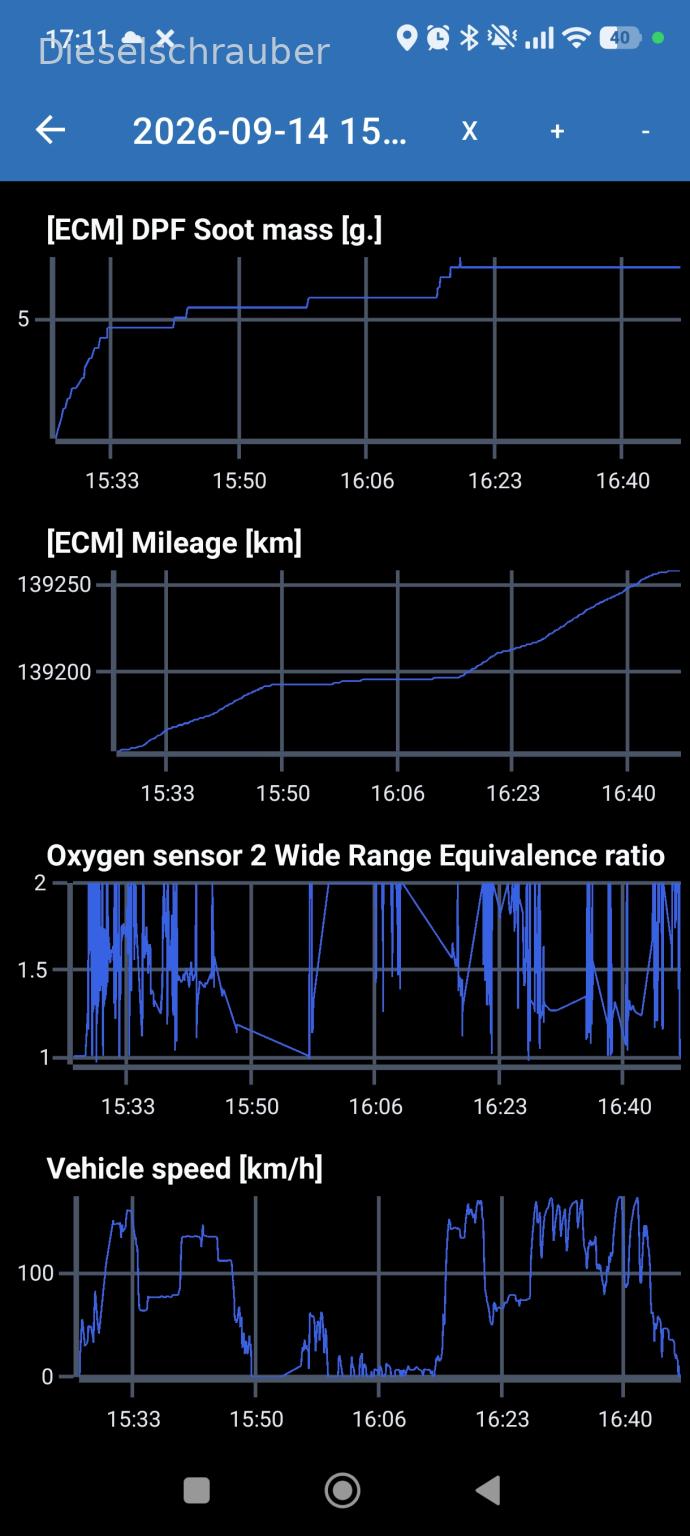
Now I've driven about 110 km, and the soot mass only increased significantly in the city during the early part of the trip, while it remained constant on the highway on the way home. The lambda value was between 1.3 and 1.6, depending on the obstacles.
Could it possibly be the intake manifold? The channels/swirl flaps look so strange that the car might be having trouble getting enough air in the low-load range?
| Description: |
| 1. Teil Stadt, Autobahn / Baustelle > Autobahn > zu Hause |
|
| File size: |
538.08 KB |
| Viewed: |
10 times |
|
Translated on 15-09-2026, 6:51.
|
|
| Back to top |
Profile PM |
|
|


 Bookmarks
 Links
Links Garage
 FAQ, Legal Notice & Privacy
 RSS Feed
 Register
 Login
Login

