Hello,
There are people who, even after a visit to a chip tuner, are not satisfied with just the feeling of a "grin" in their engine, but also want to know approximately how much more their engine actually produces, or whether the power gain promised by the tuner was actually achieved.
Power comes from fuel. Therefore, when tuning a diesel engine, one can estimate how much more torque and horsepower the tuner has unlocked by increasing the injection quantity compared to the stock software – as long as the engine doesn't smoke so heavily that a significant portion of the injection quantity is used for landscape darkening instead of engine performance, and the engine's efficiency hasn't been excessively reduced, for example, due to late full-throttle starts (this has already been done).
In many common PD-TDIs, the injection amount can be seen and logged in the diagnostic data. However, these data are not necessarily reliable, because many tuners change the calibration of the PDE. Therefore, an increase in the data volume, e.g., by 15% in the MWB 1, does not necessarily mean a real increase in fuel injection volume of 15%.
But there is a diagnostic value where the MSG (Motor Control System) really lets its trousers down in terms of injection quantity: namely, the duration of supply (as seen in MWB 1 and 4).
Although it is not possible to directly convert the duration of the fuel injection due to the influence of engine speed and diesel temperature into Nm or PS, in comparison to the standard software, it is possible to estimate, based on full-throttle log data of a well-warmed-up (so that the diesel temperature compensation does not create false impressions) tuned engine, how much additional injection volume the tuner has actually implemented.
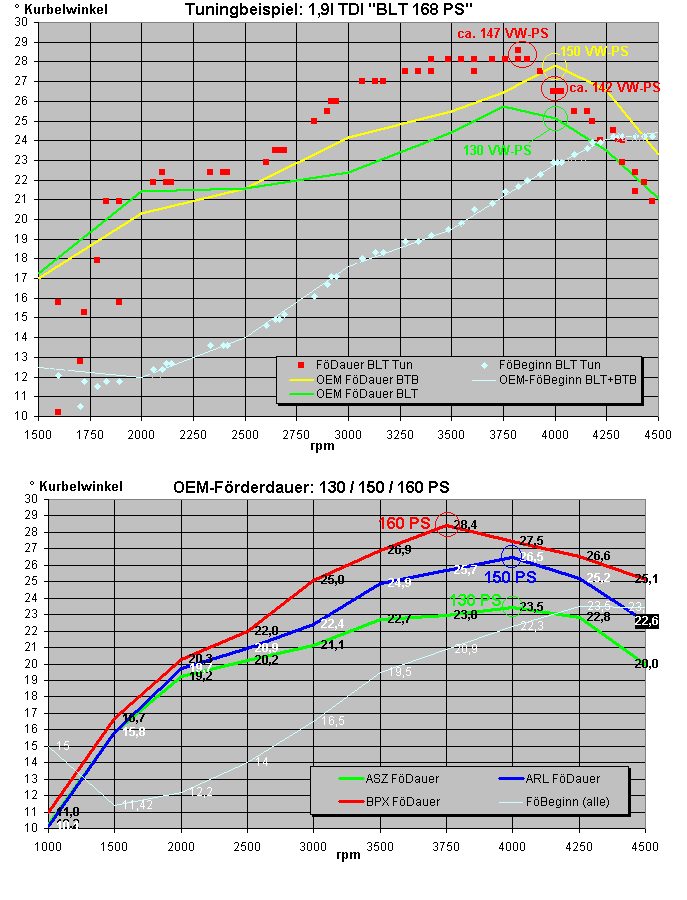
The appendix shows a practical example: Log data from a chipped BLT (1.9l PD 130 PS EU4 in a Polo 9N).
The navigation operations took place at an altitude of approximately 50 meters, with an atmospheric pressure of approximately 1011 mbar and an outside temperature of approximately 18°C – therefore, there were no conditions under which a pre-emptive reduction in engine power by the engine software would be expected.
In the upper diagram, the following data is recorded with respect to speed:
a) Duration of support for the series software (BLT, green)
b) Förderdauerverlauf eines Werksmotors mit gleicher PDE-Größe und 150 PS (BTB im Sharan, gelb) als Orientierung zum nötigen Förderdauer-Zuschlag für +20PS
c) Förderdauer-Logdaten des gechippten BLT (red points).
The log data was collected from several full-throttle acceleration runs. Below 2000 rpm, the values are significantly lower because the driver did not always apply full throttle at the same speed.
Interventions that are relevant to performance and that could produce more power than usual (by, for example, using a specific amount of fuel that is higher than the standard) are not detectable. For example, the logged fuel start time exactly matches the curve of the two standard software versions (light blue).
Unfortunately, the system-based gradation of the power duration angle data only allows for Pmax differences of approximately 3.3 hp. Nevertheless, it is easily discernible from the image that the tuned engine is at almost exactly the same level as the 150 hp factory engine in the Pmax range at approximately 4000 rpm. The greatest power gain is achieved approximately in the range of 2700 to 3700 rpm, which is evident in the different course of the green line and the red points.
Considering the speed-dependent relationship between the duration of operation and torque, the "duration-vs-torque" graph of this tuning software, compared to the 130 and 150 hp factory engines, shows a peak torque (Pmax) of approximately 147 "VW-PS" at around 3800 rpm. Compared to the standard software, this represents a power increase of approximately 17 hp.
Does anyone know of a chip tuning offer that can deliver 147 horsepower for the 130 horsepower VAG TDIs? Probably not. And also, this tuning software was reportedly sold by vehicle owners with a slightly different Pmax specification, namely 168 hp.
In the world of numbers that normal consumers understand, the tuner suggests a gain of 38 horsepower compared to the 130 horsepower base, but it only delivers a real gain of approximately 17 horsepower.
Therefore, approximately 55% of the tuner's promises remain unfulfilled, meaning that one promised "extra" horsepower for the tuner corresponds to approximately 0.45 real horsepower. This also means that the motor's efficiency losses (due to the turbine in the stock charger, which is actually too small for the tuner performance) further reduce the previously calculated approximately 147 horsepower.
There is also another engine group with different OEM power levels at the same PDE size: ASZ, ARL, and BPX, with 310/320/330 Nm and 130/150/160 hp. Their duration of support curves are shown below in the appendix, calculated from the series software (note the Pmax point of the BPX at 3750 rpm instead of 4000 rpm at ASZ and ARL!).
Owners of chipped ASZ engines can use this data to estimate how the engine's power curve compares to that of ARL and BPX engines (with a slight difference in the Pmax range for the ASZ series engine compared to the GT1749VB from ARL and BPX) – provided that the engine is not excessively worn and that the start timing is not significantly different from the original (more than approximately 2°KW).
Interestingly, one can also avoid the issue of the relationship between the duration of fuel injection and the amount of fuel injected by using pseudo-tricks such as a modified mechanical adjustment of the PDE in the UT, which tuners sometimes refer to as a secret tip.
If even a few reproducible extra Nm or HP could be achieved through this simple method, then it would certainly be discussed in every forum where these PD motors are a topic, after more than 10 years since their introduction...
| Description: |
|
| File size: |
28.41 KB |
| Viewed: |
5601 times |
|
Gruß Ulf
_________
MG4 Electric
Translated on 03-07-2026, 15:19.
|


 Bookmarks
 Links
Links Garage
 FAQ, Legal Notice & Privacy
 RSS Feed
 Register
 Login
Login