I've been dealing with problems related to my...
A4 1.9 TDI B7 2006 Avant...
I've owned the car for almost 7 years, and my commute is about 6 km each way.
I know... nonsense about a diesel... I used to have the 3.0 quattro, which was amazing...
For the past 2 years, my car has not performed any DPF regeneration cycles.
I always had to take it to the workshop every two months, costing 160 euros.
Then I bought myself a vcds... and I was able to do it all myself from then on.
My new girlfriend lives about 250 km away.
It has been quieter since then.
And now: I just got home from work, and everything is covered in oil.
Dipstick popped out... initial thought is that the seal on the dipstick is broken.
But does it even have rubber rings?
After reading a lot, it could be a problem with the cylinder head gasket, a hole in the piston, or worn piston rings due to...
Full power, no smoke. 120,000 km now...
Frequent forced regeneration cycles could potentially damage the piston or the rings.
due to... because of the temperatures...
The hoses are all sealed.
I will now replace the valve cover and perform a compression test.
Then everything should be clear, right?
Do you have any other tips or ideas? I can't afford an engine failure right now... oh man...
The vacation is now also in jeopardy .
Perhaps it was an isolated incident; it was almost 35°C that day.
Since then, I haven't moved him.
So, I've experienced the dipstick being pushed out before, but that usually only happens when something extreme occurs.
Once, on an old gasoline-powered Golf, the engine crankcase ventilation system became clogged with oil sludge during the winter and then froze. But now it's summer.
So, it seems like pressure is building up inside the engine casing, which is quite obvious.
I wouldn't think there's anything wrong with the pistons; if there were, you'd have other problems too. At the very least, there's oil consumption and smoke coming from the exhaust.
First question, regarding unusual problems:
Has anything been repaired recently?
Second question:
Is the brake working properly?
I would start by checking to make sure that the engine's ventilation system is clear and unobstructed everywhere. General visual inspection to check if all hoses in the engine compartment are in good condition, and if any are kinked or pinched.
And a very likely culprit: Check the vacuum line from the brake booster.
Let's run the engine and see if we can hear any unusual hissing sounds.
And maybe try carefully to see if you can somehow replicate that behavior. Whether it starts idling, or only at high RPMs...
Hi Dejan,
First, you should check the crankcase ventilation system. When it's pressurized, the pressure will force its way out through the oil dipstick.
If the engine is performing well, a major engine failure is less likely.
A compression test is always a good idea, but first, please give us the data from the idle speed control system and perform an engine scan.
hg
Herbert.
Edit - it seems two posts overlapped.
Horch A4 8K CJCD
Golf 7 DDYA
(+ Audi 80 Avant B4 1Z 475Tkm - habe ich vom ersten bis zum letzten Tag gerne gefahren)
(+ Passat Variant 32B CY 400Tkm)
The pressure is constantly increasing over time. I tested it immediately after starting the engine, by removing the dipstick, and then again after 2-3 minutes. The pressure was noticeably higher in the latter case.
I once opened the oil filler cap, and the pressure immediately disappeared from the dipstick.
Similarly, I removed the hose from the crankcase ventilation system from the valve cover, and only a very small amount of exhaust gases came out.
I made videos.
My neighbor thinks the PD units' lifespan might be over.
"However, I noticed this during the compression test," he said, "because you have to lower them."
Or the poetry of the turbocharger.
I'm having a breakdown...
I really hope he doesn't go to Africa...
The new valve cover will be here on Monday.
Compression test next week as well.
How much work is involved in performing a compression test, and what would the approximate cost be?
The videos seem unremarkable to me, but perhaps someone else will notice something.
Two things come to mind regarding the current circumstances:
- Overfilling with engine oil/diesel.
- Crack in the piston.
- Faulty crankcase ventilation system.
For the former, simply check the oil level. If oil dilution is noticeable, inspect the tandem pump and check whether the pressure-driven elements are sealing properly against the cylinder head (pressure loss test).
In the case of the second option, with a very high mileage, a crack in the piston (in its early stages) is conceivable, through which an increasing amount of exhaust gases can enter the crankcase as the load increases.
To define "many km": This refers to more than 250,000 km. I know how much the average Swiss person drives.
If the crankcase ventilation system on that engine is affordable and easy to replace, I would do that first if there are no other obvious issues.
Edit: Above, you mentioned you wanted to replace the oil pan gasket. Has the problem persisted even after replacing the gasket and, consequently, the entire crankcase ventilation system?
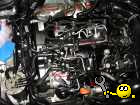
The crankcase ventilation system in my model is integrated into the valve cover.
This will be replaced on Monday.
Currently, the mileage is 120,000 km.
When I pull out the dipstick, it makes a hissing sound.
I'm going to let the car run for 3 minutes and then record another video.
The vehicle has not been moved since the incident. May I drive now?
And what if the measuring tool wasn't properly calibrated? But then it wouldn't be like that.
A lot of oil in the engine compartment and on the parking lot.
The oil change was done approximately 17,000 km ago and will now also be done on Monday, along with all the filters.
Oil level is currently at the minimum, probably because a lot has leaked out.
Normally, how much pressure or exhaust gases are released from the Combined Heat and Power (CHP) unit?
Have you ever considered using a tandem pump?
My Golf also suffered the same fate at 305,000 km... definitely about 10 liters of diesel/oil in the crankcase.
SG
Golf V 2.0 TDI - 4motion (BKD) im Ruhezustand mit >500Tkm
Golf 7 Alltrack - 4motion (DGCA)
Passat Alltrack - 4motion (CFGC)
Touareg V10 TDI (AYH)
First of all, sorry for the late reply, I'm so swamped... I'll explain more about that later...
So, it was the crankcase ventilation system that was built into the cylinder head cover (valve cover)!!!
Test successfully completed, covering approximately 550 km.
Audi immediately thought of "turbo"...
Thank you all very much! We're going on vacation in the Audi on Saturday.
PS: In addition to my other work, I own and manage a small measurement and scanning business, which includes highly accurate 3D scanners and...
Contour and roughness measuring instruments. If anyone in the community needs support, please don't hesitate to reach out! www.messraum.ch


 Bookmarks
 Links
Links Garage
 FAQ, Legal Notice & Privacy
 RSS Feed
 Register
 Login
Login


 .
.




 I know how much the average Swiss person drives.