| Author |
Message |
schneirk
Schrauber

Joined: 09/13/2005
Posts: 57
Karma: +8 / -0 
Location: Bad Salzuflen
Free account, no CAN development support
dieselschrauber likes this. |
 06-01-2006, 14:11 Subject: 06-01-2006, 14:11 Subject: |
Quote |
|
Hello,
Here is some additional information about the turbochargers from BorgWarner Turbo Systems (BWTS).
The "KKK" marking is still present on the nameplate simply because VW "refuses" to change the supplier's symbol.
Okay, so BWTS supplies the ATL "B" automatic transmission for the 1.9L 96kW engine in the PQ24 and MPV models.
as well as the "A" 63-77kW models in the PQ34/PQ35 and T5 series.
The letters A and B, as well as the absence of an index, are used to distinguish between the different charger variants, i.e., sizes, for the 1.4L 66kW engine.
KP39A: 016B, 019P, 016J, 016L, 016P, 019S, 016R, 016M, 019J
BV39A: 014B, 014A, 014G, 014Q, 014H,
The chargers are thermodynamically identical, but differ in terms of the position of the diffuser, the EGR outlet, the compressor pressure connection, and the VTG construction (KP-BV, which is a type of wastegate).
KP39B: 016S, 019H - Identical ATL units, except for the flow rate setting (minimum flow).
BV39B: 014R, 014_ " " " "
The chargers "A" and "B" have the same physical dimensions "39", meaning a turbine wheel inlet diameter of 38.5mm, but have different opening ratios (trim), i.e., an outlet diameter of "A" = 37.7mm and "B" = 34.5mm, and different turbine runner designs. The "B" turbine runner is designed for a higher flow rate. This can be observed by visually inspecting the two turbine runners.
The compressor impellers, with an outlet diameter of 45.0mm, are identical except for the opening ratio, which is "A"=32.8mm and "B"=33.8.
In summary, the ATL "B" turbocharger, designed for 96kW engines, is engineered for higher boost pressures and, consequently, higher air mass flow rates.
Regards,
Dirk.
Translated on 03-09-2026, 2:19.
|
|
| Back to top |
Profile PM |
 |
ulf
Profi-Schrauber

Joined: 04/13/2002
Posts: 11058
Karma: +18 / -0
Location: Saarland
2023 MG ZS
Premium Support
|
| 06-01-2006, 16:05 Subject: |
Quote |
|
schneirk wrote: | | Loaders "A" and "B" have the same physical dimensions "39", meaning a turbine wheel inlet diameter of 38.5mm, but have different opening ratios (trim), i.e., outlet diameters "A" = 37.7mm and "B" = 34.5mm, and different TR (turbine runner) designs. The "B" TR is designed for a higher flow rate. You can tell this by looking at the two TRs. | Hi Dirk,
Thank you for your explanations  .
A few more questions about that:
TR (Turbine Rotor) = Exhaust side, I assume. So, the characteristic value (39) refers to the inlet on the exhaust side, and Garrett turbochargers GT17xx would have approximately 4 mm more there, which is about 21% more cross-sectional area.
Quote: | | The compressor impellers, with an outlet diameter of 45.0mm, are identical except for the opening ratio, which is "A"=32.8mm and "B"=33.8. | Would 32.8 and 33.8 mm then be the inlet diameters at the compressor?
Then, the turbochargers with the dimensions posted by Bertil (approximately 39 mm) would also have larger inlet cross-sections on the compressor side, and would therefore be "larger" overall?
If so, why does the VAG group equip the 96kW 1.9-liter engines with such different chargers?
Quote: | | In summary, the ATL "B" for the 96kW engine is designed for higher/greater boost pressures and, consequently, higher mass flow rates. | By the way, the website states a maximum mass flow rate of 0.14 kg/sec for the KP39. Does that apply to the "B" versions? http://www.turbos.bwauto.com/de/products/passenger_diesel.asp
@ Bertil :
I have searched the VW/Audi database with all letters for 038145702.
The resulting turbochargers, designated G and H, were installed in A4, A6, and Passat models with 1.9 and 2.0 TDI engines, producing between 130 and 140 horsepower.
But aren't all of those models longitudinal engine designs? Could a turbocharger (including the exhaust manifold) from one of those really fit into a G4 without any special modifications? Gruß Ulf
_________
MG4 Electric
Translated on 03-09-2026, 2:25.
|
|
| Back to top |
Profile PM Garage |
|
matthiasTDI96
Profi-Schrauber
Joined: 02/27/2003
Posts: 5886
Karma: +251 / -0
Premium Support
|
| 06-01-2006, 16:56 Subject: |
Quote |
|
Perhaps that's why there's a possibility of detaching the manifold from the turbocharger? This would allow it to be used in both longitudinal and transverse engine configurations, and only the turbocharger would need to be swapped.
Translated on 03-09-2026, 2:28.
|
|
| Back to top |
Profile PM |
|
Bertil
Profi-Schrauber
Joined: 04/15/2002
Posts: 5628
Karma: +108 / -0
Premium Support
|
| 06-01-2006, 19:57 Subject: |
Quote |
|
Hi Ulf,
ulf wrote: | ...
A few more questions about that:
TR (Turbine Rotor) = Exhaust side, I assume. So, the characteristic value (39) refers to the inlet on the exhaust side, and Garrett turbochargers GT17xx would have approximately 4 mm more there, which is about 21% more cross-sectional area.
|
The exhaust side is almost completely irrelevant for the turbo (see above). It's always about the intake side!
Quote: |
Then, the turbochargers with the dimensions posted by Bertil (approximately 39 mm) would also have larger inlet cross-sections on the compressor side, and would therefore be "larger" overall?
If so, why does the VAG group equip the 96kW 1.9-liter engines with such different chargers?
|
I would also like to know that. That's why I asked about it some time ago. It probably didn't interest anyone back then.
Quote: |
@Bertil:
I searched the VW/Audi database with all the letters for 038145702.
The resulting turbochargers, models G and H, were used in A4, A6, and Passat vehicles with 1.9 and 2.0 TDI engines, producing between 130 and 140 horsepower.
But, AFAIK, aren't they all longitudinally-mounted engine models? Could a turbocharger (including the exhaust manifold) from one of those really fit into a G4, without any special modifications? |
Well, I just can't figure out my car. It doesn't fit into any parts list that I know of or that has been published.
Since it was a vehicle used in a fleet (presumably for internet services), I imagine that leftover stock might have been used in its construction.
Fleet vehicles are manufactured in large quantities as identical models and represent a huge business for the car manufacturer. A colleague who monitored production quality at Opel in Rüsselsheim once said that production times could be achieved that are 10-20% below the normal standard. Due to the large-scale purchase of parts, these cars are also extremely cheap to manufacture. Sometimes, parts that are not used in the standard production run are also installed. The discounts offered to buyers may sound utopian, but they are still very attractive. The production staff simply builds the same vehicle for days on end.
I believe the turbo on mine is a lengthwise installation and was connected to the crossflow manifold using a special adapter. Gruß Bertil
Skoda 5E5 CZDA + Mini R50 W10 + VW ID.3 + Fiat Ducato 250 + 161 DX
*** Technische Anfragen per PN werden von mir nicht beantwortet! ***
Translated on 03-09-2026, 2:30.
|
|
| Back to top |
Profile PM |
|
ulf
Profi-Schrauber
Joined: 04/13/2002
Posts: 11058
Karma: +18 / -0
Location: Saarland
2023 MG ZS
Premium Support
|
| 06-01-2006, 20:47 Subject: |
Quote |
|
Bertil wrote: | (Why does the VAG group equip the 96kW 1.9-liter engines with such different alternators?)
I would also like to know that. That's why I asked about it some time ago. Apparently, nobody was interested at that time. | Did you also compare the "specifications" of the loaders in a similarly clear way back then?
Quote: | | I also believe that the turbocharger on mine is a lengthwise installation and was connected to the crossflow intake manifold with a special manifold. | If it really is a 96kW turbocharger, shouldn't it have the Garrett designation "VA"?
But you are talking about a V-charger on the AXR and another VA from a Passat...  
Or is the charger also one of those "parts not produced in large quantities," and therefore not listed in the documentation? Gruß Ulf
_________
MG4 Electric
Translated on 03-09-2026, 2:34.
|
|
| Back to top |
Profile PM Garage |
|
Bertil
Profi-Schrauber
Joined: 04/15/2002
Posts: 5628
Karma: +108 / -0
Premium Support
|
| 07-01-2006, 0:52 Subject: |
Quote |
|
ulf wrote: | Did you also compare the "specifications" of the loaders in a similarly clear way back then?
|
No, but I said back then that the KKK seemed much smaller to me (which it also appears to be from the outside).
Quote: |
Quote: | | I believe that the turbocharger on mine is a lengthwise installation and was connected to the cross-flow intake manifold with a special manifold. | If it really is a 96kW turbocharger, shouldn't it have the Garrett designation "VA"?
|
I didn't mention anything about 96 kW. I only talked about the length of the intake manifold. The GT1749V should be available in the ATD engine in the Passat as well.
Above, I mentioned my "turbocharger in my AXR..."
Quote: |
But you are talking about a V-charger on the AXR and another VA from a Passat...
|
Okay, here it is again, for you to take notes:
The V is in my AXR, and I have the VA lying around here. The KP39 is attached to the replacement motor for the AXR (so, I don't have any issues with the turbocharger  ).
The V6 engine is from a 96kW Passat, and I know that.
Quote: |
Or is the loader also such a "non-mass-produced part," and therefore doesn't appear in the documentation? |
I still haven't been able to clarify the question completely.
The "V" exhaust manifold without a collector (like the one in my AXR engine) probably never existed in the G4. At least, that's what AKTE says. Gruß Bertil
Skoda 5E5 CZDA + Mini R50 W10 + VW ID.3 + Fiat Ducato 250 + 161 DX
*** Technische Anfragen per PN werden von mir nicht beantwortet! ***
Translated on 03-09-2026, 2:37.
|
|
| Back to top |
Profile PM |
|
mullemaus
Guest
Free account, no CAN development support
|
| 07-01-2006, 11:57 Subject: |
Quote |
|
The ATD was not installed in the Passat . It was reserved for the transversely mounted engines. In the Passat, the 100PS TDI engine had the AVB as the engine code. However, even this engine used the GT1749V turbocharger. }
Translated on 03-09-2026, 2:39.
|
|
| Back to top |
|
|
ulf
Profi-Schrauber
Joined: 04/13/2002
Posts: 11058
Karma: +18 / -0
Location: Saarland
2023 MG ZS
Premium Support
|
| 07-01-2006, 12:49 Subject: |
Quote |
|
mullemaus wrote: | | The ATD was not installed in the Passat. It was reserved for the transversely mounted engines. In the Passat, the 100PS TDI had the AVB as the engine code. But even this one had the GT1749V turbocharger. | . . . with a separate exhaust manifold, but with the part number 028 145 702 R. And that part number doesn't match Bertil's turbocharger on the AXR engine either.
@ Bertil:
Does the Garrett-KKK comparison refer to your Golf and the one belonging to your tenant? Are the engines identical except for the turbocharger, including the engine control unit (ECU) software and approximate mileage/break-in status? Gruß Ulf
_________
MG4 Electric
Translated on 03-09-2026, 2:40.
|
|
| Back to top |
Profile PM Garage |
|
Bertil
Profi-Schrauber
Joined: 04/15/2002
Posts: 5628
Karma: +108 / -0
Premium Support
|
| 07-01-2006, 16:06 Subject: |
Quote |
|
ulf wrote: | ...
@Bertil:
Does the Garrett-KKK comparison refer to your Golf and the one belonging to your tenant?
|
What does the car have to do with my tenant?
I already explained above how I compared the chargers.
Quote: | So, let's go over it again, for note-taking:
"The V is in my AXR, and I have the VA lying around here. The KP39 is attached to the replacement motor in the AXR (so I don't have any issues with the turbo)."
The VA (front axle) is from a 96kw Passat, and I know that. |
I have these loaders in my workshop for comparison, so I don't need any more vehicles.
Quote: |
Are the engines the same, except for the turbocharger, including the software (version) of the engine control unit (ECU) and the approximate mileage/break-in status? |
Mine has about 105,000 km on it. The rear axle, which came from a Passat, had 110,000 km on it when it was removed. The KP39 turbocharger on my spare engine has 12,000 km on it (and was used on my main engine for about 300 km).
I already wrote all of that above.
Ulf! Why don't you read what's written there. 
mullemaus wrote: | | The ATD engine was not installed in the Passat. It was reserved for the transversely mounted engines. In the Passat, the 100 hp TDI engine had the designation AVB. However, even this engine used the GT1749V turbocharger. |
Thank you... Passat is not my area of expertise  . I always have to look things up. Gruß Bertil
Skoda 5E5 CZDA + Mini R50 W10 + VW ID.3 + Fiat Ducato 250 + 161 DX
*** Technische Anfragen per PN werden von mir nicht beantwortet! ***
Translated on 03-09-2026, 2:43.
|
|
| Back to top |
Profile PM |
|
ulf
Profi-Schrauber
Joined: 04/13/2002
Posts: 11058
Karma: +18 / -0
Location: Saarland
2023 MG ZS
Premium Support
ptrker likes this. |
| 08-01-2006, 20:36 Subject: |
Quote |
|
Bertil wrote: | Mine has about 105,000 km, the rear axle from the Passat had 110,000 km on it before being removed, and the KP39 on my spare engine has 12,000 km (and briefly on my engine, about 300 km).
I had already written all of that above | .
Sorry  , I was still thinking about the comparison with the Mieter-G4 and had overlooked the fact that you actually had the KKK installed in your car.
I just measured the compressor of my KP39B.
The inlet diameter is approximately 37.5 mm. Following this, there is a tapering section of about 13 mm in length, reducing the diameter to 35.5 mm, and this tapered section extends all the way to the compressor impeller.
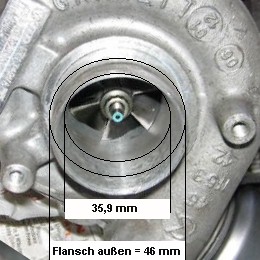
For comparison, I found another photo of a GT1749VA (038 253 016 F) and tried to calculate the compressor inlet diameter -> attachment.
Since the intake flanges of the KKK and Garrett turbochargers are connected by the same rubber reducer, I assume they have the same outer diameter, which is 46 mm (measured on my KKK).
Based on the photo, the compressor inlet diameter of the GT1749VA appears to be approximately 35.9 mm, which is practically the same size as my KP39B.
Only the inlet cone of the GT1749VA appears to be slightly more recessed into the intake manifold.
When comparing the inlet diameters at the compressor, it would not be expected to see a (significant) increase in performance by using a GT1749VA instead of my current KP39B.
However, my measurements contradict both the data posted by Bertil for the GT1749VA, as well as the data from schneirk... it's a bit puzzling.
| Description: |
|
| File size: |
47.76 KB |
| Viewed: |
4197 times |
|
Gruß Ulf
_________
MG4 Electric
Translated on 03-09-2026, 2:47.
|
|
| Back to top |
Profile PM Garage |
|
A2TDI
Guest
Free account, no CAN development support
|
| 22-01-2006, 13:31 Subject: |
Quote |
|
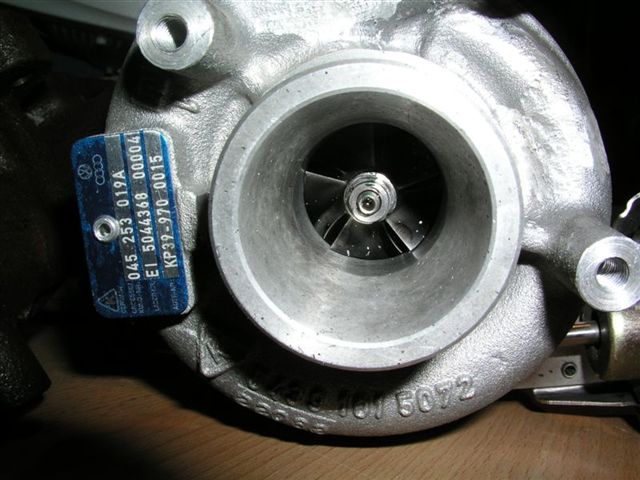
'It's likely that nothing will help here, as this is probably only about KP39A and B, but...'
KP39 without index:
Inlet diameter: 36mm, tapering to 30mm at the turbine.
Compressor outlet: 27mm internal diameter.
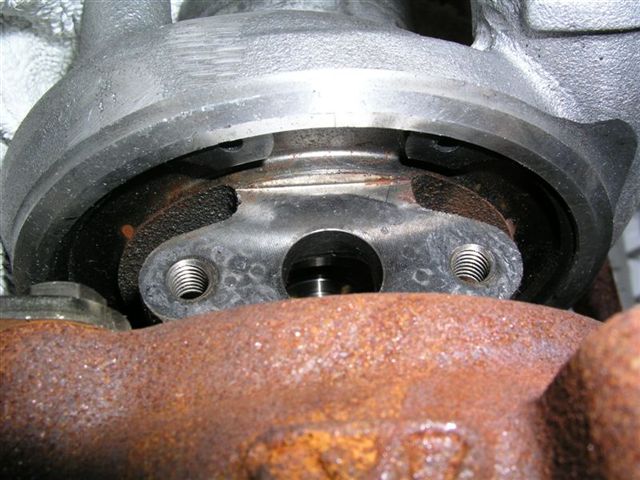
Are the compressor housings on your KP39 chargers also secured with a retaining ring? If so, could one build a hybrid charger?
Regards,
Thomas.
| Description: |
|
| File size: |
54.17 KB |
| Viewed: |
4100 times |
|
| Description: |
|
| File size: |
62.71 KB |
| Viewed: |
3361 times |
|
Translated on 03-09-2026, 2:50.
|
|
| Back to top |
|
|
schneirk
Schrauber
Joined: 09/13/2005
Posts: 57
Karma: +8 / -0
Location: Bad Salzuflen
Free account, no CAN development support
|
| 14-02-2006, 17:15 Subject: |
Quote |
|
Quote: | Comparing the inlet diameters at the turbocharger, one would not expect any (significant) performance gain by using a GT1749VA instead of my current KP39B.
However, my measurements contradict both the data posted by Bertil for the GT1749VA, and those of schneirk... something quite puzzling about the whole thing. |
Hello,
I was traveling for business and personal reasons for a longer period of time.
I'm finally getting around to replying.
A key difference between the Garrett GT1749 and the BWTS (KKK) turbocharger KP/BV39 is the critical compressor outlet diameter, which cannot be measured from the outside.
The GT1749 has a diameter of 49mm, while the KP/BV39 has a diameter of 45.7mm.
For impeller design, the blade angle (or "trim") of the impeller is important, which refers to the ratio of the inlet diameter to the outlet diameter. For BWTS, this is 73% for a 77kW unit and 75% for a 96kW unit. The larger the trim, the more flow capacity the impeller has, making it suitable for higher volumetric flow rates.
In this case, the trim of the Garrett and the BWTS turbos happens to have almost identical inlet diameters, which is purely coincidental.
In other words, the BWTS-VR 45.7-34.3 = 75% has approximately the same maximum mass flow rate (clogging limit) as the Garrett VR 49-xx.x = xx%.
The outer diameter of the intake port of the compressor housing must be identical, as VW aims to use as many identical parts as possible across different turbochargers and applications, and therefore uses the same intake manifold in these cases.
Translated on 03-09-2026, 2:53.
|
|
| Back to top |
Profile PM |
|
schneirk
Schrauber
Joined: 09/13/2005
Posts: 57
Karma: +8 / -0
Location: Bad Salzuflen
Free account, no CAN development support
|
| 14-02-2006, 17:19 Subject: |
Quote |
|
A2TDI wrote: |
KP39 without index:
Inlet diameter: 36mm, tapering to 30mm at the turbine.
Compressor outlet: 27mm internal diameter.
Are the compressor housings on your KP39 chargers also secured with a retaining ring? If so, could one build a hybrid charger?
|
The ATL 019A, with a 1.4-liter capacity and 66kW power, has a compressor outlet diameter of 40.6mm and an inlet diameter of 27mm, and it cannot be compared to the 1.9-liter chargers.
for your information:
KP39_ and BV39_ (without index) = 1.4L, 66kW, 3-cylinder engine.
KP39A and BV39A = 1.9L, 63-77 kW.
KP39B and BV39B = 1.9L, 96kW
Translated on 03-09-2026, 2:56.
|
|
| Back to top |
Profile PM |
|
ulf
Profi-Schrauber
Joined: 04/13/2002
Posts: 11058
Karma: +18 / -0
Location: Saarland
2023 MG ZS
Premium Support
|
| 14-02-2006, 19:13 Subject: |
Quote |
|
schneirk wrote: | | That is to say, the BWTS-VR 45.7-34.3 = 75% has approximately the same maximum mass flow rate (clogging limit) as the Garrett VR 49-xx.x = xx%. |
Hello Dirk,
As far as I know, the cross-sectional area of the compressor inlet is also a significant factor in determining the choking limit.
If it onlydepended on the trim, one could theoretically reduce the size of the compressor indefinitely without compromising the maximum mass flow rate? Gruß Ulf
_________
MG4 Electric
Translated on 03-09-2026, 2:58.
|
|
| Back to top |
Profile PM Garage |
|
schneirk
Schrauber
Joined: 09/13/2005
Posts: 57
Karma: +8 / -0
Location: Bad Salzuflen
Free account, no CAN development support
dieselschrauber and guste100 likes this. |
| 15-02-2006, 15:18 Subject: |
Quote |
|
Hello Ulf,
I wanted to keep the answer easy to understand.
Yes, you are right.
The inlet area of a compressor impeller is also responsible for the maximum flow rate (choke limit) of the compressor, as are the number, shape, and contour (curvature/development) of the blades, and the spiral ("snail") of the compressor housing.
The opening ratio (trim) of a compressor has inherent limits; values below approximately 67% and above 77% result in a significant decrease in peak efficiency. It's generally better to choose a smaller compressor with a larger trim ratio or a larger compressor with a smaller trim ratio. The optimal range is around 74%.
We are now entering the area of aerodynamics (velocity triangles, length of the inlet duct, optimal speed/pressure conversion, etc.).
Example.
A compressor with an outlet diameter of 45mm and an inlet of 30mm (resulting in a 67% trim ratio) has approximately the same maximum volumetric flow rate as a VR (vaneless rotor) with diameters of 40mm and 30mm (resulting in a 74% trim ratio), assuming the same VG (volumetric gap), number of blades, profile, etc.
Advantage of the smaller compressor: higher peak efficiency, a "left-shifted" operating range (meaning better performance at lower flow rates), higher efficiency at smaller flow rates, and lower moment of inertia.
Which brings us back to the popular topic of performance enhancement...
Larger supercharger = higher performance and reduced turbo lag with the same engine management system.
Translated on 03-09-2026, 3:00.
|
|
| Back to top |
Profile PM |
|
ulf
Profi-Schrauber
Joined: 04/13/2002
Posts: 11058
Karma: +18 / -0
Location: Saarland
2023 MG ZS
Premium Support
|
| 15-02-2006, 17:54 Subject: |
Quote |
|
schneirk wrote: | | I wanted to keep the answer easy to understand... | . . . and then there are often silly counter-questions, like the ones I  .
Otherwise, thank you for your general overview .
I could imagine that you would be well-suited to write a technical article about the basics of turbochargers, including examples of characteristic curves, definitions of terms like "boost" and "air-to-ratio," potential conflicts when sizing a turbocharger, and the effects of changes to the turbocharger geometry.
Something like that is still missing here, and I think many members would appreciate it for that .
Quote: | | Larger compressor = higher performance and reduced lag (turbo lag) with the same engine speed... | What does "ESM" mean here? Gruß Ulf
_________
MG4 Electric
Translated on 03-09-2026, 3:03.
|
|
| Back to top |
Profile PM Garage |
|
|


 Bookmarks
 Links
Links Garage
 FAQ, Legal Notice & Privacy
 RSS Feed
 Register
 Login
Login

