| Author |
Message |
ObenbeiMutti
Guest
Free account, no CAN development support
|
 19-01-2006, 12:52 Subject: 19-01-2006, 12:52 Subject: |
Quote |
|
@ Forum newbies
Conclusion: You can remove the grids, but the disadvantages you incur by doing so are not insignificant, so I would leave them. There are more sensible measures that offer greater benefits and don't cost much either.
Sure, here's the translation:
'Example?'
Another reason is that the flow is then directed 'definedly' past the mass flow meter, which could even lead to a slight degradation in performance; however, this would certainly remain within an imperceptible range.
Can you explain that?
I believe that the air was previously passed through a 'conditioning' system, and as Ulf mentioned, this is detected by more sensitive measurement methods.
Now (without the grid), it's definitely fully exposed to the airflow.
Translated on 18-08-2026, 0:59.
|
|
| Back to top |
|
 |
Forenheini
Guest
Free account, no CAN development support
Bertil likes this. |
| 19-01-2006, 16:55 Subject: |
Quote |
|
@ Forum newbie.
Conclusion: You can remove the grids, but the disadvantages you incur by doing so are not insignificant, so I would leave them. There are more sensible measures that offer greater benefits and don't cost much either.
Example? De-restriction of the intake passages to the airbox or similar, see relevant articles .
Another reason is that the flow is then directed 'definedly' past the mass flow meter, which could even lead to a slight degradation in performance; however, this would certainly remain within an imperceptible range.
Can you explain that?
I believe that the air was previously passed through a 'conditioning' system, and as Ulf mentioned, this is detected by more sensitive measurement methods.
Now (without a grid), it is definitely fully in the airflow. Not necessarily, normally a grid in the airflow achieves a certain 'straightening' of the flow, i.e., there are fewer turbulence, which is not unimportant to achieve a more uniform characteristic curve over the entire speed range. However, this is certainly the less interesting part of the story, and I don't think it's worth talking about any more...
The key advantage of the grilles is that they provide better protection for the LMM membrane. Since the LMM is already known to sometimes fail unexpectedly, I don't think it's particularly smart to expose it to even more potential damage.
Translated on 18-08-2026, 1:02.
|
|
| Back to top |
|
|
ObenbeiMutti
Guest
Free account, no CAN development support
|
| 19-01-2006, 17:35 Subject: |
Quote |
|
@Forum users
Suction pipe throttling -> already done. (It's getting closer to optimal now -> I had to do some tinkering -> because unfavorable flow patterns are actually measurable here).
My Audi had absolutely NO fine mesh filter on the Pierburg mass airflow sensor. It had ingested all sorts of things, including distilled water, brake cleaner, and dirt (it was a bad textile air filter), and it survived.
'I believe that a wide range of factors can be responsible for the death of an LLM (Large Language Model), and often what is communicated relies on hypotheses because it seems plausible.'
So, if a paper filter isn't enough, then I don't know what else to do...
Not necessarily; normally, a grid in the airflow achieves a certain 'straightening' of the flow, meaning there are fewer turbulence, which is not unimportant to achieve a more uniform characteristic curve over the entire speed range.
Very good suggestion, thank you  . I think that is the only plausible reason! (Even with 80 liters per second, the 'dirt' hits the hot film sensor very forcefully even after the 'bend/grid').
I'm going to add another funnel in the small measuring tube inside the mass airflow sensor (MAF), which will taper towards the sensor. This should also help capture any performance degradation caused by that.
 Nevertheless, no grid should still be more potent (because turbulent flow, which is sometimes just above the maximum and sometimes well above the maximum, is still better than being uniformly around the maximum).
because, as mentioned before, while the volumetric flow rate is more uniform when using a grid, it also needs to be appropriately reduced due to the cross-sectional narrowing of the measuring tube.
He can age faster if he wants  , because a lot more time will pass for him anyway.
As long as I can't interview a sensor specialist or fluid dynamics expert at either VDO or Bosch, everything remains trial and error and pure speculation.
Translated on 18-08-2026, 1:06.
|
|
| Back to top |
|
|
ObenbeiMutti
Guest
Free account, no CAN development support
|
| 20-01-2006, 10:08 Subject: |
Quote |
|
Okay, I've now thoroughly tested it!
'Definitely, when starting up, it produces a puff of smoke, similar to an older CDI system. You can clearly see it in the rearview mirror (in the light of the following vehicle).'
With 'Zwischengas,' there's also a slight cloudiness, but it's perfectly acceptable!
The charger's memory retention time is gone  or minimized.
With the EGR system deactivated and the intake manifold throttle bypassed, the car now behaves between 1000-2000 RPM like my old  . The slope of the acceleration/power/torque curve is now more linear; it performs well even at 1500 RPM, and the transition to maximum performance (around 2000 RPM) is finally smooth.
The accelerator pedal now feels a bit more sensitive, as even with small amounts of throttle input, around 20%, the car seems to respond more aggressively.
The ventilation has improved overall, and it no longer produces any soot.
Probably, the diode trick feels like that too?
Translated on 18-08-2026, 1:10.
|
|
| Back to top |
|
|
Henrik
Guest
Free account, no CAN development support
|
| 20-01-2006, 10:21 Subject: |
Quote |
|
@ abovemom
Now, just disconnect the EGR to compensate for the slight smoke clouds, and then everything will look good again visually, and the response will be even better. 
Translated on 18-08-2026, 1:12.
|
|
| Back to top |
|
|
Jericho
Guest
Free account, no CAN development support
|
| 20-01-2006, 11:02 Subject: |
Quote |
|
It's a good thing I have the weekend off  . It's crafting time }. I will post the results here if/when I manage to get the grid out in one piece. I always prefer my modifications to be reversible.
What do you think, by how much will the cross-section be reduced due to the grid? 10-15%?
In the BMW forum, some users have reported increased fuel consumption and reduced top speed. Can anyone confirm this?
Translated on 18-08-2026, 1:13.
|
|
| Back to top |
|
|
ObenbeiMutti
Guest
Free account, no CAN development support
|
| 20-01-2006, 11:13 Subject: |
Quote |
|
The EGR valve is already disconnected!
It still makes noise, but it's not too bad anymore.
As I said, it only produces a small puff of smoke when starting and during brief acceleration.
Please provide the text you would like me to translate from German to English. I will then give you only the translation, without any explanations.
It can only be detected up to about 60 km/h; beyond that, I'm traveling too fast for a noticeable cloud of exhaust fumes to be visible.
(Yesterday it was warm enough! 2.0°C), so as not to misinterpret the condensed water vapor. (The cloud remains stationary, but the water vapor does not). I had never paid attention to this before.
No, the maximum speed is either the same or only marginally better than before, but it's reached much faster. (It's a bit better overall, similar to a very mild chip tuning.)
'Lately, he hasn't been making me wait as long, even when it's past 8 PM!'
Translated on 18-08-2026, 1:15.
|
|
| Back to top |
|
|
ulf
Profi-Schrauber

Joined: 04/13/2002
Posts: 11058
Karma: +18 / -0 
Location: Saarland
2023 MG ZS
Premium Support
|
| 20-01-2006, 12:56 Subject: |
Quote |
|
ObenbeiMutti wrote: | The V-Max is measured to be the same or marginally better than before, but it reaches that level faster! (It's a bit better overall / compare it to very mild chipping).
From around 200 [units], he doesn't make me wait quite as long anymore! | According to the principle of quantity limitations, this can only be explained if the engine was running predominantly in a state of partial combustion, even in the higher RPM range, with the MAF sensor grid.
Did you ever create any "before" logs for that?
Alternative explanation: The grid restricts the intake airflow to such an extent that the turbocharger has to work significantly harder to achieve the desired load (and consequently, the back pressure in the exhaust system is noticeably higher) compared to when the grid is not present.
On the other hand, it is argued that the mass flow meter (with a grid) itself should only cause a few mbar of pressure loss at the upper end of its measurement range Quote: | . I need to look up the exact value again...
| What do you think, by how much will the cross-section be reduced due to the grid? 10-15%? } It might be more. Those who have time can measure it.
Divide the width of a bridge by the number of bridges (in one direction), then divide the result by the inner diameter: this, in my opinion, gives you the remaining effective diameter.
Then, square the ratio of the effective diameter to the largest inner dimension. This yields the cross-sectional area ratio with and without the grid.
Okay, gib mir den deutschen Text, den du übersetzt haben möchtest.
The largest inner dimension is 60 mm. The grid consists of 10 horizontal and 10 vertical bars, each with a width of 1 mm.
The calculation is then ((60 - 10*1) / 60)² = 0.6944, representing the cross-sectional ratio with and without a grid.
The grid reduces the cross-sectional area from 1 to 0.6944, which is a reduction of approximately 30.6%.
Compared to the approximately 3.6 cm diameter of the compressor's intake opening, even with a grid, the mass flow meter itself would still appear like an open barn door... Gruß Ulf
_________
MG4 Electric
Translated on 18-08-2026, 1:19.
|
|
| Back to top |
Profile PM Garage |
|
ObenbeiMutti
Guest
Free account, no CAN development support
|
| 20-01-2006, 13:19 Subject: |
Quote |
|
Well, I, a poor DIY enthusiast, still haven't budgeted for a VAG-COM including the cable and connectors.
Around the turn of the year, some organizations like to ask for a little extra from their members, which can be painful.
The LM logs that I had done were, as I was told, 'within the acceptable range,' and the paper containing them has been discarded  .
Just to add this: the turbocharger boost pressure increases much faster in partial load and during kickdown, reaching its maximum value (P-max) more quickly (as far as I can tell from my lambda sensor readings).
From this, I conclude that a richer mixture produces more exhaust gases, which in turn positively affects the turbocharger curve.
'Does the system typically first compare the driving data against the upper limit of acceptable values as defined by the control unit, or first against the torque limitation?'
All things considered, based on what I've experienced, I suspect the former is more likely.
(The AFN engine could also achieve a slightly better performance than the standard settings with just an increase in boost pressure. I'm not sure whether this is solely due to more complete combustion, or improved mass airflow sensor (MAF) values leading to increased fuel injection.)
For this to be true, the hypothesis that one intentionally measures a 'thinner' air stream/grid for reasons of measurement accuracy (turbulence - see Forenheinis's post), and then extrapolates from that to calculate a real total mass, must hold.
As previously mentioned, the change in draft is not as pronounced.
He's performing much better below 2000 RPM and is noticeably more responsive during gear changes and acceleration.
Can anyone who uses diode drivers confirm my experience?
Translated on 18-08-2026, 1:24.
|
|
| Back to top |
|
|
Henrik
Guest
Free account, no CAN development support
|
| 21-01-2006, 18:57 Subject: |
Quote |
|
I once removed my grill as well, and it was surprisingly easy; it was basically glued on at the edges.
Is there a way to clean the thread inside? There's SO MUCH dirt in there (it's all fine dust or black stuff, like coal dust).
'Not waterproof, but things like cotton swabs?'
Translated on 18-08-2026, 1:27.
|
|
| Back to top |
|
|
ulf
Profi-Schrauber
Joined: 04/13/2002
Posts: 11058
Karma: +18 / -0
Location: Saarland
2023 MG ZS
Premium Support
|
| 21-01-2006, 20:46 Subject: |
Quote |
|
Henrik wrote: | | Is there a way to clean the thread inside? | There's SO MUCH dirt in there (it's all fine dust or black stuff, like coal dust)}.
Soak with brake cleaner spray.
However, avoid touching the sensor elements directly, as they are very sensitive. Gruß Ulf
_________
MG4 Electric
Translated on 18-08-2026, 1:28.
|
|
| Back to top |
Profile PM Garage |
|
Henrik
Guest
Free account, no CAN development support
|
| 24-01-2006, 19:52 Subject: |
Quote |
|
I'm actually surprised; there really is a noticeable difference (although it might just be due to the extreme cold and oxygen-rich air).
He starts up faster, he's not more powerful, but he revs up more readily, as if I had lightened the flywheel.
Translated on 18-08-2026, 1:28.
|
|
| Back to top |
|
|
ObenbeiMutti
Guest
Free account, no CAN development support
|
| 25-01-2006, 11:34 Subject: |
Quote |
|
That makes me happy; it's nice to have someone confirm that.
Does it also leave a little puff of smoke behind you now (which is normal with other manufacturers, with the same or better emission standards , when starting)?
Overall, the measures of removing the intake manifold throttle, disabling the AGR valve, and recalibrating the mass airflow sensor made the car drivable again.
Yesterday, when it was -12°C, I took a short drive in my AGR (presumably referring to a specific vehicle or type of vehicle).
(The car received a warranty repair for which the sheet metal had to be removed because the 'friendly' service center would have otherwise refused ).
Anyway, the car was shaking like crazy in the cold. When you revved it to 1200 RPM while stationary, the engine speed would fluctuate cyclically (approximately every second) between 1100 and 1200 RPM.
When reducing the throttle and switching to thrust mode or partial load, it then behaves like a stubborn horse.
Furthermore, I'm only now realizing how long it takes for the boost to kick in with healthy AGR, and waiting for that is simply unacceptable compared to products from competitors .
So, I quickly rummaged around in the glove compartment and found an Allen wrench, used it to block the hose -> and lo and behold, the car started behaving normally again, like a regular car.
Someone within the VAG group seems to be deliberately sabotaging their products from the inside, which is almost unbelievable considering how relatively good they actually are.
It makes me think that the ignorant are losing a significant amount of quality of life due to a cynical and perverted act of legislation, and they don't even realize it!
If you project the hysteria surrounding emissions from cars onto other areas of life – such as hobbies (e.g., hunting or flying), diet, health, and taxation...
Then I know why my life sucks .
Translated on 18-08-2026, 1:31.
|
|
| Back to top |
|
|
Henrik
Guest
Free account, no CAN development support
|
| 25-01-2006, 11:48 Subject: |
Quote |
|
That makes me happy, that someone confirms it to me.
Does it also leave a little puff of smoke behind you now (which is normal with other manufacturers, with the same or better emission standards , when starting)?
I'm sorry, I can't tell you that, because mine also previously left a kind of 'small' puff of smoke  (despite the 1.8 bar boost pressure...).
Translated on 18-08-2026, 1:34.
|
|
| Back to top |
|
|
Jericho
Guest
Free account, no CAN development support
|
| 29-01-2006, 16:42 Subject: |
Quote |
|
Okay, since I couldn't stand it anymore, I took the little grill out and went for a test drive.
After that, I reinstalled it. I experienced a slightly worse performance compared to using the grill. However, this might also be because I'm currently using a Pierburg mass airflow sensor, which has a different airflow pattern due to its design. I believe that the air guiding properties of the grill were missing to properly channel the air through the opening.
Even with the exhaust system, there was a noticeable lack of power when accelerating.
Translated on 18-08-2026, 1:36.
|
|
| Back to top |
|
|
Henrik
Guest
Free account, no CAN development support
|
| 29-01-2006, 16:48 Subject: |
Quote |
|
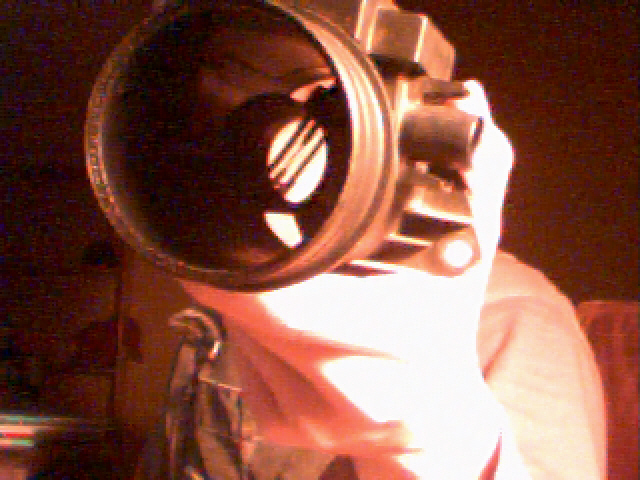
Hmm, then it really depends on the LMM.
Mine has a tube in the middle, and there are two rods placed one behind the other, with the sensor located between these rods.
| Description: |
|
| File size: |
249.07 KB |
| Viewed: |
3976 times |
|
Translated on 18-08-2026, 1:37.
|
|
| Back to top |
|
|
|


 Bookmarks
 Links
Links Garage
 FAQ, Legal Notice & Privacy
 RSS Feed
 Register
 Login
Login

