| Author |
Message |
dleds
Joined: 04/16/2014
Posts: 40
Karma: +14 / -1 
Premium Support
|
 11-03-2023, 0:10 Subject: 11-03-2023, 0:10 Subject: |
Quote |
|
Okay, regarding the maximum fuel injection quantity, Volkswagen is spending millions of dollars trying to determine which injectors, with which rail pressure and pilot injection settings, achieve the highest combustion chamber pressure somewhere within the range of 10-16 degrees after top dead center.
Man kann also davon ausgehen das eine Mehrmenge die theoretische Mehrleistung nicht 1zu1 sprich linear umsetzen kann. Dabei bleiben Gramm Gramm, unabhängig ob diese durch lange Öffnungszeiten bei niedrigen Raildruck(übel, gibt nur mehr Abgastemperatur und kaum Leistung/Drehmoment) oder durch Erhöhung des Raildruckes entstehen. Eine Mehrleistung größer der prozentualen Mehrmenge ist nur dann möglich wenn der Motorwirkungsgrad sich erhöht. Hierzu siehe mein erster Satz, VW hat Millionen investiert um den Punkt zu finden an dem der Motor am besten ist. Even if the programmer compromises everything in favor of increased performance (emission regulations, durability, noise levels, etc.), they won't be able to extract more than a 2% increase without risking damage to the engine.after just 5 km, it becomes noticeable. This is simply because emissions and noise levels are already being overlooked when driving at full throttle.
Your performance is a perfect fit for the audience.
Regarding boost pressure, it's not increased because the excess fuel increases the exhaust volume. This, in turn, causes the Variable Geometry Turbine (VGT) to adjust further, which reduces the backpressure in the exhaust system. Consequently, the mass of air entering the engine increases at the same pressure. This alone leads to a higher turbocharger speed, as the compressor is fixed. Increasing the pressure could potentially cause the turbocharger to overspin.Regarding performance with high mileage, it's true that standard engines can still deliver their rated power even after 200,000 km. The tuning utilizes the reserves that programmers use to generate additional power. Also, there are chipped engines that still maintain their increased power output after 200,000 km, although these are often examples that haven't been pushed to their absolute limit. For example, compare a 2.0 TDI with 100 hp versus one with 180 hp, or engines from the pre-common rail era.
Regarding boost pressure in the lower gears, that can happen, but it's probably less likely to affect your engine. A Supra with a turbocharger from a Scania, on the other hand, is more prone to it... I once built a "Frankenstein" T5 2.5 TDI Euro 3/4 engine that actually had the problem of overboosting in second gear when it was unloaded. It was quite rough and unpleasant to drive.
Translated on 21-07-2026, 5:58.
|
|
| Back to top |
Profile PM |
 |
kevin272
Joined: 01/28/2023
Posts: 11
Karma: +0 / -0
Free account, no CAN development support
|
| 11-03-2023, 11:02 Subject: |
Quote |
|
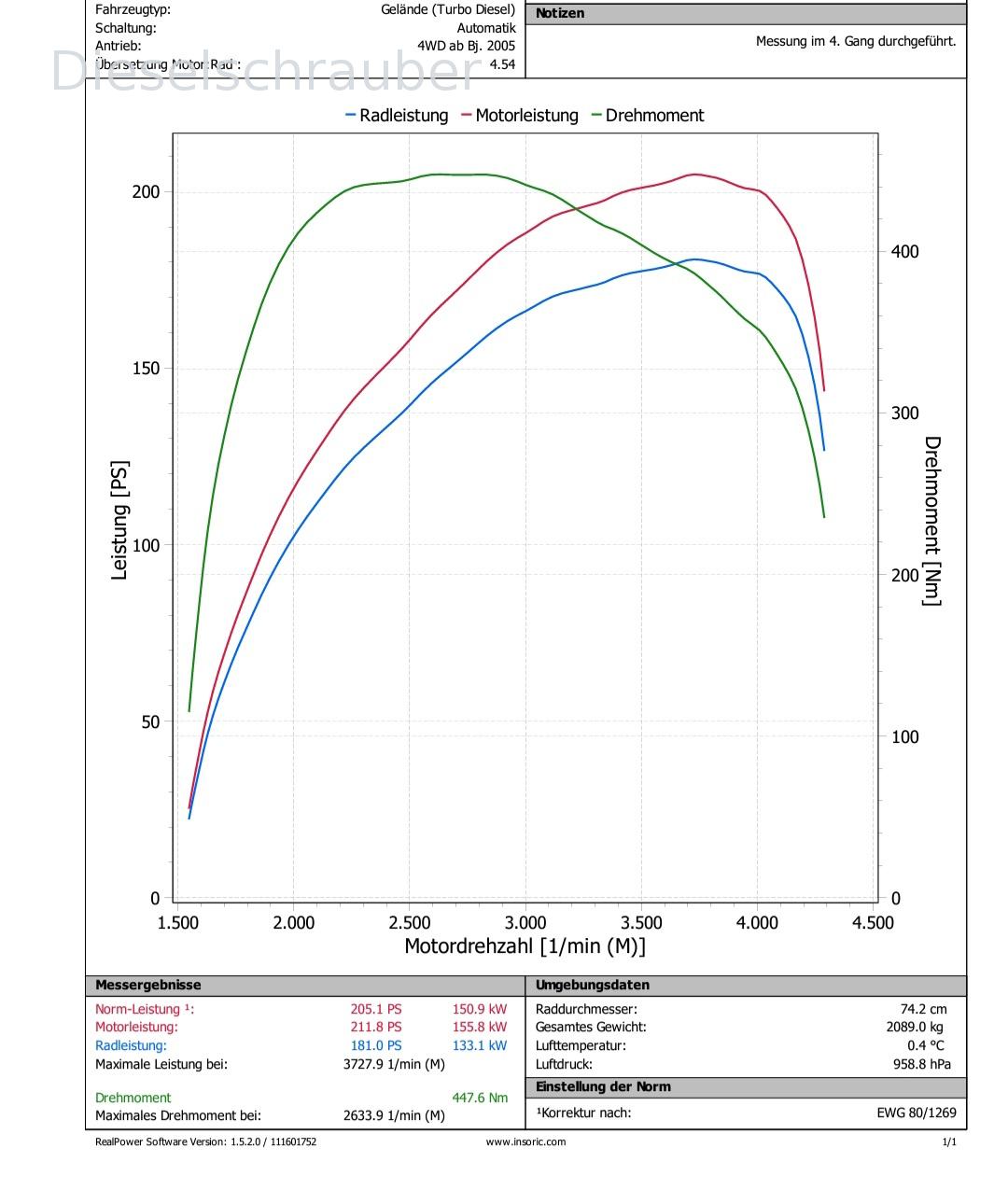
What also surprised me was that it achieves its maximum power at a relatively low RPM of 3700, whereas you would typically expect it to be closer to or exactly at 4000 RPM for that type of engine.
In the attached performance graph, you can see a slight dip shortly after 3700, as if something is being regulated. It only drops rapidly starting at 4000.
If I take the logged torque values and calculate based on them, I also arrive at 220 horsepower.
So, I think we can probably ignore it and just keep going.
So, everything should be okay with the engine.
Even if I were to go to my tuner and ask him to squeeze out a few more horsepower, or visit another tuner to try and achieve the advertised 220/224 hp with 20 Nm more torque, I'm sure I wouldn't really notice it given the car's weight, and I don't know if it would run as smoothly afterwards.
Some tuners claim to achieve even 235 horsepower with the DPF (Diesel Particulate Filter) still installed.
I have no idea how they do that without damaging the exhaust system.
I believe my software is designed with a very human-centric approach, focusing not only on maximum performance but also on durability.
I still have one idea regarding the DPF (Diesel Particulate Filter).
I seem to recall hearing that when the DPF is full of soot and about to undergo regeneration, there might be a slight loss of power.
Immediately after the regeneration cycle, an engine has its maximum power output. Is that correct? Perhaps the DPF was close to being fully regenerated during the measurement. This is about soot, not ash.
As far as my technical understanding goes, it has no impact or only a very minimal one.
If the DPF is causing a loss of power, it's likely either full of ash or defective.
| Description: |
|
| File size: |
208.86 KB |
| Viewed: |
1742 times |
|
Translated on 21-07-2026, 6:03.
|
|
| Back to top |
Profile PM |
|
dleds
Joined: 04/16/2014
Posts: 40
Karma: +14 / -1
Premium Support
|
| 11-03-2023, 16:55 Subject: |
Quote |
|
It's almost normal for Volkswagen TDI engines to achieve peak performance at lower RPMs. This is because the cylinder heads have a restrictive design that limits their potential airflow and gas exchange capacity. Consequently, VW tends to choose relatively small turbochargers in order to broaden the usable engine speed range by ensuring early boost response.
The loader therefore quickly reaches the point where it's close to its maximum load capacity. This is evident in the performance diagrams; when the torque starts to plateau, somewhere in the engine, the amount of fuel being supplied begins to be physically limited. Shortly thereafter, the peak power output is usually reached.
Translated on 21-07-2026, 6:06.
|
|
| Back to top |
Profile PM |
|
kevin272
Joined: 01/28/2023
Posts: 11
Karma: +0 / -0
Free account, no CAN development support
|
| 14-03-2023, 11:47 Subject: |
Quote |
|
It just leaves the question of why it generates less power in the lower gears. However, since it has more power available from the 4th gear onwards, it probably isn't a technical defect.
It seems that the software is reducing performance in the lower three gears for some reason I can't figure out.
The car's acceleration from 0 to 100 km/h (0-60 mph) is almost identical to the standard version at 8.5 seconds. Normally, around 30 horsepower and 60 Nm more (although it's not known exactly what the standard version had) should make a noticeable difference.
Even the 2.0 TDI with only 177 horsepower takes almost 9 seconds.
What's also strange is that the 190 hp version is only slightly faster, with a time of 8.7 seconds.
Or could it simply be due to the design of the engine itself, where even with more horsepower, the car doesn't accelerate faster, for example, because of a large turbocharger that takes longer to build up boost pressure?
For comparison, the 2.0 TFSI engine with 211 hp and 350 Nm accelerates the Q5 to 100 km/h (62 mph) in a significantly faster time of 7.2 seconds, despite having less torque.
Translated on 21-07-2026, 6:08.
|
|
| Back to top |
Profile PM |
|
Herbert
Profi-Schrauber

Joined: 06/22/2005
Posts: 4627
Karma: +1342 / -0
Premium Support
dieselschrauber, Rüdi and E30_V8 likes this. |
| 14-03-2023, 12:52 Subject: |
Quote |
|
Hi there,
You must distinguish between power and torque. Power refers to a specific rotational speed.
When accelerating, it's not the engine's torque that matters, but rather the torque curve – specifically, the torque applied to the wheel due to the special gear ratio.
You can modify the engine to achieve maximum power output, but the car won't go any faster than the rev limiter allows. It's like attaching a bigger barn door – it won't make a difference.
And if your tuner is capable (and you understand what you're doing), it won't add more torque than the drivetrain can handle in the long run.
hg
Herbert.
Horch A4 8K CJCD
Golf 7 DDYA
(+ Audi 80 Avant B4 1Z 475Tkm - habe ich vom ersten bis zum letzten Tag gerne gefahren)
(+ Passat Variant 32B CY 400Tkm)
Translated on 21-07-2026, 6:10.
|
|
| Back to top |
Profile PM |
|
kevin272
Joined: 01/28/2023
Posts: 11
Karma: +0 / -0
Free account, no CAN development support
|
| 14-03-2023, 21:00 Subject: |
Quote |
|
I want to clarify that I'm not talking about the top speed, but rather about acceleration and quick responsiveness.
The powertrain from the engine onwards is completely identical to the 3.0 TDI with 258 hp and 580 Nm of torque. This includes the same transmission, driveshaft, etc.
Designed for significantly more power.
That's why I don't see the point of why the power is limited in the lower RPM range and first three gears on the 2.0 TDI, or why the tuner programmed it that way.
It's a fact that it delivers less torque in the lower gears. I logged it myself.
Unfortunately, I don't know exactly where or what is being limited in this case.
Either it was intentionally programmed that way, or it's being limited by something.
I can only imagine that I might have had the wrong software installed.
There's also the same Q5 with the same engine available as a manual transmission and front-wheel drive, which makes more sense in that configuration.
I got it with all-wheel drive and an automatic transmission.
Perhaps that wasn't considered.
Translated on 21-07-2026, 6:13.
|
|
| Back to top |
Profile PM |
|
Herbert
Profi-Schrauber
Joined: 06/22/2005
Posts: 4627
Karma: +1342 / -0
Premium Support
dieselschrauber likes this. |
| 15-03-2023, 11:59 Subject: |
Quote |
|
Quote: | | The powertrain from the engine onwards is completely identical to the 3.0 TDI with 258 hp and 580 Nm. The same transmission, driveshaft, etc. |
Just create a comparison table of MKB and GKB.
hg
Herbert. Horch A4 8K CJCD
Golf 7 DDYA
(+ Audi 80 Avant B4 1Z 475Tkm - habe ich vom ersten bis zum letzten Tag gerne gefahren)
(+ Passat Variant 32B CY 400Tkm)
Translated on 21-07-2026, 6:15.
|
|
| Back to top |
Profile PM |
|
kevin272
Joined: 01/28/2023
Posts: 11
Karma: +0 / -0
Free account, no CAN development support
|
| 16-03-2023, 12:34 Subject: |
Quote |
|
I have already studied this extensively online and directly on the car itself.
A friend of mine has the same 3.0 TDI engine (same production period, his car is from 10/16, mine is from 12/16), and he completely disassembled and compared the two cars.
Both visually and in terms of technical specifications.
Of course, MKB is different.
GKB is a PJT part. According to the spare parts catalog, it has the same design as the QUR (used in the 3.0 TDI 190kW engine).
The differences are mainly in the slightly different positioning of the screw holes on the transmission flange, a relocated oil cooler line that now runs forward towards the radiator, and different transmission software tuning.
The internal components of the transmission, including the dual-clutch system, are always identical. The gear ratio is also the same (applies to the TDI models).
The dual-mass flywheel is always the same.
Structure:
Each engine has its own flywheel with a starter ring gear.
The ZMS (presumably referring to a specific component) is integrated in such a way that the mounting point is always the same for all engines.
So, it's not the usual setup where the torsional vibration damper (ZMS) is directly bolted to the engine, meaning each engine has its own dedicated ZMS.
Therefore, a difference is ruled out in that case as well.
The identification letter on the rear differential is the same as for the 3.0 TDI. The part numbers for the driveshaft and everything else are also identical.
Mechanically, there should be no weaker components installed in the powertrain. The part numbers are identical, and even the barcodes match. Therefore, it is definitely the same parts.
There are also no spare parts available for purchase for the transmission, such as dual-mass flywheels (DMFs) or clutches, or for the drivetrain, that specifically differentiate between 2.0 TDI and 3.0 TDI engines. They are always compatible with both. The only differences exist between gasoline and diesel engines, and even then, they are limited to parts relevant to gear ratios.
The only difference between the 2.0 TDI and the 3.0 TDI is the brakes. The 3.0 TDI has internally ventilated rear brake discs.
By the way, I'm thinking about upgrading the brakes, as even in stock form, they were already getting hot at the rear.
"It seems like Audi cut costs somewhere; there's probably a reason why the 3-liter engine has a different rear disc brake."
Regarding the lack of power in the lower RPM range, I've gained new insights and have done some more test drives with data logging.
The torque limitation in the lowest three gears seems to be coming from the engine control unit, not the transmission itself. The torque reduction setting in the transmission is permanently set to a factor of 1 and therefore does not intervene.
My logged values are also confirmed by the performance measurement.
In the fourth gear, as mentioned, the engine produced approximately 212 horsepower and 450 Nm of torque. In third gear, measurements showed around 200 horsepower and 420 Nm of torque.
I will ask the editor to review and correct it.
My only explanation is that he probably used the engine control unit (ECU) map designed for a manual transmission front-wheel drive vehicle. The part number (MKB) is the same in both cases. In my opinion, that's the only situation where something like that would make sense.
"To prevent wheelspin and to protect the clutch. The standard clutch is already quite small. Or he may have forgotten certain engine maps. Which makes me wonder why there are factory-set speed limits for each gear."
I need to check if the manual transmission has a different engine control unit (ECU) software than the automatic one, or if they are the same.
Perhaps that is the reason.
Adjust the transmission software settings, either instead of or in addition to other modifications.
In the 3.0 TDI engine, the transmission software extends the gear ratios up to 4500 RPM.
For the 2.0 TDI engine, only use first gear up to 4500 RPM. After that, limit the RPM to a maximum of 4200.
I understand that the optimal clock speed is around 3700 MHz, but pushing it higher likely takes less time than any unnecessary switching operation.
Generally, the transmission in the 2.0 TDI shifts more frequently and aggressively.
"Especially around 100 km/h, it hesitates and struggles to engage the 7th gear, constantly shifting back and forth between the 6th and 7th gears, and you really have to press the pedal hard for it to downshift and accelerate."
The transmission constantly forces the engine into very low RPM ranges and its turbo lag, which is caused by the large turbocharger. This further enhances the feeling of sluggishness.
The 3.0 TDI engine is designed to rev more freely.
The entire gear ratio tuning in the 3.0 TDI is geared more towards a sporty feel. It's likely, at least in part, intentional to encourage customers to opt for the 3.0-liter engine.
However, I'm not sure if that alone is what makes the car faster in the 0-100 km/h range.
It's important to deliver the full power output from low RPMs, and then it will definitely run under 8 seconds and become more aggressive.
Performance is performance, regardless of whether it comes from a 4-cylinder or a 6-cylinder engine, and logically, it must accelerate the mass faster.
Even a Q7 (the older model) or a Touareg with the smallest 3.0 TDI engine, producing 204 hp/450 Nm of torque, which are significantly heavier, have a worse power-to-weight ratio, and larger dimensions, accelerate faster to 100 km/h and can overtake me at speeds around 80 km/h. However, I become faster from approximately 120 km/h onwards.
Based on my experience, I know that the 204 hp 3.0-liter engine often produces less power than advertised and typically delivers around 200 hp and 400 Nm of torque.
That can't be right; I should actually be a little faster. I think it's definitely possible to compare the performance of both vehicles.
Consider whether the engine delivers full power at low speeds or only performs well on the highway; it shouldn't matter to him.
I don't want to extract any more power; I just want it to engage all the gears properly.
As I mentioned, I was looking for faster overtaking maneuvers and more power when accelerating.
As I said above, everything is great when driving above 100 km/h.
It's slow down there.
Regarding my statement about the 300 horsepower, that was obviously only referring to what the engine block itself is likely capable of withstanding.
Of course, this does not apply to the other components. That is perfectly clear to me. I know many people who have been running that engine with 245 hp and 500 Nm of torque with a DPF(!) for tens of thousands of kilometers, they consistently get full power on the highway, and nothing happens.
So, I'm not really worried about that; my performance improvement is quite limited.
Especially since the turbo is additionally water-cooled, it will likely handle heat and stress better than an oil-cooled turbocharger like the one in the 184 hp 2.0 TDI engine.
Translated on 21-07-2026, 6:24.
|
|
| Back to top |
Profile PM |
|
|


 Bookmarks
 Links
Links Garage
 FAQ, Legal Notice & Privacy
 RSS Feed
 Register
 Login
Login

