| Author |
Message |
wolfgang b.
Blaumann


Joined: 11/16/2004
Posts: 150
Karma: +6 / -0 
Location: Neustadt am Rbg. MY Sealine 220 Family - LUNA - DJ5977 - DSC 211 387 910 - Binnen, Ostsee, Adria
Free account, no CAN development support
|
 09-06-2008, 20:55 Subject: 09-06-2008, 20:55 Subject: |
Quote |
|
Tagessuppe wrote: |
Hello.
To achieve around 150 horsepower with my turbodiesel engine, I modified the...
Designed to increase full load capacity, also known as a particulate matter screw.
It's located on the lower left side, if you remove the cover of the fuel injection pump.
A small screw, secured with a Torx T10 head, is loosened using a small screwdriver. A quarter turn outwards corresponds to approximately 10 horsepower more.
Above a certain speed, the idle speed needs to be reduced, even though it is normally electronically controlled, otherwise the engine will rev up excessively while idling.
Furthermore, I have shifted the start of fuel injection earlier by 10 degrees (my engine with exhaust gas recirculation has a very late fuel injection timing to minimize NOx emissions), and I have increased the boost pressure. However, the latter would not be necessary, as the engine already has sufficient boost pressure at 0.9 bar.
Sincerely. |
Hello,
Can you show me, using pictures on my website, where I can find this screw and how to lower the idle speed again? Gruß Wolfgang 
Der mit dem Schiffsdiesel
Eins kann mir keiner nehmen,
und das ist die pure Lust am Leben
Skype: my-luna
Translated on 04-08-2026, 0:16.
|
|
| Back to top |
Profile PM |
 |
Tagessuppe
Profi-Schrauber

Joined: 11/13/2002
Posts: 1140
Karma: +36 / -0
Location: Wien
2001 Audi A2 
Premium Support
|
| 09-06-2008, 22:36 Subject: |
Quote |
|
Hello Wolfgang.
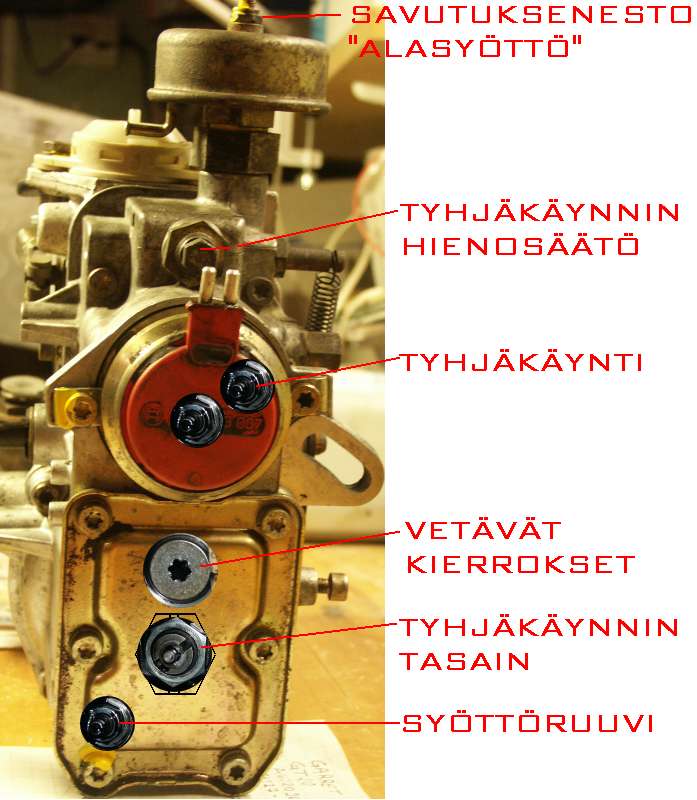
With permission from the Finnish Mersuforum, I am allowed to show this technical drawing of the pump. Copyright (c) Veskola.
The screw that causes the joy to appear is located on the bottom left and is labeled "SYOTTORUUVI", also known as a fine dust screw. Loosen the lock nut and turn it outwards, meaning counter-clockwise. I was able to turn mine 2 1/2 revolutions without needing any idle speed adaptation.
Since you have a turbocharger with a low-pressure exhaust recirculation (LPE) system, it should probably be around 3-4 revolutions.
Better 5 
It seems that the idle speed control on your device is regulated differently than on the pump shown in the image.
For me, it was labeled "THYAKAYNTI," which translates to "idle speed adjustment screw."
The screw above it, labeled "THYAKAYNTI HIENOSAATO," is for fine-tuning.
It seems you're referring to the container that replaces the red cover.
adjusts the idle speed (rotate counter-clockwise).
I have to say that my engine only revved up when it was warm.
The automatic transmission was in neutral. If your boat doesn't have a neutral gear, it won't be as bad.
But first, let's tighten the screws on particulate matter emissions.
If the injection is done correctly, the boost pressure will also work properly. A target of 0.9 to 1.1 bar should be aimed for. However, 0.9 bar should be achievable with a low-latency kit (LLK).
When you remove the cover of the pump, some oil will initially spill out, so place a cloth underneath it.
If you then run the engine at idle with the cover open, that's not a big deal.
because only a small amount of motor oil is being fed into the pump, possibly around 10 ml per minute.
You can safely ignore the ALDA function. It has no purpose for a vacuum pump. This means that if you introduce any substance into it, the pump will start working.
While in a turbocharger pump, the motor immediately switches to being an air compressor if the intake line is disconnected or the engine protection system activates.
Hope I was able to help  .
Best regards.
| Description: |
|
| File size: |
69.43 KB |
| Viewed: |
15204 times |
|
Translated on 04-08-2026, 0:22.
|
|
| Back to top |
Profile PM Garage |
|
wolfgang b.
Blaumann
Joined: 11/16/2004
Posts: 150
Karma: +6 / -0
Location: Neustadt am Rbg. MY Sealine 220 Family - LUNA - DJ5977 - DSC 211 387 910 - Binnen, Ostsee, Adria
Free account, no CAN development support
|
| 17-06-2008, 11:09 Subject: |
Quote |
|
Okay, I'm going to continue reporting now.
I was on a boat in Berlin this weekend.
The oil level indicator and sensor (ranging from 0 to 150 degrees) have been replaced with original VDO parts.
The boost pressure gauge, which originally displayed values from -05 to  ,5 bar, has been replaced with a VDO gauge.
Removed the charge air cooler pipes and intake manifold because otherwise it's impossible to access the glow plugs.
Removed the rear cover of the fuel injection pump. It was quite a job.
"because there is only 2 cm of space between the ESP (Electronic Stability Program) and the oil cooler near the oil filter, making it possible to install it using only a..."
A Torx screwdriver with an angled head could not be used due to insufficient space.
1/4 inch ratchet.
The fine dust mixture screw was now exposed.
Ich habe sie 2 Umdrehungen heraus gedreht. That's the best it gets.
since it's already touching the lid.
After a little over 1.5 hours, everything was put back together again.
I still have the charge air duct between the turbocharger and the intercooler open.
calmly for the first test.
The engine was slowly warmed up without using any turbocharger boost pressure.
I stuffed a towel into the charging tube to create back pressure.
Warm up at 2000 RPM, after about an hour:
Oil: 100 degrees Celsius, Water: 75 degrees Celsius, Boost pressure: 0 bar, Speed: 10 km/h.
Then full speed ahead:
3300 revolutions, speed 14 km/h.
Okay, I've reconnected the intercooler pipe to the turbocharger now.
Accelerated to 3000 RPM.
Boost pressure: 0.1 bar, speed: 13 km/h.
Okay, full throttle: 4000 RPM.
After approximately 3 minutes, the oil reached 130 degrees, while the water was at 110 degrees. The experiment was then stopped.
The boost pressure was 0.6 bar, and the speed was 17 km/h.
Just before transitioning to gliding.
Without the suction cup-like platform at the bottom, it might have been enough to make it float.
Once the boat is out of the water and gliding, does its speed then...?
and further expand it.
But now, let's move on to my other problem.
Why did the water temperature rise so quickly?
After the test, I continued driving for about 2 more hours at approximately 2000 RPM.
Oil: 108 degrees. Water: 78 degrees.
The oil temperature seems to be always...
increase the speed a bit more.
Why is the water temperature rising so quickly?
Is the injection timing not set correctly?
Or does the turbocharger, which is cooled by engine coolant, generate...?
"So much temperature that the plate heat exchanger is unable to cool the coolant."
Can it cool down quickly enough? Gruß Wolfgang
Der mit dem Schiffsdiesel
Eins kann mir keiner nehmen,
und das ist die pure Lust am Leben
Skype: my-luna
Translated on 04-08-2026, 0:30.
|
|
| Back to top |
Profile PM |
|
tdi on water
Blaumann
Joined: 01/26/2007
Posts: 56
Karma: +1 / -0
Free account, no CAN development support
|
| 17-06-2008, 14:00 Subject: |
Quote |
|
wolfgang b. wrote: |
Warm up at 2000 RPM, after about an hour:
Oil: 100 degrees Celsius, Water: 75 degrees Celsius, Boost pressure: 0 bar, Speed: 10 km/h.
Okay, full throttle: 4000 RPM.
After approximately 3 minutes, the oil reached 130 degrees, while the water was at 110 degrees. The experiment was then stopped.
After the test, I continued driving for about 2 more hours at approximately 2000 RPM.
Oil: 108 degrees. Water: 78 degrees.
Why is the water temperature rising so quickly?
|
Hello Wolfgang,
You only have a slightly elevated temperature issue.
There are actually only a few possibilities.
1) Your engine's coolant thermostat or coolant pump is not working properly.
The cooling capacity of the coolant heat exchanger and the oil cooler is too low.
3) Problems with the seawater pump.
Check the built-in strainer on your seawater pump. No, this isn't a joke!
This comb (also known as the ramp or impeller shroud) allows for adjustment of the pump's flow rate/cooling capacity.
There are different types of combs for various speed ranges.
I would start by checking point 3). Changing the flow rate of the seawater pump will likely allow you to quickly identify changes in your cooling system.
I just hope that your heat exchangers for the coolant and engine oil are not undersized.
Replacing or renewing a faulty pump is much easier than it might seem.
One more question at the end: Only 17 kilometers at full throttle? That must be a typo, right? Gruß
tdi on water
Translated on 04-08-2026, 0:38.
|
|
| Back to top |
Profile PM |
|
Tagessuppe
Profi-Schrauber
Joined: 11/13/2002
Posts: 1140
Karma: +36 / -0
Location: Wien
2001 Audi A2
Premium Support
|
| 17-06-2008, 19:57 Subject: |
Quote |
|
Okay, I'm leaning towards thinking it might be a heat exchanger that's too small. How many kilowatts should it be rated for?
The OM605 engine produces 115 horsepower (83 kW) at 5000 RPM, so it has a very high revving capability!
With about 2 and a half turns of the fine dust adjustment screw, roughly speaking, it's around 100 kW.
Approximately 35% of the 100 kW should be converted into usable power.
Of the 65 kW of heating power, perhaps 35 kW should be lost through the exhaust.
However, a large portion of them will be recaptured by your turbo/bent-fin cooling system.
So, let's say roughly 40 kW that you want to dissipate into the water.
I have to say that I never really liked the curved cooling system from the beginning, because...
This can have a negative effect on boost pressure and response time in a turbocharger.
As I mentioned, the maximum RPM is 5000, and that's what we need to achieve to potentially activate the turbo. Perhaps we could add a protrusion to the cover?
Or, as they do in Finland, you can drill a hole through the lid and extend the screw outwards to allow for on-the-fly performance adjustments.
How did it perform with that particular turbocharger and 0.6 bar of boost pressure?
Did he burn the fuel properly, or does he still need more boost pressure? With 0.6 bar and 2.5 turns of the "joy screw," it should be burning well enough.
Translated on 04-08-2026, 0:42.
|
|
| Back to top |
Profile PM Garage |
|
wolfgang b.
Blaumann
Joined: 11/16/2004
Posts: 150
Karma: +6 / -0
Location: Neustadt am Rbg. MY Sealine 220 Family - LUNA - DJ5977 - DSC 211 387 910 - Binnen, Ostsee, Adria
Free account, no CAN development support
|
| 17-06-2008, 20:18 Subject: |
Quote |
|
tdi on water wrote: |
Hello Wolfgang,
You only have a slightly elevated temperature issue.
? |
I think almost 110 degrees at 2000 RPM is already quite a lot.
I think something in the range of 80-90 would be fine.
Do you have an oil temperature gauge installed in your TDI vehicle?
tdi on water wrote: |
There are actually only a few possibilities.
1) Your engine's coolant thermostat or coolant pump is not working properly.
? |
I replaced the coolant pump with a new one during the overhaul.
I chose the one with metal wings.
However, I'm not entirely sure about the thermostat anymore.
But I mean, I think I tested it in a saucepan.
In addition, it received a 3 mm hole to regulate the temperature.
to further reduce it in the lower load range.
tdi on water wrote: |
The cooling capacity of the coolant heat exchanger and the oil cooler is too low.
? |
I'm not sure about the plate heat exchanger from the sanitary area.
whether the cooling performance is sufficient.
How large is your heat exchanger bundle?
I would like to know the number of pipes and the total length.
The standard oil cooler from Mercedes is still in place and uses coolant for cooling.
In the turbocharger circuit, there is an oil cooler in the return line that is cooled by seawater.
tdi on water wrote: |
3) Problems with the seawater pump.
Check the built-in strainer on your seawater pump. No, this isn't a joke!
? |
The seawater pump is a one-inch Jabsco pump, suitable for speeds up to 4000 RPM.
tdi on water wrote: |
This comb (also known as the ramp or impeller shroud) allows for adjustment of the pump's flow rate/cooling capacity.
There are different types of combs for various speed ranges.
? |
Should fit, or how should I check that?
tdi on water wrote: |
I would start by checking point 3). Changing the flow rate of the seawater pump will likely allow you to quickly identify changes in your cooling system.
? |
tdi on water wrote: |
I just hope that your heat exchangers for the coolant and engine oil are not undersized.
Replacing or renewing a faulty pump is much easier than it might seem.
One more question at the end: Only 17 km at full throttle? | That must be a typo, right? }
You should keep in mind that the Sealine 23-foot boat weighs approximately 2.6 tons.
With a length of 17 kilometers, it is still in the displacement phase.
It starts to gradually transition into gliding mode at around 20 km.
With the 205 horsepower engine, its top speed increased to approximately 50 km/h. Gruß Wolfgang
Der mit dem Schiffsdiesel
Eins kann mir keiner nehmen,
und das ist die pure Lust am Leben
Skype: my-luna
Translated on 04-08-2026, 0:49.
|
|
| Back to top |
Profile PM |
|
wolfgang b.
Blaumann
Joined: 11/16/2004
Posts: 150
Karma: +6 / -0
Location: Neustadt am Rbg. MY Sealine 220 Family - LUNA - DJ5977 - DSC 211 387 910 - Binnen, Ostsee, Adria
Free account, no CAN development support
|
| 17-06-2008, 20:50 Subject: |
Quote |
|
Tagessuppe wrote: | So, I'm almost certain it's a heat exchanger that's too small? How many kilowatts should it be?
The OM605 engine produces 115 horsepower (83 kW) at 5000 RPM, so it has a very high revving capability!
With about 2 and a half turns of the fine dust adjustment screw, roughly speaking, it's around 100 kW.
Approximately 35% of the 100 kW should be converted into usable power.
Of the 65 kW of heating power, perhaps 35 kW should be lost through the exhaust.
However, a large portion of them will be recaptured by your turbo/bent-fin cooling system.
So, let's say roughly 40 kW that you want to dissipate into the water.
I have to say that I never really liked the curved cooling system from the beginning, because...
This can have a negative effect on boost pressure and response time in a turbocharger.
As I mentioned, the maximum RPM is 5000, and that's what we need to achieve to potentially activate the turbo. Perhaps we could add a protrusion to the cover?
Or, as they do in Finland, you can drill a hole through the lid and extend the screw outwards to allow for on-the-fly performance adjustments.
How did it perform with that particular turbocharger and 0.6 bar of boost pressure?
Did he burn the fuel properly, or does he still need more boost pressure? At 0.6 bar and 2 1/2 turns of the "joy screw," it should generally be burning well enough. |
Hello,
Based on what I can tell, it seems to have burned well, and there doesn't appear to be any black smoke (Russ). However, it's difficult to judge properly since the exhaust is submerged in water.
During the test without a charger, it hesitated when pushed to full throttle, and the rear of the vehicle became completely black.
I cleaned it again before the second full-throttle test with the turbocharger.
I would rather run the motor with a slightly larger screw at its maximum torque.
The OM605.960 engine has 150 horsepower. The naturally aspirated diesel engine has 115 horsepower.
That's why we did the test without the turbo.
Unfortunately, I forgot to record the data from the plate heat exchanger.
 Gruß Wolfgang
Der mit dem Schiffsdiesel
Eins kann mir keiner nehmen,
und das ist die pure Lust am Leben
Skype: my-luna
Translated on 04-08-2026, 0:56.
|
|
| Back to top |
Profile PM |
|
Tagessuppe
Profi-Schrauber
Joined: 11/13/2002
Posts: 1140
Karma: +36 / -0
Location: Wien
2001 Audi A2
Premium Support
|
| 17-06-2008, 21:22 Subject: |
Quote |
|
wolfgang b. wrote: |
He burned well, as far as I can tell, there's no soot. It's difficult to judge because the exhaust is underwater. |
That's already good news  .
Quote: |
I would rather run the motor with a slightly larger screw at its maximum torque.
|
This turbocharger is going to be difficult to deal with. It's already quite large and heavy.
"Definitely tighten the window adjustment screw. That might make a difference. If you increase the fuel enrichment to the point where your Luna starts planing, and then release the throttle with the large screw once it's in planing mode, the turbo might be able to maintain boost pressure even at lower RPM."
Quote: |
Unfortunately, I forgot to record the data from the plate heat exchanger.
|
In a pinch, one could estimate it based on its dimensions.
But the water heaters that I know of typically have a power output between 24 kW and 40 kW.
If the cooling capacity is truly too low, you could connect a second unit either in parallel or in series. If the fresh water pump is indeed that powerful, I would almost recommend connecting it in series.
By the way, the Mercedes thermostat is set to 82 degrees.
It is very unlikely that this is too narrow.
Usually, they overcharge when there's a defect.
Translated on 04-08-2026, 1:01.
|
|
| Back to top |
Profile PM Garage |
|
wolfgang b.
Blaumann
Joined: 11/16/2004
Posts: 150
Karma: +6 / -0
Location: Neustadt am Rbg. MY Sealine 220 Family - LUNA - DJ5977 - DSC 211 387 910 - Binnen, Ostsee, Adria
Free account, no CAN development support
|
| 18-06-2008, 5:38 Subject: |
Quote |
|
Hello,
So, the heat exchanger has one-inch connections.
It is approximately 50 cm long, 12 cm wide, and 6 cm high.
I once searched for a similar product on exxxx for comparison.
I don't think they are that big.
A 40 kW system is about half the size.
Gruß Wolfgang
Der mit dem Schiffsdiesel
Eins kann mir keiner nehmen,
und das ist die pure Lust am Leben
Skype: my-luna
Translated on 04-08-2026, 1:03.
|
|
| Back to top |
Profile PM |
|
Tagessuppe
Profi-Schrauber
Joined: 11/13/2002
Posts: 1140
Karma: +36 / -0
Location: Wien
2001 Audi A2
Premium Support
|
| 18-06-2008, 10:28 Subject: |
Quote |
|
"You're right, Wolfgang! Just taking him as a comparison is enough."
http://www.monopoel.de/catalog/waermetauscher-ausfuehrung-gerade-p-428.html
Then yours should have at least 80 kW, which will likely be even higher with a temperature difference of 100 degrees.
In this case, I almost think that the flow rate will be too low.
Looking at the size of the water pumps and coolant hoses, the 1-inch fittings are only about 1/10th their size. I think this is where the bottleneck lies.
Perhaps add a second wastegate in parallel, or even better, give the turbocharger and manifold their own dedicated wastegate.
Translated on 04-08-2026, 1:04.
|
|
| Back to top |
Profile PM Garage |
|
Tagessuppe
Profi-Schrauber
Joined: 11/13/2002
Posts: 1140
Karma: +36 / -0
Location: Wien
2001 Audi A2
Premium Support
|
| 18-06-2008, 14:15 Subject: |
Quote |
|
I'm sorry, I think I made a mistake in the thermal calculations.
With an estimated efficiency of 33% and a maximum power output (P-Max) of 100 kW, the waste heat should be approximately 200 kW. Of this, roughly 150 kW would need to be transferred to the heat exchanger (since the turbocharger and exhaust manifold are also being cooled).
The data are rough estimates and are intended to provide only a small glimpse into the heat balance.
Considering that, I think your weight tolerance will probably be too small.
Translated on 04-08-2026, 1:06.
|
|
| Back to top |
Profile PM Garage |
|
tdi on water
Blaumann
Joined: 01/26/2007
Posts: 56
Karma: +1 / -0
Free account, no CAN development support
|
| 20-06-2008, 13:20 Subject: |
Quote |
|
wolfgang b. wrote: |
I just hope that your heat exchangers for the coolant and engine oil are not undersized.
Replacing or renewing a faulty pump is much easier than it might seem.
? |
Sorry, Wolfgang.
"It is important to note that..." oder "Please keep in mind that..."
"... the heat exchangers for the coolant and engine oil are NOT undersized."
What does my suggestion do to the pump?
If these seawater pumps rotate too quickly, they can sometimes experience a rapid decrease in cooling performance. Gruß
tdi on water
Translated on 04-08-2026, 1:07.
|
|
| Back to top |
Profile PM |
|
wolfgang b.
Blaumann
Joined: 11/16/2004
Posts: 150
Karma: +6 / -0
Location: Neustadt am Rbg. MY Sealine 220 Family - LUNA - DJ5977 - DSC 211 387 910 - Binnen, Ostsee, Adria
Free account, no CAN development support
|
| 20-06-2008, 20:37 Subject: |
Quote |
|
tdi on water wrote: |
Otherwise, feel free to call me again; you have my phone number.
Perhaps I can help you with one of my first-generation VA heat exchangers. However, I'm not sure if it will be sufficient for your needs, as you have a large amount of heat being generated by the water-cooled turbocharger.
|
Hello Andreas,
I tried to reach you, but I couldn't.
Can I reach you by phone on the weekend? Gruß Wolfgang
Der mit dem Schiffsdiesel
Eins kann mir keiner nehmen,
und das ist die pure Lust am Leben
Skype: my-luna
Translated on 04-08-2026, 1:09.
|
|
| Back to top |
Profile PM |
|
tdi on water
Blaumann
Joined: 01/26/2007
Posts: 56
Karma: +1 / -0
Free account, no CAN development support
|
|
| Back to top |
Profile PM |
|
wolfgang b.
Blaumann
Joined: 11/16/2004
Posts: 150
Karma: +6 / -0
Location: Neustadt am Rbg. MY Sealine 220 Family - LUNA - DJ5977 - DSC 211 387 910 - Binnen, Ostsee, Adria
Free account, no CAN development support
|
| 23-06-2008, 18:39 Subject: |
Quote |
|
Hello Andreas,
And I don't believe it.
I spoke with Bukh in Bremen on the phone this afternoon.
I also have a Johnson pump installed in my system.
Type F7B-8.
There is a diagram on page 29 of the catalog.
The speed range goes up to 4000 revolutions per minute.
Mr. Einhoff from Bukh also stated that the pumping capacity would not immediately decrease afterwards.
I'm going to reduce the speed a little bit more.
But I don't think your assumption about the speed being too high is entirely correct.
I once calculated that with a pulley ratio of 175 mm to 150 mm, the pump would rotate at...
At 4000 RPM on the engine, it reaches 4600 RPM.
| Description: |
|

Download |
| File name: |
JOHNSON PUMP Diagramm.pdf |
| File size: |
68.88 KB |
| Downloaded: |
726 times |
Gruß Wolfgang
Der mit dem Schiffsdiesel
Eins kann mir keiner nehmen,
und das ist die pure Lust am Leben
Skype: my-luna
Translated on 04-08-2026, 1:12.
|
|
| Back to top |
Profile PM |
|
tdi on water
Blaumann
Joined: 01/26/2007
Posts: 56
Karma: +1 / -0
Free account, no CAN development support
|
| 24-06-2008, 8:17 Subject: |
Quote |
|
Whether it's completely accurate or not doesn't really matter.
If this resolves your thermal issue.
Or?
Gruß
tdi on water
Translated on 04-08-2026, 1:13.
|
|
| Back to top |
Profile PM |
|
|


 Bookmarks
 Links
Links Garage
 FAQ, Legal Notice & Privacy
 RSS Feed
 Register
 Login
Login


