| Author |
Message |
dieselschrauber
Administrator

Joined: 04/12/2002
Posts: 18119
Karma: +801 / -0 
Location: St.Gallen
2018 Volkswagen T6 
|
 19-05-2003, 9:34 Subject: 19-05-2003, 9:34 Subject: |
Quote |
|
Hi,
donalexo wrote: |
By the way: How is the vacuum pump sealed to the cylinder head? Can this seal be reused after the timing belt check, or is it a good idea to get a replacement beforehand?
Regards,
Alex |
In my A3, the part you're referring to is a rubber ring.
During the timing belt replacement, I removed the vacuum pump, but I didn't replace the new seal.
So far (5000 km), there have been no leaks.
Best regards, Rainer.
Translated on 26-08-2026, 8:44.
|
|
| Back to top |
Profile PM WWW Garage |
 |
ulf
Profi-Schrauber

Joined: 04/13/2002
Posts: 11058
Karma: +18 / -0
Location: Saarland
2023 MG ZS
Premium Support
|
| 19-05-2003, 17:02 Subject: |
Quote |
|
donalexo wrote: |
A coked wave would likely be a reason for a complete charger replacement, wouldn't it? |
AFAIK, yes  .
Quote: | | Blockages in this area could actually only arise from the KGE, right? Then, one would probably need to give the LLK a small flush with something like gasoline to free it from deposits. |
Normally, only oil (mist) should enter the engine oil sump from the KGE, which should be easily displaced by the airflow (unless there's a large pool of oil in the sump that becomes stiff like honey in extremely cold temperatures).
I was thinking more about solid foreign objects in this case, without any specific assumptions about their origin.
Quote: | Perhaps the membrane diaphragm in the wastegate control system is also defective, for example, it has too much internal friction, so that the spring can no longer push the diaphragm all the way back? Have there been such cases before?
Or the actuation rod has become lodged in the guide and is preventing the end stop from engaging.  |
Sorry, I have absolutely no practical experience with that. Gruß Ulf
_________
MG4 Electric
Translated on 26-08-2026, 8:46.
|
|
| Back to top |
Profile PM Garage |
|
donalexo
Profi-Schrauber
Joined: 01/09/2003
Posts: 695
Karma: +0 / -0
Location: Würzburg
Support
|
| 24-05-2003, 22:44 Subject: |
Quote |
|
Hello fellow DIY enthusiasts!
Today, I had a little time again to dedicate to my problem.
A thorough inspection of the air intake system revealed that it is completely free of any obstructions, and therefore can be ruled out as a cause of the problem.
In the second step, I disassembled my vacuum pump to be able to see the position of the camshaft. Unfortunately, checking the valve timing was not as easy as I thought. This is partly because the direct view of the toothed wheel on the flywheel is severely obstructed by the coolant hose. I used a flashlight and pushed the coolant hose aside with my other hand. However, I could only see it at a slight angle from above through the transmission opening (parallax error?). Furthermore, I used Ulf's "slide-gear" technique in 5th gear to set the engine to Top Dead Center (TDC). This was quite difficult, as I had to perform the action on a slight incline rather than on a level surface. During this process, I rotated the engine forward and backward.
Is this permissible? What is the hysteresis of the camshaft when it is alternately pushed forward and backward (by only a few degrees around top dead center)?
Due to the poor visibility of the OT marking, I'm not entirely sure if I was able to set the exact position. For safety's sake, it would be helpful if someone could provide me with a description of the OT marking for the AGR engine. There are two openings under the rubber stopper. The starter ring gear is visible under the front opening. The rear opening is located behind the ring gear.
I noticed the OT marking in the rear opening. There's a position where you can see a hole with a nose-like protrusion pointing upwards. I hope this is indeed the OT marking. Unfortunately, I couldn't identify any markings on the tooth ring in the front opening. This may have been due to the poor visibility. Please correct me if the OT marking looks different!
Assuming that I had correctly set the engine to Top Dead Center (TDC) and that the reverse hysteresis of the valve drive is negligible, I believe I have identified that the groove on the front of the camshaft was not exactly parallel to the cylinder head plane. There is an estimated angular error of approximately 4-5 degrees.
If that's true, then that could be the key to solving my problem, right?
Does anyone happen to know the valve timing for TDI engines (the opening angle of the intake and exhaust valves)?
Could these findings, along with the assumed misalignment of approximately 4-5 degrees, explain a loss of performance and a delayed build-up of boost pressure?
Thank you for your assistance.
Regards,
Alex.
AUDI A3 1.9 TDI, EZ 12/96, ursprüglich MKB AGR, umgebaut zum AHF mit GT1749V-Lader, verkauft mit 250tkm
Golf 4 1.9 TDI, EZ 1/98, MKB ALH, jetzt auch mit GT1749V-Lader, verkauft mit 300tkm
Touran 1.9 TDI, EZ 09/2004
Audi A4 Avant 2.0 TDI, EZ 03/2010
Translated on 26-08-2026, 8:50.
|
|
| Back to top |
Profile PM |
|
ulf
Profi-Schrauber
Joined: 04/13/2002
Posts: 11058
Karma: +18 / -0
Location: Saarland
2023 MG ZS
Premium Support
|
| 24-05-2003, 22:55 Subject: |
Quote |
|
donalexo wrote: |
Assuming that I had correctly set the engine to Top Dead Center (TDC) and that the reverse hysteresis of the valve timing mechanism is negligible, I believe I have identified that the groove on the front of the camshaft was not exactly parallel to the cylinder head plane. There is an estimated angular error of approximately 4-5 degrees.
If that's true, then that could be the key to my problem, right? |
Hi Alex,
That would indicate a misadjustment of the valve timing by 8-10 degrees of crankshaft rotation.
Assuming that the TDI allows for continuous adjustment (meaning that the developers themselves consider the usual fixed positioning of the crankshaft on the shaft, common in gasoline engines, to be insufficiently precise), this could very well be a significant misadjustment.
You should definitely double-check the setting using a standard tool (like a measuring rule) to be sure.
And correct it if the visually observed deviation from the target value is confirmed.
I can't be certain whether this will solve all of your problems... Gruß Ulf
_________
MG4 Electric
Translated on 26-08-2026, 8:54.
|
|
| Back to top |
Profile PM Garage |
|
donalexo
Profi-Schrauber
Joined: 01/09/2003
Posts: 695
Karma: +0 / -0
Location: Würzburg
Support
|
| 24-05-2003, 23:03 Subject: |
Quote |
|
@Ulf:
Thank you for your quick reply! 
Do you know by heart what the OT marking looks like on the AGR unit? Can it be seen in the front or rear opening of the transmission?
Regards,
Alex. AUDI A3 1.9 TDI, EZ 12/96, ursprüglich MKB AGR, umgebaut zum AHF mit GT1749V-Lader, verkauft mit 250tkm
Golf 4 1.9 TDI, EZ 1/98, MKB ALH, jetzt auch mit GT1749V-Lader, verkauft mit 300tkm
Touran 1.9 TDI, EZ 09/2004
Audi A4 Avant 2.0 TDI, EZ 03/2010
Translated on 26-08-2026, 8:56.
|
|
| Back to top |
Profile PM |
|
ulf
Profi-Schrauber
Joined: 04/13/2002
Posts: 11058
Karma: +18 / -0
Location: Saarland
2023 MG ZS
Premium Support
|
| 25-05-2003, 8:54 Subject: |
Quote |
|
donalexo wrote: |
Do you know by heart what the OT marking looks like on the AGR? Is it visible in the front or rear opening of the transmission? |
Hi Alex,
No, I'm not familiar with the AGR in detail.
However, I suspect that there must be a clear reference point somewhere, such as a notch or a metal tab on the engine block or transmission, and that is what matters. Gruß Ulf
_________
MG4 Electric
Translated on 26-08-2026, 8:57.
|
|
| Back to top |
Profile PM Garage |
|
donalexo
Profi-Schrauber
Joined: 01/09/2003
Posts: 695
Karma: +0 / -0
Location: Würzburg
Support
|
| 21-06-2003, 1:12 Subject: |
Quote |
|
Hello TDI community,
Today, I finally took the time to really work on my car. It was due for its 135,000 km service. While I was at it, I checked everything possible, but I still haven't found the cause of my slow turbo boost build-up.
Here are the things I checked today:
1. The catalytic converter was tapped with a rubber hammer; no loose parts were audible, and the exhaust pulsation was normal.
Replaced the air filter (it was already quite dirty after only 15,000 km of driving on country roads).
3. Intake path checked, no issues found.
4. The charge air duct is leak-free.
5. The EGR valve can be disabled (using a metal gasket).
6. The magnetic valve for turbocharger pressure regulation is functioning correctly.
7. The fuel filter is only 15,000 km old, and no air bubbles are visible in the intake hose.
8. Valve timing checked visually without using a timing tool (engine set to TDC for cylinder 1, vacuum pump removed, parallelism of the camshaft lobe groove to the cylinder head assessed by eye), apparently okay.
9. Removed the pressure hose connected to the intake manifold, inspected the interior with a flashlight, and observed a significant amount of oil carbon buildup, causing a reduction in the cross-sectional area.
10. Checked the coolant level in the expansion tank for smell and visual appearance; the coolant is clear and has no exhaust fumes odor.
11. Performed a simple compression test, 2nd gear, steep hill, consistent compression.
After changing the oil and filter, and replacing the air filter, I performed a test drive using VAG-COM, but the result was disappointing: my problem still persists.
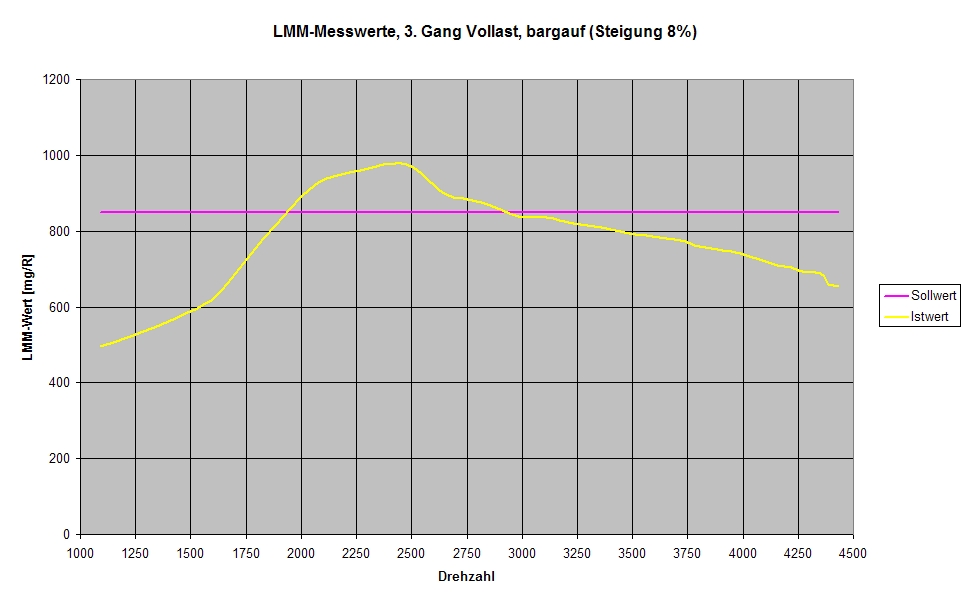
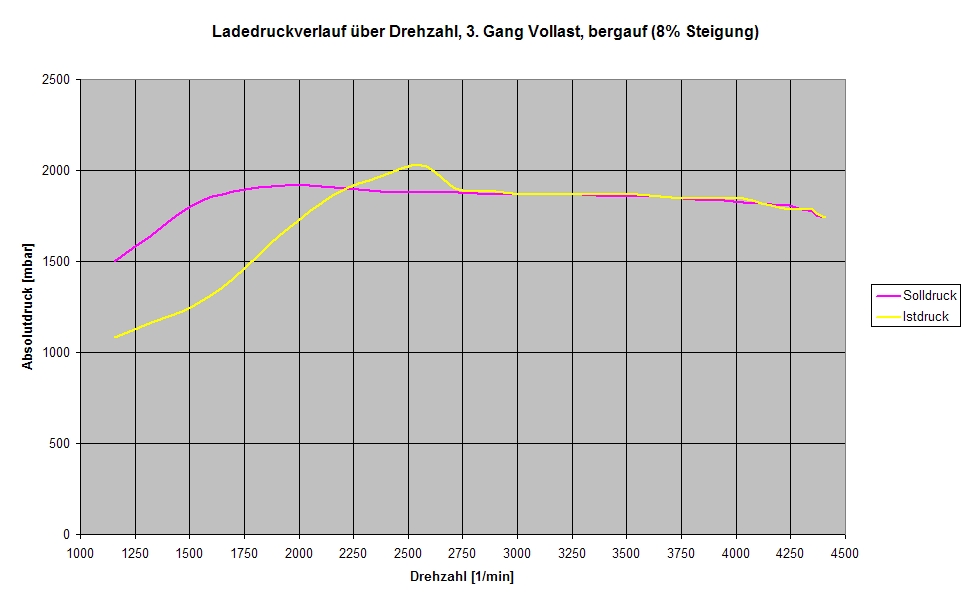
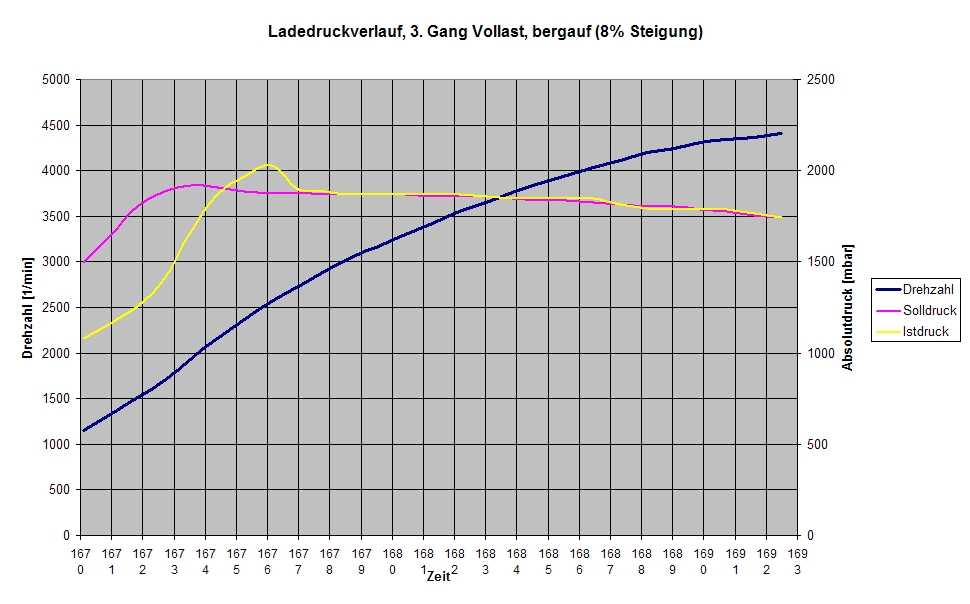
In the low RPM range, the target boost pressure is not reached. Above approximately 2500 RPM, the boost pressure control functions correctly. However, starting around 3000 RPM, the engine becomes sluggish and unresponsive (despite the correct boost pressure) because the mass airflow sensor (MAF) value drops significantly. However, the MAF sensor can be ruled out as the cause of the problem, as it has already been replaced.
Seht Euch doch mal bitte die graphische Aufbereitung meiner Messergebnisse an und gebt Euren Senf dazu (Echt gut die neue Attachement-Funktion. Thank you, Rainer!
I'm quite at a loss now. Maybe someone here has another idea.
In the end, you're still left with a leaky wastegate, or even worse, a faulty turbocharger, which wouldn't be ideal at all!
Regards,
Alex.
| Description: |
|
| File size: |
115.53 KB |
| Viewed: |
3204 times |
|
| Description: |
| Man sieht sehr schön, dass der Ladedruck erst viel zu spät erreicht wird. |
|
| File size: |
120.35 KB |
| Viewed: |
2406 times |
|
| Description: |
|
| File size: |
187.54 KB |
| Viewed: |
2518 times |
|
AUDI A3 1.9 TDI, EZ 12/96, ursprüglich MKB AGR, umgebaut zum AHF mit GT1749V-Lader, verkauft mit 250tkm
Golf 4 1.9 TDI, EZ 1/98, MKB ALH, jetzt auch mit GT1749V-Lader, verkauft mit 300tkm
Touran 1.9 TDI, EZ 09/2004
Audi A4 Avant 2.0 TDI, EZ 03/2010
Translated on 26-08-2026, 9:00.
|
|
| Back to top |
Profile PM |
|
DocSnydor
Guest
Free account, no CAN development support
|
| 21-06-2003, 16:49 Subject: |
Quote |
|
Hi Alex,
Do you still have the same problem?
I'm still driving around like this...
Today, I almost went as far as to consider temporarily removing the catalytic converter, but unfortunately, the weather didn't cooperate.
My car also lacks power. It feels like the mass airflow sensor (MAF) is providing incorrect readings. However, it shouldn't be the MAF in my case, since I'm still using the diode modification...
And then, the boost pressure only reaches 'normal' values from 2500 RPM onwards.
Do you also experience that the ventilation sometimes works better than usual (regardless of the weather, etc.)?
To try and get rid of the smell of Russian fuel from the car, I've been driving at full speed on the highway for the past two weeks (top speed of 180 km/h and 210 km/h going down the Münchberger Senke, according to the speedometer), but it hasn't made any difference...
@all
Has anyone here ever experienced a definitively blocked catheter? What symptoms were observed?
Best regards.
David.
Translated on 26-08-2026, 9:05.
|
|
| Back to top |
|
|
donalexo
Profi-Schrauber
Joined: 01/09/2003
Posts: 695
Karma: +0 / -0
Location: Würzburg
Support
|
| 21-06-2003, 23:01 Subject: |
Quote |
|
Hi DocSnydor!
I also suspected the cat for a while. However, I now believe that it must be a different problem.
The pressure loss at the defective/clogged catalytic converter would only become fully apparent at higher engine speeds, when the mass airflow is correspondingly high. The pressure loss should increase approximately with the square of the volumetric flow rate. This would be a good explanation for the decrease in the mass airflow sensor (MAF) value above 3000 RPM and the loss of power in the higher RPM range.
However, I highly doubt that the slow build-up of boost pressure can be explained by that.
I'm increasingly suspecting a problem with the wastegate valve. Perhaps it's not closing completely and is allowing a small bypass to remain open.
During my last car project this weekend, I also took a closer look at the turbo (unfortunately, only from the outside). The installation position near the AGR (Abgas Rückführung - Exhaust Gas Recirculation) is so poorly designed that it's difficult to access the diaphragm chamber and the linkage of the wastegate from either above or below.
"I definitely noticed an adjustable nut on the actuation rod there, just like with the VTG. Perhaps the rod just needs to be shortened slightly so that the wastegate can properly seat against its housing; after all, it's pressed against it by the diaphragm."
I can rule out any issues with the operation of the control elements, as the boost pressure regulation works perfectly at higher engine speeds.
Has there ever been a case where the length setting on a loader, which is adjusted on the boom, changed during operation due to vibrations?
Regards,
Alex.
AUDI A3 1.9 TDI, EZ 12/96, ursprüglich MKB AGR, umgebaut zum AHF mit GT1749V-Lader, verkauft mit 250tkm
Golf 4 1.9 TDI, EZ 1/98, MKB ALH, jetzt auch mit GT1749V-Lader, verkauft mit 300tkm
Touran 1.9 TDI, EZ 09/2004
Audi A4 Avant 2.0 TDI, EZ 03/2010
Translated on 26-08-2026, 9:08.
|
|
| Back to top |
Profile PM |
|
ulf
Profi-Schrauber
Joined: 04/13/2002
Posts: 11058
Karma: +18 / -0
Location: Saarland
2023 MG ZS
Premium Support
|
| 22-06-2003, 8:57 Subject: General Considerations: A Comprehensive Guide |
Quote |
|
Hello everyone.
A drop in the mass airflow sensor (MAF) value (even with a functioning MAF sensor!) cannot be caused by a wastegate that is not closing properly, as long as the target boost pressure is present.
The reason for your problem, in my opinion, is a bottleneck in the gas passages that restricts the gas flow despite full boost pressure , especially at higher engine speeds, leading to a drop in the mass airflow sensor (MAF) value (representing cylinder filling per stroke).
In the lower RPM range, the throttle restricts the turbocharger's boost pressure, which is just beginning to build, thus shifting the optimal operating range towards higher RPMs.
A restriction can occur either on the intake side (e.g., oil and soot buildup in the intake manifold) or on the exhaust side (e.g., a broken catalytic converter).
By examining the chronological development of the problem, one should be able to infer the actual cause.
-> The oil sludge buildup in the intake manifold accumulates gradually over tens of thousands of kilometers.
-> A cat, on the other hand, would likely experience a more sudden and drastic breakdown, so the performance loss and accompanying symptoms would probably appear overnight.
Maybe this will be helpful in some way.
Gruß Ulf
_________
MG4 Electric
Translated on 26-08-2026, 9:11.
|
|
| Back to top |
Profile PM Garage |
|
DocSnydor
Guest
Free account, no CAN development support
|
| 22-06-2003, 14:07 Subject: General Considerations: A Comprehensive Guide |
Quote |
|
By examining the chronological development of the problem, one should be able to infer the actual cause.
-> The oil sludge buildup in the intake manifold accumulates gradually over tens of thousands of kilometers.
-> A cat, on the other hand, would likely experience a more sudden and drastic breakdown, so the performance loss and accompanying symptoms would probably appear overnight.
Maybe this will help you somehow.
Okay, then there's not much left for me to check. The intake manifold is definitely clean; I cleaned it recently. Man, that thing was so clogged...
My next 'project' will probably be the cat.
I can't say whether the loss of power happened suddenly. I bought the car used with 150,000 km on it. Somehow, I have the feeling it's never been particularly powerful... But couldn't the catalytic converter also become clogged over time? I've always driven the car very fuel-efficiently, rarely using the highway, and even then, never driving faster than 140 km/h.
Let's see if I can somehow remove the catalytic converter. I drove the car for a while about a year ago without the exhaust system (nothing after the catalytic converter). When I then installed a new mid-pipe and end silencer, the engine's power also suddenly became much weaker...
@Alex
I had also once wanted to twist the strut between the membrane valve and the wastegate, but thanks to the great installation position and friend Rust, nothing would work anymore. And something like that is certainly quick to break... 
Translated on 26-08-2026, 9:15.
|
|
| Back to top |
|
|
donalexo
Profi-Schrauber
Joined: 01/09/2003
Posts: 695
Karma: +0 / -0
Location: Würzburg
Support
|
| 22-06-2003, 14:10 Subject: |
Quote |
|
@ all:
Let's assume that DocSnydor is experiencing the same problem as I am; then things are starting to get tight. In a previous post, he wrote the following:
Quote: | I have already done it myself:
- LMM (Laminar Flow Module) replaced with a diode (resulted in slight improvement).
- Pump replaced (didn't improve performance, but eliminated the jerking/stuttering).
- AGR valve deactivated (metal part) and intake manifold cleaned (slight improvement again).
- Complete air system checked (no leaks).
- new nozzles (no noticeable difference)
- New air filter, new diesel filter (no difference).
- Performance tests conducted (all values within acceptable range except for boost pressure, LM = 255).
|
According to him, cleaning the intake manifold only brought about a slight improvement.
Based on Ulf's last comment, it seems like the issue is likely related to a restriction in the intake or exhaust system.
In short, with DocSnydor, only the catalytic converter or exhaust system would be a viable option, while for me, it would be the exhaust and/or intake system.
@DocSnydor:
How did you clean your intake manifold? What "cleaning agent" did you use to remove the deposits? Did you also try to remove any slag from the intake ports in the cylinder head, and if so, how?
Regards,
Alex. AUDI A3 1.9 TDI, EZ 12/96, ursprüglich MKB AGR, umgebaut zum AHF mit GT1749V-Lader, verkauft mit 250tkm
Golf 4 1.9 TDI, EZ 1/98, MKB ALH, jetzt auch mit GT1749V-Lader, verkauft mit 300tkm
Touran 1.9 TDI, EZ 09/2004
Audi A4 Avant 2.0 TDI, EZ 03/2010
Translated on 26-08-2026, 9:18.
|
|
| Back to top |
Profile PM |
|
ulf
Profi-Schrauber
Joined: 04/13/2002
Posts: 11058
Karma: +18 / -0
Location: Saarland
2023 MG ZS
Premium Support
|
| 22-06-2003, 14:16 Subject: General Considerations: A Comprehensive Guide |
Quote |
|
DocSnydor wrote: | | But couldn't the catalytic converter also get clogged up over time? I always drove the car very fuel-efficiently, rarely on the highway, and even then, never faster than 140 km/h. |
Hi Doc.
In the catalytic converter, when "limping" (driving at low speeds), only loose soot is likely to deposit, but this is quickly expelled as soon as the car is briefly revved to around 4000 rpm in higher gears.
 Occasionally, one reads here, among other things, about "exceptional" soot emissions.
Unlike gasoline engines, it seems to me that TDIs (like my own tractor) recover much faster (approximately 20 seconds) and largely regain their full power. Gruß Ulf
_________
MG4 Electric
Translated on 26-08-2026, 9:21.
|
|
| Back to top |
Profile PM Garage |
|
DocSnydor
Guest
Free account, no CAN development support
|
| 22-06-2003, 17:05 Subject: |
Quote |
|
@Alex
Here's how the 'cleaning' process went for me:
I completely removed the intake manifold, filled it halfway with gasoline, and ignited it  . The whole thing then burned for about half an hour. During that time, I used a bent screwdriver and my fingers, which were covered in grime, to scrape out everything I could reach from the intake channels of the cylinder head. Afterwards, I attached a powerful vacuum cleaner to the cylinder head and vacuumed up the loose debris (for my peace of mind  ). In the meantime, the manifold was cool enough to touch again. Inside, there was only a slight layer of residue left, which I was then able to remove with a pressure washer. The result: the intake manifold was shiny and clean again. Unfortunately, it didn't make much of a difference; I had hoped for more given the degree of contamination .
@Ulf
Oh Ulf, you're not giving me much hope at all .
I've hammered at the cat a few times, but nothing seems to be rattling inside  .
Translated on 26-08-2026, 9:23.
|
|
| Back to top |
|
|
donalexo
Profi-Schrauber
Joined: 01/09/2003
Posts: 695
Karma: +0 / -0
Location: Würzburg
Support
|
| 24-06-2003, 0:38 Subject: |
Quote |
|
@DocSnydor:
Unfortunately, I cannot apply the cleaning method you described to the intake manifold of the AGR engine because the AGR valve is inextricably connected to the intake manifold. The valve, especially the diaphragm, would certainly become unusable during this process.
But I think that using products like degreasers, all-purpose cleaners, or brake cleaners could also remove those deposits.
@all:
I took another test drive today. I noticed that the engine felt very sluggish today, especially in the 32°C heat. I didn't dare to push it hard in some places where I normally would have.
Today, I measured the fuel injection quantity limits and the boost pressure. As expected, the reduced mass airflow above 3000 RPM is also reflected in a smoke level that is slightly below the target range.
Meanwhile, I've decided to re-check the valve timing using a setting gauge. During the last assembly, I determined the dimensions using a caliper, and I plan to machine a suitable tool as soon as possible so I won't have to rely on estimations anymore.
My research has shown that the VAG tool 3418 is required for the AGR valve. It is significantly different from the "universal" adjustment tool used for some other TDI engines.
I would still prefer a slightly misaligned camshaft as an explanation for the problem. Above all, it would allow me to force the friendly mechanic to correctly adjust the valve timing.
Keep your fingers crossed that I'll still be able to diagnose a malposition of the umbilical cord.
Regards,
Alex.
AUDI A3 1.9 TDI, EZ 12/96, ursprüglich MKB AGR, umgebaut zum AHF mit GT1749V-Lader, verkauft mit 250tkm
Golf 4 1.9 TDI, EZ 1/98, MKB ALH, jetzt auch mit GT1749V-Lader, verkauft mit 300tkm
Touran 1.9 TDI, EZ 09/2004
Audi A4 Avant 2.0 TDI, EZ 03/2010
Translated on 26-08-2026, 9:26.
|
|
| Back to top |
Profile PM |
|
DocSnydor
Guest
Free account, no CAN development support
|
| 25-06-2003, 10:55 Subject: |
Quote |
|
Okay, yesterday the weather was nice, so after work, I jacked up the car and removed the catalytic converter. It wasn't that bad. The screws came off relatively easily .
Unfortunately, it didn't make a difference; the performance is virtually the same with and without the catalytic converter. However, the sound was amazing; I drove for a few kilometers completely without an exhaust, i.e., only with the flexible pipe. The best part was the roaring and whistling from the turbocharger. The car sounded like a K700 (those who know it -> a Russian tractor).
Well, now the exhaust is back on. And I can eliminate some more things from my troubleshooting process... Unfortunately, not much remains.
Translated on 26-08-2026, 9:29.
|
|
| Back to top |
|
|
|


 Bookmarks
 Links
Links Garage
 FAQ, Legal Notice & Privacy
 RSS Feed
 Register
 Login
Login
