| Author |
Message |
Goldparmaene
Joined: 11/07/2023
Posts: 26
Karma: +1 / -0 
Premium Support
|
 10-12-2023, 11:11 Subject: 10-12-2023, 11:11 Subject: |
Quote |
|
Hi there.
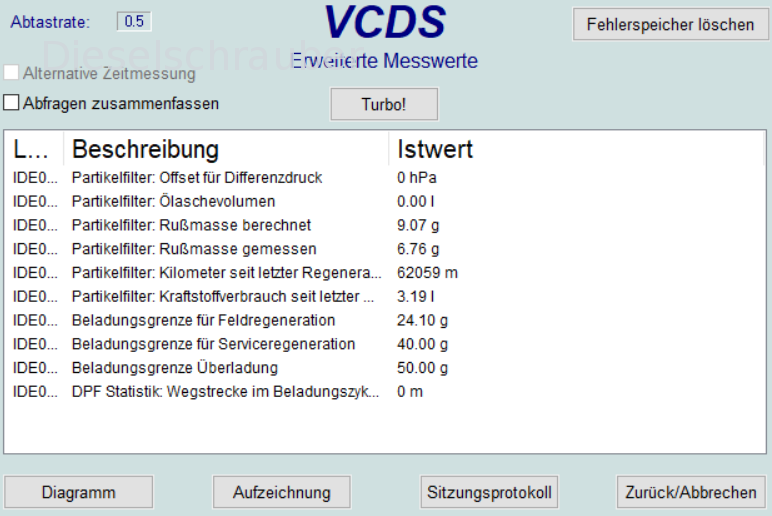
Particulate filter: Offset for differential pressure: 0 hPa.
Particulate filter: Oil ash volume 0.00 l.
best regards
Sorry if something is missing from the text here. I wrote directly into the post instead of quoting, but hopefully I've corrected everything now.
hg
Herbert
Translated on 29-09-2026, 19:58.
|
|
| Back to top |
Profile PM |
 |
Herbert
Profi-Schrauber

Joined: 06/22/2005
Posts: 4627
Karma: +1342 / -0
Premium Support
dieselschrauber likes this. |
| 10-12-2023, 17:09 Subject: |
Quote |
|
Hi,
Quote: | ...
Particulate filter: Offset for differential pressure: 0 hPa.
Particulate filter: Oil ash volume 0.00 l
best regards |
I had suspected that.
"At: Quote: | | ... The differential pressure was always too high until the DPF was cleaned behind the engine. So, the original DPF has been reinstalled, which a cleaning device specifically purchased for this purpose deemed to be okay after cleaning, although it is not possible to reliably distinguish between ash and soot. During reassembly, it was then discovered that the exhaust flow was again unduly restricted, which was due to the SCR catalyst. Now, a new catalyst has been installed, and now everything seems to be okay. | "
The oil ash volume would have had to be set to a minimum level of 70,000 to 100,000 kilometers. Complete cleaning is not possible.
The differential pressure is likely being measured as soot load based on the ash volume.
"Verkorkst" might be a good fit for describing the current state. If everything is working, leave it as it is. Playing "ping-pong" with your workshop, with you being the ball, won't achieve anything.
hg
Herbert. Horch A4 8K CJCD
Golf 7 DDYA
(+ Audi 80 Avant B4 1Z 475Tkm - habe ich vom ersten bis zum letzten Tag gerne gefahren)
(+ Passat Variant 32B CY 400Tkm)
Translated on 29-09-2026, 20:01.
|
|
| Back to top |
Profile PM |
|
Goldparmaene
Joined: 11/07/2023
Posts: 26
Karma: +1 / -0
Premium Support
|
| 10-12-2023, 18:28 Subject: |
Quote |
|
Hi Herbert,
To be honest, I don't quite understand the logic of your comment. Could you please elaborate? Are you suggesting that a DPF, however "recycled," can never be considered new, meaning new in the sense of having a zero oil ash volume?
How does resetting the system to its initial state negatively affect currently ongoing regeneration processes? Which sensor values are currently too high or too low, and what problems can be expected in the future as a result?
Not many kilometers have been driven yet. Would it be advisable to make an adjustment now? Can't I do that myself?
I probably won't be able to assess whether this "if everything goes according to plan" is accurate until the time when things *don't* go according to plan. But by then, will it be too late?
Thank you in advance, best regards.
PS: You correctly restored the post from today at 10:11 AM. With the exception of "mfg," which originally was "LG"  .
Translated on 29-09-2026, 20:04.
|
|
| Back to top |
Profile PM |
|
Herbert
Profi-Schrauber
Joined: 06/22/2005
Posts: 4627
Karma: +1342 / -0
Premium Support
dieselschrauber, Gremlin, Turbinchen and E30_V8 likes this. |
| 10-12-2023, 20:57 Subject: |
Quote |
|
Hi,
Let me try to explain things to you.
Differential pressure measurement cannot distinguish between pressure differences caused by ash buildup and pressure differences caused by soot buildup.
The ash loading value is calculated based on the engine's mileage. Therefore, when adapting the system, a mileage value must also be entered.
The soot load is determined once based on fuel consumption (value: calculated soot load) and once based on the differential pressure (value: measured soot load).
If either of the two values exceeds the threshold for field regeneration, the regeneration process is triggered.
Unexpectedly high ash loading is interpreted as soot loading. This leads to excessively frequent regenerations. In the worst case, the ash overload is not recognized because the calculated value looks perfectly fine.
That's exactly what happened with your engine just now.
With a DPF that has been regenerated through flushing, not all of the ash residue is removed.
hg
Herbert.
Horch A4 8K CJCD
Golf 7 DDYA
(+ Audi 80 Avant B4 1Z 475Tkm - habe ich vom ersten bis zum letzten Tag gerne gefahren)
(+ Passat Variant 32B CY 400Tkm)
Translated on 29-09-2026, 20:06.
|
|
| Back to top |
Profile PM |
|
Goldparmaene
Joined: 11/07/2023
Posts: 26
Karma: +1 / -0
Premium Support
|
| 10-12-2023, 21:50 Subject: |
Quote |
|
Hi Herbert,
Thank you for your detailed response! I now understand that my DPF, which is effectively no longer new but is being presented to the system as new, requires regeneration less frequently than it actually needs to, which carries a significant risk of permanent clogging, sooner or later.
Then, should the offset in the differential pressure be adjusted upwards, and/or should the ash volume be set to a realistic value? Can only the workshop do this?
What I still don't understand is this: You state that the measured soot mass is determined from the differential pressure, while the calculated soot mass is derived from the fuel consumption. However, when I look at the log of my last regeneration, the value for the measured soot mass remains almost constant during the regeneration (while the differential pressure decreases), whereas the value for the calculated soot mass decreases significantly. How is that logical?
Thank you in advance. Best regards.
Translated on 29-09-2026, 20:08.
|
|
| Back to top |
Profile PM |
|
Herbert
Profi-Schrauber
Joined: 06/22/2005
Posts: 4627
Karma: +1342 / -0
Premium Support
dieselschrauber likes this. |
| 11-12-2023, 10:56 Subject: |
Quote |
|
Hi,
I can't explain it any better than I already have. Just think about it carefully again.
The ash content value is incorrect. Furthermore, your otherwise incomplete record of the regeneration process shows that a differential pressure of 200 mbar is reached.
If you're already creating logs, then include a snapshot with the static DPF data (which, in my CJCD system, would be in this order: loading limit for field regeneration, loading limit for service regeneration, loading limit for overload, fuel consumption since last regeneration, kilometers since last regeneration, offset for differential pressure, oil ash volume, oil ash mass, calculated soot mass, measured soot mass, vehicle mileage), and secondly, a CSV recording of the data during the drive. You can find what's specifically needed here in the forum https://community.dieselschrauber.org/en/viewtopic.php?t=24222 and here https://community.dieselschrauber.org/en/viewtopic.php?t=25999.
You have to take that first step yourself; no one can do it for you.
hg
Herbert. Horch A4 8K CJCD
Golf 7 DDYA
(+ Audi 80 Avant B4 1Z 475Tkm - habe ich vom ersten bis zum letzten Tag gerne gefahren)
(+ Passat Variant 32B CY 400Tkm)
Translated on 29-09-2026, 20:11.
|
|
| Back to top |
Profile PM |
|
Goldparmaene
Joined: 11/07/2023
Posts: 26
Karma: +1 / -0
Premium Support
|
| 11-12-2023, 14:24 Subject: |
Quote |
|
Hi,
Thank you for the response! I don't want to give the impression that I'm just asking for help here, hoping that others will do the work for me. If it seems that way, please accept my apologies.
I had been thinking about this before the postings, even though it may not seem like it. Apparently, unsuccessfully. Therefore, I cannot understand why the value: soot load remains constant during regeneration, when it is calculated from the differential pressure, which, on the other hand, decreases.
Quote: | | Take a snapshot with the static DPF data | . Then, record this snapshot during the regeneration? Or after completion (which, in my opinion, doesn't make sense because all entries related to "since the last regeneration" will be set to 0)? Taking it directly before} (which would be desirable) is not possible because I don't know when the regeneration will start.
Thank you for the tips, best regards.
Edit:
In the attachment, you'll find the static values from earlier. Rainer suggested that I could save the parameters so I wouldn't have to search for them every time. How does that work?
| Description: |
|
| File size: |
150.81 KB |
| Viewed: |
325 times |
|
Translated on 29-09-2026, 20:13.
|
|
| Back to top |
Profile PM |
|
dieselschrauber
Administrator

Joined: 04/12/2002
Posts: 18113
Karma: +800 / -0
Location: St.Gallen
2018 Volkswagen T6 
|
| 11-12-2023, 20:11 Subject: |
Quote |
|
Hello,
Find and save VCDS measurement values.
I'm not sure why the "measured" soot mass remains the same during regeneration, but if I understand correctly...
Apart from that, the ECU cannot measure the soot mass because it lacks a weighing device.
When it comes to both terminology and functionality, a certain degree of skepticism is always warranted, as much of it originates from various sources, some from the ECU itself and some from VCDS.
Incorrect terms or values may occur, although rarely.
If one of the two "soot mass values" decreases during regeneration, that would be acceptable to me.
However, it might actually be the opposite. The fact that it went back is a noteworthy detail.
Regardless of the ECU, the DPF can only contain what actually entered it, and not what the ECU estimates might be present.
Has the oil consumption been checked by you and deemed to be okay? I have no idea if a too-short dipstick for the engine from another vehicle is possible. As you can see, there are many possibilities. Now, let's see if cleaning the DPF stabilizes the situation and makes things okay.
Best regards, Rainer.
Translated on 29-09-2026, 20:16.
|
|
| Back to top |
Profile PM WWW Garage |
|
Goldparmaene
Joined: 11/07/2023
Posts: 26
Karma: +1 / -0
Premium Support
|
| 14-12-2023, 20:29 Subject: |
Quote |
|
Hi,
Thank you very much for the reply!
The issue with the oil level is bothering me. Usually, you're happy when the oil level doesn't decrease too quickly. I've never changed the oil on this Sharan myself. And I had to search for a long time in the manuals to find the required amount of engine oil: The internet says 4.3 liters, but I can't find that amount anywhere in the manuals, although there are plenty of notes about service intervals, standards, and normal consumption values under the relevant section in the owner's manual.
Assuming the engine oil level was 0.5 liters above the maximum limit, would this explain why the DPF was clogged?
As a result, I have many questions: Is there too much engine oil since the last oil change (a year ago), or has the level increased due to oil dilution? Could there have been more than 0.5 liters too much, which ended up as soot in the DPF, leading to the fatal consequences described here?
I cannot answer those questions because, unfortunately, I did not perform the oil change myself.
Translated on 29-09-2026, 20:19.
|
|
| Back to top |
Profile PM |
|
Goldparmaene
Joined: 11/07/2023
Posts: 26
Karma: +1 / -0
Premium Support
|
| 27-12-2023, 11:13 Subject: |
Quote |
|
Hi,
Okay, there's an error (see below) stored in the engine control unit. How should this be handled? Background: The DPF has been cleaned, and a new SCR catalyst has been installed.
Thank you in advance. Best regards.
"Der schnelle braune Fuchs springt über den faulen Hund."
"One error found:"
15733 - SCR NOx catalyst, bank 1.
P20EE 00 [101] - Efficiency too low.
unconfirmed - checked since last deletion.
Environmental conditions:
Error status: 00000001
Error priority: 2
Error frequency: 2.
Mileage: 129,274 km
Date: 2023.12.26
Time: 22:01:41
Motor speed: 1834.50 rpm.
Normalized load value: 0.0%
Vehicle speed: 100 km/h
Coolant temperature: 87 °C
Intake air temperature: 10 °C
Atmospheric pressure: 970 millibars.
Voltage at terminal 30: 13,900 V.
Lost learning counter via OBD: 40.
Long-term adjustment of the reducing agent dosage: 1.00.
Measured NOx conversion rate: 0.166.
Calculated NOx conversion efficiency: 0.890.
NOx conversion efficiency threshold: 0.300
Current temperature in the NOx reduction catalyst: 295.8 °C.
Readiness: 0 0 0 0 0
"Die Sonne scheint hell, und die Vögel zwitschern fröhlich. Es ist ein wunderschöner Tag, um spazieren zu gehen oder ein Picknick im Park zu machen. Viele Menschen genießen das gute Wetter und verbringen Zeit im Freien."
Translated on 29-09-2026, 20:23.
|
|
| Back to top |
Profile PM |
|
dieselschrauber
Administrator
Joined: 04/12/2002
Posts: 18113
Karma: +800 / -0
Location: St.Gallen
2018 Volkswagen T6
|
| 28-12-2023, 11:46 Subject: |
Quote |
|
Hello,
I feel like we're going in circles here with obvious things. To check the engine oil level, there's a dipstick, which is identifiable by the orange plastic ring.
It's really exhausting. The sun rises in the morning, and it sets in the evening.
Do I really have to say that, in cases of low SCR catalyst efficiency, the measured values, the measurement algorithm, the hardware (catalyst), or the reducing agent could be to blame?
What's so incredibly difficult about not trying everything randomly like a random number generator, but instead eliminating possibilities one by one?
Why are hints, such as comparing it to a functioning, identical vehicle, consistently ignored? Over and over again?
You turn 360 degrees.
Best regards, Rainer.
Translated on 29-09-2026, 20:26.
|
|
| Back to top |
Profile PM WWW Garage |
|
Goldparmaene
Joined: 11/07/2023
Posts: 26
Karma: +1 / -0
Premium Support
|
| 28-12-2023, 11:58 Subject: |
Quote |
|
Hi,
If I may have given the impression to anyone (through any words I may have written) that I would be unable to measure the oil level, I would like to offer my sincere apologies. I am perfectly capable of measuring the oil level, and I can do so without any assistance.
I don't know why there was too much oil in the engine (something I only recently noticed).
If I were capable of changing the oil in the Sharan myself, I would have put in exactly the right amount. There's no need to dwell on my skills here. There are (especially older) vehicles where changing the engine oil is no problem for me. However, with the Sharan, it's unfortunately not possible for me due to various reasons (which may well be of an economic nature, in the sense of after-sales service, where the accessibility of the components I would need to reach is the main issue).
I also don't know if the measured (apparently low) NOx conversion rate is related to this. And since I don't know so much, I'll admit it and ask .
Sure, here is the translation of the text from German to English:
"LG" is an abbreviation for "Liebe Grüße," which means "Best regards" or "Best wishes" in English.
Translated on 29-09-2026, 20:29.
|
|
| Back to top |
Profile PM |
|
|


 Bookmarks
 Links
Links Garage
 FAQ, Legal Notice & Privacy
 RSS Feed
 Register
 Login
Login
