| Author |
Message |
Jan6K

Joined: 04/12/2002
Posts: 4741
Karma: +107 / -0 
Location: Hagen
Premium Support
|
 11-11-2003, 13:49 Subject: 11-11-2003, 13:49 Subject: |
Quote |
|
Hi everyone,
To get the discussion back on track...
Yesterday, I bought a proximity sensor from Conrad because the argument about the oil pan temperature makes sense, and it's also easier to wire up.
The entire thing is built in a very primitive way, essentially just a flat rod with circuit traces on both sides, to which the sensor is "barely" soldered at the bottom, and the whole thing is then seemingly coated with some kind of transparent substance.
Hopefully, this will work... but since it has worked for some people already, it should be okay.
At least, this setup offers the option of equipping the entire thing with a different sensor (like a PT100), in case I can't get the electronic adjustment to work.
I didn't buy the measuring device for its intended purpose; instead, I want to adapt it to one of my -200...+200 mV panel meters.
Has anyone ever disassembled one of those Conrad devices and, as a result, have any ideas about the circuit design?
"So far, I've measured 2.56 kOhms at 22 degrees Celsius, 5.6 kOhms at 5 degrees Celsius, and when I hold the device near the outflowing air of the storage heater (50...60 degrees Celsius), the resistance drops down to 600 Ohms." It appears to be an ARt NTC thermistor. I want to determine its characteristic curve today in an oil bath, but I first need a suitable thermometer for comparison.
If anyone cares... but to me, it doesn't look very linear, does it?
It's possible that the linearity only starts at higher temperatures, since the Conrad gauges only start to indicate above 40 or 60 degrees, right?
Best regards,
Jan.
1Z5 CFHF  / AHB H4D 
Translated on 03-07-2026, 15:19.
|
|
| Back to top |
Profile PM |
 |
dieselschrauber
Administrator

Joined: 04/12/2002
Posts: 18113
Karma: +800 / -0
Location: St.Gallen
2018 Volkswagen T6 
|
| 11-11-2003, 13:58 Subject: |
Quote |
|
Hi Jan,
Quote: | | Has anyone ever disassembled a Conrad product and, as a result, have ideas about the circuit design? |
Conrad offers a PDF document with assembly instructions for the LED panel meter labeled "Digital Boost Pressure Indicator." There is also a circuit diagram included in the PDF.
Best regards, Rainer.
Translated on 03-07-2026, 15:19.
|
|
| Back to top |
Profile PM WWW Garage |
|
Jan6K
Joined: 04/12/2002
Posts: 4741
Karma: +107 / -0
Location: Hagen
Premium Support
|
| 11-11-2003, 14:20 Subject: |
Quote |
|
Hi Rainer,
The basic circuit is perfectly clear; I've built something similar myself for my digital LDA (which, unlike yours, uses its own sensor, but is otherwise very similar in terms of the circuit design).
"I wouldn't have any problem with a linear temperature sensor either - simply create a voltage divider with a potentiometer. Depending on whether it's an NTC or PTC sensor, connect the sensor to the appropriate side, apply a reference voltage to the negative input, and then calibrate the whole thing."
The main problem is that I don't (yet) have a characteristic curve for the sensor.
Did your version of the PDF include a circuit diagram specifically for that Conrad sensor?
I had already looked at the PDF for the panel meter you're using before the LDA projects, but I didn't remember it, so I checked it again. The PDF from  actually only contains the usual circuits for current and voltage, but those are quite obvious http://www.produktinfo.conrad.com/datenblaetter/175000-199999/192821-as-01-de-digital-led-panelmeter.pdf).
It would be particularly interesting to know if there's a circuit specifically designed for that exact sensor from Conrad (article number 842460 - unfortunately, there's no datasheet available), as that would greatly simplify the experiments or at least help in deciding whether to connect something else to it.
Best regards,
Jan. 1Z5 CFHF / AHB H4D
Translated on 03-07-2026, 15:19.
|
|
| Back to top |
Profile PM |
|
Gremlin
Guest
Free account, no CAN development support
|
| 11-11-2003, 14:43 Subject: |
Quote |
|
[img][/img]
hehehe...
You just need to look carefully on the Conrad website, or click on 'infocenter' at the top.
http://www.cheesebuerger.de/smilies/schilder/30.gif{MARKER}
CU Gremlin.http://www.produktinfo.conrad.com/datenblaetter/825000-849999/842460-da-01-ml-Oelstab-Sensor_de-en.pdf
| Description: |
|

Download |
| File name: |
842460-da-01-ml-Oelstab-Sensor_de-en.pdf |
| File size: |
5.61 KB |
| Downloaded: |
638 times |
Translated on 03-07-2026, 15:19.
|
|
| Back to top |
|
|
Jan6K
Joined: 04/12/2002
Posts: 4741
Karma: +107 / -0
Location: Hagen
Premium Support
|
| 11-11-2003, 17:22 Subject: |
Quote |
|
Hi Gremlin,
Thank you very much!
I was "just" searching for the article number, and it said the item wasn't listed, but it can still be ordered by phone (!).
I will test these values from the PDF in the oven because of the +/-10% ), so all that remains is to build a suitable circuit, because it doesn't look very linear ;-(.
Best regards,
Jan. 1Z5 CFHF / AHB H4D
Translated on 03-07-2026, 15:19.
|
|
| Back to top |
Profile PM |
|
Rudi
Guest
Free account, no CAN development support
|
| 11-11-2003, 17:33 Subject: |
Quote |
|
Hi Jan,
The PIC 12F675 has an ADC (Analog-to-Digital Converter) for processing the sensor data. Controlling the display.
Are you using unidirectional PWM?
The free version of the PICC compiler from HiTech is sufficient for the young developer.
Best regards, Rudi.
Translated on 03-07-2026, 15:19.
|
|
| Back to top |
|
|
Jan6K
Joined: 04/12/2002
Posts: 4741
Karma: +107 / -0
Location: Hagen
Premium Support
|
| 11-11-2003, 17:39 Subject: |
Quote |
|
Hi Rudi,
Actually, I didn't really intend to go that far. I'm currently hoping for a simple circuit using just resistors, with the expectation that at least the interesting range of 50-130 degrees will be reasonably linear. However, the measurement points in the PDF are too closely spaced to determine that definitively. Therefore, everything is currently bubbling together with an analog thermometer inside the oven .
Best regards,
Jan. 1Z5 CFHF / AHB H4D
Translated on 03-07-2026, 15:19.
|
|
| Back to top |
Profile PM |
|
olbetec
Schrauber

Joined: 08/14/2002
Posts: 76
Karma: +4 / -0
Location: Garbsen bei Hannover
Support
|
| 11-11-2003, 18:13 Subject: Linearize... |
Quote |
|
So: When you don't know anything, there are two possibilities.
1. Shut your mouth... 
2. Googling.
If you want to explore solution 2 further, I've copied one of my search results for you below. Have fun!
http://www.mrt.uni-essen.de/download/vm22.pdf
Linearized with the parallel resistance.
OlBe. Fabia I TDI, EZ06/01 (1,9/74kW, ATD)
Octavia II TDI DSG EZ11/06 (2,0/103kW, BMM)
Translated on 03-07-2026, 15:19.
|
|
| Back to top |
Profile PM |
|
ulf
Profi-Schrauber

Joined: 04/13/2002
Posts: 11058
Karma: +18 / -0
Location: Saarland
2023 MG ZS
Premium Support
|
| 11-11-2003, 18:50 Subject: |
Quote |
|
Jan6K wrote: | Yesterday, I bought a proximity sensor from Conrad because the argument about the temperature of the oil pan is actually something, and besides, it's easier to wire.
The entire thing is built in a very primitive way, essentially just a flat rod with circuit traces on both sides, to which the sensor is "barely" soldered at the bottom, and the whole thing is then seemingly coated with some kind of transparent substance.
Hopefully, this will work... but since it has worked for some people already, it should be okay. |
Hi Jan,
"About x years ago, I had a rather alarming experience with a probe sensor. It consisted of a long, semi-rigid plastic tube with an NTC thermistor at the bottom." The handle was fixed to the pipe using a set screw, ensuring that its length on the side facing the handle matched the original rod.
It worked well for a while, but eventually, during an oil level check, instead of the dipstick, only two wires with an NTC sensor came out of the dipstick tube. The plastic tube had broken off just below the handle.
Fortunately, the piece of debris hadn't broken down further or moved towards the oil pan (where it could have wrapped around the crankshaft or been sucked into the pump...). Instead, it was still stuck in the dipstick tube.
Therefore, I was eventually able to pull it out completely using some trick.
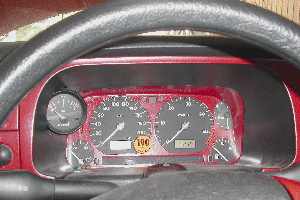
I removed the oil temperature sensor on the same day... and since then, I've been relying more on pressure measurements for oil monitoring -> see attachment.
(And there's no need to worry about "Where should I take the temperature reading, and will it be accurate?" )
Since your sensor probe is probably designed differently, you likely won't experience the same thing as I did... but the probability that parts of the probe will detach and make intimate contact with various engine components is certainly lowest with a simple (standard) metal rod.
| Description: |
| Öldruckanzeige links oben im Instrumententunnel |
|
| File size: |
29.58 KB |
| Viewed: |
3379 times |
|
Gruß Ulf
_________
MG4 Electric
Translated on 03-07-2026, 15:19.
|
|
| Back to top |
Profile PM Garage |
|
Jan6K
Joined: 04/12/2002
Posts: 4741
Karma: +107 / -0
Location: Hagen
Premium Support
|
| 11-11-2003, 19:25 Subject: |
Quote |
|
Hi,
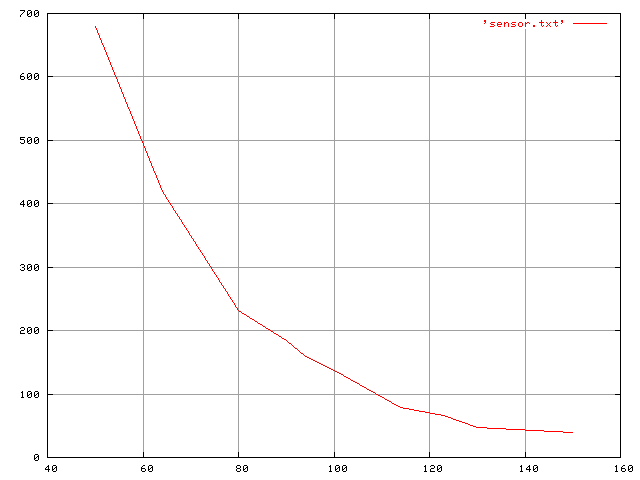
@Olbe: The link is brilliant, thank you! This should be achievable, especially now that I have determined a fairly accurate characteristic curve in the oven, which also roughly matches the "reference values" from the PDF posted by Gremlin - see below.
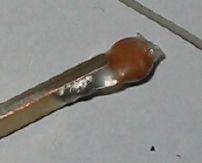
@Ulf: I also have some concerns when looking at the construction, although the risk of it falling apart isn't quite as high as what you described. Here's a picture of the measuring tip.
The NTC sensor and the rod, along with its two leads, are coated with a transparent substance that is presumably meant to protect them, although the NTC sensor itself is not completely covered. It makes you wonder if that oil could cause any damage...
Therefore, there's probably some risk involved, but more likely it's that the tip will break off rather than the whole thing falling apart.
By the way... does anyone have any ideas about what color we could dye it? It should survive in the engine oil, and of course, it shouldn't peel off.
Best regards,
Jan.
| Description: |
|
| File size: |
4.69 KB |
| Viewed: |
3268 times |
|
| Description: |
| Die Kennlinie aus dem Backofen |
|
| File size: |
4.57 KB |
| Viewed: |
4764 times |
|
1Z5 CFHF / AHB H4D
Translated on 03-07-2026, 15:19.
|
|
| Back to top |
Profile PM |
|
Jan6K
Joined: 04/12/2002
Posts: 4741
Karma: +107 / -0
Location: Hagen
Premium Support
|
| 11-11-2003, 21:21 Subject: |
Quote |
|
Hello everyone,
Here's a small additional note:
I've been doing a lot of calculations, and I've naturally fallen into the error of thinking that while linearizing the characteristic curve leads to a linear resistance curve, it doesn't necessarily result in a linearly measurable voltage. While the PDF contains a circuit using operational amplifiers, it will only function correctly within the range where linearization has been applied, and that range is inherently limited.
So, I created a program that, through trial and error ), - I was too lazy to solve equations - tests different combinations of resistors for a parallel-series circuit and evaluates them based on my measurements.
For example, by connecting a 202 Ohm resistor in parallel and a 912 Ohm resistor in series, you can achieve a nearly linear output voltage curve between 40 and 130 degrees, which should be sufficient for normal operation. However, the problem remains the determination of the extreme values, as you don't want any incorrect readings displayed there. It would, of course, also be possible to use OPs, but I'm now slowly starting to think about whether I should just disassemble the appropriate display from the casing }.
On the other hand, crafting is also fun... so, for values below 40 and above 130, you could simply switch the labels to "too small" and "too large."
What do you think is a reasonable maximum temperature? What is the maximum oil temperature reached in a TDI engine when driving at full throttle on the highway during the summer?
Best regards,
Jan. 1Z5 CFHF / AHB H4D
Translated on 03-07-2026, 15:19.
|
|
| Back to top |
Profile PM |
|
Jan6K
Joined: 04/12/2002
Posts: 4741
Karma: +107 / -0
Location: Hagen
Premium Support
|
| 12-11-2003, 7:25 Subject: |
Quote |
|
Hello everyone,
and sorry for the mass posting.
I searched and researched further last night, and I then found a very simple circuit that meets my requirements (http://www.citruspage.de/homepage/tempsen.html,, and the first part of which is directly connected to the very high-impedance input of the panel meter).
Ultimately, using the original sensor would only provide a very inaccurate reading, so I'm going to convert the entire system to use a PT100 sensor instead.
Therefore, only one question remains: What type of coating or insulation can be applied over it that will survive in the engine oil and not break down?
Thank you very much, and best regards.
Jan.
1Z5 CFHF / AHB H4D
Translated on 03-07-2026, 15:19.
|
|
| Back to top |
Profile PM |
|
dieter
Profi-Schrauber
Joined: 01/27/2003
Posts: 270
Karma: +13 / -0
Location: LK Uelzen
Support
|
| 12-11-2003, 11:24 Subject: |
Quote |
|
Hi Jan,
Suggestion for your PT1000 probe:
PT1000 sensor in a stainless steel housing (approximately 2mm diameter) with a cable, inserted into a brass tube (available at hardware stores). Then, the entire assembly is cast with a temperature- and oil-resistant polyester resin or similar material.
There are companies (like Polyester-Rüegg in Hamburg) that know what materials are suitable for that.
You can also solder a fitting onto the tube beforehand, so that it can also function as a sounding rod.
I can't share the concerns about inductive timing sensors. I used them in my boxer engines for years and never had any problems. However, the sensor I used was not from Conrad, but from VDO.
greetings
dieter
Translated on 03-07-2026, 15:19.
|
|
| Back to top |
Profile PM |
|
smith2
Guest
Free account, no CAN development support
|
| 12-11-2003, 14:33 Subject: |
Quote |
|
Hello everyone,
Let's talk about contact corrosion again.
These things should all be enjoyed in moderation. This topic should be considered with nuance, but it is certainly not something to be taken lightly, as some of you seem to be doing here.
Another aspect to consider is that if various contaminants (such as saltwater, DOT4, or water vapor) are added to the aluminum-copper combination, then degradation is inevitable. I know these images all too well, because our parts look as if they've been doused with hydrochloric acid and left that way for years after the 'media test.'
Okay, the TDI engines are all sealed, which means the level of contamination is significantly lower. However, if anything at all happens to the oil pan or the oil supply system, you will have a very difficult time proving that your sensor is not to blame!!! It's also clear that nothing happened with older production years. Because the cost pressure is currently so enormous that even some safety components are being compromised.
So, please be a little more careful when selecting components in this regard!
Sure, I understand. Please provide the German text you would like me to translate into English. I will provide only the translation, without any explanations.
What are you doing with the oil temperature reading? What do you use these for?
Sure, here is the translation of the text from German to English:
'cu smith2'
Translated on 03-07-2026, 15:19.
|
|
| Back to top |
|
|
Jan6K
Joined: 04/12/2002
Posts: 4741
Karma: +107 / -0
Location: Hagen
Premium Support
|
| 13-11-2003, 10:30 Subject: |
Quote |
|
Hi.
@Smith2:
The purpose of this exercise:
This is a good way to tell when the engine is warm, because you should avoid demanding high performance until the oil temperature reaches around 75 degrees.
The oil takes longer to warm up than the coolant, so the water temperature is not the determining factor.
@Everyone: Using a brass rod would also work, but even then, it still depends on the amount you use to "coat" the surface.
Polyester is certainly an option, but I think the version with the color is simpler. The question is, what can one possibly use there?
Best regards,
Jan.
1Z5 CFHF / AHB H4D
Translated on 03-07-2026, 15:19.
|
|
| Back to top |
Profile PM |
|
Holger247
Schrauber
Joined: 11/05/2002
Posts: 259
Karma: +0 / -0
Location: Böblingen
Support
|
| 13-11-2003, 11:01 Subject: |
Quote |
|
Regarding contact corrosion:
"In my ALH engine with an aluminum oil pan, there's an oil drain plug with a non-removable aluminum sealing ring." The sealing ring is probably not removable to prevent users from accidentally using a standard copper or brass sealing ring.
At VW, the only replacement part available is the entire screw with the sealing ring (for those who are willing to invest that much, it costs 0.86 cents).
Interestingly, during the oil changes performed at the workshop on my car, VW always included a new sealing ring in the bill. However, when I examined the screw with the aluminum ring, I was certain that it was still the original one.
At one point, before the second-to-last replacement, I had replaced that crooked part with a brass ring. During the last replacement, I couldn't detect any corrosion on the tank. I'd rather have aluminum in it again, though.
--------------------------------------------
GIV - 98 - ALH
Touran 5T 2.0 TDI
Translated on 03-07-2026, 15:19.
|
|
| Back to top |
Profile PM |
|
|


 Bookmarks
 Links
Links Garage
 FAQ, Legal Notice & Privacy
 RSS Feed
 Register
 Login
Login
