
| Diesel, Engine Technology and Vehicle Technology. Repair, Maintenance and Diagnostics (OBD). |
Fuel injector replacement: Tuning without electronic modifications (Articles) |
|
|
| 🔗 ⭐ 🖨 |
| Fuel injector replacement: Tuning without electronic modifications | |
|---|---|
ulf  09-03-2005, 17:58 09-03-2005, 17:58 |
|
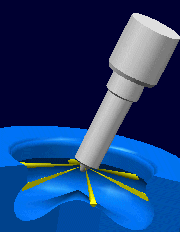 To achieve good exhaust emissions with a low soot content, a very fine atomization is required, which can only be realized with small nozzle bore diameters relative to the pump's flow rate. This design of the TDI injection systems, with a pronounced "stagnation effect" in front of the injectors, achieves nozzle-side injection pressures exceeding 1000 bar even in VP37 engines (with the intended support of pressure wave effects in the high-pressure area of the system) - but only in the higher engine speed range, because the delivery rate is directly dependent on the engine speed, resulting in lower pressures in the lower speed range. Idle speed significantly lower. However, even here, acceptable emission levels are still expected to be achieved. Therefore, the nozzle holes must be small enough to ensure good atomization even at idle. This, in turn, means that the drill holes for the pumping speed are "actually too small" for the high rotational speeds. In reality, with standard VP37 TDIs, the amount of diesel fuel pumped at high engine speeds "cannot flow quickly enough" through the openings, causing a portion of the fuel volume to be "lost" due to increased leakage at the pump and injectors, elastic expansion, particularly in the injector lines, and even compression effects within the fuel itself. To compensate for this, the mass airflow sensor, for example, is continuously adjusted by the EDC as the engine speed increases when the accelerator is fully pressed (which extends the injection duration), while the actual amount of fuel injected remains largely constant until the engine reaches its speed limit. The relationship between engine speed, injection quantity, and the displacement of the quantity control device (or the control voltage of the feedback sensor) is engine-type specific and stored in the pump characteristic curve of the EDC system. The finely tuned compromise between pump and injector data constitutes a significant part of the overall design of the injection system. In addition to the hole diameter, the overall hole geometry, the opening pressure, and other parameters on the nozzle side determine the injection pattern and amount. The aforementioned volume losses in the injection system offer the opportunity to inject more diesel into the cylinders to increase performance. This can generally be achieved by installing injection nozzles with larger bore sizes that are compatible with the system. "Due to the larger injection nozzle diameter, more fuel flows at full load, and at partial load, a specific amount of diesel can be injected more quickly, which concentrates the combustion process more towards the top dead center (TDC) and slightly increases the engine's efficiency." Typically, when replacing fuel injectors, the complete "injector holder assemblies" are replaced – that is, the parts that can be removed as a whole from the cylinder head after disconnecting the fuel lines and retaining clips. For simplicity, the common term "fuel injectors" will be used here. The increased performance achieved by installing "larger injectors" primarily stems from a reduction in fuel delivery losses, and this effect is most noticeable in areas where these losses are high, such as at higher engine speeds. In addition, driving the injection pump requires slightly less power with larger nozzles, as the aforementioned pressure build-up effect before the (larger) nozzle openings is reduced, and therefore, lower pressures are generated. However, the latter already reveals the downside of this approach – namely, a generally poorer atomization of the fuel due to the reduced injection pressure. In other words, using larger nozzles shifts the factory-set compromise towards higher performance, but at the expense of emission values. The poorer atomization counteracts the aforementioned positive effects on fuel utilization or consumption. By changing the performance and emission values, the operating permit for the vehicle is essentially invalidated. The following practical instructions are therefore only to be understood for vehicle use outside of public roads or for motorsports purposes, etc.! As with virtually any tuning modification, the engine will naturally be subjected to greater stress due to the larger injectors. Here, the peak pressures primarily increase – in contrast to the usual tuning method of extending the injection duration, where the thermal load and exhaust gas temperature primarily increase. A potential problem when swapping nozzles could be the spray pattern of the "foreign" nozzles, which are not intended for the specific engine. It is fundamentally conceivable that the larger nozzles could spray not into the combustion chamber, but for example too high or too low, directly onto the piston material, which could lead to overheating, piston seizing, melting damage, etc. To prevent such consequences, the alignment of the spray nozzles in both the old and new systems should be checked as precisely as possible to ensure they match. Since the nozzles are usually installed at an angle to the combustion chamber, each hole, relative to the nozzle axis, points in a different direction. "If a nozzle testing device for comparing spray patterns is not available, one can try using sufficiently thin, straight pieces of wire made from softer alloys (to avoid scratching the holes, for example,..." Insert copper wire or fine bristles from brushes, etc., into the holes. If both nozzles are pointing in the same direction and the nozzles are otherwise externally identical, there is generally not a significant risk of engine damage due to unsuitable spray patterns, based on previous experience. The potential increase in performance can be roughly estimated based on the ratio of the cross-sectional areas of the respective injectors and/or the cylinder outputs of the donor and recipient engines, especially when considering moderate increases in the injector bore size. For example, the cross-sectional areas of the original injectors for the AFN engine (205 µm hole diameter) and the 2.5-liter 5-cylinder engine with 111 kW (216 µm hole diameter) have a ratio of approximately 1:1.11. The cylinder power output of 20.25 kW for the standard AFN engine and 22.2 kW for the 111 kW / 5-cylinder engine corresponds to a ratio of approximately 1:1.10. "In practice, replacing the injectors in an AFN engine with the specified larger injectors, without any other modifications, results in an average power increase of approximately 10% between 2000 and 4000 rpm (determined based on the fuel flow time at full throttle in 3rd gear)." Sure, here is the translation of the text from German to English: "Gang." Exception: The ALH engine (66 kW) with automatic transmission and the specifically "small" injectors is likely to produce a significant increase in power, even when using the original injectors from the manual transmission ALH (also 66 kW), due to the increased injection pressures. Larger nozzles generally also increase the potential for further performance gains through extended injection durations, without quickly reaching the danger zone for piston melting damage. Other potential problems, such as those arising from possible increases in boost pressure (to ensure sufficient fresh air supply) or engine overloads, will not be discussed in detail here. The greater the change in the nozzle geometry, the further the factory-set compromise between exhaust emissions, fuel consumption, and performance will shift, and the more side effects may occur, such as... Jerky operation at partial load, poorer starting behavior, and visibly increased soot formation, etc. Exception: The ALH engines (with manual transmission) and the ASV engines have different injectors, but the same pump. Both are classified as EU 3 emission standard, which means that the ASV injectors should not cause any problems with fuel atomization in the ALH engine. Therefore, the exhaust emissions can remain acceptable as long as the amount of fresh air (or the intake pressure) is sufficient to compensate for the increased amount of diesel fuel. However, since the pump characteristic curve for the 66 kW injectors is stored in the ALH engine control unit (ECU), using ASV injectors will not only result in increased power but also certain side effects. Each injector replacement can disrupt the hydraulic side of the fuel injection system to some extent. In vehicles with a fuel consumption display, the display will show a lower consumption value than the actual amount refueled, because the vehicle's onboard electronics use the standard fuel pump characteristics for the consumption calculation, and the engine control unit (ECU) doesn't register the increased fuel injection volume. While chip tuning can generally fix this issue, the reduced injection pressure and poorer atomization caused by larger injectors cannot be compensated for by any further chip tuning. Therefore, an "automatic" visit to a chip tuner after replacing the injectors can only serve to adjust the shape of the new power curve to your preferences, improve emissions values by increasing boost pressure, correct inaccurate fuel consumption readings, and possibly... To eliminate side effects such as stuttering, etc. If simply changing the nozzle doesn't provide the desired increase in power, and if fine-tuning the power curve or exhaust emissions is not the goal, an additional 10c tuning (or a power box) can unlock further performance. If you experience hesitation or starting problems after installing larger injectors, you can also try adjusting the injection quantity and the starting quantity yourself. Moving the quantity control valve on the pump body can help: see the DIY solution for preventing "rattling" in engines with VP 37. Only when the initial adjustments don't yield satisfactory results is there an "objective" need to consult a chip tuner – unless a tuner offers a complete package of larger injectors and modified software that is approved for registration and therefore legal. To adjust the AGR function to the increased fuel injection volume, which is largely unnoticed by the MSG (Motor Steuergerät - Engine Control Unit), the adaptation of channel 3 should also be adjusted towards a higher air mass. "Jerking" or "stuttering" problems may not occur at all if the larger injectors have a higher opening pressure (indicated on the injector body). Due to the limited speed at which the pump builds pressure, the larger injectors open slightly later, which shortens the actual injection duration while maintaining the same fuel volume. This can even compensate for the larger flow cross-section, so that the quantity control must be opened further to inject smaller amounts of diesel. VAGCOM then displays a higher (apparent) idle fuel quantity, which, from the perspective of the EDC (Engine Control Unit), corresponds to a leaner pump setting that reduces jerking. In this case, the unregulated injection start will also be shifted slightly later (which can be observed using the VAGCOM basic settings mode), which in turn can worsen the starting behavior and, in some cases, cause the injection start timing control to reach its earliest setting at full throttle. Then, it is recommended to adjust the basic settings of the pumps accordingly at a later date. Based on previous experience, increasing the nozzle size only slightly increases the engine speed (on the order of up to about 50 rpm), because above approximately 5000 rpm, the injection volume is significantly reduced as the engine speed increases. When replacing the injectors, it is important to maintain meticulous cleanliness, as even the smallest speck of dirt in the fuel system can lead to malfunctions and damage. The copper sealing rings between the injectors and the cylinder head should always be replaced, and the injector mounting holes should be carefully cleaned. Over time, fine grains of sand and other particles accumulate in the narrow gap between the nozzle body and the cylinder head, and this usually causes the nozzle to become stuck when you try to pull it out. Then, you should use a wrench to grip the nozzle, twist it back and forth, and simultaneously pull it out. A few drops of oil placed in the aforementioned gap will adhere the dirt on the nozzle and cylinder head, preventing it from falling into the cylinder. The specified torque values for the injection lines are 25 Nm, and for the nozzle holder screws, they are 20 Nm. To check for leaks between the nozzles and the combustion chamber, you can add a small amount of oil to the annular gap around the nozzles. When the engine is running, rising bubbles will indicate if combustion pressure is being blown out. In this case, the retaining screws of the affected nozzles should be tightened moderately. If necessary, the nozzle should be removed again, the sealing surfaces cleaned, and a new sealing ring installed. After installing new injectors, the starter motor often has to work hard until the fuel lines and injectors are bled and the engine starts. This process can be simplified by initially only replacing two injectors from cylinders with a large firing order (e.g., injectors 1 and 4 in a 4-cylinder engine), then starting the engine and allowing it to run until it reaches a stable idle, and only then replacing the next pair of injectors. Alternative after switching all nozzles simultaneously: Loosely tighten the injector line banjo bolts on the high-pressure side and briefly engage the starter until diesel fuel clearly leaks out. Then tighten all the nuts completely and start the engine. Larger amounts of "pigment" (referring to deposits) caused by diesel fuel in the engine compartment can be prevented by wiping the injectors with a cloth. What's up with PD engines? Even with the 2-valve common rail diesel engines, the external dimensions of the injector nozzle elements (PDE) are identical, and the nozzle bore sizes are generally larger to accommodate the increased power output per cylinder. Exception: When upgrading the power output to achieve better emission standards (for the 100 hp engine: ATD = EU3, AXR = EU4; for the 130 hp engine: ASZ = EU3, BLT = EU4), smaller common rail injectors (PDE) may be installed to improve fuel atomization. If these engines are converted to meet the respective EU3-PDE standards, a general increase in performance can be expected. However, it is difficult to predict how much the performance will increase with the installation of larger PDE units, as there is currently very little practical experience available. When replacing the pressure die (PDE), always use the corresponding adjustment screws, as different designs were used throughout the production period. If the PDE and adjustment screws do not match, the PDE can become unusable in a very short time! Since there are three O-ring seals between the pressure drop element (PDE) and the cylinder head, the PDEs (after removing the retaining bracket) can only be removed from the cylinder head with considerable force. VAG workshops use a special tool for this purpose, which engages in the groove of the PDE and generates upward force impulses with a striking hammer, pulling the PDE out of the transmission. When replacing the pressure relief valve (PRV), it's always best to use new O-rings, as these separate the areas for fuel supply, fuel return, and engine oil (in the valve cover). VAG workshops use auxiliary tools (sleeves) to assemble the O-rings. These sleeves are slid over the high-pressure fuel pump (PDE) and ensure precise and properly aligned installation of the seals. If the O-rings are leaking, the fuel pressure may drop and/or the engine oil may be diluted by diesel fuel! Translated on 03-07-2026, 15:19. |
|
 |
|
| Ratings - Fuel injector replacement: Tuning without electronic modifications | |
Average rating: 4.68 - worst rating: 1 - best rating: 5 - number of ratings: 25 - View ratings |
|
|
| 🔗 ⭐ 🖨 |
|
Foren- und Portal-Software: V7.8 © 2003 - 2026 Kaufmann Automotive GmbH, Embedded Software Freelancer & Shop für Kfz-Diagnosegeräte. Parse time: 0.070s
 |


 Bookmarks
 Links
Links Garage
 FAQ, Legal Notice & Privacy
 RSS Feed
 Register
 Login
Login


