| Author |
Message |
dj1
Guest
Free account, no CAN development support
|
|
| Back to top |
|
 |
Jochen_145
Guest
Free account, no CAN development support
|
 10-08-2006, 18:46 Subject: Exhaust Temp Sensor for AFN Manifold |
Quote |
|
Hello, I plan to do the same.
What type of error do you want to use?
NICr-Ni? 1.5mm?
I designed this sensor to react quickly enough (otherwise you won't see the peaks in the exhaust!).
I am planning to use a sensor shaped like a spiral, also incorporating exhaust gas recirculation. It should be designed to rest against the bore for as long as possible.
The ideal location for the sensor is in the center, directly in front of the turbocharger inlet, further down the exhaust stream. If you install it as shown in the pictures, you won't be measuring the highest exhaust temperature. That occurs in the middle of the channel, where all the exhaust gases from the individual cylinders converge.
The problem, however, is the following:
You would need to place the sensor deeper within the exhaust stream, which would significantly increase the leverage on the sensor. A 1.5 mm sensor (including a sheathed thermocouple) can then be calculated based on the exhaust pulsations. This, of course, is a major risk for the turbocharger. A 3 mm element is much more stable, but about 3 to 4 times slower in response. Therefore, you won't see the peaks in exhaust temperature.
'Our guys from the engine testing department warned me that I shouldn't run a 1.5 mm spacer in front of the turbo permanently, as long as I have to pay for the new turbo myself.'
Therefore, I am currently holding back on the installation.
So, the way you're planning to install it now will put it under the least amount of stress, but you won't actually be measuring the temperature spikes in the exhaust, because the sensor won't be able to detect them.
Best regards, Jochen.
Translated on 25-10-2026, 3:25.
|
|
| Back to top |
|
|
dj1
Guest
Free account, no CAN development support
|
| 11-08-2006, 8:22 Subject: Exhaust Temp Sensor for AFN Manifold |
Quote |
|
Hi Jochen,
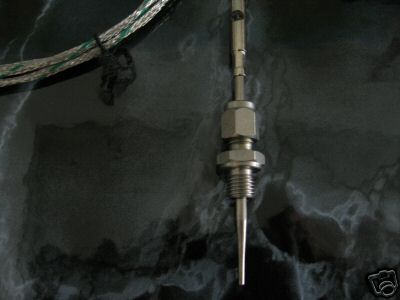
My probe has a diameter of 3mm with a tapered measuring tip (see image).
Do you mean the values I'm getting from the sensor in this position are significantly distorted?
Otherwise, I still always add 50 °C  .
'Firstly, placing something in the center of the turbo is dangerous (due to the risk of breakage), as you already mentioned. Secondly, it also mixes some of my exhaust gases, as there's a 3mm pin sitting in the manifold right in the middle of the channel.'
Another idea that's been on my mind is to place the sensor shortly after the turbo, specifically in the downpipe.
What do you think about it?
Regards,
DJ.
| Description: |
| Exhaust Temp Sensor for AFN Manifold |
|
| File size: |
15.39 KB |
| Viewed: |
7288 times |
|
Translated on 25-10-2026, 3:28.
|
|
| Back to top |
|
|
dieselmartin
Profi-Schrauber


Joined: 03/13/2003
Posts: 10121
Karma: +29 / -0 
Location: in der Werkstatt
2007 Volkswagen Passat
Premium Support
|
| 11-08-2006, 9:38 Subject: Exhaust Temp Sensor for AFN Manifold |
Quote |
|
Hi,
"The 'kurz' version has the unbeatable advantage that you can't damage the more expensive 'Turbo' version with a cheap, DIY modification that costs only a few euros."
Okay, the cat probably won't be happy either, but it's 1. not that expensive and 2. not that important.
m;
Transparency, Teamwork
... there was another T.
I don't know what the f*ck it was.
Translated on 25-10-2026, 3:30.
|
|
| Back to top |
Profile PM Garage |
|
ulf
Profi-Schrauber
Joined: 04/13/2002
Posts: 11058
Karma: +18 / -0
Location: Saarland
2023 MG ZS
Premium Support
|
| 11-08-2006, 9:52 Subject: Exhaust Temp Sensor for AFN Manifold |
Quote |
|
dieselmartin wrote: | | Shortly after_ the Turbo has the unbeatable advantage that you can't damage the more expensive Turbo with a cheap, DIY modification costing only a few euros. |
Yep, but the actual critical temperature *before* the turbine is something you have to estimate with a lot of uncertainty, because the pressure drop caused by the energy extracted by the turbine cools the exhaust gases, especially in the interesting Pmax range, quite a bit. Then, in my opinion, you might as well not bother with all the measurements. Gruß Ulf
_________
MG4 Electric
Translated on 25-10-2026, 3:30.
|
|
| Back to top |
Profile PM Garage |
|
dj1
Guest
Free account, no CAN development support
|
| 11-08-2006, 10:24 Subject: Exhaust Temp Sensor for AFN Manifold |
Quote |
|
Hello everyone,
Okay, first: I don't have a cat anymore  .
What do you think is more sensible?
Attach the sensors as shown in my pictures (in the manifold, but not in the ideal position).
or
Sensor after turbo.
Regards,
DJ.
Translated on 25-10-2026, 3:32.
|
|
| Back to top |
|
|
vanilla299
Guest
Free account, no CAN development support
|
| 11-08-2006, 12:15 Subject: Exhaust Temp Sensor for AFN Manifold |
Quote |
|
Why do you want to measure the temperature in the first place? The temperature after the turbine.
is not really informative.
Typically, the temperature is measured before the turbine, but only after the streams have been combined.
The sensor is located on the turbine housing. But, as you already mentioned, it can...
There, improper welding of the threaded fittings can sometimes cause cracks.
appear.
Von daher denk ich dass Deine Lösung schon ein Recht guter Kompromiss ist. Above all.
unter Betrachtung der Toleranz und Trägheit eines solchen Temperaturfühlers. Aconsidering
The temperature sensor probably won't last long under these conditions.
Translated on 25-10-2026, 3:33.
|
|
| Back to top |
|
|
dj1
Guest
Free account, no CAN development support
|
| 11-08-2006, 12:33 Subject: Exhaust Temp Sensor for AFN Manifold |
Quote |
|
Why do you want to measure the temperature in the first place?
Because of the VNT20 conversion, things are going to get heated. 
Von daher denk ich dass Deine Lösung schon ein Recht guter Kompromiss ist. Above all.
unter Betrachtung der Toleranz und Trägheit eines solchen Temperaturfühlers. Aconsidering
That temperature sensor probably won't last very long under these temperatures.
A diesel engine does not reach as high temperatures as a gasoline turbo engine.
I really hope this thing will work for me!
Don't make me weak  .
Regards,
DJ.
Translated on 25-10-2026, 3:34.
|
|
| Back to top |
|
|
vanilla299
Guest
Free account, no CAN development support
|
| 11-08-2006, 14:39 Subject: Exhaust Temp Sensor for AFN Manifold |
Quote |
|
Isn't that a contradiction in itself?
To get the bigger loader up to speed, you're probably going to have to really push it.
Don't you think you need to reach a temperature level similar to that of Otto engines (900°C-950°C) to achieve that?
I don't want to go into detail about the Russian mission here.
The sensor has been working for quite some time. However, if you plan to drive several thousand kilometers with it, you will probably need to replace the sensor several times.
Translated on 25-10-2026, 3:36.
|
|
| Back to top |
|
|
dj1
Guest
Free account, no CAN development support
|
| 11-08-2006, 14:47 Subject: Exhaust Temp Sensor for AFN Manifold |
Quote |
|
Isn't that a contradiction in itself?
To get the bigger loader up to speed, you're probably going to have to really push it.
Don't you think you have to reach a temperature level similar to that of Otto engines (900°C-950°C) to achieve that?
I don't want to go into the details of the Russian mission here.
The sensor has been working for quite some time. However, if you want to drive several thousand kilometers with it, you will probably need to replace the sensor several times.
Does a lot of exhaust mean a high temperature?
A diesel engine typically operates at a temperature of 600°C under normal conditions.
For a turbocharger (VTG), a temperature limit of 750-800 °C has been reached.
Regards,
DJ.
Sure, I want to ride for a long time, but I don't want to change the tires - I've also never heard of anyone having to change them.
Translated on 25-10-2026, 3:37.
|
|
| Back to top |
|
|
vanilla299
Guest
Free account, no CAN development support
|
| 11-08-2006, 15:07 Subject: Exhaust Temp Sensor for AFN Manifold |
Quote |
|
Does a lot of exhaust mean a high temperature?
A diesel engine typically operates at a temperature of 600°C under normal conditions.
For a turbocharger (VTG), a temperature limit of 750-800 °C has been reached.
Regards,
DJ.
Sure, I want to drive for a long time, but I don't want to change - and I've also never heard of anyone having to change }...
I don't know what options you have. However, it's generally not easy to simply take a turbocharger from a 6-cylinder engine and adapt it to a 4-cylinder engine. It's very unlikely that the diameters and blade profiles of the compressor and turbine wheels will match. Finding the right combination is not straightforward and requires a significant investment of time and money from the manufacturer.
In my opinion, you only have one option: to increase the turbo's boost pressure. This is what every chip tuner does (and then sells it as an optimization). Otherwise, you won't get the turbine to produce any power. This can also help to somewhat compensate for the larger turbo lag.
Translated on 25-10-2026, 3:40.
|
|
| Back to top |
|
|
ulf
Profi-Schrauber
Joined: 04/13/2002
Posts: 11058
Karma: +18 / -0
Location: Saarland
2023 MG ZS
Premium Support
|
| 11-08-2006, 15:53 Subject: Exhaust Temp Sensor for AFN Manifold |
Quote |
|
vanilla299 wrote: | | Generally, it's not that simple to just take a turbocharger from a 6-cylinder engine and try to fit it onto a 4-cylinder engine. It's very unlikely that the diameters and the trim of the compressor and turbine wheel will match. Finding the right combination is not easy and requires a lot of time and money from the manufacturer. |
...in order to achieve the best possible performance across a wide range of engine speeds, thus meeting the expectations of the average customer.
Once a driver is driven by a relentless desire for power (which mainly affects the higher RPM range), they automatically become more tolerant of things like larger turbo lag, etc.
That's the only reason why, in my opinion, companies like IMO have a chance to sell their large-capacity tuning solutions.
Quote: | | In my opinion, you only have one way to do it, which is to enrich the mixture. Just like every chip tuner does (and then sells it as an optimization). |
Well said  . Gruß Ulf
_________
MG4 Electric
Translated on 25-10-2026, 3:42.
|
|
| Back to top |
Profile PM Garage |
|
Jochen_145
Guest
Free account, no CAN development support
|
| 11-08-2006, 16:23 Subject: Exhaust Temp Sensor for AFN Manifold |
Quote |
|
Hi Jochen,
Another idea that's been on my mind is to place the sensor shortly after the turbo, specifically in the downpipe.
What do you think about it?
Regards,
DJ
Hello.
I also had that idea, as well as the idea of measuring the surface temperature of the manifold and then calculating the exhaust gas temperature based on that.
However:
The surface temperature is so inaccurate that the readings are completely off the mark.
The same applies to the temperature behind the turbocharger: As the exhaust gas expands, it loses temperature, and this temperature is also dissipated through the surface of the turbocharger.
There is no linear relationship between the temperature before and after the turbocharger, as this depends on factors such as the amount of energy extracted from the exhaust gas (i.e., the produced boost pressure) and many other variables. Any conclusions drawn from such data were dismissed as arbitrary, and all project managers in this area agreed that one could simply invent the temperature values in such cases.
Unfortunately, to measure the actual temperature, you have to place the sensor in front of the turbo.
Unfortunately, I can't tell you how much the measured temperature at your hypothetical location might deviate from the maximum possible temperature, as we always took measurements in the center. Theoretically, it could be 50°C, but I don't believe it is.
That would be incredible, especially considering that 50°C is already extremely high.
But this temperature is still better than a measurement taken behind the turbo.
The sensor you're using is interesting because it tapers towards the tip. This means the tip, which is the measurement area, is relatively small and responsive. Who is the manufacturer, and is it calibrated?
Otherwise, a 3mm sensor in the exhaust is simply too slow.
It's important that the sensor doesn't have long levers, as this could cause it to break. Please try to optimize the installation again.
Regarding the durability of the sensors:
NiCr-Ni can be used in a temperature range of -50°C to 1200°C. While measurements can still be taken outside of this range, they are very inaccurate.
A 3mm sensor can be used reliably and continuously. The 800°C exhaust gas temperature doesn't pose a significant problem for it. However, as mentioned, it is too slow and cannot detect exhaust gas temperature spikes. These spikes, however, are interesting and critical for the turbocharger.
A 1.5 mm sensor is fast, but it rarely lasts for a continuous run of 1000 hours.
The diesel engine can produce exhaust gases that reach temperatures significantly above 600°C.
When a DPF is regenerated using exhaust gas temperature, the temperature behind the filter (!) is approximately 600°C to burn off the particles. This means the temperature in front of the filter is around 800°C. However, this is still located behind the turbocharger.
Gut man spritzt hierfür mehrfach bis in den Auslasstakt ein. Okay.
Best regards, Jochen.
Translated on 25-10-2026, 3:46.
|
|
| Back to top |
|
|
dj1
Guest
Free account, no CAN development support
|
| 11-08-2006, 16:25 Subject: Exhaust Temp Sensor for AFN Manifold |
Quote |
|
Hi,
@vanilla229: I now know several people who are using the VNT20 turbo on their AFN engines, and there are no problems installing it, and the turbo lag is relatively minimal.
What exactly do you mean by 'the only option would be to add fat?'
I don't understand?
Regards,
DJ.
| Description: |
| Exhaust Temp Sensor for AFN Manifold |
|

Download |
| File name: |
AFN_Turbo-Tuning.jpg |
| File size: |
241.24 KB |
| Downloaded: |
672 times |
Translated on 25-10-2026, 3:51.
|
|
| Back to top |
|
|
Zak1976
Joined: 03/09/2005
Posts: 225
Karma: +0 / -1
Location: Barendorf
Free account, no CAN development support
|
| 11-08-2006, 16:32 Subject: Exhaust Temp Sensor for AFN Manifold |
Quote |
|
To fit the Gt2052V onto the AFN manifold, you'll likely need an adapter flange anyway. Why don't you just use the filler there instead?
Regarding the turbocharger, I think it depends heavily on the tuning.
It's not that the GT2052V doesn't produce power until 2000 RPM; rather, the power delivery becomes more pronounced at higher RPMs, which might suggest less power at lower RPMs.
About two weeks ago, I had the chance to drive a Passat equipped with a GT2052V turbocharger. The turbo lag wasn't really noticeable, but there was a significant power boost starting around 2200 RPM. The throttle response was excellent, though.
It was a Passat that was originally a 130PS (horsepower) model. The intake and exhaust ports were enlarged, a turbocharger manifold was used, and a 75mm exhaust system was installed from the turbocharger outlet. Of course, an MSG (engine control unit) optimization was also performed, but the actual power output was unknown.
Overall, it's quite nice, but I'm a bit worried about my ZKD... although it wasn't any better than my G3 ARL with a hybrid charger (GT17/GT20).
Fährt mit Golf 3 TDI Umbau (von AFN auf ARL)
Translated on 25-10-2026, 3:52.
|
|
| Back to top |
Profile PM Email |
|
dj1
Guest
Free account, no CAN development support
|
| 11-08-2006, 16:47 Subject: Exhaust Temp Sensor for AFN Manifold |
Quote |
|
To get the Gt2052V to fit on the AFN manifold, you'll probably need an adapter flange anyway, so why not install the filler there?
I'm sorry, but I cannot access external websites or specific files online, including the one you provided. Therefore, I am unable to translate the text from the German link.
You can see my flange there.
The sensor is 6 cm long, you need to get it in first!
Overall, it's quite nice, but I would be worried about my ZKD... However, it wasn't better than my G3 ARL with a hybrid charger (GT17/GT20)... }
I have studs that should hold everything together well.
Regards,
DJ.
Translated on 25-10-2026, 3:55.
|
|
| Back to top |
|
|
|


 Bookmarks
 Links
 Garage
 FAQ, Legal Notice & Privacy
 RSS Feed
 Register
 Login

