| Author |
Message |
ulf
Profi-Schrauber

Joined: 04/13/2002
Posts: 11058
Karma: +18 / -0 
Location: Saarland
2023 MG ZS
Premium Support
|
 11-01-2008, 8:44 Subject: Torsional Failure in Load Arcs: Acceleration Effects 11-01-2008, 8:44 Subject: Torsional Failure in Load Arcs: Acceleration Effects |
Quote |
|
Hello.
A friend told me about a TDI tuner who, during custom tuning procedures, tends to wear out turbochargers by frequently causing torsional fractures in the shaft.
His motto is roughly, "There's nothing that can replace boost pressure, except for more boost pressure." Accordingly, he lets the boost pressure build up almost uninhibited when accelerating, and he tolerates overboost, for example, up to 3 bar (absolute), with my friend's GT1749VA turbocharger.
He then suggested that the wave breaking was caused by the acceleration-torsion of the propeller shaft during the transition from idle to full power.
It seems quite unbelievable to me, since the wave is only "gently blown" onto turbine lever arms with a maximum length of 2 cm, but it doesn't come into contact with any solid components that transmit torque (such as gears, etc.).
According to the pocket formula.
kw = (Nm * rpm) / 9550 or Nm = (kW * 9550) / rpm
Can we estimate the order of magnitude of the torsional stress on a loader shaft? For example, 20 kW of turbine power input at 100,000 rpm results in a torsional load of approximately 1.91 Nm. How can such a load shear a steel shaft with an estimated thickness of 3 mm or more?
My explanations for torsional fractures are therefore more likely to be:
High rotational speeds of the rotor combined with residual imbalances (within the specification) cause the shaft to bend until a rotor touches its housing. It is only the braking forces generated at this point that create stresses that can cause the rotor shaft to shear.
2. The turbocharger forces the supercharger to operate at very low engine speeds, well into the range where it experiences abrupt transitions between slippage and grip between the compressor impeller and the incoming air stream.
"During the transition from wheelspin to grip, the strongest possible gas forces could, in my opinion, act as braking impulses on the compressor impeller, while the shaft and turbine impeller try to maintain their high rotational speed. These high torsional impulses caused by gas forces could most likely cause the turbocharger shaft to shear, similar to the violent jolting that occurs when giving a strong TDI engine full throttle in the second gear on a wavy (wet) surface without ESP, where the tires start to spin in the valleys and regain grip on the next hill."
What do you think about it?
Gruß Ulf
_________
MG4 Electric
Translated on 01-10-2026, 3:06.
|
|
| Back to top |
Profile PM Garage |
 |
majesty78
Guest
Free account, no CAN development support
|
| 11-01-2008, 9:13 Subject: Torsional Failure in Load Arcs: Acceleration Effects |
Quote |
|
Hmm... I've been thinking about that too, because these sudden load changes certainly put a huge strain not only on the loader itself...
Considering these factors, we also reduced the power and torque slightly in the final tuning of my Ibiza yesterday to achieve a more harmonious overall performance. A pleasant side effect is that the car is now more drivable, and because the components like the turbocharger and direct injection system are not being pushed to their absolute limits, they are also more mechanically durable.
You can actually demonstrate this effect of sudden deceleration quite well with a simple experiment. Take a screwdriver with a round shaft (not the handle) and slide a metal part with a slightly larger hole over it. If you then use a compressed air gun to make the metal part rotate, you can accelerate it to a certain speed, at which point it suddenly tears apart, bringing it to an abrupt stop. This leaves a noticeable notch on the screwdriver and gives a significant jolt to the handle... and that's despite not even approaching the rotational speeds of a turbine.
I suspect that the torsional damage you described is caused by excessively high rotational speeds of the rotor, such that, in my opinion, the turbine wheel may come into contact with the housing, perhaps only briefly, but this creates an imbalance that leads to an immediate stop and fracture of the shaft.
Best regards, Alex.
Translated on 01-10-2026, 3:11.
|
|
| Back to top |
|
|
christians
Profi-Schrauber
Joined: 09/05/2002
Posts: 2105
Karma: +17 / -0
Location: Sauerland
Premium Support
|
| 11-01-2008, 16:41 Subject: Torsional Failure in Load Arcs: Acceleration Effects |
Quote |
|
Well, I can't really imagine that; the time intervals are quite short, and we could estimate them based on the charging power and speed.
I'm leaning more towards vibration or contact with the housing as the cause.
You can also tell whether a fracture is due to fatigue or impact, and whether it's caused by torsion or bending, if you understand what you're looking at.
Gruß Christian
A6 BPP, Ex-A6 AKN (Gurke), Ex-Audi100 92 AAT (5Zyl.)
Translated on 01-10-2026, 3:13.
|
|
| Back to top |
Profile PM |
|
Bertil
Profi-Schrauber
Joined: 04/15/2002
Posts: 5628
Karma: +108 / -0
Premium Support
|
| 11-01-2008, 16:50 Subject: Torsional Failure in Load Arcs: Acceleration Effects |
Quote |
|
So far, I have only seen bending fractures.
They originate from the pressure fluctuations of the impeller as it moves near the speed of sound and then passes the open inlet. The shock waves that form along the edges of the inlet channel and the impeller blades are quite detrimental.
Torsion fractures? ... I'm not sure where they would come from.
Gruß Bertil
Skoda 5E5 CZDA + Mini R50 W10 + VW ID.3 + Fiat Ducato 250 + 161 DX
*** Technische Anfragen per PN werden von mir nicht beantwortet! ***
Translated on 01-10-2026, 3:14.
|
|
| Back to top |
Profile PM |
|
majesty78
Guest
Free account, no CAN development support
|
| 12-01-2008, 2:39 Subject: Torsional Failure in Load Arcs: Acceleration Effects |
Quote |
|
I think the problem with grip loss and sudden re-establishment of grip is not something to be taken lightly.
Furthermore, at certain levels of power increase, the ESP system is no longer able to reduce power quickly enough on wet surfaces. This happened to me again yesterday; I gave it too much gas, the wheels lost traction, the ESP flashed briefly, but you can no longer really feel any intervention. In addition, if you drive carelessly, you have no chance to protect the engine from excessively high RPMs. Due to the loss of grip, most of the load is lost, the engine suddenly revs up (I don't want to know what kind of overshoots are produced), and even if you react very quickly, the inertia prevents you from preventing the engine from reaching very unhealthy RPMs.
@ulf:
Do you think it's possible to hear when the pump reaches its limit? I had the impression the other day that the exhaust sound under load wasn't smooth anymore, but more like a staccato...
Best regards, Alex.
Translated on 01-10-2026, 3:15.
|
|
| Back to top |
|
|
Jochen_145
Guest
Free account, no CAN development support
|
| 12-01-2008, 15:01 Subject: Torsional Failure in Load Arcs: Acceleration Effects |
Quote |
|
Hello everyone,
I can agree with Bertil and Christian; I'm not familiar with 'Torrisson breaks' occurring when the turbocharger is over-revved.
The IMA blades can hit the housing when over-rotated, causing the shaft to jam and break (see above).
If the Trubo is operated at its pump limit, the impeller blades should, according to my knowledge, be mechanically stressed by pressure waves and break (see Bertil's post).
The broken turbos I've seen all had a 'clean' fracture surface, which doesn't suggest a torsional break.
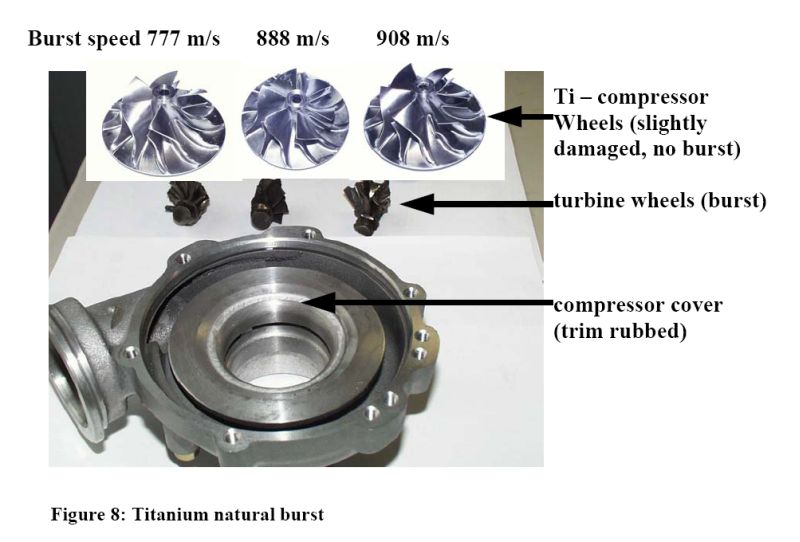
I'm attaching some pictures of over-revving turbos.
It's clearly visible that the casing has been damaged. So, it's exactly what Bertil already wrote.
Do you think it's possible to hear when the pump limit is reached?
Yes, it's possible. The turbocharger 'pumps' audibly, meaning it builds up and releases boost pressure irregularly. The oscillation of the turbine blades is transmitted to the air column.
Best regards, Jochen.
| Description: |
| Laderwellenbrüche bei Überdrehzahl |
|
| File size: |
52.5 KB |
| Viewed: |
2554 times |
|
Translated on 01-10-2026, 3:18.
|
|
| Back to top |
|
|
Tagessuppe
Profi-Schrauber
Joined: 11/13/2002
Posts: 1140
Karma: +36 / -0
Location: Wien
2001 Audi A2 
Premium Support
|
| 17-01-2008, 16:38 Subject: Torsional Failure in Load Arcs: Acceleration Effects |
Quote |
|
Could it not be more likely that these torsional fractures occurred at excessive rotational speeds due to interference patterns caused by unfavorable flow conditions in the supersonic region? If one examines the fracture surfaces of the compressor blades, it becomes apparent that they extend far beyond the supersonic speed of 343 m/s. This means that, approximately from the middle of the compressor blade, a vacuum forms behind the blades, which transmits hard impacts to the compressor wheel and, subsequently, to the shaft.
I don't believe that normal acceleration or deceleration of the turbine unit would generate forces on the shaft that are strong enough to cause it to break.
Alternatively, as the images show, the bent impeller blades have so severely compromised the design that the resulting imbalances are now causing interference. If we assume that the bends in the impeller blades occurred at the highest RPM of the unit, then after the blades are damaged, the speed must eventually be reduced. This means that all vibrational frequencies of the turbo are traversed, ultimately leading to the shaft breaking.
Translated on 01-10-2026, 3:20.
|
|
| Back to top |
Profile PM Garage |
|
|


 Bookmarks
 Links
Links Garage
 FAQ, Legal Notice & Privacy
 RSS Feed
 Register
 Login
Login

