| Author |
Message |
ulf
Profi-Schrauber

Joined: 04/13/2002
Posts: 11058
Karma: +18 / -0 
Location: Saarland
2023 MG ZS
Premium Support
|
 22-02-2008, 18:32 Subject: LLT Puzzle: Weather dependency? 22-02-2008, 18:32 Subject: LLT Puzzle: Weather dependency? |
Quote |
|
Hello,
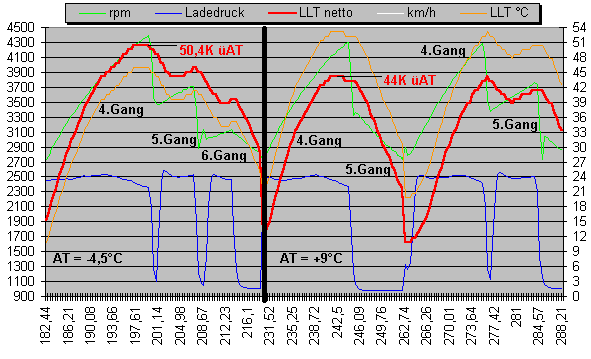
After the last modification I made to my SMIC's cooling air ducting, I ran a few tests.
The attachment shows the same highway section, very similar rpm, load demand (LD), gear, and speed profiles, and yet the maximum LLT-üAT varies by a good 6K  .
These are "small worlds" within the field of life sciences and medicine (LLK).
Can someone explain this?
| Description: |
| LLT Puzzle: Weather dependency? |
|
| File size: |
12.85 KB |
| Viewed: |
1839 times |
|
Gruß Ulf
_________
MG4 Electric
Translated on 20-07-2026, 13:19.
|
|
| Back to top |
Profile PM Garage |
 |
dieselmartin
Profi-Schrauber

Joined: 03/13/2003
Posts: 10121
Karma: +29 / -0
Location: in der Werkstatt
2007 Volkswagen Passat
Premium Support
|
| 22-02-2008, 23:12 Subject: LLT Puzzle: Weather dependency? |
Quote |
|
How does air behave in relation to temperature and heat capacity?
Certainly, humidity plays a role in that.
However, I am not familiar with the specific values and conditions involved in that matter.
Okay, please provide the German text you would like me to translate into English. I will only provide the translation.
Transparency, Teamwork
... there was another T.
I don't know what the f*ck it was.
Translated on 20-07-2026, 13:20.
|
|
| Back to top |
Profile PM Garage |
|
tdi-schrauber
Blaumann

Joined: 01/17/2006
Posts: 101
Karma: +5 / -0
Free account, no CAN development support
|
| 22-02-2008, 23:55 Subject: Re: LLT Puzzle: Weather dependency? |
Quote |
|
Hello!
ulf wrote: |
Can someone explain this? |
Is the question meant to be taken seriously?
BYE
TDI mechanics.
Translated on 20-07-2026, 13:21.
|
|
| Back to top |
Profile PM |
|
dieselmartin
Profi-Schrauber
Joined: 03/13/2003
Posts: 10121
Karma: +29 / -0
Location: in der Werkstatt
2007 Volkswagen Passat
Premium Support
|
| 23-02-2008, 9:53 Subject: Re: LLT Puzzle: Weather dependency? |
Quote |
|
tdi-schrauber wrote: | Hello!
ulf wrote: |
Can someone explain this? |
Is the question meant to be taken seriously? |
I highly suspect that.
Ulf has a lot of data in front of him, and I don't see an immediate explanation either.
I suspect we're missing the forest for the trees.
Your counter-question sounds like you have an explanation ready... so go ahead and tell me  .
Okay, please provide the German text you would like me to translate into English. I will only provide the translation. Transparency, Teamwork
... there was another T.
I don't know what the f*ck it was.
Translated on 20-07-2026, 13:22.
|
|
| Back to top |
Profile PM Garage |
|
Audi_A4_haza
Guest
Free account, no CAN development support
|
| 23-02-2008, 12:24 Subject: Re: LLT Puzzle: Weather dependency? |
Quote |
|
Hello,
After the last modification I made to my SMIC's cooling air ducting, I ran a few tests.
The attachment shows the same highway section, very similar rpm, load demand (LD), gear, and speed profiles, and yet the maximum LLT-üAT varies by a good 6K .
These are 'small worlds' within the field of liquid crystal technology.
Can someone explain this?
Hello Ulf!
Unfortunately, I'm not entirely up-to-date on this. What exactly did you change or modify? I would appreciate it if you could provide a link or something similar.
I could check my university notes regarding the physical properties of air.
Best regards from Haza.
Translated on 20-07-2026, 13:24.
|
|
| Back to top |
|
|
ulf
Profi-Schrauber
Joined: 04/13/2002
Posts: 11058
Karma: +18 / -0
Location: Saarland
2023 MG ZS
Premium Support
|
| 23-02-2008, 13:23 Subject: Re: LLT Puzzle: Weather dependency? |
Quote |
|
dieselmartin wrote: | Ulf has a lot of data in front of him, and I don't see an immediate explanation either.
I suspect we are not seeing the forest for the trees. | I see it similarly...
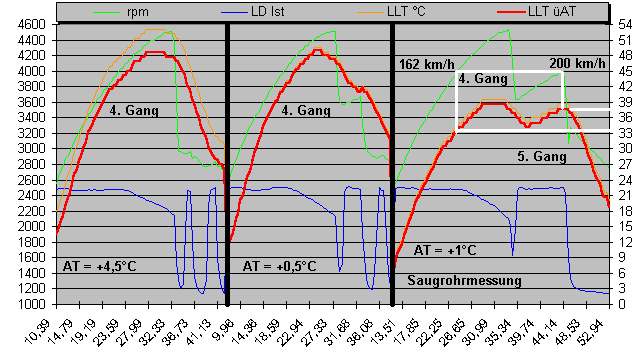
At first, I thought about the influence of the actual wind: during the measurement with the 50K altitude sensor, I had a tailwind, while in the other measurement, I had a headwind.
Die rechte Messung im Anhang, bei der ich mal bis 200 km/h weiterbeschleunigen konnte, brachte "drehzahlbereinigt" im 5. Gang trotz ~ 40 km/h mehr Fahrtwind bei gleichem LD eine um ca. 4K höhere LLT als im 4. Gang: hier zeigt sich deutlich, daß die Verschleppung des LLT-Anstieges aufgrund der Wärmespeicherkapazität des SMIC einen noch größeren Einfluß hat als der Fahrtwind im "HighSpeed-Bereich". Die LThe LT value was lower in that measurement because the sensor was located in the intake manifold behind the SMIC at that time.
The first two measurements show that the LLT (low-temperature limit) in my measurements has been almost completely independent of the AT (ambient temperature) so far. Even if there was only a 4 K difference in AT between the runs, instead of 14 K as in the initial post, the final LLT would at least have had to differ by about 2 K if there were a strong dependence on the AT .
Audi_A4_haza wrote: | | What exactly did you change? I would appreciate a link or something similar. | Something like that:

"...where the exhaust opening is now slightly larger (in both measurements from the original post). In image 3, it should probably say: "Lowest Limit Temperature up to 44 or 50 K above ambient temperature, depending on the whim of the technology??".
| Description: |
| LLT Puzzle: Weather dependency? |
|
| File size: |
13.26 KB |
| Viewed: |
1542 times |
|
Gruß Ulf
_________
MG4 Electric
Translated on 20-07-2026, 13:27.
|
|
| Back to top |
Profile PM Garage |
|
Jochen_145
Guest
Free account, no CAN development support
|
| 23-02-2008, 13:40 Subject: LLT Puzzle: Weather dependency? |
Quote |
|
Ulf has a lot of data in front of him, and I also don't see an immediate explanation.
I suspect that we are not seeing the forest for the trees.
Hello,
That's because Ulf has already answered that question many times.
It is due to the heat capacity, which is responsible for energy transfer in heat exchangers. This is calculated, as is well known, as kg*K].
So, it is not the temperature difference of the air volume that determines the maximum heat transfer in a liquid-liquid contactor, but rather the temperature difference of the air mass [kg].
Under constant conditions (speed, impingement area), the same volume of air reaches the local cooling system. This is determined by the cross-sectional area of the inlet opening and the vehicle's speed, and it is independent of temperature because neither of these factors changes measurably at different temperatures.
However, what changes is the mass of the air volume as the temperature decreases.
Therefore, the heat pipe can transfer more energy to the surrounding air at low ambient temperatures, allowing the heat source to cool down further because there is more mass available for absorbing the energy.
(ouch, that's complicated wording... anyone who can say the same thing more simply, please change it  ).
Best regards, Jochen.
Translated on 20-07-2026, 13:30.
|
|
| Back to top |
|
|
powermac
Guest
Free account, no CAN development support
|
| 23-02-2008, 14:36 Subject: LLT Puzzle: Weather dependency? |
Quote |
|
Have you ever thought about the humidity of the surrounding air?
The value is usually lower at -4°C than at +9°C.
I think that definitely has an influence on it.
Translated on 20-07-2026, 13:32.
|
|
| Back to top |
|
|
ulf
Profi-Schrauber
Joined: 04/13/2002
Posts: 11058
Karma: +18 / -0
Location: Saarland
2023 MG ZS
Premium Support
|
| 23-02-2008, 18:30 Subject: LLT Puzzle: Weather dependency? |
Quote |
|
Jochen_145 wrote: |
However, what changes is the mass of the air volume as the temperature decreases.
Therefore, the liquid coolant can transfer more energy to the surrounding air at low ambient temperatures, allowing the heat sink to cool down further because there is more mass available to absorb the energy.
| Hi Jochen,
To me, that reads like a self-inflicted wound.
If "cold" cooling air is more effective than warm air, then the liquid-cooled temperature (LLT) should be lowered further towards ambient temperature (AT) as the outside temperature decreases.
For me, it's exactly the opposite:
Bei AT = -4,5°C : max. LLT = 50K; üAT = [value].
At AT = 9°C: maximum allowable leakage current (LLT) = 44 mA under ambient temperature (üAT). Gruß Ulf
_________
MG4 Electric
Translated on 20-07-2026, 13:34.
|
|
| Back to top |
Profile PM Garage |
|
Jochen_145
Guest
Free account, no CAN development support
|
| 23-02-2008, 21:04 Subject: LLT Puzzle: Weather dependency? |
Quote |
|
To me, that reads like a self-goal:
I'm sorry if that sounds like something.
If 'cold' cooling air is more effective than warm air, then the LLT (Low Temperature System) should be cooled down further towards the AT (Ambient Temperature), the colder it is outside.
I would absolutely agree with that. Cooling attempts using dry ice are very successful and operate precisely according to this principle.
For me, it's exactly the opposite:
You just don't have laboratory conditions.
A tuner,  not entirely unfamiliar to us, would now start claiming that the aging of your MAP sensor is the reason, but I find that excuse too simplistic.
'The problem is simply that you don't have enough sensors to accurately capture the environmental data. We know as little about the actual engine compartment temperature as we do about the actual intake air temperature and the ATL outlet temperature...'
When you try to measure the 'last' 2 Kelvin, all boundary parameters become increasingly important (and the measurement technology becomes more expensive  ).
Best regards, Jochen.
Translated on 20-07-2026, 13:36.
|
|
| Back to top |
|
|
ulf
Profi-Schrauber
Joined: 04/13/2002
Posts: 11058
Karma: +18 / -0
Location: Saarland
2023 MG ZS
Premium Support
|
| 24-02-2008, 16:42 Subject: LLT Puzzle: Weather dependency? |
Quote |
|
Jochen_145 wrote: | | The "problem is simply that you don't have enough sensors to capture the precise environmental data. We know as little about the actual engine compartment temperature as we do about the actual intake air temperature and the ATL outlet temperature... | However, it should be said that my two temperature sensors (AT via KI, LLT via MSG) have always worked so well together that, with (almost) identical driving cycles, they never produced such different values for the LLT and AT.At the start of the measurements, the coolant temperature was consistently between 75-80°C (according to the onboard computer), the intake air came in entirely from the front (the water separator slot in the strut mount was sealed with foam), and my aluminum air intake duct behind the engine is very well insulated with foam and an outer layer of aluminum.
But just now I realized that there might be a difference between the measurements that could be influenced by LLT (Low Latency Transport).
To reduce the engine's air cooling through circulation within the engine bay (in order to increase heating performance in winter), I sealed the gap between the water cooling system and the frame crossmember at the top and on the sides.
Therefore, less air is forced into the engine compartment from the front, and due to the unchanged suction of the underbody ventilation opening, the air pressure in the engine compartment decreases slightly.
The fact that the SMIC is vented both through the wheel arch ventilation opening and the engine compartment likely caused the absolute pressure behind the cooling grille to decrease slightly, which increased the cooling air flow somewhat.
Unfortunately, I no longer remember whether I performed the intervention before or after the first measurement (with a maximum of 50K üAT). If it was after, that would at least be a theoretical explanation for the different maximum LLT üAT values. The question is whether something like a slightly higher pressure gradient in the cooling network could really cause a reduction in LLT by 6K... Gruß Ulf
_________
MG4 Electric
Translated on 20-07-2026, 13:40.
|
|
| Back to top |
Profile PM Garage |
|
ulf
Profi-Schrauber
Joined: 04/13/2002
Posts: 11058
Karma: +18 / -0
Location: Saarland
2023 MG ZS
Premium Support
|
| 25-02-2008, 12:13 Subject: LLT Puzzle: Weather dependency? |
Quote |
|
Okay, I think today's log sheds some light on the mystery.
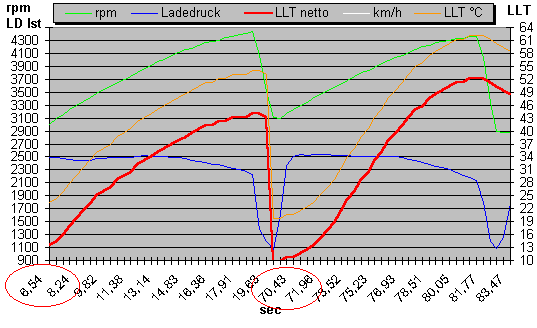
During the initial acceleration in 4th gear up to 4400 rpm, the long-term fuel trim remained "nicely low," at a maximum of 44 kPa vacuum absolute pressure.
After that, I was still able to drive in full power in 5th gear up to approximately 200 km/h at 4000 rpm, and the oil temperature (LLT) continued to rise to 52°C despite the increased airflow.
Subsequently, there was approximately 20 seconds of boost operation, and then full throttle in 4th gear up to 4300 rpm, during which the long-term fuel trim (LTFT) increased again to 52K üAT!
This means an 8K higher LLT (Low Load Torque) at approximately 4400 rpm in the 4th gear, despite the LD (Load Demand) being reduced by 0.1 bar compared to the initial acceleration – and this reduction occurred within about one minute during the same logging run. Since the log was created around 6:10 AM, we can rule out "heat islands" as a cause of the ambient temperature.
Given that the water temperature was likely around 80°C at the start of the log, I suspect that the water thermostat opened between the two accelerations in 4th gear, causing the cooling system to flood the engine compartment with warm air, which then transferred heat to the fresh air through the (plastic!) intake passages.
So, I will also try to insulate the plastic parts of the intake system as well as possible with thermal insulation and then continue logging data.
I had already considered placing the AT sensor in the LuFiKa, but I rejected the idea: The AI display is so heavily filtered that it increases by a maximum of about 2K per minute, even if you heat the sensor with a hairdryer  . Gruß Ulf
_________
MG4 Electric
Translated on 20-07-2026, 13:45.
|
|
| Back to top |
Profile PM Garage |
|
dieselmartin
Profi-Schrauber
Joined: 03/13/2003
Posts: 10121
Karma: +29 / -0
Location: in der Werkstatt
2007 Volkswagen Passat
Premium Support
|
| 25-02-2008, 12:32 Subject: LLT Puzzle: Weather dependency? |
Quote |
|
For a temporary measurement of temperatures, I suggest the following:

The cables are so thin that you can even run them through the ventilation system.
If you open the casing, you'll even find two external sensors inside.
And don't let yourself be shaken off.
Okay, please provide the German text you would like me to translate into English. I will only provide the translation. Transparency, Teamwork
... there was another T.
I don't know what the f*ck it was.
Translated on 20-07-2026, 13:47.
|
|
| Back to top |
Profile PM Garage |
|
ulf
Profi-Schrauber
Joined: 04/13/2002
Posts: 11058
Karma: +18 / -0
Location: Saarland
2023 MG ZS
Premium Support
|
| 25-02-2008, 12:55 Subject: LLT Puzzle: Weather dependency? |
Quote |
|
dieselmartin wrote: | For a temporary measurement of temperatures, I suggest the following:
The cables are so thin that you can even run them through the ventilation system.
If you open the casing, you even have 2 external sensors. | Hmm, is it possible to extend the sensor cable to about 3 meters (running the Wi-Fi connection past the A-pillar to the center console), or is that another example of delicate CrNi technology?
. In our southern part of the Saarland region, we didn't notice anything...
I just roughly calculated the additional heating power that the fresh air likely absorbed during the second acceleration in 4th gear.
Assuming the SMIC (Super Marine Ice Machine) has an efficiency of 50%, the air before the liquid-liquid heat exchanger (LLK) must have been approximately 16K warmer so that there would still be a temperature difference of 8K after the LLK.
4000 rpm with an air consumption of 1050 mg per stroke, resulting in 140 grams of fresh air per second.
To heat this mass flow of 16K, with a specific heat capacity of 1.01 J/(g*K), you need a heating power of approximately 2.24 kW: quite substantial .
EDIT
Here's another picture showing the two acceleration tests in 4th gear, taken about a minute apart. You can clearly see how the load limit torque (LLT) increases faster and higher during the second test – as mentioned, under completely identical external conditions.
| Description: |
| LLT Puzzle: Weather dependency? |
|
| File size: |
9.6 KB |
| Viewed: |
1310 times |
|
Gruß Ulf
_________
MG4 Electric
Translated on 20-07-2026, 13:50.
|
|
| Back to top |
Profile PM Garage |
|
Jochen_145
Guest
Free account, no CAN development support
|
| 25-02-2008, 21:51 Subject: LLT Puzzle: Weather dependency? |
Quote |
|
(...) or is this just another overly delicate CrNi(?) technique?
Mimosa-like NiCr-Ni alloy technology?
I'm not sure which manufacturer you've used before, but if you need an accuracy within a range of 1 to 2 Kelvin and want to cover a temperature range from -50°C to 800°C, there probably isn't anything simpler than NiCr-Ni.
Extending the cable runs is not a problem unless you are adding an additional thermocouple (terminal block). The only thing you should pay attention to is bends in the cable routing, as these can significantly increase measurement errors.
And if you need it very quickly right now, I have something that can achieve a sampling rate of up to 100 Hz!
If you need even greater accuracy, the PT100 sensor with a 4-wire configuration remains a good option. This minimizes problems when extending the signal line. It can also be implemented relatively quickly.
To heat this mass flow by 16K, with a specific heat capacity of 1.01 J/(g*K), you need a heating power of approximately 2.24 kW: quite substantial .
I would still argue that you are drawing 'warm' air over the water cooler.
Heat transfer through pipes of the sizes you're calculating is simply too high for practical application at IMA.
It's not as if you have a temperature close to the ambient temperature under the hood when the thermostat is closed. However, once the cooling system opens, the temperature suddenly jumps to 65°C...
Best regards, Jochen.
Translated on 20-07-2026, 13:54.
|
|
| Back to top |
|
|
ulf
Profi-Schrauber
Joined: 04/13/2002
Posts: 11058
Karma: +18 / -0
Location: Saarland
2023 MG ZS
Premium Support
|
| 25-02-2008, 23:12 Subject: LLT Puzzle: Weather dependency? |
Quote |
|
Jochen_145 wrote: | Mimosa-like NiCr-Ni alloy?
Well, I don't know which manufacturer you've been using so far, but if you want to stay within an accuracy range of 1 to 2 K and cover a temperature range from -50°C to 800°C, there probably isn't anything simpler than NiCr-Ni. | I only need a range from 0 to +40°C.
Quote: | I would still claim that you are drawing in "warm" air over the water cooler.
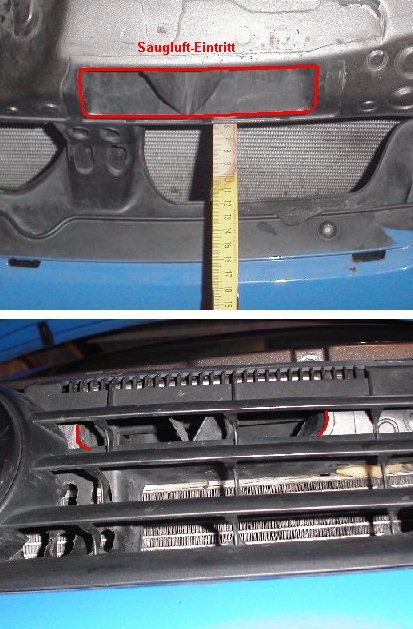
Heat transfer through the pipes in these magnitudes, as you are calculating, is too much for practical application at IMA. | If the front of the water cooling system begins 6 cm behind the suction area and I am traveling at 160 km/h or more, I highly doubt that warm air from the cooling circuit would flow forward and upward against the airflow (and almost perpendicular to the radiator grill slats) in order to be drawn in there.
Behind the air intake, there are still two potential leak points that could allow warm air to enter the engine compartment, with a combined estimated area of approximately 5 square centimeters. However, I will also seal these leaks within the next few days.
| Description: |
| LLT Puzzle: Weather dependency? |
|
| File size: |
98.14 KB |
| Viewed: |
1277 times |
|
Gruß Ulf
_________
MG4 Electric
Translated on 20-07-2026, 13:57.
|
|
| Back to top |
Profile PM Garage |
|
|


 Bookmarks
 Links
Links Garage
 FAQ, Legal Notice & Privacy
 RSS Feed
 Register
 Login
Login


