| Author |
Message |
ulf
Profi-Schrauber

Joined: 04/13/2002
Posts: 11058
Karma: +18 / -0 
Location: Saarland
2023 MG ZS
Premium Support
|
 18-12-2009, 19:36 Subject: PD BUK Cold Start Issues: Causes and Solutions 18-12-2009, 19:36 Subject: PD BUK Cold Start Issues: Causes and Solutions |
Quote |
|
Hello,
My BUK (presumably a car make/model) is actually running great - except for the tendency to have rough cold starts with noticeable light blue smoke. Based on my observations so far, this problem gets worse the longer the car has been standing and the colder the engine is. However, I've never had to crank it for more than about 1 second before it starts.
After being idle for a sufficiently long time (e.g., a week of vacation), it also hesitates briefly in the summer, even when no one is thinking about faulty glow plugs. Nevertheless, all the glow plugs are intact.
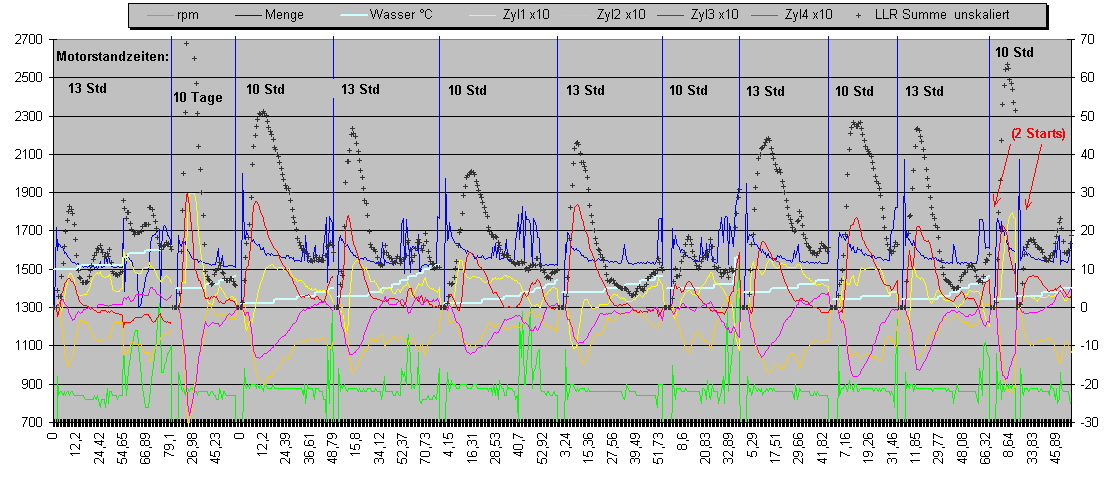
The logs from MWB units 1 and 13 indicate that the LLR (Linear Load Regulator) of cylinder 3 occasionally exceeds the scale limit (3 mg) for a few seconds after some starts, but then quickly returns to normal values.
If the engine, which is still slightly cool, has to pull uphill, the amount of fuel injected into cylinder 3 will increase again to a similar level as it was immediately after starting, but without any jerking or misfiring.
Around a water temperature of approximately 35°C, the long-term run (LRR) values are very difficult to bring back to normal. Also, cylinder 3, which is already weak when cold, sometimes shows slightly negative readings compared to the other cylinders when it warms up.
Since my 6-month warranty for this used car expires in January 2010, I'm wondering if there are underlying, expensive defects causing the symptoms I've been experiencing, for which I would gradually have to seek repairs from the dealer – such as a temperature-sensitive crack in the cylinder head between the water and diesel channels. This crack allows varying amounts of coolant to leak into the diesel circuit depending on how long the engine has been idle. After a cold start, this primarily affects the PDE 3 injector until the coolant is flushed away by the tandem pump, or the remaining coolant mixes with diesel and is injected into the exhaust system.
Apparently, air pockets within the pressure distribution element (PDE) should be detectable in the MWB 23 measurement data, which I have also logged on several occasions.
Unfortunately, the MSG only starts providing real data (not equal to zero) approximately 20 seconds after startup, by which time the engine is already running relatively smoothly. However, at that point, no clear outliers can be detected: in 3 logs from different days, all cylinders are within the range of -30 to zero.
What possible causes for this difficulty starting after a long period of inactivity do you think are likely?
If I don't get a reasonable explanation, I want to remove all the glow plugs on Sunday and actuate the starter – hoping that by analyzing the (compressed) gases that come out of the spark plug holes, I can get an indication of whether there is coolant mixed in with cylinder 3 or if there is too little diesel being injected (due to undetected air in the common rail pressure sensor).
| Description: |
| PD BUK Cold Start Issues: Causes and Solutions |
|
| File size: |
34.68 KB |
| Viewed: |
10800 times |
|
Gruß Ulf
_________
MG4 Electric
Translated on 01-08-2026, 19:25.
|
|
| Back to top |
Profile PM Garage |
 |
Bertil
Profi-Schrauber
Joined: 04/15/2002
Posts: 5628
Karma: +108 / -0
Premium Support
|
| 18-12-2009, 22:17 Subject: PD BUK Cold Start Issues: Causes and Solutions |
Quote |
|
ulf wrote: | ...
The logs from MWB units 1 and 13 indicate that the lower limit of resolution (LLR) for cylinder 3 occasionally exceeds the scale range (3 mg) for a few seconds after certain starts.
|
Not in all cold starts?
That's strange.
Quote: |
...
Since my 6-month warranty for used cars expires in January 2010, I'm wondering if there are any underlying, expensive defects causing these symptoms.
|
Yes... it could be, but it doesn't have to be. What's certain is that something isn't quite right. Definitely take the warranty.
Quote: |
- A temperature-sensitive crack in the cylinder head between the water and diesel channels, through which varying amounts of coolant leak into the diesel circuit depending on the dwell time. This primarily affects injector nozzle 3 after a cold start, until the coolant is flushed away by the tandem pump, or the remaining coolant forms an ignition-resistant emulsion that is injected with the diesel and expelled through the exhaust.
|
You should be able to tell if your coolant level is low.
However, the coolant evaporates or burns off so quickly from the cylinder that after just two or three ignitions, you won't notice it anymore. I think there's something else going on.
Quote: |
...
What possible causes for this difficulty starting after a long period of inactivity do you think are likely?
... |
What kind of oil do you use?
What's the oil pressure like on the hydraulic cylinders?
What does this light blue smoke smell like (burnt diesel, sweet like coolant, or strong like oil)?
Was ich mir denken könnte ist ein Problem mit nicht sauber öffnenten Ventilen. Im Kalten Zustand bekommt der Zylinder nicht genug Luft und verbrennt unsauber und mit zu geringer Intensität. Das merkt die EDC und regelt die LLR hoch. Das er dabei aber eigentlich zu viel des Guten tut, merkt die EDC nicht. Dfor the cloud.
Another idea - A damaged PD (pressure die) punch. I've seen some really badly hammered parts before.
Next idea: The PDE (presumably a piece of equipment) has problems achieving the correct output level during startup, for example, due to leaks or similar issues.
You'll likely have to perform an inspection with the "heart" exposed. I'm also willing to consider your other idea (coolant), but even then, partial disassembly will be necessary (and it sounds like it's only the GK components involved). Gruß Bertil
Skoda 5E5 CZDA + Mini R50 W10 + VW ID.3 + Fiat Ducato 250 + 161 DX
*** Technische Anfragen per PN werden von mir nicht beantwortet! ***
Translated on 01-08-2026, 19:32.
|
|
| Back to top |
Profile PM |
|
ulf
Profi-Schrauber
Joined: 04/13/2002
Posts: 11058
Karma: +18 / -0
Location: Saarland
2023 MG ZS
Premium Support
|
| 18-12-2009, 23:29 Subject: PD BUK Cold Start Issues: Causes and Solutions |
Quote |
|
Bertil wrote: | ulf wrote: | ...Logs from MWB 1 and 13 indicate that the LLR of cylinder 3, after some starts, goes into the scale engagement range (3 mg) for a few seconds.
| Not in all cold starts?
That's strange | . Well, take a look at the image... the LLR data is stretched by a factor of 10 (right scale).
Quote: | | Make sure to keep the warranty documentation at all times. | What exactly does that mean? For example, sending a registered letter for timely registration of potential warranty claims, along with a description of the symptoms observed so far, and continuing to investigate them until a definitive diagnosis is reached?
Quote: | Quote: | | - approximately a temperature-sensitive crack in the cylinder head between the water and diesel channels, through which more or less coolant leaks into the diesel circuit depending on the dwell time. |
You should be able to tell if there's a coolant leak by observing this. | Well, I recently added about 50-100 ml to reach the "max" mark on the expansion tank again when the engine was cold. However, the last check was in late summer, so I don't know if this loss is just an illusion caused by temperature changes. 
Quote: | | What kind of oil do you use? | LM Top Tech 4x00 (which is the 505.01 5W40).
Quote: | | What about the oil pressure to the lifters? | No idea... it's noticeably rattling with that typical "too much valve lash" sound, but it doesn't seem to be doing anything. And I can't imagine that a lifter could be so overfilled on the very first rotation after starting that the valve doesn't close completely.
Quote: | | What kind of smell does this light blue smoke have (badly burnt diesel, sweet like coolant, or strong like oil)? | I should take a sniff next time it starts.
Quote: | | Another idea - Damaged PD (Positive Displacement) impeller. I've seen some really badly damaged parts before. | Even with only about 26,000 km of mileage?
"But I can check it out myself sometime. Taking off the valve cover isn't a big deal."
Quote: | | Next idea - PDE has problems achieving the correct amount during startup, for example, due to leaks or something similar. | As I said: the engine's runtime seems to play a significant role as well, see the image: the second start after 10 days at 5° water looks more chaotic than the fifth start after 10 hours and 1° water (the seemingly faster decay of extreme regulator amplitudes is an illusion caused by the third logged MWB23, which reduces the sampling rate by 1/3; also during the 7th and 9th starts. The image shows the first approximately 80 seconds after each start).
For an explanation involving PDE hydraulics, one would have to assume that it possesses a kind of "memory" or persistence  .
Therefore, I am more inclined to hypothesize that there is some kind of leak between the diesel circuit and either the air or coolant system, which could elegantly explain the worsening of the symptoms with increasing idle time.
I would actually like to rule out a crack leading towards the oil side, because if there were such a crack, diesel would be forced into the oil during engine operation, but the oil level wouldn't rise. Furthermore, oil would dilute and spread within the diesel, which I don't think would cause the noticeable misfires.
Instead of coolant in the diesel circuit, I also considered the possibility of very slowly leaking air through a tiny imperfection, for example, at the fuel injector, which would first need to be flushed out of the combustion chamber.
But at least a longer priming period for the pre-feed pump (default setting of MWB35 before starting) doesn't seem to help much  .
...although I'm not sure how quickly you could get air out of the cylinder head through those small throttle bore holes.
I'll probably also temporarily insert a short piece of clear tubing into both the diesel supply and return lines to try and identify any air bubbles that might be flowing through. Gruß Ulf
_________
MG4 Electric
Translated on 01-08-2026, 19:40.
|
|
| Back to top |
Profile PM Garage |
|
Bertil
Profi-Schrauber
Joined: 04/15/2002
Posts: 5628
Karma: +108 / -0
Premium Support
|
| 19-12-2009, 11:29 Subject: PD BUK Cold Start Issues: Causes and Solutions |
Quote |
|
ulf wrote: |
What exactly does that mean? For example, sending a registered letter to ensure timely registration, possibly including warranty claims along with a description of the symptoms observed so far, and continuing to monitor them until a definitive diagnosis is reached?
|
In principle, yes... But I have no idea whether simply registering here is enough. 
Quote: | Well, I recently spilled an estimated 50-100 ml.
|
"So little that it doesn't have a significant impact on combustion..."
Quote: |
LM Top Tech 4x00 (equivalent to 505.01 5W40).
|
Okay... But it usually needs a 50602 or even a 50700. However, I assume that doesn't matter.
Quote: | ... the noticeable rattling with the typical "too much valve lash" sound doesn't do anything. And I can't imagine that a hydraulic lifter would be so overfilled after the first rotation of the engine that the valve wouldn't close completely.
|
Not that one! On the contrary, it doesn't open properly (or not at all).
If the hydraulic cylinder slowly leaks, the valve clearance decreases depending on how long it's been standing. Consequently, it takes a corresponding amount of time for the oil to re-establish the correct pressure within the hydraulic cylinder.
That would fit well with your description.
I once experienced something similar with a gasoline engine. In that case, the noise from the corresponding hydraulic lifter was quite noticeable. Unfortunately, it's almost impossible to hear the hydraulic lifter clatter on a diesel engine during cold starts.
Quote: |
Quote: | | Another idea - Damaged PD (Positive Displacement) impeller. I've seen some really badly damaged parts before. | Even with only about 26,000 km of mileage?
|
Actually not, but I don't think anything is impossible... 
Quote: |
Quote: | | Next idea - PDE has problems achieving the correct mixture during cold starts, for example, due to leaks or something similar. | As I said: the engine's operating time also seems likely to play a role.
...
|
I also think that's rather unlikely.
Quote: |
For an explanation involving PDE hydraulics, one would have to assume that it possesses a kind of "memory" or persistence .
|
Yes, I agree with that too.
Quote: |
Therefore, I am more inclined to hypothesize that there is some kind of leak between the diesel circuit and either the air or coolant system, which could elegantly explain the worsening of the symptoms with increasing idle time.
|
"Ulf, the coolant in the combustion chamber is leaking out too quickly after launch. That problem would have disappeared very quickly. But yours has been around for longer. I'm not really convinced."
After a cylinder head gasket replacement, there can sometimes be more water in the combustion chamber than would normally be possible (otherwise, you would experience significantly higher water loss). And these engines run very smoothly after one to three ignition cycles per cylinder.
Quote: |
Instead of coolant in the diesel circuit, I also considered the possibility of very slowly leaking air through a tiny imperfection, for example, at the fuel injector, which would first need to be flushed out of the combustion chamber.
|
And does it always hit cylinder three specifically?
Well, I've heard much worse  .
I think the air conditioning should be available to everyone in the DiFi building.
Quote: |
I will probably also temporarily insert a short piece of clear tubing into both the diesel pre- and return lines to potentially identify any air bubbles that may be flowing through. |
I can do that, but I don't believe there will be a significant improvement before the next version of the software is released.
I still have concerns about the sealing of the PD element. If the seals are not properly seated, the diesel supply will be inadequate.
Why only in the cold?
The metal at the ZK is working and therefore it might be fine in a warm environment.
Take a look at the sealing rings of the PDE (Power Distribution Element). While you're there, you can also check the alignment of the PDE. Gruß Bertil
Skoda 5E5 CZDA + Mini R50 W10 + VW ID.3 + Fiat Ducato 250 + 161 DX
*** Technische Anfragen per PN werden von mir nicht beantwortet! ***
Translated on 01-08-2026, 19:50.
|
|
| Back to top |
Profile PM |
|
ulf
Profi-Schrauber
Joined: 04/13/2002
Posts: 11058
Karma: +18 / -0
Location: Saarland
2023 MG ZS
Premium Support
|
| 19-12-2009, 14:32 Subject: PD BUK Cold Start Issues: Causes and Solutions |
Quote |
|
Bertil wrote: | ulf wrote: | | Well, I recently spilled an estimated 50-100 ml | . So it was too little to have a significant burning effect... |
Quote: | Quote: | | Therefore, I am more inclined towards the hypothesis of some kind of leak between the diesel circuit and either air or coolant, which can quite elegantly explain the worsening of the symptoms with increasing idle time. | Ulf, coolant in the combustion chamber is leaving too quickly after startup. That error would have disappeared very quickly. But yours has been around longer. I don't really believe that. | If coolant were to find its way in, I think it's more likely entering through the diesel circuit. If a fuel injector receives a few drops of coolant instead of diesel, it will probably take some time for it to clear and pump out pure diesel again. And during that time, the engine will stumble. Quote: |
To exhibit these symptoms, even a minimal amount of water in the diesel circuit might be sufficient. This small amount, which is lost after each engine run, wouldn't necessarily lead to a rapid loss of coolant... ?
. . . the noticeable rattling with the typical "too much valve lash" sound doesn't do anything. And I can't imagine that a hydraulic lifter could be so overfilled after the first rotation following startup that the valve doesn't close completely.
Not that one! On the contrary, it doesn't open | properly (or not at all).
If the hydraulic cylinder slowly leaks, the valve clearance decreases depending on how long it's been standing. Consequently, it takes a corresponding amount of time for the oil to re-establish the correct pressure within the hydraulic system.
That would fit well with your description.
I once experienced something similar with a gasoline engine. In that case, the noise from the corresponding hydraulic lifter was clearly audible. Unfortunately, it's almost impossible to hear the hydraulic lifter clatter on a diesel engine during cold starts. Quote: | Hmm, perhaps I have sharper ears than you think: With our former ALH Ibiza, I could distinctly hear the typical light ticking sound after each cold start for about 2 seconds, which then disappeared as oil pressure flowed in.
The PD-TDI engine starts more smoothly and runs with a more refined sound than a VP37 engine, but even so, I don't hear the same ticking noise in the BUK as I do in the ALH. Therefore, I would like to rule out this theory.
Instead of coolant in the diesel circuit, I also considered very slowly leaking air through a tiny leak, for example, at the fuel injector, which first needs to be flushed out of the combustion chamber.;)And does it always affect cylinder three?
Well, I've heard much worse | . I think air in the coolant system should affect everything. Quote: | Spontaneously thought of that, yes. But the engine block is already slightly tilted, which would tend to direct the air towards the PDE on the timing chain side (No. 1). However, if it comes from the return flow with the pump running, it will likely find the first opportunity to move upwards towards the PDE, and that would be No. 4. This whole thing is probably further complicated by the back-and-forth movement of the diesel engine via the temperature compensation distribution pipe (SSP 29, page 23), so I don't think the actual path of air in the diesel circuit is easily predictable.
I will probably also temporarily insert a short piece of clear tubing into both the diesel supply and return lines to potentially identify any air bubbles flowing through them. |
I can do that, but I don't believe in leaving much to chance before the VFP. Quote: | Do you mean the tandem pump? The VFP, in my opinion, is located inside the tank...
Could air also potentially enter through the sealing surface of the tandem pump (ZK)? If so, it should be visible in the return line. Therefore, a clear hose in the return line is probably sufficient.
| I still have concerns about the sealing of the PD element. If the seals are not properly seated, the diesel supply is inadequate.
Why only in the cold?
The metal at the ZK is working and therefore it might be fine in a warm environment.
Take a look at the sealing rings of the PDE. While you're at it, you can also check the alignment of the PDE. To see the sealing rings, don't you have to disassemble the PDE? I actually wanted to avoid that for as long as possible, because of the weak point called the tensioner thread in the transmission case.
However, if diesel fuel were to leak past the seals, it would likely accumulate in the oil, as there is no other way for it to escape (without additional cracks in the cylinder head). If the diesel leakage is so significant that it causes a lack of pressure in the common rail system, I would expect to see an increase in oil level, which I have not observed so far, considering my two cold starts per workday.
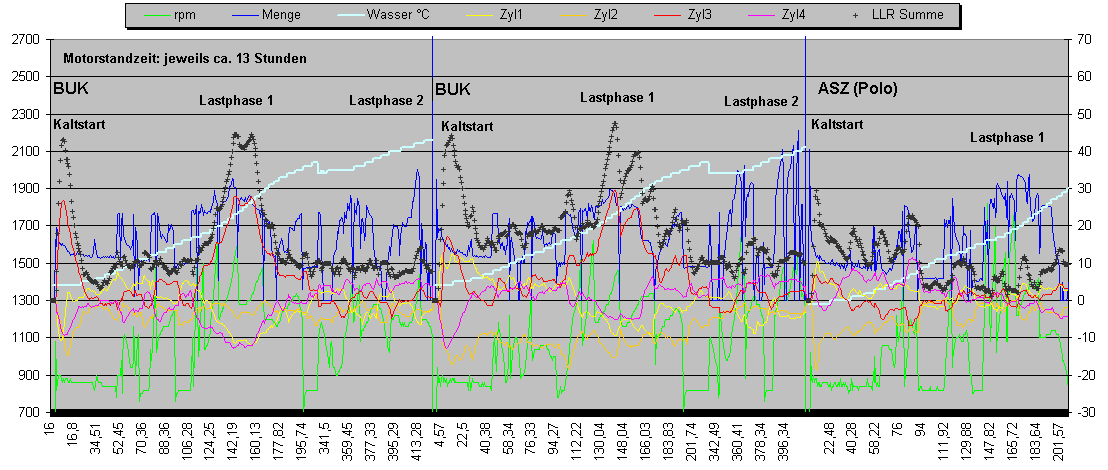
This morning, I logged the acceleration data (ASZ) in my Polo on the same initial route that I drive every morning.
Right after the start, even the Polo felt a little rough, but the LRR (Longitudinal Roll Rate) data didn't spike nearly as much as it did with the BUK.
Similarly striking is the fact that only the BUK-LRR deviates significantly from the expected behavior around 130 seconds when fuel injection rates approach 30 mg, while the ASZ remains largely unaffected during the same driving cycle (load phase 1).
Under similar load conditions, starting approximately 6 minutes after a cold start at a water temperature of 35°C or higher, the LRR (likely referring to a specific parameter) of the BUK remains relatively stable (Load Phase 2).
This would, in turn, fit with your theory of PDE-related writing problems. }
| Description: |
| PD BUK Cold Start Issues: Causes and Solutions |
|
| File size: |
35.67 KB |
| Viewed: |
8675 times |
|
Gruß Ulf
_________
MG4 Electric
Translated on 01-08-2026, 20:03.
|
|
| Back to top |
Profile PM Garage |
|
Bertil
Profi-Schrauber
Joined: 04/15/2002
Posts: 5628
Karma: +108 / -0
Premium Support
|
| 19-12-2009, 17:09 Subject: PD BUK Cold Start Issues: Causes and Solutions |
Quote |
|
ulf wrote: | | Therefore, I am more inclined towards the hypothesis of some kind of leak between the diesel circuit and air or coolant, which can quite elegantly explain the worsening of the symptoms with increasing idle time. |
No... For that to be possible, there would need to be corresponding points of contact between the water and diesel systems, and this would only apply specifically to the third partial derivative equation (PDE).
Even with a water content of up to 10 or 15%, you won't notice a significant difference in how it starts.
Quote: |
To exhibit these symptoms, even a minimal amount of water in the diesel circuit might be sufficient. This small amount, which could be lost after each engine run, wouldn't necessarily lead to a rapid loss of coolant... ?
|
I find that highly unlikely, especially considering the design of the fuel system.
Quote: |
Hmm, maybe I have sharper ears than you think: In our former ALH Golf, I could clearly hear the typical light ticking sound after every cold start for about 2 seconds, which then disappeared as the oil pressure built up.
|
Definitiv nicht. Die Hydros heute hören sich ganz anders an wie zu ALH Zeiten. Da kannst du die Ohren noch so spitzten. Das wirst du nicht hören. Möglicherweise mit einem Stethoskop, aber mit Blankem Ohr? NiOnce.
Quote: |
The PD-TDI engine starts more smoothly and runs with a more refined sound than a VP37 engine, but even so, I don't hear the same ticking noise in the BUK as I do in the ALH. Therefore, I would like to rule out this theory.
|
I would have said the same thing two years ago when I was having warm-start problems with my AXR. I would never have suspected a hydraulic lifter.
Quote: | Initially, yes. But the engine block is already slightly misaligned, which would likely direct the air towards the PDE on the timing chain side (No. 1).
|
Then it would have to be location-dependent. This is easy to check. Park the car on a hill, facing in all four directions. This will change the fuel flow. Therefore, I should see different starting behavior in each case.
Quote: |
However, if it emerges from the main flow with the pump running, I believe it will likely seek the first opportunity to move upwards towards the PDE (Positive Displacement Element), and that would be point number 4. This whole process is probably further complicated by the back-and-forth movement of the diesel fuel via the temperature compensation distribution pipe (SSP 29, page 23), making it difficult for me to predict the actual path of air within the diesel circuit.
|
And then, coincidentally always only PDE three? I find that very unlikely.
Quote: | Are you referring to the tandem pump? As far as I know, the VFP is located in the tank...
|
Ja .... Tandempumpe ... Sorry.
Quote: |
Could air also potentially enter through the sealing surface of the tandem pump (ZK)? If so, it should be visible in the return line. Therefore, a clear hose in the return line is probably sufficient.
|
Yes, but even here, it shouldn't consistently hit the third cylinder in such a systematic way.
Quote: |
To see the sealing rings, don't you have to disassemble the PDE (Positive Displacement Element)?
|
Yes.
Quote: |
I actually wanted to avoid that for as long as possible, because of the vulnerability known as the tensioner thread in the main spindle.
|
If you find yourself constantly tinkering with every potential weakness of your car (see flap motors), then it's better to sell it. The threads on the brake caliper supports also tend to strip out. Unfortunately, you have to remove them when changing the brake pads. After that, you can replace the wheel bearings and the wheel bearing housing. 
Quote: |
However, if diesel fuel were to leak past the seals, it would have to accumulate in the oil, as there is no other way out (without additional cracks in the cylinder head). If the diesel leakage is so high that the injectors starve for pressure, I would expect to see an increase in oil levels, which I haven't observed so far, considering my two cold starts per workday.
|
There are three sealing rings. Only one of them faces the oil side. The other two seal the inlet and outlet against each other, and the third seals towards the combustion chamber. It is specifically the latter that can push combustion pressure towards the diesel supply, which could lead to air in the common rail system (PDE).
However, this would likely result in an incomplete combustion and no smoke.
Or, alternatively, diesel fuel could be leaking through this seal into the combustion chamber (before a cold start).
I haven't given much thought to the middle one yet.
The first one matches your description.
Quote: | ...
This would, in turn, fit with your theory of PDE-related writing problems. |
Yes...
Okay, here's the translation:
"Oh, and I remembered something else... Elaborate PDE guides. That would be a complete disaster. In Klaten, the third PDE "wobbles" in its mount, but when it's warm, it fits snugly."
"Clattering pistons would also be an idea, but probably too far-fetched." Gruß Bertil
Skoda 5E5 CZDA + Mini R50 W10 + VW ID.3 + Fiat Ducato 250 + 161 DX
*** Technische Anfragen per PN werden von mir nicht beantwortet! ***
Translated on 01-08-2026, 20:16.
|
|
| Back to top |
Profile PM |
|
Steffen W
Profi-Schrauber
Joined: 07/05/2008
Posts: 1276
Karma: +104 / -0
Location: Altenburg
Premium Support
|
| 19-12-2009, 20:35 Subject: PD BUK Cold Start Issues: Causes and Solutions |
Quote |
|
Good evening, gentlemen.
Is it allowed to participate?
Bertil wrote: |
I haven't given much thought to the middle one yet.
|
Inspection without disassembling the PDE (Portable Document Engine).
If one of the intermediate rings between the fuel supply and return lines leaks, the fuel pressure will drop. This can lead to the formation of bubbles in the hot fuel, which can be observed as low values in diagnostic trouble code (DTC) MWB 23 (SSP 209 page 41). Alternatively, the fuel pressure can be measured at the test port on the tandem pump using a pressure gauge. If the pressure is too low and, during the measurement, the return hose is clamped off at the differential pressure sensor (Difi), and the gauge then moves into the target value range, then the intermediate high-pressure fuel pump (HPFP) sealing ring is likely the culprit. The DTC MWB 23 can then be read to identify which cylinder is affected.
My two glow plugs, as indicated in the signature, exhibit a brief period of rough running immediately after a cold start in temperatures of -10 degrees Celsius or colder. However, they do not do this when the built-in preheating systems (Defa, Eberspächer) are used and the cylinder head is not completely cold. In those cases, both engines start flawlessly, even today at -15 degrees Celsius.
Diesel fuel is an oil that becomes more viscous in cold temperatures. It's possible that the needle valve in the magnetic solenoid is slightly stiff immediately after a cold start due to the increased resistance of the cold fuel. However, after a few seconds, when the tandem pump starts circulating the fuel, it might improve. Also, Ulf's PDE 3 seems to perform worse in this regard compared to others? Could that be the case, Bertil?
The Sharan also experiences this problem, especially at warm temperatures when starting immediately and when the fuel tank is half empty. This is due to air in the fuel system (a common issue). Turning the ignition off and on twice allows the pre-pump to prime, and then it should start. Passat Variant BGW 2005
2024 Dacia Duster blue dci 115
Translated on 01-08-2026, 20:25.
|
|
| Back to top |
Profile PM |
|
chli1976
Profi-Schrauber
Joined: 11/29/2003
Posts: 872
Karma: +185 / -0
Premium Support
|
| 19-12-2009, 21:22 Subject: PD BUK Cold Start Issues: Causes and Solutions |
Quote |
|
"I'm experiencing the same problem with my AJM engine. When temperatures drop below 0°C and the car stands for an extended period (overnight), it becomes increasingly difficult to start. I have to crank it for longer, and after it starts, the engine runs roughly for 1-2 seconds, and there's white smoke. The glow plugs are okay, and the compression is fine. I've already increased the preheating time, but that doesn't help. Increasing the starting fuel quantity also doesn't improve things. I tried reducing the starting fuel quantity once, and it seems to be a little better. I'll try again tomorrow after two days of standing at -7°C."
Once it starts running, it will function normally until it stops again overnight.
VCDS
Translated on 01-08-2026, 20:29.
|
|
| Back to top |
Profile PM |
|
Bertil
Profi-Schrauber
Joined: 04/15/2002
Posts: 5628
Karma: +108 / -0
Premium Support
|
| 19-12-2009, 22:41 Subject: PD BUK Cold Start Issues: Causes and Solutions |
Quote |
|
Steffen W wrote: | Good evening, gentlemen.
Is it allowed to participate?
|
Sure, I didn't want to have a monologue with Ulf .
Quote: |
...
Diesel fuel is an oil that becomes more viscous in cold temperatures. It's possible that the needle valve in the magnetic solenoid is slightly stiff immediately after a cold start due to the increased resistance of the cold fuel. However, after a few seconds, when the tandem pump starts circulating the fuel, it might improve. Also, Ulf's PDE 3 seems to perform worse in this regard compared to others? Could that be the case, Bertil?
|
That could very well be the case.
That would be my idea.
Quote: |
PDE has problems accurately delivering the correct amount during cold starts - for example, leaks or similar issues. |
... under the heading "something similar". Gruß Bertil
Skoda 5E5 CZDA + Mini R50 W10 + VW ID.3 + Fiat Ducato 250 + 161 DX
*** Technische Anfragen per PN werden von mir nicht beantwortet! ***
Translated on 01-08-2026, 20:31.
|
|
| Back to top |
Profile PM |
|
Steffen W
Profi-Schrauber
Joined: 07/05/2008
Posts: 1276
Karma: +104 / -0
Location: Altenburg
Premium Support
|
| 20-12-2009, 9:49 Subject: PD BUK Cold Start Issues: Causes and Solutions |
Quote |
|
Bertil wrote: | l"]
"Clattering pistons would also be an idea, but probably too far-fetched." |
Probably yes. But anyway, since we're talking about crank mechanisms:
You could try using a welding wire today and, after performing the polarity reversal test (cold), specifically examine cylinder 3.
Perhaps it would be a good idea to quickly check the compression on all cylinders sometime.
And even if it's just to check the point, even though results in that regard are hopefully unlikely. (It will probably be related to PDE 3.)
It's about warranty claims that are about to expire soon. And you were planning on removing the glow plugs today anyway. Passat Variant BGW 2005
2024 Dacia Duster blue dci 115
Translated on 01-08-2026, 20:33.
|
|
| Back to top |
Profile PM |
|
ulf
Profi-Schrauber
Joined: 04/13/2002
Posts: 11058
Karma: +18 / -0
Location: Saarland
2023 MG ZS
Premium Support
|
| 20-12-2009, 12:38 Subject: PD BUK Cold Start Issues: Causes and Solutions |
Quote |
|
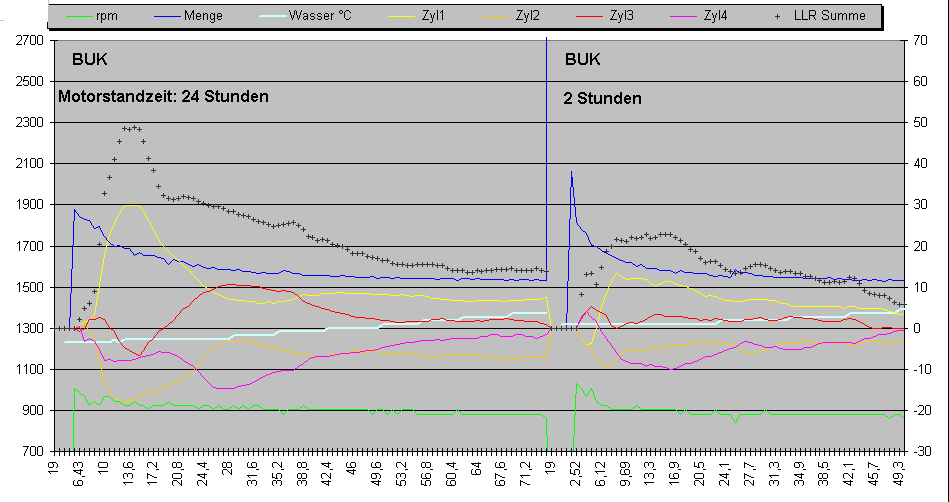
Okay, there's new data regarding the question of which PDE is always affected.
I was the first to notice the logs for the following image, and I observed them in the garage, which has a slight slope on its floor. This meant that the car was tilted sideways more than usual, and as a result, PDE number 1 started deviating from its normal behavior much sooner than PDE number 3 would typically do.
So, we can probably rule out hardware errors related to specific cores as a cause?
The second start, again with a similarly low water temperature, was also somewhat uneven, but the LRR (likely referring to an engine or system) is nowhere near as erratic as it is after prolonged inactivity. This, in my opinion, demonstrates the dependence on standing time, which further supports the theory of slow leakage of non-diesel fuel (air or water).
I also had my significant other remove a video from the digital camera of the first launch – it was an .avi file with approximately 23 MB.
I would try to upload it to YouTube, but I probably need to sign up/register first... or does anyone know a simpler way to make it accessible to everyone?
| Description: |
| PD BUK Cold Start Issues: Causes and Solutions |
|
| File size: |
15.32 KB |
| Viewed: |
8442 times |
|
Gruß Ulf
_________
MG4 Electric
Translated on 01-08-2026, 20:36.
|
|
| Back to top |
Profile PM Garage |
|
Bertil
Profi-Schrauber
Joined: 04/15/2002
Posts: 5628
Karma: +108 / -0
Premium Support
|
| 20-12-2009, 13:37 Subject: PD BUK Cold Start Issues: Causes and Solutions |
Quote |
|
ulf wrote: |
So, we can probably rule out hardware errors related to specific cores as a cause?
|
At least it's possible that the error is migrating.
But why?
Quote: |
The second start, again with a similarly low water temperature, was also somewhat uneven, but the LRR (likely referring to an engine or system) is nowhere near as erratic as it is after prolonged inactivity. This, in my opinion, demonstrates the dependence on standing time, which further supports the theory of slow leakage of non-diesel fuel (air or water).
|
I would rule out water consumption based on the usage you mentioned.
It might be possible to use air conditioning, but in that case, the air would need to be circulated quickly and the settings adjusted accordingly.
That's precisely why I would bring the Hydros back into consideration.
The oil supply also depends on the specific circumstances.
Here's a simple suggestion: Change the oil (to a good quality oil).
It wouldn't be the first TDI engine to experience cold start problems due to a loss of oil viscosity. In such cases, the hydraulic lifters empty too quickly (one is always faster than the others) and are filled too slowly during the starting phase. The engine only runs smoothly when the correct valve clearance is properly adjusted for all cylinders.
"In that case, nothing would be broken, and it would also make sense to me considering the mileage." Gruß Bertil
Skoda 5E5 CZDA + Mini R50 W10 + VW ID.3 + Fiat Ducato 250 + 161 DX
*** Technische Anfragen per PN werden von mir nicht beantwortet! ***
Translated on 01-08-2026, 20:39.
|
|
| Back to top |
Profile PM |
|
Bertil
Profi-Schrauber
Joined: 04/15/2002
Posts: 5628
Karma: +108 / -0
Premium Support
|
| 20-12-2009, 14:23 Subject: PD BUK Cold Start Issues: Causes and Solutions |
Quote |
|
By the way, I just came out of the garage.
My wife has been complaining for a week about a "rough" cold start with the AXR engine. Well, the AXR isn't exactly new anymore, and so I dismissed it as "normal" (I just didn't feel like doing any repairs on the old car).
After lunch today, I went to the garage and connected the diagnostic tool (Lappi). The data looked very similar to what Ulf saw. Cylinder number three was running much richer than the others. After about 20-30 seconds, everything seemed normal.
Diagnosis -> Pull out the dipstick -> Added 1.5 liters of oil  .
Let's see how he starts tonight or early tomorrow morning.  Gruß Bertil
Skoda 5E5 CZDA + Mini R50 W10 + VW ID.3 + Fiat Ducato 250 + 161 DX
*** Technische Anfragen per PN werden von mir nicht beantwortet! ***
Translated on 01-08-2026, 20:42.
|
|
| Back to top |
Profile PM |
|
ulf
Profi-Schrauber
Joined: 04/13/2002
Posts: 11058
Karma: +18 / -0
Location: Saarland
2023 MG ZS
Premium Support
|
| 20-12-2009, 17:30 Subject: PD BUK Cold Start Issues: Causes and Solutions |
Quote |
|
Okay, here's the cold start video from December 19, 2009, see the log image labeled "Standing time: 24 hours."
http://www.youtube.com/watch?v=gTcb2zKzsSM
(Is there a way to embed something here? The object link from YouTube isn't working ).
The knocking sound is actually coming from the engine, so it's not just something like a broom falling over...
The short puff of blue/white smoke dissipated faster than I could hold my nose. Otherwise, it smelled as strange as TDI engines usually do after a cold start.
What do you think about this? Is it still within the normal range for a water temperature of -3°C? Gruß Ulf
_________
MG4 Electric
Translated on 01-08-2026, 20:44.
|
|
| Back to top |
Profile PM Garage |
|
Steffen W
Profi-Schrauber
Joined: 07/05/2008
Posts: 1276
Karma: +104 / -0
Location: Altenburg
Premium Support
|
| 20-12-2009, 19:28 Subject: PD BUK Cold Start Issues: Causes and Solutions |
Quote |
|
The Sharan mentioned in the signature also starts like that. If it's not pre-warmed, and if it's very cold. It makes those noises for a few seconds. You probably hear them so loudly because it was just standing in the tight garage, with walls all around the engine compartment.
"Initially, I always thought the problem might be with the needle magnet valve. But what Bertil says about empty cylinders and the resulting uneven engine running also makes a lot of sense..."
Perhaps we should try using 50601 0W30 oil in very cold temperatures?
That's nothing to complain about.
Passat Variant BGW 2005
2024 Dacia Duster blue dci 115
Translated on 01-08-2026, 20:45.
|
|
| Back to top |
Profile PM |
|
DieselBär30x
Profi-Schrauber

Joined: 01/17/2008
Posts: 3560
Karma: +101 / -0
Location: München & Passau
Premium Support
|
| 20-12-2009, 19:45 Subject: PD BUK Cold Start Issues: Causes and Solutions |
Quote |
|
Hello everyone!
...just so that I can also add my two cents...
"Ulf, my AXC (PD-1.9) also starts exactly like in your video, and I've been searching for the 'problem' for a long time, but the spark plugs are new, and the compression is okay!"
However, the logs from MWB 13, 18, and 23 did not reveal any anomalies in my analysis.
And I can't (or won't) believe that it should be this normal, even with a proper pre-glow cycle. My AFN starts (or *used to start* *eye roll*) immediately at -10°C without any pre-glow and runs perfectly smoothly – a little rough, but without such misfires.
Best regards from Munich!
PS: @Ulf, you could have at least held your nose up to the camera once, so that we could finally put a face to the name . 1. S.verlängerung: Audi A4 Avant quattro, 1,9 TDi MKB: AFN, BJ98, Vollausstattung, +VP1L
2. Moped BMW K1200RS, 130 PS, BJ98, Vollausst.
3. T5 1,9 TDI PD (AXC), BJ04 - nur Ärger!
Translated on 01-08-2026, 20:48.
|
|
| Back to top |
Profile PM |
|
|


 Bookmarks
 Links
Links Garage
 FAQ, Legal Notice & Privacy
 RSS Feed
 Register
 Login
Login

